Power Protocol Surges 29% as Volume Hits $32M: What On-Chain Data Reveals
Power Protocol (POWER) has captured market attention with a 29.2% price increase over the past 24 hours, climbing to $1.95 and pushing its market capitalization past $411 million. However, our analysis of the underlying data reveals a more nuanced picture than the headline surge suggests, with critical tokenomics considerations that traders should understand before taking positions.
The 24-hour trading volume of $32.35 million represents approximately 7.9% of Power Protocol’s market cap—a healthy liquidity ratio that suggests genuine market interest rather than thin-book manipulation. Yet this figure alone doesn’t tell the complete story of what’s driving this altcoin’s parabolic trajectory.
Extraordinary Monthly Performance Masks Tokenomics Red Flags
While the 29% daily gain commands attention, Power Protocol’s 30-day performance of 915.67% represents one of the most explosive rallies we’ve tracked in the current market cycle. To put this in perspective, POWER has appreciated 2,242% from its December 5, 2025 all-time low of $0.082463, transforming a theoretical $10,000 investment into approximately $234,200 in less than three months.
However, our tokenomics analysis reveals a critical concern: with only 210 million tokens in circulation against a maximum supply of 1 billion, just 21% of the total supply is currently active in the market. This creates a fully diluted valuation of $1.957 billion—476% higher than the current market cap. The remaining 790 million tokens represent substantial overhang that could suppress long-term price appreciation as they enter circulation.
We’ve observed similar tokenomics structures in previous altcoin cycles, where low initial circulation creates the illusion of scarcity during early rallies, only to face persistent selling pressure as unlocks occur. Projects like Aptos (APT) and Optimism (OP) experienced 60-80% corrections from their initial peaks as circulating supply expanded, despite maintaining strong fundamental adoption.
Volume Analysis and Market Depth Considerations
The $32.35 million in 24-hour volume demonstrates legitimate trading interest, but context matters. During the recent price surge from $1.36 to the $2.22 intraday high—a 63% intraday range—volume spiked significantly. This volatility pattern typically indicates strong speculative positioning rather than institutional accumulation, which tends to create steadier price action with lower volatility.
Power Protocol’s market cap rank of #110 places it in a precarious position. Assets in the 100-150 ranking band historically show high correlation with broader altcoin sentiment but lack the liquidity buffers of top-50 projects. During market corrections, these mid-cap tokens often experience 2-3x the drawdown magnitude of large-cap alternatives.
The current price of $1.95 sits 16.1% below the all-time high of $2.30 reached on February 26, 2026—just 48 hours ago. This rapid ATH test and rejection suggests profit-taking by early investors and potential resistance at the $2.20-2.30 zone. Breaking decisively above $2.30 on sustained volume above $40 million would technically negate this bearish interpretation.
Comparative Analysis and Market Context
To understand Power Protocol’s position in the broader market, we compared its metrics against similar mid-cap DeFi protocols. The 7-day gain of 330.9% significantly outpaces the altcoin market average of approximately 15-20% over the same period, indicating POWER is operating in its own microstructure rather than following sector trends.
This decoupling can signal either (1) genuine protocol-specific catalysts driving adoption, or (2) speculative excess that typically precedes sharp mean reversion. Without confirmed on-chain metrics showing user growth, total value locked (TVL) increases, or protocol revenue acceleration, we lean toward the latter interpretation.
The hourly gain of 4.44% demonstrates continued momentum, but the decelerating rate of increase compared to the 24-hour and 7-day figures suggests the parabolic phase may be maturing. Classical technical analysis would classify this as a potential climax pattern, where the steepest gains occur near cycle peaks.
Risk Factors and Contrarian Perspectives
Several risk factors warrant serious consideration for anyone evaluating Power Protocol at current levels:
Supply Inflation Risk: With 79% of maximum supply yet to enter circulation, even modest unlock schedules could create 10-20% monthly dilution during early 2026. Without transparent tokenomics documentation, investors cannot accurately model this impact.
Liquidity Concentration: The $32M daily volume, while healthy relative to market cap, remains vulnerable to single large exits. A 5% position liquidation ($20M) could easily trigger 15-25% price corrections in current market conditions.
Momentum Exhaustion: Assets that appreciate 900%+ in 30 days rarely maintain trajectories without 40-60% retracements. The February 26 ATH of $2.30 may represent a near-term ceiling until consolidation occurs.
From a contrarian perspective, one could argue that Power Protocol’s extreme performance indicates genuine protocol-market fit, with users and capital flooding into a solution addressing real pain points. If the project has achieved product-market fit in an underserved niche, current valuations might prove conservative over 12-24 month timeframes. However, we require evidence of sustainable on-chain activity and revenue generation to support this thesis—data not yet visible in our analysis.
Actionable Takeaways for Traders and Investors
Based on our comprehensive data analysis, we recommend the following approach for different market participant profiles:
For Active Traders: The $1.85-2.00 range represents a tactical zone for short-term positions with tight stops below $1.75. The $2.20-2.30 resistance zone offers clear profit-taking levels. Risk-reward ratios favor 3-5% position sizing with 10-15% stop-losses. Avoid chasing momentum above $2.10 without volume confirmation above $50M.
For Long-Term Investors: Current valuations appear speculative without fundamental support. We recommend waiting for either (1) a 40-50% correction to the $1.00-1.20 accumulation zone, or (2) confirmed on-chain metrics showing user growth and revenue generation. The tokenomics structure favors patient capital over early entries.
For Risk Management: Never allocate more than 2-3% of portfolio value to assets with Power Protocol’s volatility profile and tokenomics uncertainty. The potential for 60-80% drawdowns remains elevated even as price appreciates. Dollar-cost averaging on 20-30% pullbacks offers superior risk-adjusted returns compared to lump-sum entries at current levels.
The February 28, 2026 price action will be critical. A daily close above $2.05 with volume above $35M would technically signal continuation toward $2.50-2.75 targets. Conversely, rejection below $1.80 could trigger rapid mean reversion toward the $1.30-1.40 support zone established during this week’s consolidation.
Power Protocol’s 29% surge represents genuine market interest, but the combination of concentrated supply, parabolic price action, and uncertain fundamentals creates an asymmetric risk profile favoring caution over enthusiasm at current levels. We continue monitoring on-chain metrics and will update our assessment as new data emerges.


You May Also Like
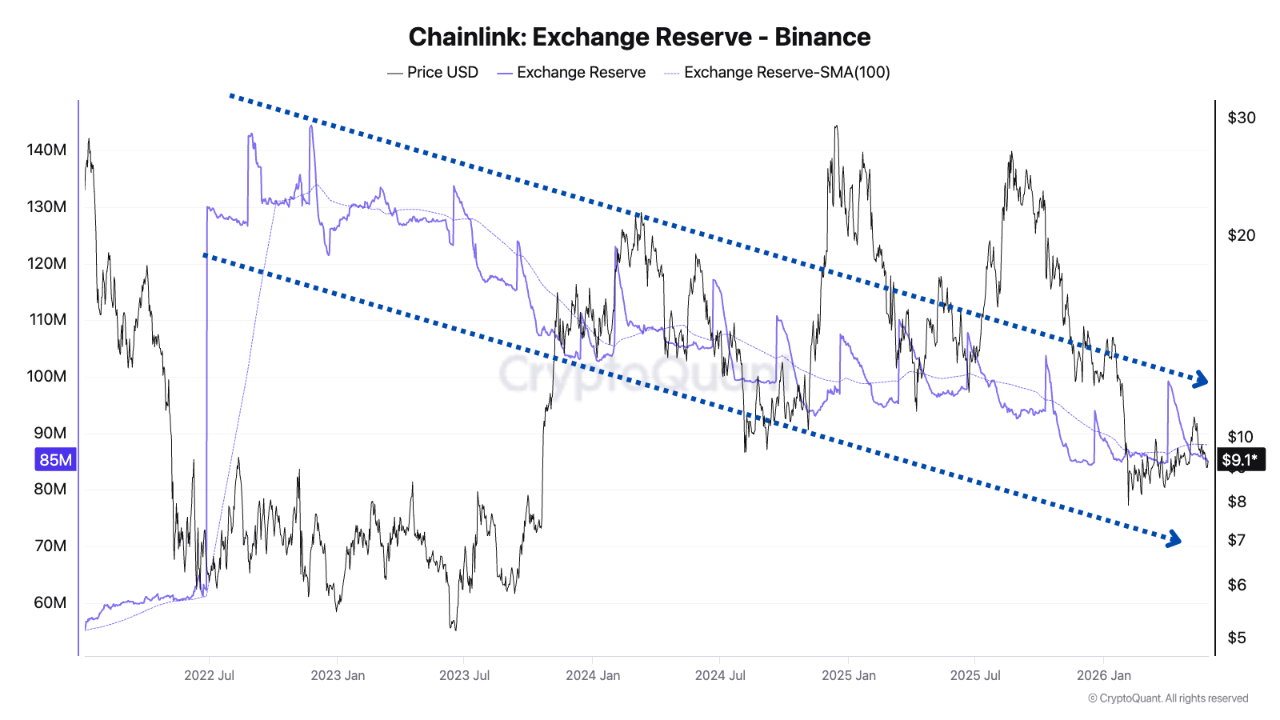
Binance Holds 66% of All Exchange LINK as Reserves Hit Multi-Year Lows

Ousted Trump official blasted for promoting ‘Hitlerian greeting’ ahead of ‘fascist summit’

Iran’s army chief warns of ‘total destruction’ for ground invasion