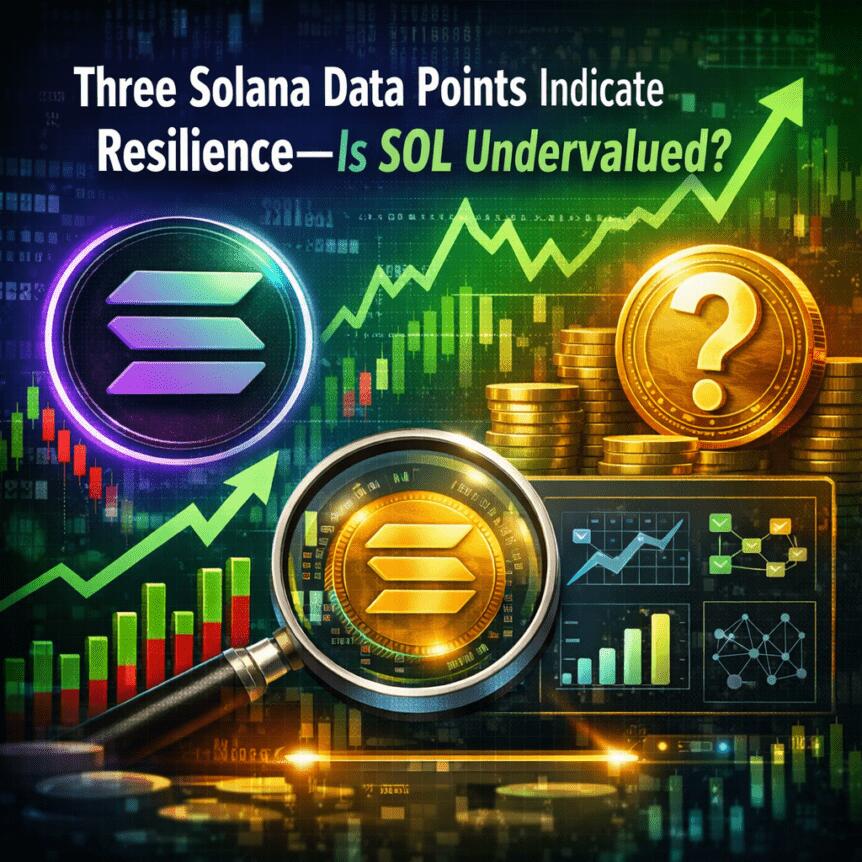
Three Solana data points indicate resilience—is SOL undervalued?
Solana’s SOL (CRYPTO: SOL) has cratered about 72% from its all-time high near $295, and the token trades well beneath the $188 level that accompanied the launch of spot SOL ETFs in October 2025. While price action has been painful over a four-month window, the network’s on-chain activity and revenue metrics tell a more nuanced story, raising questions about whether SOL’s long-run value could realign with the strength of its ecosystem. After a surge in ETF inflows through late 2025, momentum cooled in December and into 2026, even as the fundamentals of the network remained lively. The divergence between price and usage, as well as the evolving ETF backdrop and macro liquidity, continues to shape SOL’s near-term trajectory.
Key takeaways
- Spot SOL ETF inflows surged in the initial five weeks after launch, averaging well over $100 million in that burst, before decelerating to roughly $20–25 million per week as SOL slid to around $86 in February 2026.
- On-chain activity remains robust: SOL processed about $108 billion in DEX volume over the last 30 days—cresting higher than Ethereum’s $63.7 billion and Base’s $31.48 billion—while January volumes exceeded December and November levels.
- Recent performance metrics show SOL capturing stronger daily on-chain revenue and user activity than many peers: about $3.1 million in app revenue in the last 24 hours versus ETH’s $2.95 million, with 2.17 million active addresses against 682,236 for ETH.
- The RWA sector linked to SOL climbed to $1.71 billion, up 45% in 30 days, though Ether holds a substantial portion of the distributed asset value in that space (around $15 billion of $25.37 billion).
- From a technical standpoint, a base could form in the $51–$80 range with near-term demand around $22–$29, while a weekly resistance sits near $120; a sustained move above or below these zones could influence the path to recovery or further consolidation.
Tickers mentioned: $SOL, $BTC, $ETH
Sentiment: Neutral
Price impact: Negative, as SOL has retraced sharply from its peaks and trades well below prior highs despite strong network activity.
Market context: The Solana network shows a notable disconnect between price and usage, a pattern seen in periods of rising on-chain throughput even as broader crypto markets face liquidity shifts and ETF flows that can lag moment-to-moment price movements.
Why it matters
The Solana narrative illustrates a broader theme in crypto markets: network activity and revenue streams can outpace price moves over extended periods. SOL’s DEX volumes have remained a bright spot, underscoring continuous demand for on-chain trading and ecosystem activity. This contrast matters for investors who monitor not just price but the health of an asset’s underlying infrastructure and its capacity to capture value through on-chain activity and real-world applications.
On the ETF front, SOL’s experience in late 2025 demonstrated the potential for demand to outpace price during the early life of a spot-based product. While inflows cooled, the ETF structure did not appear to vanish from the equation entirely. The broader market context shows BTC (CRYPTO: BTC) and ETH (CRYPTO: ETH) ETFs also suffering negative flows for multiple months, suggesting that product-driven demand remains sensitive to macro liquidity, risk sentiment, and regulatory developments. In other words, SOL remains part of a shifting ETF landscape where investor interest can ebb and flow independently of network use.
From a valuation perspective, the gap between on-chain activity and price is not unique to SOL. The asset sits amid a cluster of cost bases and liquidity pockets that suggest a potential for renewed attention if macro conditions improve or if price action begins to respect the network’s fundamentals. The RWA (Real-World Asset) exposure linked to SOL has grown meaningfully, signaling an appetite to bridge crypto with tangible assets, even as the sector maintains a considerable share of the distributed asset value in related markets.
What to watch next
- Monitor SOL’s price interaction with the $51–$80 demand zone and whether the 0.75 Fibonacci retracement range around $60–$70 acts as a springboard for a bottom formation.
- Track weekly price action around the $120 resistance level to gauge whether bulls can establish a sustained move beyond that barrier.
- Watch SOL ETF inflows: whether weekly inflows stabilize around the $20–$25 million range or pick up again amid shifting market sentiment.
- Follow on-chain activity and DEX volumes as a proxy for ecosystem health, particularly given SOL’s historical dominance in DeFi on-chain volume versus peers.
Sources & verification
- Spot SOL ETF inflows data and long-run ETF performance published by SoSoValue (spot SOL ETF fund flow page).
- Solana DEX and overall on-chain activity metrics from DeFiLlama’s Solana chain data page showing daily and monthly volumes.
- On-chain revenue and user metrics, including app revenue, active addresses, and chain fees, reported through the article’s data points.
- RWA sector total value and Ether’s share of distributed asset value as reported by app.rwa.xyz for Solana and related assets.
- Specific price and technical reference levels (e.g., $86 price in February 2026, resistance at $120, and demand zones) as outlined in the article’s technical analysis.
Why it matters for readers
The Solana narrative underscores the importance of looking beyond price alone in crypto investing. A network can exhibit robust usage and monetizable activity while its token price remains under pressure due to external liquidity conditions or shifting investor sentiment. This dual reality can create opportunities for deeper analysis, especially for traders and long-term holders who assess both on-chain fundamentals and macro-driven price drivers.
For developers and builders, the sustained on-chain activity signals continued interest in Solana-based applications, which can be critical for long-term network health and the ability to attract developers, liquidity, and real-capital engagement. Investors should therefore weigh not only the immediate price action but the trajectory of DeFi volume, revenue streams, and asset-backed exposures like the RWA sector when evaluating SOL’s risk-reward profile.
What to watch next
- Price action near the $120 weekly resistance and the $51–$80 demand zone in the coming weeks.
- ETF inflow data updates to confirm whether SOL’s momentum re-accelerates or remains subdued.
- Changes in DEX turnover and on-chain revenue as a leading indicator of potential shifts in SOL’s valuation relative to usage.
- Any developments in the RWA space that could influence SOL’s value proposition and liquidity across related markets.
Sources & verification
- Spot SOL ETF fund flows page on SoSoValue: Total Crypto Spot ETF Fund Flow (for US BTC). https://sosovalue.com/assets/etf/Total_Crypto_Spot_ETF_Fund_Flow?page=usBTC
- Solana DEX volumes and network activity data: DeFiLlama Solana chain metrics. https://defillama.com/dexs/chain/solana?groupBy=Weekly
- URPD – UTXO realized price distribution data for SOL: Glassnode. https://studio.glassnode.com/charts/indicators.UtxoRealizedPriceDistributionAth?a=SOL
- RWA sector data for Solana: app.rwa.xyz Solana network page. https://app.rwa.xyz/networks/solana
- Price and volume references including price levels and ETF performance data within the article text. https://cointelegraph.com/
-
Solana’s market momentum and near-term path
Solana’s price action remains the focal point for many traders, but the data suggests a more nuanced story. While SOL has retraced from its peak, the network continues to demonstrate considerable activity, with DeFi volumes outpacing several other chains in recent periods and on-chain revenue staying competitive with major protocols. The divergence between on-chain use and price points to a potential bottom that could be validated or refuted by how SOL navigates the $60–$70 zone and whether buyers can push through $120 in the weeks ahead. For investors, this sets up a classic: a risk-reward scenario where the cost basis created by network activity could become a catalyst if macro conditions improve or if ETF flows stabilize and turn positive again.
This article was originally published as Three Solana data points indicate resilience—is SOL undervalued? on Crypto Breaking News – your trusted source for crypto news, Bitcoin news, and blockchain updates.
You May Also Like
Top 5 Cryptocurrencies for Long-Term Investment in 2026: Expert Analysis

Tindig Pilipinas backs clergy’s complaint to fast-track Sara Duterte impeachment