

Crypto Holds Key Levels While Gold Surges on Escalating Middle East Conflict

Highlights:
- Bitcoin and Ethereum stayed range-bound after the Middle East conflict despite a sharp weekend selloff.
- Around $300 million in long liquidations hit the market, but forced selling remained contained.
- March call option buying at $74k and $75k shows traders’ position for a possible rebound.
QCP Capital, a crypto-asset trading firm, said rising tensions around Iran left crypto trading inside familiar ranges despite sharp weekend headlines. Bitcoin dropped to $63,000 shortly after news of the US strike broke. Ethereum fell as well and briefly touched $1,910. Buyers returned within hours and pushed both assets back toward their earlier levels.
The move triggered about $300 million in long liquidations across major exchanges. That figure stood out, yet it did not resemble the heavier unwinds seen in early February. Traders had already trimmed exposure during the previous week. As a result, forced selling slowed once initial positions cleared.
Desks described the reaction as fast but orderly. Liquidity remained available on leading venues. Market makers continued quoting without wide dislocations. Bitcoin held its broader range and avoided a break below established support. QCP also flagged a shift in defensive positioning. Some capital rotated toward tokenized gold, which trades continuously. Investors who wanted round-the-clock access to safe-haven exposure used those products. Even so, crypto did not show signs of structural stress.
Traders also looked back to last June’s strike. Bitcoin fell sharply at first, then recovered the following Monday. Weeks later, it traded as high as $123,000. Participants now compare that episode with current price behavior, although they note that today’s escalation carries greater scale.
Options Markets Signal Caution, Not Panic
Derivatives markets reacted quickly once headlines spread. One-day implied volatility jumped to 93% during the first wave of selling. That spike eased as trading progressed. Front-end implied volatility struggled to remain above 60.
Implied volatility had moved more sharply the previous Tuesday at similar spot prices. That earlier reaction suggests traders anticipated potential turbulence heading into the weekend. Many had already adjusted positioning before the strike occurred. Flow data showed targeted upside interest. Traders bought large blocks of March call options at $74,000 and $75,000 strikes. They executed those trades while geopolitical risks continued to build. That positioning points to expectations of a possible rebound in March.
At the same time, desks avoided heavy downside hedging beyond short-term coverage. They balanced risk rather than chase protection at elevated premiums. Liquidity conditions stayed stable across major derivatives platforms. Political messaging also shaped sentiment. President Donald Trump said military operations could last “four weeks or so.” Market participants appeared to treat that timeline as defined rather than open-ended. They did not price in an extended ground conflict involving US troops.
Middle East Conflict Drives Safe-Haven Flows
While crypto stabilized, precious metals attracted firm demand. Gold rose above $5,400 during the initial reaction to the escalation. Silver also rallied and briefly moved past $96 per ounce. Investors increased allocations to assets they view as defensive.
Oil prices increased because traders evaluated the risks of supply within the region. Increasing energy prices have the potential of impacting on inflation expectations. That connection tends to favor gold when there is uncertainty. Analysts indicated that a broader regional spillover would tend to reinforce that relationship.
Meanwhile, Bitcoin is trading at $66,254 after briefly touching $67,000 earlier today. BTC has lost 0.49% on the daily chart and 20% on the monthly chart. Meanwhile, the trading volume has decreased by 9.87% to $39.23 billion, while the market cap stands at $1.32 trillion.
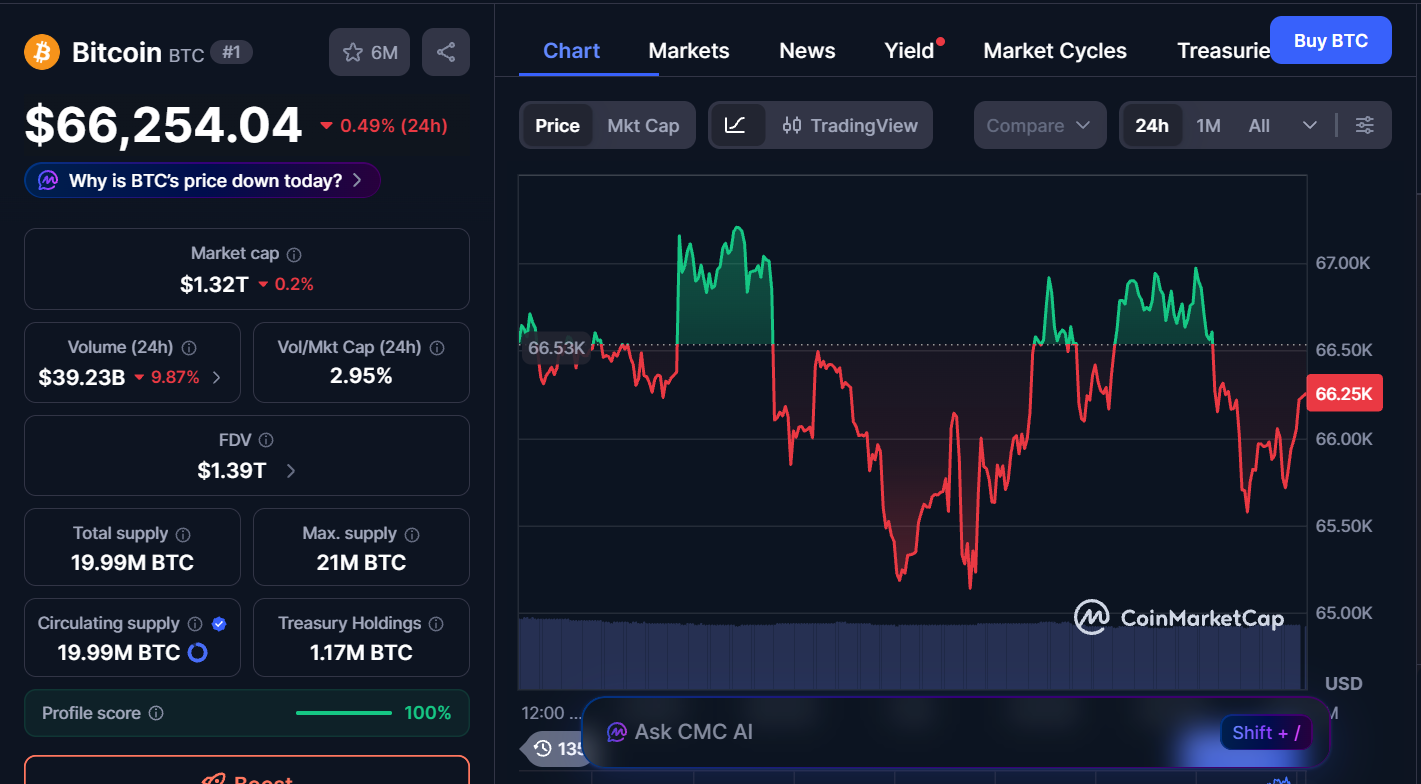 Bitcoin Price Chart: CoinMarketCap
ETH, on the other hand, is trading at $1,956, representing a 1.57% decrease over the past 24 hours. The market cap stands at $236.12 billion, while the trading volume has decreased by 9.9% to $21.23 billion.
eToro Platform
Best Crypto Exchange
- Over 90 top cryptos to trade
- Regulated by top-tier entities
- User-friendly trading app
- 30+ million users
eToro is a multi-asset investment platform. The value of your investments may go up or down. Your capital is at risk. Don’t invest unless you’re prepared to lose all the money you invest. This is a high-risk investment, and you should not expect to be protected if something goes wrong.
You May Also Like

Polymarket Prices 86% Odds Of Sub-$80 – Will $83 Break?

ADA Price Prediction: Here’s The Best Place To Make 50x Gains
