Spot bitcoin exchange-traded funds (ETFs) roared back into the spotlight on Tuesday, attracting $332.7 million in net inflows, even as Ethereum funds posted sharp withdrawals. The move suggests a potential rotation back to Bitcoin after Ethereum dominated ETF flows throughout August. According to SoSoValue, Fidelity’s FBTC led the charge with $132.7 million in inflows, followed by BlackRock’s IBIT at $72.8 million. Other issuers, including Grayscale, Ark & 21Shares, Bitwise, VanEck, and Invesco, also logged gains.Source: SoSoValue In contrast, Ethereum products recorded $135.3 million in daily net outflows, weighed down by Fidelity’s FETH shedding $99.2 million and Bitwise’s ETHW losing $24.2 million. Ethereum’s August Surge vs. Bitcoin’s September History August had been Ethereum’s month. Analysts described a “rotational shift” toward ETH, driven by yield-bearing staking, improving regulatory signals, and rising adoption by corporate treasuries. Ethereum ETFs attracted $3.87 billion in net inflows last month, compared to Bitcoin’s $751 million in outflows. Trading activity showed the divergence, with Ethereum ETF volume surging to $58.37 billion in August, nearly doubling July’s $33.87 billion, while Bitcoin ETF volume dipped slightly to $78.14 billion. The price action reinforced that enthusiasm. Ethereum notched a new all-time high of $4,953.73 in August, and public company holdings of ETH swelled dramatically. 71 companies disclosed a combined $119.68 billion in Ethereum by August 31st, up from 67 firms with $98.97 billion the prior month. Bitcoin, by contrast, saw outflows and lagged in performance despite maintaining a far larger total ETF inflow base of $54.24 billion cumulatively. But September tells a different story. Historically, Ethereum has stumbled during the month: in September 2024, ETH ETFs saw $46.54 million in outflows, registering redemptions in three out of four weeks. Bitcoin ETFs, meanwhile, posted a $1.26 billion inflow over the same period, benefiting from risk-averse positioning as markets cooled. What’s Fueling the Rotation from Ethereum to Bitcoin? Market watchers suggest this September may again favor Bitcoin. Historically, September has been a “cool-down” month for crypto, with ETH often underperforming due to weaker seasonal flows and lower risk appetite. Bitcoin, seen as the safer benchmark asset, typically regains inflows when volatility rises. Macro forces are also at play. With global central banks signaling caution and bond yields holding firm, investors appear to be trimming higher-risk ETH exposure in favor of Bitcoin, still viewed as the digital reserve asset of choice. The derivatives market shows the shift. Over the past 24 hours, Ethereum futures saw $1.22 billion in outflows, nearly double Bitcoin’s $646.7 million in outflows, according to Coinglass. Also, Bitcoin treasuries remain a magnet for institutional flows. As of Sept. 1, weekly bitcoin net inflows totaled 3,102 BTC (about $335.8 million), with Michael Saylor’s MicroStrategy adding 4,048 BTC worth $449 million on Sept. 2 alone. By contrast, Ethereum treasuries have lagged, with fewer corporate balance sheets disclosing significant ETH allocations despite August’s record price run-up. The gap shows a key reason for the rotation: while ETH may offer yield and programmability, Bitcoin continues to dominate as the go-to institutional treasury asset. That hunt for yield is exactly where the danger lies, according to Sharplink Gaming co-CEO Joseph Chalom. Speaking on Bankless, Chalom warned that companies piling into Ether to squeeze out extra returns could expose themselves to cascading risks if markets turn. “There will be people just like in traditional finance who want that last 100 basis points of yield and think it’s riskless,” Chalom said, noting that double-digit ETH yields often carry credit, counterparty, duration, and smart contract risks. The greater concern, he added, is that firms already behind the curve may double down imprudently in an attempt to catch up. “The sector could be tainted by people that do imprudent things—whether in how they raise capital or in the kind of yield strategies they chase with their ETH holdings,” he cautioned. As of late Tuesday, Bitcoin rose 0.55% to $110,943, while Ethereum slipped 1% to $4,327. Whether this marks the start of a sustained September rotation back into Bitcoin or just a short-term rebalancing remains the key question hanging over crypto marketsSpot bitcoin exchange-traded funds (ETFs) roared back into the spotlight on Tuesday, attracting $332.7 million in net inflows, even as Ethereum funds posted sharp withdrawals. The move suggests a potential rotation back to Bitcoin after Ethereum dominated ETF flows throughout August. According to SoSoValue, Fidelity’s FBTC led the charge with $132.7 million in inflows, followed by BlackRock’s IBIT at $72.8 million. Other issuers, including Grayscale, Ark & 21Shares, Bitwise, VanEck, and Invesco, also logged gains.Source: SoSoValue In contrast, Ethereum products recorded $135.3 million in daily net outflows, weighed down by Fidelity’s FETH shedding $99.2 million and Bitwise’s ETHW losing $24.2 million. Ethereum’s August Surge vs. Bitcoin’s September History August had been Ethereum’s month. Analysts described a “rotational shift” toward ETH, driven by yield-bearing staking, improving regulatory signals, and rising adoption by corporate treasuries. Ethereum ETFs attracted $3.87 billion in net inflows last month, compared to Bitcoin’s $751 million in outflows. Trading activity showed the divergence, with Ethereum ETF volume surging to $58.37 billion in August, nearly doubling July’s $33.87 billion, while Bitcoin ETF volume dipped slightly to $78.14 billion. The price action reinforced that enthusiasm. Ethereum notched a new all-time high of $4,953.73 in August, and public company holdings of ETH swelled dramatically. 71 companies disclosed a combined $119.68 billion in Ethereum by August 31st, up from 67 firms with $98.97 billion the prior month. Bitcoin, by contrast, saw outflows and lagged in performance despite maintaining a far larger total ETF inflow base of $54.24 billion cumulatively. But September tells a different story. Historically, Ethereum has stumbled during the month: in September 2024, ETH ETFs saw $46.54 million in outflows, registering redemptions in three out of four weeks. Bitcoin ETFs, meanwhile, posted a $1.26 billion inflow over the same period, benefiting from risk-averse positioning as markets cooled. What’s Fueling the Rotation from Ethereum to Bitcoin? Market watchers suggest this September may again favor Bitcoin. Historically, September has been a “cool-down” month for crypto, with ETH often underperforming due to weaker seasonal flows and lower risk appetite. Bitcoin, seen as the safer benchmark asset, typically regains inflows when volatility rises. Macro forces are also at play. With global central banks signaling caution and bond yields holding firm, investors appear to be trimming higher-risk ETH exposure in favor of Bitcoin, still viewed as the digital reserve asset of choice. The derivatives market shows the shift. Over the past 24 hours, Ethereum futures saw $1.22 billion in outflows, nearly double Bitcoin’s $646.7 million in outflows, according to Coinglass. Also, Bitcoin treasuries remain a magnet for institutional flows. As of Sept. 1, weekly bitcoin net inflows totaled 3,102 BTC (about $335.8 million), with Michael Saylor’s MicroStrategy adding 4,048 BTC worth $449 million on Sept. 2 alone. By contrast, Ethereum treasuries have lagged, with fewer corporate balance sheets disclosing significant ETH allocations despite August’s record price run-up. The gap shows a key reason for the rotation: while ETH may offer yield and programmability, Bitcoin continues to dominate as the go-to institutional treasury asset. That hunt for yield is exactly where the danger lies, according to Sharplink Gaming co-CEO Joseph Chalom. Speaking on Bankless, Chalom warned that companies piling into Ether to squeeze out extra returns could expose themselves to cascading risks if markets turn. “There will be people just like in traditional finance who want that last 100 basis points of yield and think it’s riskless,” Chalom said, noting that double-digit ETH yields often carry credit, counterparty, duration, and smart contract risks. The greater concern, he added, is that firms already behind the curve may double down imprudently in an attempt to catch up. “The sector could be tainted by people that do imprudent things—whether in how they raise capital or in the kind of yield strategies they chase with their ETH holdings,” he cautioned. As of late Tuesday, Bitcoin rose 0.55% to $110,943, while Ethereum slipped 1% to $4,327. Whether this marks the start of a sustained September rotation back into Bitcoin or just a short-term rebalancing remains the key question hanging over crypto markets

Bitcoin ETFs Pull $332.7M in a Day as Ethereum Sees $135M Outflows — Rotation Back into BTC?

Spot bitcoin exchange-traded funds (ETFs) roared back into the spotlight on Tuesday, attracting $332.7 million in net inflows, even as Ethereum funds posted sharp withdrawals. The move suggests a potential rotation back to Bitcoin after Ethereum dominated ETF flows throughout August.

According to SoSoValue, Fidelity’s FBTC led the charge with $132.7 million in inflows, followed by BlackRock’s IBIT at $72.8 million. Other issuers, including Grayscale, Ark & 21Shares, Bitwise, VanEck, and Invesco, also logged gains.
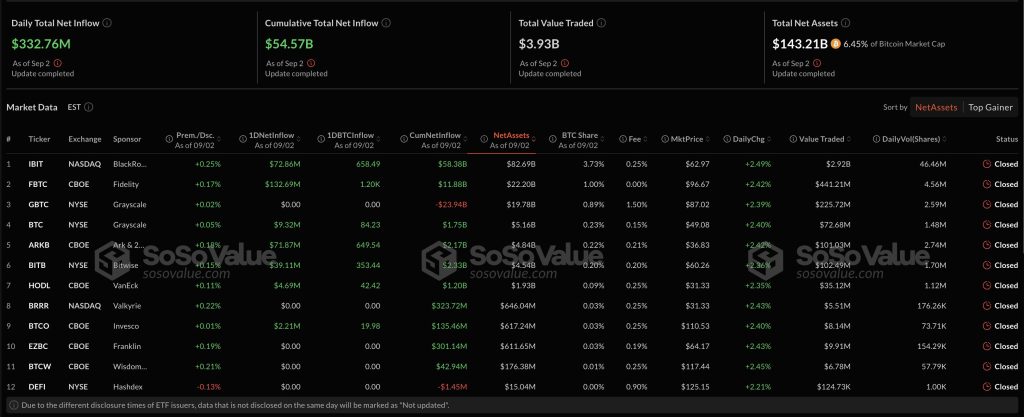
Source: SoSoValue

In contrast, Ethereum products recorded $135.3 million in daily net outflows, weighed down by Fidelity’s FETH shedding $99.2 million and Bitwise’s ETHW losing $24.2 million.

Ethereum’s August Surge vs. Bitcoin’s September History

August had been Ethereum’s month. Analysts described a “rotational shift” toward ETH, driven by yield-bearing staking, improving regulatory signals, and rising adoption by corporate treasuries.

Ethereum ETFs attracted $3.87 billion in net inflows last month, compared to Bitcoin’s $751 million in outflows. Trading activity showed the divergence, with Ethereum ETF volume surging to $58.37 billion in August, nearly doubling July’s $33.87 billion, while Bitcoin ETF volume dipped slightly to $78.14 billion.

The price action reinforced that enthusiasm. Ethereum notched a new all-time high of $4,953.73 in August, and public company holdings of ETH swelled dramatically. 71 companies disclosed a combined $119.68 billion in Ethereum by August 31st, up from 67 firms with $98.97 billion the prior month.

Bitcoin, by contrast, saw outflows and lagged in performance despite maintaining a far larger total ETF inflow base of $54.24 billion cumulatively.

But September tells a different story. Historically, Ethereum has stumbled during the month: in September 2024, ETH ETFs saw $46.54 million in outflows, registering redemptions in three out of four weeks.

Bitcoin ETFs, meanwhile, posted a $1.26 billion inflow over the same period, benefiting from risk-averse positioning as markets cooled.

What’s Fueling the Rotation from Ethereum to Bitcoin?

Market watchers suggest this September may again favor Bitcoin. Historically, September has been a “cool-down” month for crypto, with ETH often underperforming due to weaker seasonal flows and lower risk appetite. Bitcoin, seen as the safer benchmark asset, typically regains inflows when volatility rises.

Macro forces are also at play. With global central banks signaling caution and bond yields holding firm, investors appear to be trimming higher-risk ETH exposure in favor of Bitcoin, still viewed as the digital reserve asset of choice.

The derivatives market shows the shift. Over the past 24 hours, Ethereum futures saw $1.22 billion in outflows, nearly double Bitcoin’s $646.7 million in outflows, according to Coinglass.

Also, Bitcoin treasuries remain a magnet for institutional flows. As of Sept. 1, weekly bitcoin net inflows totaled 3,102 BTC (about $335.8 million), with Michael Saylor’s MicroStrategy adding 4,048 BTC worth $449 million on Sept. 2 alone.

By contrast, Ethereum treasuries have lagged, with fewer corporate balance sheets disclosing significant ETH allocations despite August’s record price run-up. The gap shows a key reason for the rotation: while ETH may offer yield and programmability, Bitcoin continues to dominate as the go-to institutional treasury asset.

That hunt for yield is exactly where the danger lies, according to Sharplink Gaming co-CEO Joseph Chalom. Speaking on Bankless, Chalom warned that companies piling into Ether to squeeze out extra returns could expose themselves to cascading risks if markets turn.

“There will be people just like in traditional finance who want that last 100 basis points of yield and think it’s riskless,” Chalom said, noting that double-digit ETH yields often carry credit, counterparty, duration, and smart contract risks. The greater concern, he added, is that firms already behind the curve may double down imprudently in an attempt to catch up.

“The sector could be tainted by people that do imprudent things—whether in how they raise capital or in the kind of yield strategies they chase with their ETH holdings,” he cautioned.

As of late Tuesday, Bitcoin rose 0.55% to $110,943, while Ethereum slipped 1% to $4,327. Whether this marks the start of a sustained September rotation back into Bitcoin or just a short-term rebalancing remains the key question hanging over crypto markets.

Market Opportunity
Bitcoin Logo
Bitcoin Price(BTC)
$95,055.26
$95,055.26$95,055.26
-0.54%
USD
Bitcoin (BTC) Live Price Chart
Disclaimer: The articles reposted on this site are sourced from public platforms and are provided for informational purposes only. They do not necessarily reflect the views of MEXC. All rights remain with the original authors. If you believe any content infringes on third-party rights, please contact service@support.mexc.com for removal. MEXC makes no guarantees regarding the accuracy, completeness, or timeliness of the content and is not responsible for any actions taken based on the information provided. The content does not constitute financial, legal, or other professional advice, nor should it be considered a recommendation or endorsement by MEXC.

You May Also Like

Mitosis Price Flashes a Massive Breakout Hope; Cup-And-Handle Pattern Signals MITO Targeting 50% Rally To $0.115305 Level

Mitosis Price Flashes a Massive Breakout Hope; Cup-And-Handle Pattern Signals MITO Targeting 50% Rally To $0.115305 Level

The analyst identified a formation of a cup-and-handle pattern on Mitosis’s chart, suggesting that MITO is preparing to see a looming price explosion.
Share
Blockchainreporter2026/01/18 09:00
Spot ETH ETFs Surge: Remarkable $48M Inflow Streak Continues

Spot ETH ETFs Surge: Remarkable $48M Inflow Streak Continues

BitcoinWorld Spot ETH ETFs Surge: Remarkable $48M Inflow Streak Continues The cryptocurrency world is buzzing with exciting news as Spot ETH ETFs continue to capture significant investor attention. For the second consecutive day, these innovative investment vehicles have seen substantial positive flows, reinforcing confidence in the Ethereum ecosystem. This consistent performance signals a growing appetite for regulated crypto exposure among traditional investors. What’s Fueling the Latest Spot ETH ETF Inflows? On September 19, U.S. Spot ETH ETFs collectively recorded a net inflow of an impressive $48 million. This marked another day of positive momentum, building on previous gains. Such figures are not just numbers; they represent tangible capital moving into the Ethereum market through accessible investment products. BlackRock’s ETHA Leads the Charge: A standout performer was BlackRock’s ETHA, which alone attracted a staggering $140 million in inflows. This substantial figure highlights the significant influence of major financial institutions in driving the adoption of crypto-backed ETFs. Institutional Confidence: The consistent inflows, particularly from prominent asset managers like BlackRock, suggest increasing institutional comfort and conviction in Ethereum’s long-term potential. Why Are Consecutive Spot ETH ETF Inflows So Significant? Two consecutive days of net inflows into Spot ETH ETFs are more than just a fleeting trend; they indicate a strengthening pattern of investor interest. This sustained positive movement suggests that initial hesitancy might be giving way to broader acceptance and strategic positioning within the digital asset space. Understanding the implications of these inflows is crucial: Market Validation: Continuous inflows serve as a strong validation for Ethereum as a legitimate and valuable asset class within traditional finance. Liquidity and Stability: Increased capital flowing into these ETFs can contribute to greater market liquidity and potentially enhance price stability for Ethereum itself, reducing volatility over time. Paving the Way: The success of Spot ETH ETFs could also pave the way for other cryptocurrency-based investment products, further integrating digital assets into mainstream financial portfolios. Are All Spot ETH ETFs Experiencing the Same Momentum? While the overall picture for Spot ETH ETFs is overwhelmingly positive, it’s important to note that individual fund performances can vary. The market is dynamic, and different funds may experience unique flow patterns based on investor preferences, fund structure, and underlying strategies. Mixed Performance: On the same day, Fidelity’s FETH saw net outflows of $53.4 million, and Grayscale’s Mini ETH recorded outflows of $11.3 million. Normal Market Fluctuations: These outflows, while notable, are a normal part of market dynamics. Investors might be rebalancing portfolios, taking profits, or shifting capital between different investment vehicles. The net positive inflow across the entire sector indicates that new money is still entering faster than it is leaving. This nuanced view helps us appreciate the complex interplay of forces shaping the market for Spot ETH ETFs. What’s Next for Spot ETH ETFs and the Ethereum Market? The sustained interest in Spot ETH ETFs suggests a potentially bright future for Ethereum’s integration into traditional financial markets. As more investors gain access to ETH through regulated products, the demand for the underlying asset could increase, influencing its price and overall market capitalization. For investors looking to navigate this evolving landscape, here are some actionable insights: Stay Informed: Keep an eye on daily inflow and outflow data, as these can provide early indicators of market sentiment. Understand Diversification: While Spot ETH ETFs offer exposure, remember the importance of a diversified investment portfolio. Monitor Regulatory Developments: The regulatory environment for cryptocurrencies is constantly evolving, which can impact the performance and availability of these investment products. Conclusion: A Promising Horizon for Ethereum The consistent positive net inflows into Spot ETH ETFs for a second straight day underscore a significant shift in how institutional and retail investors view Ethereum. This growing confidence, spearheaded by major players like BlackRock, signals a maturing market where digital assets are increasingly seen as viable components of a modern investment strategy. As the ecosystem continues to develop, these ETFs will likely play a crucial role in shaping Ethereum’s future trajectory and its broader acceptance in global finance. It’s an exciting time to watch the evolution of these groundbreaking financial instruments. Frequently Asked Questions (FAQs) Q1: What is a Spot ETH ETF? A Spot ETH ETF (Exchange-Traded Fund) is an investment product that directly holds Ethereum. It allows investors to gain exposure to Ethereum’s price movements without needing to buy, store, or manage the actual cryptocurrency themselves. Q2: Why are these recent inflows into Spot ETH ETFs important? The recent inflows signify growing institutional and retail investor confidence in Ethereum as an asset. Consistent positive flows can lead to increased market liquidity, potential price stability, and broader acceptance of cryptocurrencies in traditional financial portfolios. Q3: Which funds are leading the inflows for Spot ETH ETFs? On September 19, BlackRock’s ETHA led the group with a substantial $140 million in inflows, demonstrating strong interest from a major financial institution. Q4: Do all Spot ETH ETFs experience inflows simultaneously? No, not all Spot ETH ETFs experience inflows at the same time. While the overall sector may see net positive flows, individual funds like Fidelity’s FETH and Grayscale’s Mini ETH can experience outflows due to various factors such as rebalancing or profit-taking by investors. Q5: What does the success of Spot ETH ETFs mean for Ethereum’s price? Increased demand through Spot ETH ETFs can potentially drive up the price of Ethereum by increasing buying pressure on the underlying asset. However, numerous factors influence crypto prices, so it’s not a guaranteed outcome. If you found this article insightful, consider sharing it with your network! Your support helps us continue to provide valuable insights into the dynamic world of cryptocurrency. Spread the word and help others understand the exciting developments in Spot ETH ETFs! To learn more about the latest crypto market trends, explore our article on key developments shaping Ethereum institutional adoption. This post Spot ETH ETFs Surge: Remarkable $48M Inflow Streak Continues first appeared on BitcoinWorld.
Share
Coinstats2025/09/20 11:10
Trump imposes 10% tariffs on eight European countries over Greenland.

Trump imposes 10% tariffs on eight European countries over Greenland.

PANews reported on January 18th that, according to Jinshi News, on January 17th local time, US President Trump announced via social media that, due to the Greenland
Share
PANews2026/01/18 08:46