

Pundit Explains How XRP Becomes A Global Reserve Asset
Versan Aljarrah of Black Swan Capitalist is making a broader case for XRP than the usual market-cycle prediction. In a X post titled How XRP Becomes a Global Reserve Asset, he argues that XRP’s long-term role is not limited to payments or bridge liquidity, but could extend to becoming a neutral settlement layer inside a digitized global financial system.
Aljarrah’s central point is that the XRP debate has been trapped in the wrong frame. “The conversation around XRP is usually clouded by speculation and price predictions,” he wrote. “But beneath all the noise lies a far more fascinating story, one that bridges regulation, sovereign integration, and institutional recognition at the highest levels of global finance. The true potential for XRP isn’t just as a payments token or bridge asset. It’s a foundational layer in a digitized financial order where liquidity, interoperability, and neutrality are all that matter.”
How XRP Becomes A Global Reserve Asset
That thesis rests on three pillars. “To understand how XRP evolves into a global reserve asset, there are a few pillars that must align, sovereign adoption, regulatory clarity, and institutional recognition, which ultimately comes from the IMF,” Aljarrah wrote. In his telling, the process starts with nation-state usage rather than market enthusiasm.
He argues that reserve assets derive legitimacy from official acceptance, not price action. “Before any asset can become a global reserve instrument, it first needs sovereign legitimacy,” he wrote. “Reserve assets, whether gold, the US dollar, or Electronic Special Drawing Rights (ESDRs) derive their credibility not from market speculation but from their acceptance and usage by nation-states.”
From there, Aljarrah shifts to how XRP could fit into cross-border finance, especially for countries looking to reduce dependence on dollar-based settlement systems. “Emerging markets are all exploring blockchain-based solutions to improve liquidity, reduce costs, and stabilize their currencies,” he wrote.“For nations with volatile or dollar-dependent economies like the BRICS, XRP’s design presents a unique advantage as a neutral settlement bridge, meaning it can connect local currencies without forcing countries into the geopolitical influence of the military-industrial complex that comes with the dollar-based system.”
That leads into one of the strongest claims in the thread. “Therefore, it is not a matter of ‘if,’ but ‘when’ nations begin leveraging XRP to solve monetary inefficiencies,” Aljarrah said. “Countries all over the world have already integrated XRP into their payment rails and are already using it for cross-border settlements. That sets the stage for global institutional acknowledgment.”
The next phase, in his view, is legal clarity. Aljarrah points to the CLARITY Act as a turning point because it could make XRP more accessible to institutions and sovereigns if Ripple’s influence over supply is reduced far enough.
“By reducing its holdings, Ripple effectively decentralizes its influence over XRP, making it legally neutral, non-sovereign, and globally accessible, requirements for an asset to achieve reserve and settlement status,” he wrote. “Once Ripple’s holdings fall under the Clarity Act’s compliance thresholds, institutional adoption accelerates, and sovereign nations can hold and transact with XRP without triggering securities laws.”
Only after those two conditions are met does Aljarrah bring in the IMF. He argues that in a tokenized financial system, XRP could begin to resemble a programmable reserve settlement instrument. “Once integrated as a reserve asset, the valuation of XRP would be determined by its settlement utility, liquidity depth, and transaction output within a network of sovereign participants and multilateral institutions such as the BRICS,” he wrote.
“This is probably the most important piece because price discovery would shift from noise to institutional liquidity corridors, where value reflects the asset’s function in global settlement operations. In essence, XRP’s price would be measured by how much value it moves.”
Aljarrah closes by framing XRP less as a speculative crypto asset and more as infrastructure. “This isn’t just about XRP, it’s about the transition from a centralized, dollar-dominated financial order to a multipolar, interoperable system powered by digital assets, infrastructure, and neutral settlement technologies,” he wrote.
For readers following the XRP story, the message is clear: this is not a near-term trading thesis, but a long-horizon argument about reserve status, monetary plumbing and the future architecture of global liquidity.
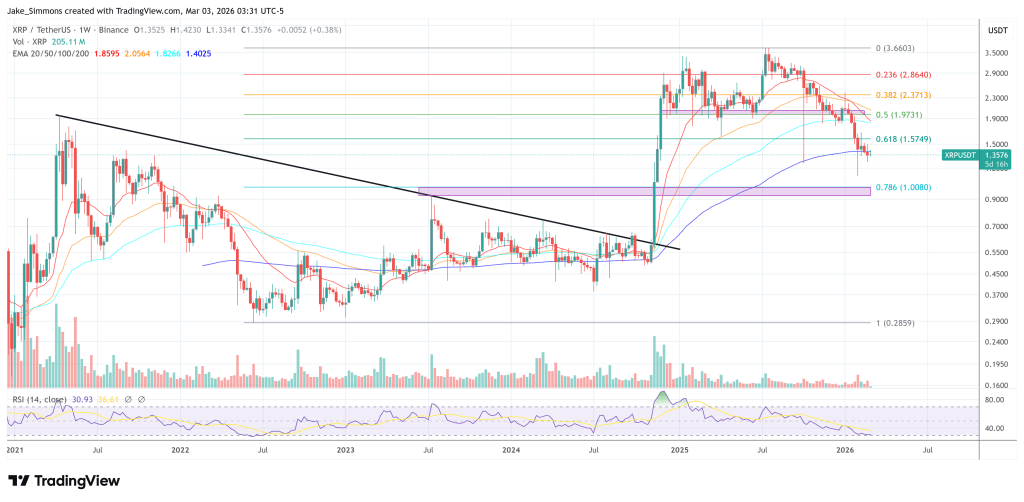
At press time, XRP traded at $1.3576.


You May Also Like

Coinbase Launches in India with Rupee Rails & Perps

Berkshire Hathaway (BRK.B) Strikes $6.8B Deal for Taylor Morrison in Abel’s First Mega-Acquisition

Euro wavers amid mixed Eurozone data, rising geopolitical tensions


Trending News
More24/7 Live News
MoreQuick Reads
More
