The post Why Jupiter Price Has Skyrocketed This Week: Here Are the Key Drivers appeared first on Coinpedia Fintech News Jupiter price has quietly become one of The post Why Jupiter Price Has Skyrocketed This Week: Here Are the Key Drivers appeared first on Coinpedia Fintech News Jupiter price has quietly become one of

Why Jupiter Price Has Skyrocketed This Week: Here Are the Key Drivers

2026/03/03 20:11
3 min read
For feedback or concerns regarding this content, please contact us at crypto.news@mexc.com
Jupiter Polymarket integration

The post Why Jupiter Price Has Skyrocketed This Week: Here Are the Key Drivers appeared first on Coinpedia Fintech News

Jupiter price has quietly become one of the strongest performers this week. While much of the market has been moving cautiously, JUP has climbed more than 24% over the past seven days, and the move doesn’t look random. Institutional capital stepped in. A major supply unlock was absorbed without panic. And technically, the chart has shifted from compression to expansion. When those pieces align, markets tend to pay attention.

So what exactly pushed Jupiter higher, and can this momentum continue?

The $35M Institutional Backing That Changed Sentiment

The biggest catalyst came from ParaFi Capital, which committed $35 million into Jupiter. That number matters, but the timing matters even more.

The investment was announced during broader market weakness, when many funds were reducing risk exposure. Instead of stepping back, ParaFi leaned in. The allocation reportedly includes long-term positioning rather than short-term trading exposure, signaling conviction in Jupiter’s role inside the Solana ecosystem. Institutional capital entering during uncertain conditions often shifts sentiment quickly. Traders see it as a vote of confidence, not just liquidity. That narrative alone helped reprice expectations around JUP.

Supply Shock That Never Materialized

At the same time, Jupiter faced a significant test. Roughly 253 million JUP tokens, worth about $36 million, were unlocked as part of scheduled vesting. In weaker conditions, events like this typically trigger heavy selling.

Instead, the price moved higher. That tells you demand was strong enough to absorb the additional supply. When large unlocks fail to push price down, it often signals accumulation underneath the surface. Markets tend to reward that kind of resilience.

Jupiter Price Chart Finally Broke Out

For weeks, JUP had been stuck inside a descending wedge pattern. Lower highs pressed price downward, while buyers quietly defended support near the $0.135 region. That compression finally resolved upward. 
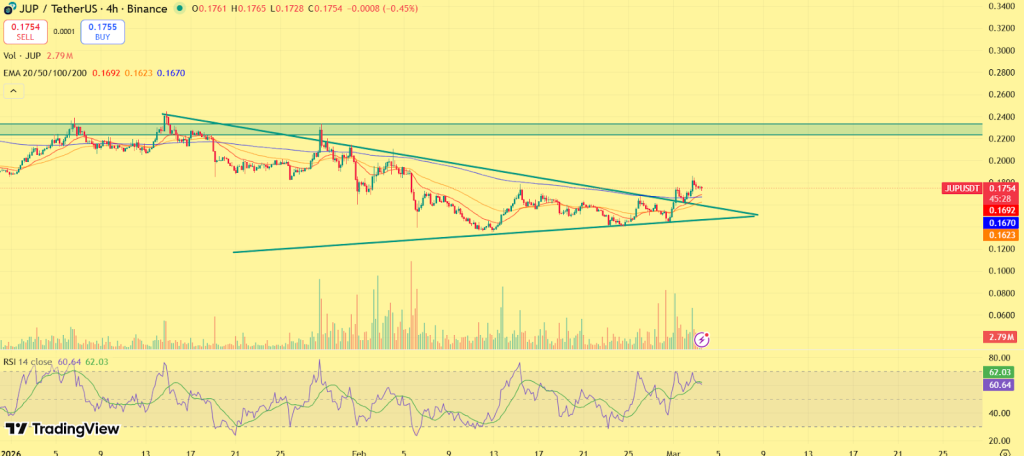
Jupiter price

JUP price broke through descending resistance with rising volume, the kind of breakout traders look for when confirming trend reversals. Momentum indicators also shifted higher, with RSI pushing above 60 without entering overbought territory. In simple terms, the market stopped drifting and started expanding. And that shift is what fuels continuation rallies.

Key Levels to Watch

JUP price now faces its first real test near the $0.18–$0.20 range. Clearing that zone convincingly could open room toward $0.22–$0.24, where previous supply once capped upside. On the downside, $0.16 has become the level bulls must defend. If price falls back below it, the breakout narrative weakens. For now, structure favors continuation, but confirmation requires holding above former resistance.

What’s Next for Jupiter (JUP) ?

Jupiter’s 24% weekly surge isn’t built on hype alone. It’s supported by institutional capital, supply absorption, and a clean technical breakout.

If broader market conditions remain stable and buyers defend support, JUP could extend this move further. However, resistance ahead will determine whether this is the start of a larger expansion phase or simply a sharp relief rally. For now, Jupiter has shifted from quiet consolidation to active momentum, and traders are watching closely to see how far it can run.


Disclaimer: The articles reposted on this site are sourced from public platforms and are provided for informational purposes only. They do not necessarily reflect the views of MEXC. All rights remain with the original authors. If you believe any content infringes on third-party rights, please contact crypto.news@mexc.com for removal. MEXC makes no guarantees regarding the accuracy, completeness, or timeliness of the content and is not responsible for any actions taken based on the information provided. The content does not constitute financial, legal, or other professional advice, nor should it be considered a recommendation or endorsement by MEXC.
Tags:

You May Also Like

Zcash is Predicted to Reach $215.89 By Mar 12, 2026

Zcash is Predicted to Reach $215.89 By Mar 12, 2026

The post Zcash is Predicted to Reach $215.89 By Mar 12, 2026 appeared on BitcoinEthereumNews.com. Disclaimer: This is not investment advice. The information provided
Share
BitcoinEthereumNews2026/03/08 08:09
Why Is Crypto Down in 2026? Binance Leverage Hits Exhaustion Lows as Pepeto Lines Up a Moonshot

Why Is Crypto Down in 2026? Binance Leverage Hits Exhaustion Lows as Pepeto Lines Up a Moonshot

Here is something the fear headlines are not telling you. The Binance estimated leverage ratio dropped to 0.146 in early March 2026, its lowest reading since April
Share
Techbullion2026/03/08 08:18
Headwind Helps Best Wallet Token

Headwind Helps Best Wallet Token

The post Headwind Helps Best Wallet Token appeared on BitcoinEthereumNews.com. Google has announced the launch of a new open-source protocol called Agent Payments Protocol (AP2) in partnership with Coinbase, the Ethereum Foundation, and 60 other organizations. This allows AI agents to make payments on behalf of users using various methods such as real-time bank transfers, credit and debit cards, and, most importantly, stablecoins. Let’s explore in detail what this could mean for the broader cryptocurrency markets, and also highlight a presale crypto (Best Wallet Token) that could explode as a result of this development. Google’s Push for Stablecoins Agent Payments Protocol (AP2) uses digital contracts known as ‘Intent Mandates’ and ‘Verifiable Credentials’ to ensure that AI agents undertake only those payments authorized by the user. Mandates, by the way, are cryptographically signed, tamper-proof digital contracts that act as verifiable proof of a user’s instruction. For example, let’s say you instruct an AI agent to never spend more than $200 in a single transaction. This instruction is written into an Intent Mandate, which serves as a digital contract. Now, whenever the AI agent tries to make a payment, it must present this mandate as proof of authorization, which will then be verified via the AP2 protocol. Alongside this, Google has also launched the A2A x402 extension to accelerate support for the Web3 ecosystem. This production-ready solution enables agent-based crypto payments and will help reshape the growth of cryptocurrency integration within the AP2 protocol. Google’s inclusion of stablecoins in AP2 is a massive vote of confidence in dollar-pegged cryptocurrencies and a huge step toward making them a mainstream payment option. This widens stablecoin usage beyond trading and speculation, positioning them at the center of the consumption economy. The recent enactment of the GENIUS Act in the U.S. gives stablecoins more structure and legal support. Imagine paying for things like data crawls, per-task…
Share
BitcoinEthereumNews2025/09/18 01:27