In a CoinStories interview with Nathalie Brunell, Jeff Park, Head of Alpha Strategies at Bitwise Asset Management, argued that US sovereign Bitcoin holdings are a matter of “when,” not “if”—but only via a deliberate, legislated process and likely in concert with key allies. Park stated plainly: “It will be inevitable that governments will buy Bitcoin […]In a CoinStories interview with Nathalie Brunell, Jeff Park, Head of Alpha Strategies at Bitwise Asset Management, argued that US sovereign Bitcoin holdings are a matter of “when,” not “if”—but only via a deliberate, legislated process and likely in concert with key allies. Park stated plainly: “It will be inevitable that governments will buy Bitcoin […]

No US Bitcoin Reserve Without Japan, Bitwise Exec Argues

In a CoinStories interview with Nathalie Brunell, Jeff Park, Head of Alpha Strategies at Bitwise Asset Management, argued that US sovereign Bitcoin holdings are a matter of “when,” not “if”—but only via a deliberate, legislated process and likely in concert with key allies.

Park stated plainly: “It will be inevitable that governments will buy Bitcoin on their balance sheet. This is something I feel very strongly,” adding that advocates should “be patient” because it is “not likely a rogue decision.”

He drew a firm distinction between an executive action and a durable national policy: “There’s a difference between an executive order mandate to buy Bitcoin as a strategic asset versus a congressional mandate,” he said. Executive orders are “volatile” and “can be turned by the next administration,” whereas a legislated strategic reserve “embed[s] the mandate of the people.”

Why The US Bitcoin Reserve May Hinge On Japan

Crucially, Park framed the US Bitcoin reserve as an allied, not unilateral, project. The United States, he said, operates within an economic “social contract” with partners such as Japan. A surprise US pivot into BTC would risk trust: “It would be a slight betrayal of that social contract if you were to stuff, let’s say, Japan with all your long-dated Treasury bonds and then didn’t give them a heads up and just bought Bitcoin on your own.”

As a practical indicator, he flagged Tokyo: “I think Japan is the one you should be paying attention to… Once you start seeing Japan embrace Bitcoin then I do think we’re ready for that dialogue to happen at the country levels.” Park also cautioned that sovereign BTC seen today mostly reflects legal seizures rather than market accumulation.

“Most of the core treasury holdings of sovereigns have so far come from seizures or forfeitures,” he said, citing the US and China. He dismissed coercive domestic takings as inconsistent with US norms: using eminent domain against a compliant private entity would cross a line “the US generally is not on that side of history for.”

Open-market accumulation at scale, meanwhile, would be price-disruptive. Instead, he pointed to a more American pathway through market structures and public-private alignment: “If you think about the construct of Fannie Mae and Freddie Mac… you could still have a private entity that is able to extend credit for the American people,” suggesting that “Bitcoin treasury companies can be… private, yes, but aligned with kind of the national mission.”

Park’s monetary rationale threads these points together. Post-2008 policy has elevated “abundant reserves” and technocratic rate-setting, making scarce collateral strategically valuable. Within that context, he said, “Bitcoin is the scarcest, hardest asset known to man and it is the social covenant that I think will supersede the dollar as we’ve known it in a way that hopefully in the future will be synergistic for both American exceptionalism.”

Park’s conclusion is exacting rather than speculative: governments buying Bitcoin is “inevitable,” but a US move requires congressional authorization, signaling and coordination with allies—particularly Japan—and institutional mechanisms capable of execution at size without violating core property-rights norms.

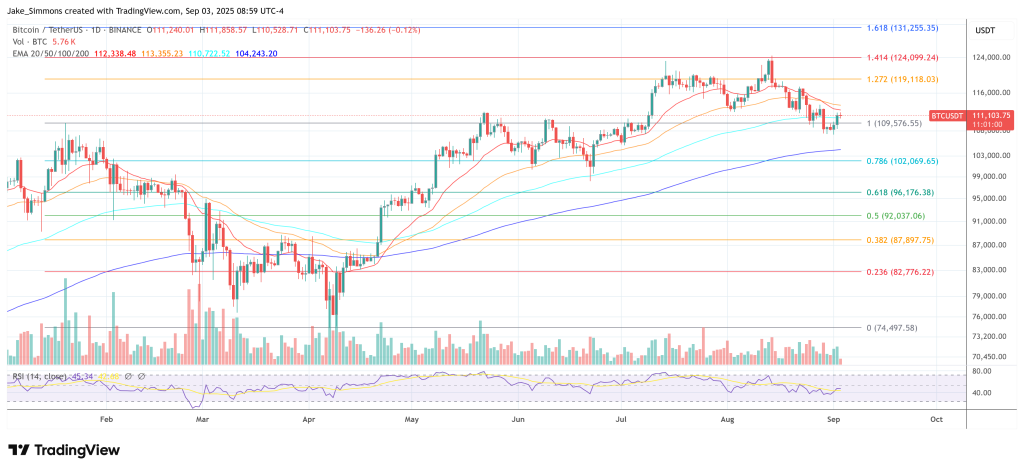
At press time, BTC traded at $111,103.
Bitcoin price
Market Opportunity
Stella Logo
Stella Price(ALPHA)
$0.006391
$0.006391$0.006391
-0.96%
USD
Stella (ALPHA) Live Price Chart
Disclaimer: The articles reposted on this site are sourced from public platforms and are provided for informational purposes only. They do not necessarily reflect the views of MEXC. All rights remain with the original authors. If you believe any content infringes on third-party rights, please contact service@support.mexc.com for removal. MEXC makes no guarantees regarding the accuracy, completeness, or timeliness of the content and is not responsible for any actions taken based on the information provided. The content does not constitute financial, legal, or other professional advice, nor should it be considered a recommendation or endorsement by MEXC.

You May Also Like

Gold Hits $3,700 as Sprott’s Wong Says Dollar’s Store-of-Value Crown May Slip

Gold Hits $3,700 as Sprott’s Wong Says Dollar’s Store-of-Value Crown May Slip

The post Gold Hits $3,700 as Sprott’s Wong Says Dollar’s Store-of-Value Crown May Slip appeared on BitcoinEthereumNews.com. Gold is strutting its way into record territory, smashing through $3,700 an ounce Wednesday morning, as Sprott Asset Management strategist Paul Wong says the yellow metal may finally snatch the dollar’s most coveted role: store of value. Wong Warns: Fiscal Dominance Puts U.S. Dollar on Notice, Gold on Top Gold prices eased slightly to $3,678.9 […] Source: https://news.bitcoin.com/gold-hits-3700-as-sprotts-wong-says-dollars-store-of-value-crown-may-slip/
Share
BitcoinEthereumNews2025/09/18 00:33
Why Institutional Capital Chooses Gold Over Bitcoin Amid Yen Currency Crisis

Why Institutional Capital Chooses Gold Over Bitcoin Amid Yen Currency Crisis

TLDR: Yen’s managed devaluation artificially strengthens the dollar, creating headwinds for Bitcoin price action. Gold has surged 61.4% while Bitcoin stagnates
Share
Blockonomi2026/01/18 12:09
Franklin Templeton CEO Dismisses 50bps Rate Cut Ahead FOMC

Franklin Templeton CEO Dismisses 50bps Rate Cut Ahead FOMC

The post Franklin Templeton CEO Dismisses 50bps Rate Cut Ahead FOMC appeared on BitcoinEthereumNews.com. Franklin Templeton CEO Jenny Johnson has weighed in on whether the Federal Reserve should make a 25 basis points (bps) Fed rate cut or 50 bps cut. This comes ahead of the Fed decision today at today’s FOMC meeting, with the market pricing in a 25 bps cut. Bitcoin and the broader crypto market are currently trading flat ahead of the rate cut decision. Franklin Templeton CEO Weighs In On Potential FOMC Decision In a CNBC interview, Jenny Johnson said that she expects the Fed to make a 25 bps cut today instead of a 50 bps cut. She acknowledged the jobs data, which suggested that the labor market is weakening. However, she noted that this data is backward-looking, indicating that it doesn’t show the current state of the economy. She alluded to the wage growth, which she remarked is an indication of a robust labor market. She added that retail sales are up and that consumers are still spending, despite inflation being sticky at 3%, which makes a case for why the FOMC should opt against a 50-basis-point Fed rate cut. In line with this, the Franklin Templeton CEO said that she would go with a 25 bps rate cut if she were Jerome Powell. She remarked that the Fed still has the October and December FOMC meetings to make further cuts if the incoming data warrants it. Johnson also asserted that the data show a robust economy. However, she noted that there can’t be an argument for no Fed rate cut since Powell already signaled at Jackson Hole that they were likely to lower interest rates at this meeting due to concerns over a weakening labor market. Notably, her comment comes as experts argue for both sides on why the Fed should make a 25 bps cut or…
Share
BitcoinEthereumNews2025/09/18 00:36





