Iran's Crypto Volume Drops 80% but Network Holds: TRM Labs The post War in Iran: Crypto Volume Plunges 80% appeared first on Coinspeaker.Iran's Crypto Volume Drops 80% but Network Holds: TRM Labs The post War in Iran: Crypto Volume Plunges 80% appeared first on Coinspeaker.

War in Iran: Crypto Volume Plunges 80%

2026/03/03 22:04
4 min read
For feedback or concerns regarding this content, please contact us at crypto.news@mexc.com

A new report by blockchain intelligence firm TRM Labs reveals that recent US and Israeli military strikes have crippled Iran’s crypto transaction volumes, causing a dramatic drop of around 80%. Despite this precipitous decline in trading activity analysts believe crypto infrastructure in Iran remains structurally sound.

In a blog post released Monday, the analytics firm described the ecosystem as shifting into a “risk containment mode” rather than suffering a systemic collapse. The strong contraction appears driven primarily by internet restrictions and deliberate protective measures taken by local exchanges, rather than a fundamental failure of the underlying blockchain networks.

EXPLORE: Best New Cryptocurrencies in 2026 – Recently Launched Coins & Investment Watchlist

Iran Crypto Outflows: Anatomy of the Volume Collapse

80% decline in trading volume occurred specifically between February 27 and March 1. This timeframe correlates directly with the onset of severe internet connectivity disruptions following the initiation of military strikes on February 28. The data suggests that mechanical access limitations prevented users from executing trades, resulting in a sudden freeze of market activity.
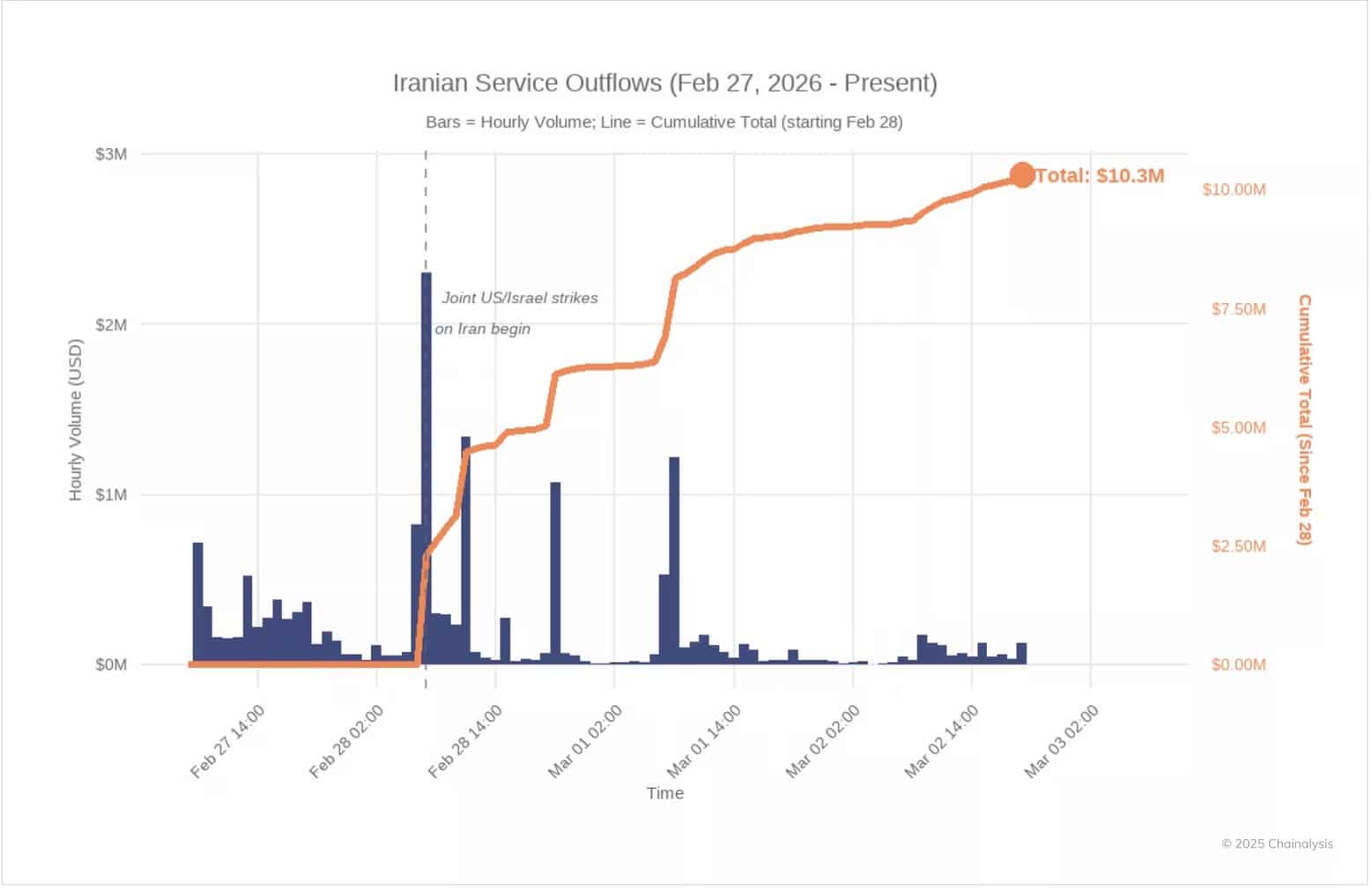
Iranian Service Outflows Source: Chainalysis

The report highlights conflicting interpretations regarding capital flows during this volatile period. While competitor analytics firm Elliptic reported a 700% spike in outflows from Nobitex, Iran’s largest exchange, suggesting potential capital flight, TRM Labs offered a more conservative analysis.
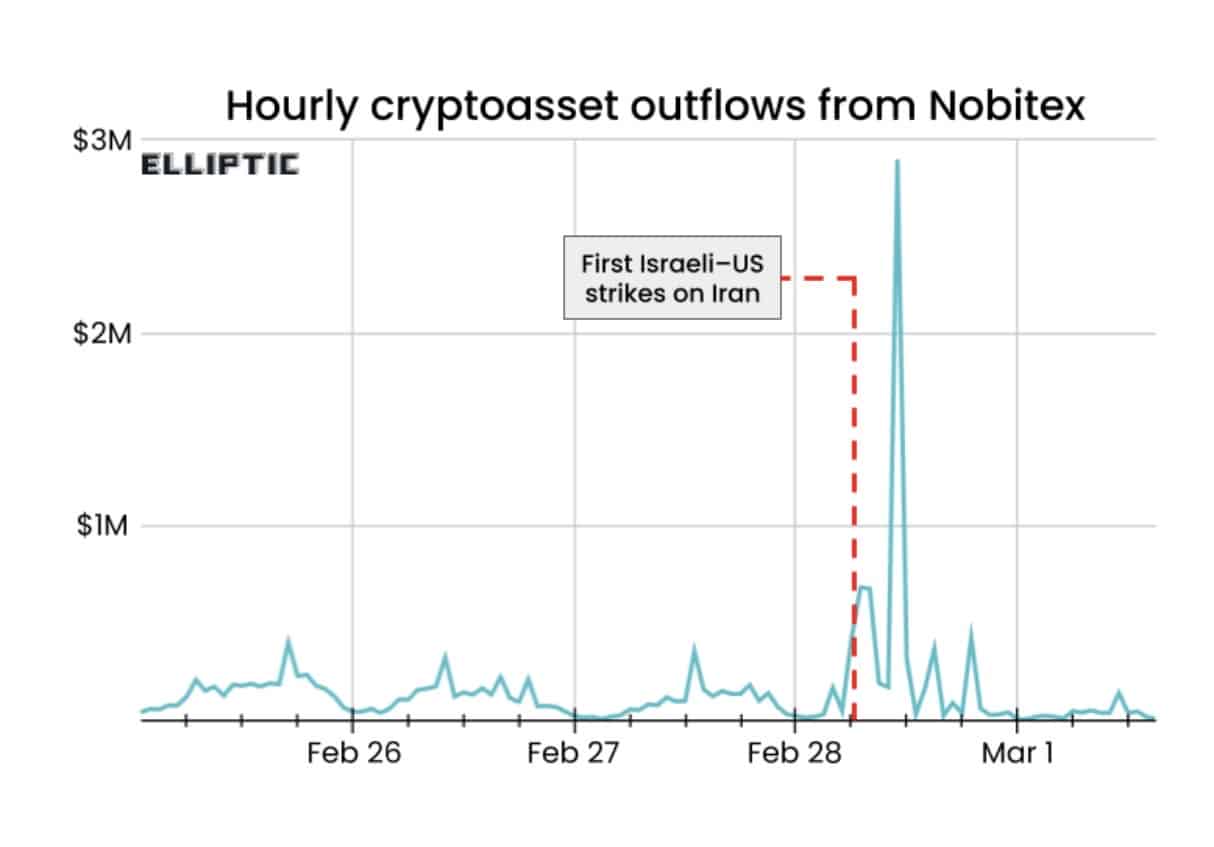
Putflows from Nobitex: Elliptic

TRM noted that Nobitex recorded roughly $3 million in combined inflows and outflows, a figure the firm described as “not necessarily outliers in the context of routine operations.”

TRM cautioned against drawing definitive conclusions about capital flight based on these flows. The firm argues that recent transaction volume data is consistent with users struggling to access platforms due to internet blackouts, rather than a mass exodus of assets from the region.

Geopolitical Pressures and Connectivity Blackouts

The contraction in crypto activity aligns with the broader operational instability caused by the coordinated military strikes. Internet restrictions serve as a mechanical choke point for digital asset transactions, cutting off the primary access route for retail traders. This dynamic is frequent in regions facing geopolitical unrest, where Bitcoin stability is often tested against infrastructure reliability.

Additionally, the regulatory environment for Iranian crypto remains heavily sanctioned. U.S. authorities continue to scrutinize the region for sanctions evasion, often focusing on stablecoin issuers and centralized exchanges. The inability to move funds freely is exacerbated by these external pressures, as global platforms routinely block IP addresses associated with the region to comply with OFAC standards.

DISCOVER: What is the Next Crypto to Explode in 2026?

Structural Integrity: Risk Management vs. Systemic Failure

Despite the severe volume drop, TRM Labs characterizes the ecosystem as being in a “risk-managed state.” Major domestic platforms have reportedly remained operational, implementing defensive measures to preserve solvency. Specifically, Iran’s central bank directed major exchanges, including Nobitex, Wallex, and Tabdeal, to temporarily suspend trading of the USDT-toman pair, the primary bridge between crypto and the domestic fiat currency.

When trading for these pairs resumed, order books showed significantly reduced depth and visible price dislocations, creating a period of impaired liquidity. However, TRM Labs noted that exchanges successfully utilized batched withdrawals and issued risk guidance to users. This distinction is critical for on-chain analysis: the network’s reduced output is a result of access limitations and protective halts, not a liquidity crisis or insolvency event common in failing markets.

EXPLORE: Upcoming Coibase Listings to Watch

Iran Crypto Freeze Clouds Outflow Analysis

Analysts suggest that distinguishing between panic-induced capital flight and routine operational flows will remain difficult until internet connectivity stabilizes. The current data points to a freeze in activity rather than a chaotic liquidation of assets. If the network remains structurally sound as TRM Labs indicates, domestic exchanges may be positioned to resume normal operations once connectivity is restored.

Market observers and compliance firms will be closely watching for the full restoration of exchange services to determine if the liquidity crunch leaves lasting damage on Iran’s crypto economy.

The divergence in analysis between major firms like Elliptic and TRM Labs underscores the complexity of monitoring sanctioned jurisdictions during active conflict.

next

The post War in Iran: Crypto Volume Plunges 80% appeared first on Coinspeaker.

Get Covered, Share 1M USDT

Get Covered, Share 1M USDTGet Covered, Share 1M USDT

Higher VVIP tiers, higher compensation odds.

Disclaimer: The articles reposted on this site are sourced from public platforms and are provided for informational purposes only. They do not necessarily reflect the views of MEXC. All rights remain with the original authors. If you believe any content infringes on third-party rights, please contact crypto.news@mexc.com for removal. MEXC makes no guarantees regarding the accuracy, completeness, or timeliness of the content and is not responsible for any actions taken based on the information provided. The content does not constitute financial, legal, or other professional advice, nor should it be considered a recommendation or endorsement by MEXC.

You May Also Like

The changing face of elder care in Malaysia — Sayed Mohammad Reza Yamani Sayed Umar

The changing face of elder care in Malaysia — Sayed Mohammad Reza Yamani Sayed Umar

JULY 10 — An elderly society is becoming increasingly prevalent in Malaysia at present. It is projected that the p...
Share
Malaymail2026/07/10 15:24
Not a loophole: Singapore AI export controls let China tap US AI legally

Not a loophole: Singapore AI export controls let China tap US AI legally

American AI technology is reaching Chinese tech giants through a route that US export controls were never designed to close: Singapore. The city-state sits outside
Share
The Cryptonomist2026/07/10 14:46
Unlocking Massive Value: Curve Finance Revenue Sharing Proposal for CRV Holders

Unlocking Massive Value: Curve Finance Revenue Sharing Proposal for CRV Holders

BitcoinWorld Unlocking Massive Value: Curve Finance Revenue Sharing Proposal for CRV Holders The dynamic world of decentralized finance (DeFi) is constantly evolving, bringing forth new opportunities and innovations. A significant development is currently unfolding at Curve Finance, a leading decentralized exchange (DEX). Its founder, Michael Egorov, has put forth an exciting proposal designed to offer a more direct path for token holders to earn revenue. This initiative, centered around a new Curve Finance revenue sharing model, aims to bolster the value for those actively participating in the protocol’s governance. What is the “Yield Basis” Proposal and How Does it Work? At the core of this forward-thinking initiative is a new protocol dubbed Yield Basis. Michael Egorov introduced this concept on the CurveDAO governance forum, outlining a mechanism to distribute sustainable profits directly to CRV holders. Specifically, it targets those who stake their CRV tokens to gain veCRV, which are essential for governance participation within the Curve ecosystem. Let’s break down the initial steps of this innovative proposal: crvUSD Issuance: Before the Yield Basis protocol goes live, $60 million in crvUSD will be issued. Strategic Fund Allocation: The funds generated from the sale of these crvUSD tokens will be strategically deployed into three distinct Bitcoin-based liquidity pools: WBTC, cbBTC, and tBTC. Pool Capping: To ensure balanced risk and diversified exposure, each of these pools will be capped at $10 million. This carefully designed structure aims to establish a robust and consistent income stream, forming the bedrock of a sustainable Curve Finance revenue sharing mechanism. Why is This Curve Finance Revenue Sharing Significant for CRV Holders? This proposal marks a pivotal moment for CRV holders, particularly those dedicated to the long-term health and governance of Curve Finance. Historically, generating revenue for token holders in the DeFi space can often be complex. The Yield Basis proposal simplifies this by offering a more direct and transparent pathway to earnings. By staking CRV for veCRV, holders are not merely engaging in governance; they are now directly positioned to benefit from the protocol’s overall success. The significance of this development is multifaceted: Direct Profit Distribution: veCRV holders are set to receive a substantial share of the profits generated by the Yield Basis protocol. Incentivized Governance: This direct financial incentive encourages more users to stake their CRV, which in turn strengthens the protocol’s decentralized governance structure. Enhanced Value Proposition: The promise of sustainable revenue sharing could significantly boost the inherent value of holding and staking CRV tokens. Ultimately, this move underscores Curve Finance’s dedication to rewarding its committed community and ensuring the long-term vitality of its ecosystem through effective Curve Finance revenue sharing. Understanding the Mechanics: Profit Distribution and Ecosystem Support The distribution model for Yield Basis has been thoughtfully crafted to strike a balance between rewarding veCRV holders and supporting the wider Curve ecosystem. Under the terms of the proposal, a substantial portion of the value generated by Yield Basis will flow back to those who contribute to the protocol’s governance. Returns for veCRV Holders: A significant share, specifically between 35% and 65% of the value generated by Yield Basis, will be distributed to veCRV holders. This flexible range allows for dynamic adjustments based on market conditions and the protocol’s performance. Ecosystem Reserve: Crucially, 25% of the Yield Basis tokens will be reserved exclusively for the Curve ecosystem. This allocation can be utilized for various strategic purposes, such as funding ongoing development, issuing grants, or further incentivizing liquidity providers. This ensures the continuous growth and innovation of the platform. The proposal is currently undergoing a democratic vote on the CurveDAO governance forum, giving the community a direct voice in shaping the future of Curve Finance revenue sharing. The voting period is scheduled to conclude on September 24th. What’s Next for Curve Finance and CRV Holders? The proposed Yield Basis protocol represents a pioneering approach to sustainable revenue generation and community incentivization within the DeFi landscape. If approved by the community, this Curve Finance revenue sharing model has the potential to establish a new benchmark for how decentralized exchanges reward their most dedicated participants. It aims to foster a more robust and engaged community by directly linking governance participation with tangible financial benefits. This strategic move by Michael Egorov and the Curve Finance team highlights a strong commitment to innovation and strengthening the decentralized nature of the protocol. For CRV holders, a thorough understanding of this proposal is crucial for making informed decisions regarding their staking strategies and overall engagement with one of DeFi’s foundational platforms. FAQs about Curve Finance Revenue Sharing Q1: What is the main goal of the Yield Basis proposal? A1: The primary goal is to establish a more direct and sustainable way for CRV token holders who stake their tokens (receiving veCRV) to earn revenue from the Curve Finance protocol. Q2: How will funds be generated for the Yield Basis protocol? A2: Initially, $60 million in crvUSD will be issued and sold. The funds from this sale will then be allocated to three Bitcoin-based pools (WBTC, cbBTC, and tBTC), with each pool capped at $10 million, to generate profits. Q3: Who benefits from the Yield Basis revenue sharing? A3: The proposal states that between 35% and 65% of the value generated by Yield Basis will be returned to veCRV holders, who are CRV stakers participating in governance. Q4: What is the purpose of the 25% reserve for the Curve ecosystem? A4: This 25% reserve of Yield Basis tokens is intended to support the broader Curve ecosystem, potentially funding development, grants, or other initiatives that contribute to the platform’s growth and sustainability. Q5: When is the vote on the Yield Basis proposal? A5: A vote on the proposal is currently underway on the CurveDAO governance forum and is scheduled to run until September 24th. If you found this article insightful and valuable, please consider sharing it with your friends, colleagues, and followers on social media! Your support helps us continue to deliver important DeFi insights and analysis to a wider audience. To learn more about the latest DeFi market trends, explore our article on key developments shaping decentralized finance institutional adoption. This post Unlocking Massive Value: Curve Finance Revenue Sharing Proposal for CRV Holders first appeared on BitcoinWorld.


Share
Coinstats2025/09/18 00:35

Record Ads, Stock Down 7%

Record Ads, Stock Down 7%Record Ads, Stock Down 7%

Jul 29: Meta earnings face the market's question.

