Hackers are now exploiting vulnerabilities in widely-used NPM coding libraries to inject malware into Ethereum smart contracts, according to cybersecurity research by blockchain compliance firm Reversing Labs(RL). In a September 3 blog post detailing the discovery, researcher Lucija Valentić revealed that threat actors bypass security scans by exploiting new open-source malware present in the Node Package Manager (NPM) package repository, which contains extensive JavaScript packages and libraries. The most destructive malware discovered was “colortoolsv2” and “mimelib2“, both published in July, which were found to abuse smart contracts to conceal malicious commands that install downloader malware on infected systems.Source: ReversingLabs How Ethereum Smart Contracts Turn Into Malware Command Centers These packages are part of broader open-source libraries affecting both NPM and GitHub, where malicious supply chain actors use advanced social engineering and deception tactics to trick developers into incorporating harmful code into their projects. According to ReversingLabs, 2025 has witnessed a diverse range of malicious campaigns targeting NPM, the leading online repository for JavaScript packages. In March, RL documented the discovery of NPM packages ethers-provider2 and ethers-providerz Since discovering the ethers campaign, researchers have detected numerous additional infostealers, downloaders, and droppers found on NPM. At the beginning of July, RL researcher Karlo Zanki discovered and reported a new NPM campaign involving a basic package that deployed blockchain in a novel way to deliver a malicious second stage. The exact package colortoolsv2 is being used to infiltrate Ethereum smart contracts. According to RL researchers, the malware is a basic NPM package containing just two files. The major file is a script named index.js, which contains a hidden malicious payload. Once installed in a project, the script would run to fetch blockchain data and execute a harmful command by loading the URL for a command and control (C2) server that would then download second-stage malware to the requesting system. Although “downloader” malware is a common method hackers use in NPM repositories to target victims, this specific malware is unusual as it uses Ethereum smart contracts to host the URLs where malicious commands are located for downloading the second-stage malware. Notably, the cybersecurity researchers acknowledge that they haven’t encountered this approach previously. Two-File Malware Hides a $2.5M Bridge Exploit Method The researchers uncovered a Solana-trading-bot infected by the malicious colortoolsv2 package called solana-trading-bot-v2, which appears to be a trustworthy GitHub project to the average observer.Source: ReversingLabs It has thousands of commits, several active contributors, and a decent number of stars and watchers, all characteristics of legitimate open-source repositories. However, all these details were fabricated, and any developer who installs it risks having user wallets that interact with the bot drained of funds. Software supply chain attacks targeting smart contracts and blockchain infrastructure are now on the rise. In July, hackers exploited a vulnerability in Arcadia Finance’s Rebalancer contract, draining approximately $2.5 million in cryptocurrency from the decentralized finance platform operating on Base blockchain. The attackers manipulated arbitrary swapData parameters to execute unauthorized swaps that emptied user vaults. A recent report by blockchain analytics firm Global Ledger revealed that hackers have now stolen $3 billion worth of crypto in 119 separate incidents during the first half of 2025, which is 150% more than all of 2024.Source: Global Ledger Slava Demchuk, CEO of analytics firm AMLBot, said access-control flaws and smart contract vulnerabilities, especially in bridges, continue to be dominant attack methods. Demchuk told Cryptonews that these hackers are exploiting the interconnected and composable nature of decentralized finance (DeFi) protocols to amplify the impact. Blockchain auditors advised that it is critical for developers to assess each library they are considering implementing before deciding to include it in their development cycleHackers are now exploiting vulnerabilities in widely-used NPM coding libraries to inject malware into Ethereum smart contracts, according to cybersecurity research by blockchain compliance firm Reversing Labs(RL). In a September 3 blog post detailing the discovery, researcher Lucija Valentić revealed that threat actors bypass security scans by exploiting new open-source malware present in the Node Package Manager (NPM) package repository, which contains extensive JavaScript packages and libraries. The most destructive malware discovered was “colortoolsv2” and “mimelib2“, both published in July, which were found to abuse smart contracts to conceal malicious commands that install downloader malware on infected systems.Source: ReversingLabs How Ethereum Smart Contracts Turn Into Malware Command Centers These packages are part of broader open-source libraries affecting both NPM and GitHub, where malicious supply chain actors use advanced social engineering and deception tactics to trick developers into incorporating harmful code into their projects. According to ReversingLabs, 2025 has witnessed a diverse range of malicious campaigns targeting NPM, the leading online repository for JavaScript packages. In March, RL documented the discovery of NPM packages ethers-provider2 and ethers-providerz Since discovering the ethers campaign, researchers have detected numerous additional infostealers, downloaders, and droppers found on NPM. At the beginning of July, RL researcher Karlo Zanki discovered and reported a new NPM campaign involving a basic package that deployed blockchain in a novel way to deliver a malicious second stage. The exact package colortoolsv2 is being used to infiltrate Ethereum smart contracts. According to RL researchers, the malware is a basic NPM package containing just two files. The major file is a script named index.js, which contains a hidden malicious payload. Once installed in a project, the script would run to fetch blockchain data and execute a harmful command by loading the URL for a command and control (C2) server that would then download second-stage malware to the requesting system. Although “downloader” malware is a common method hackers use in NPM repositories to target victims, this specific malware is unusual as it uses Ethereum smart contracts to host the URLs where malicious commands are located for downloading the second-stage malware. Notably, the cybersecurity researchers acknowledge that they haven’t encountered this approach previously. Two-File Malware Hides a $2.5M Bridge Exploit Method The researchers uncovered a Solana-trading-bot infected by the malicious colortoolsv2 package called solana-trading-bot-v2, which appears to be a trustworthy GitHub project to the average observer.Source: ReversingLabs It has thousands of commits, several active contributors, and a decent number of stars and watchers, all characteristics of legitimate open-source repositories. However, all these details were fabricated, and any developer who installs it risks having user wallets that interact with the bot drained of funds. Software supply chain attacks targeting smart contracts and blockchain infrastructure are now on the rise. In July, hackers exploited a vulnerability in Arcadia Finance’s Rebalancer contract, draining approximately $2.5 million in cryptocurrency from the decentralized finance platform operating on Base blockchain. The attackers manipulated arbitrary swapData parameters to execute unauthorized swaps that emptied user vaults. A recent report by blockchain analytics firm Global Ledger revealed that hackers have now stolen $3 billion worth of crypto in 119 separate incidents during the first half of 2025, which is 150% more than all of 2024.Source: Global Ledger Slava Demchuk, CEO of analytics firm AMLBot, said access-control flaws and smart contract vulnerabilities, especially in bridges, continue to be dominant attack methods. Demchuk told Cryptonews that these hackers are exploiting the interconnected and composable nature of decentralized finance (DeFi) protocols to amplify the impact. Blockchain auditors advised that it is critical for developers to assess each library they are considering implementing before deciding to include it in their development cycle

Hackers Exploit Ethereum to Inject Malware in Popular Coding Libraries

2025/09/04 20:39
4 min read

Hackers are now exploiting vulnerabilities in widely-used NPM coding libraries to inject malware into Ethereum smart contracts, according to cybersecurity research by blockchain compliance firm Reversing Labs(RL).

In a September 3 blog post detailing the discovery, researcher Lucija Valentić revealed that threat actors bypass security scans by exploiting new open-source malware present in the Node Package Manager (NPM) package repository, which contains extensive JavaScript packages and libraries.

The most destructive malware discovered was “colortoolsv2” and “mimelib2“, both published in July, which were found to abuse smart contracts to conceal malicious commands that install downloader malware on infected systems.
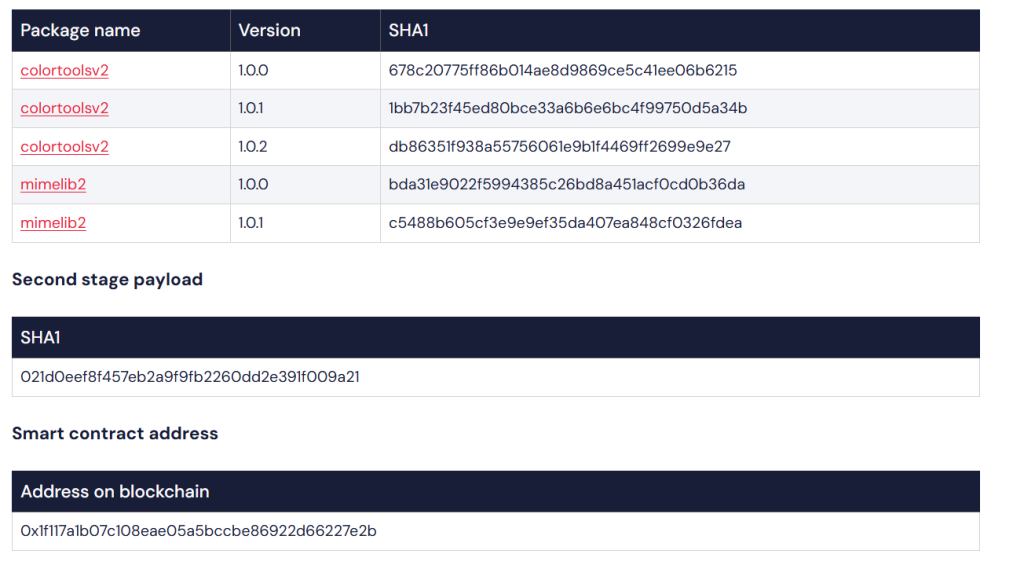
Hackers Exploit Ethereum to Inject Malware in Popular Coding LibrariesSource: ReversingLabs

How Ethereum Smart Contracts Turn Into Malware Command Centers

These packages are part of broader open-source libraries affecting both NPM and GitHub, where malicious supply chain actors use advanced social engineering and deception tactics to trick developers into incorporating harmful code into their projects.

According to ReversingLabs, 2025 has witnessed a diverse range of malicious campaigns targeting NPM, the leading online repository for JavaScript packages.

In March, RL documented the discovery of NPM packages ethers-provider2 and ethers-providerz

Since discovering the ethers campaign, researchers have detected numerous additional infostealers, downloaders, and droppers found on NPM.

At the beginning of July, RL researcher Karlo Zanki discovered and reported a new NPM campaign involving a basic package that deployed blockchain in a novel way to deliver a malicious second stage.

The exact package colortoolsv2 is being used to infiltrate Ethereum smart contracts.

According to RL researchers, the malware is a basic NPM package containing just two files.

The major file is a script named index.js, which contains a hidden malicious payload.

Once installed in a project, the script would run to fetch blockchain data and execute a harmful command by loading the URL for a command and control (C2) server that would then download second-stage malware to the requesting system.

Although “downloader” malware is a common method hackers use in NPM repositories to target victims, this specific malware is unusual as it uses Ethereum smart contracts to host the URLs where malicious commands are located for downloading the second-stage malware.

Notably, the cybersecurity researchers acknowledge that they haven’t encountered this approach previously.

Two-File Malware Hides a $2.5M Bridge Exploit Method

The researchers uncovered a Solana-trading-bot infected by the malicious colortoolsv2 package called solana-trading-bot-v2, which appears to be a trustworthy GitHub project to the average observer.

Hackers Exploit Ethereum to Inject Malware in Popular Coding LibrariesSource: ReversingLabs

It has thousands of commits, several active contributors, and a decent number of stars and watchers, all characteristics of legitimate open-source repositories.

However, all these details were fabricated, and any developer who installs it risks having user wallets that interact with the bot drained of funds.

Software supply chain attacks targeting smart contracts and blockchain infrastructure are now on the rise.

In July, hackers exploited a vulnerability in Arcadia Finance’s Rebalancer contract, draining approximately $2.5 million in cryptocurrency from the decentralized finance platform operating on Base blockchain.

The attackers manipulated arbitrary swapData parameters to execute unauthorized swaps that emptied user vaults.

A recent report by blockchain analytics firm Global Ledger revealed that hackers have now stolen $3 billion worth of crypto in 119 separate incidents during the first half of 2025, which is 150% more than all of 2024.

Hackers Exploit Ethereum to Inject Malware in Popular Coding LibrariesSource: Global Ledger

Slava Demchuk, CEO of analytics firm AMLBot, said access-control flaws and smart contract vulnerabilities, especially in bridges, continue to be dominant attack methods.

Demchuk told Cryptonews that these hackers are exploiting the interconnected and composable nature of decentralized finance (DeFi) protocols to amplify the impact.

Blockchain auditors advised that it is critical for developers to assess each library they are considering implementing before deciding to include it in their development cycle.


Disclaimer: The articles reposted on this site are sourced from public platforms and are provided for informational purposes only. They do not necessarily reflect the views of MEXC. All rights remain with the original authors. If you believe any content infringes on third-party rights, please contact service@support.mexc.com for removal. MEXC makes no guarantees regarding the accuracy, completeness, or timeliness of the content and is not responsible for any actions taken based on the information provided. The content does not constitute financial, legal, or other professional advice, nor should it be considered a recommendation or endorsement by MEXC.

You May Also Like

Is Doge Losing Steam As Traders Choose Pepeto For The Best Crypto Investment?

Is Doge Losing Steam As Traders Choose Pepeto For The Best Crypto Investment?

The post Is Doge Losing Steam As Traders Choose Pepeto For The Best Crypto Investment? appeared on BitcoinEthereumNews.com. Crypto News 17 September 2025 | 17:39 Is dogecoin really fading? As traders hunt the best crypto to buy now and weigh 2025 picks, Dogecoin (DOGE) still owns the meme coin spotlight, yet upside looks capped, today’s Dogecoin price prediction says as much. Attention is shifting to projects that blend culture with real on-chain tools. Buyers searching “best crypto to buy now” want shipped products, audits, and transparent tokenomics. That frames the true matchup: dogecoin vs. Pepeto. Enter Pepeto (PEPETO), an Ethereum-based memecoin with working rails: PepetoSwap, a zero-fee DEX, plus Pepeto Bridge for smooth cross-chain moves. By fusing story with tools people can use now, and speaking directly to crypto presale 2025 demand, Pepeto puts utility, clarity, and distribution in front. In a market where legacy meme coin leaders risk drifting on sentiment, Pepeto’s execution gives it a real seat in the “best crypto to buy now” debate. First, a quick look at why dogecoin may be losing altitude. Dogecoin Price Prediction: Is Doge Really Fading? Remember when dogecoin made crypto feel simple? In 2013, DOGE turned a meme into money and a loose forum into a movement. A decade on, the nonstop momentum has cooled; the backdrop is different, and the market is far more selective. With DOGE circling ~$0.268, the tape reads bearish-to-neutral for the next few weeks: hold the $0.26 shelf on daily closes and expect choppy range-trading toward $0.29–$0.30 where rallies keep stalling; lose $0.26 decisively and momentum often bleeds into $0.245 with risk of a deeper probe toward $0.22–$0.21; reclaim $0.30 on a clean daily close and the downside bias is likely neutralized, opening room for a squeeze into the low-$0.30s. Source: CoinMarketcap / TradingView Beyond the dogecoin price prediction, DOGE still centers on payments and lacks native smart contracts; ZK-proof verification is proposed,…
Share
BitcoinEthereumNews2025/09/18 00:14
Thousands of users protest loss of companion as OpenAI retires GPT-4o

Thousands of users protest loss of companion as OpenAI retires GPT-4o

Thousands of users are protesting the decision to retire GPT-4o, which, according to them, feels akin to losing a friend, romantic partner, or spiritual guide.
Share
Cryptopolitan2026/02/07 01:35
Lovable AI’s Astonishing Rise: Anton Osika Reveals Startup Secrets at Bitcoin World Disrupt 2025

Lovable AI’s Astonishing Rise: Anton Osika Reveals Startup Secrets at Bitcoin World Disrupt 2025

BitcoinWorld Lovable AI’s Astonishing Rise: Anton Osika Reveals Startup Secrets at Bitcoin World Disrupt 2025 Are you ready to witness a phenomenon? The world of technology is abuzz with the incredible rise of Lovable AI, a startup that’s not just breaking records but rewriting the rulebook for rapid growth. Imagine creating powerful apps and websites just by speaking to an AI – that’s the magic Lovable brings to the masses. This groundbreaking approach has propelled the company into the spotlight, making it one of the fastest-growing software firms in history. And now, the visionary behind this sensation, co-founder and CEO Anton Osika, is set to share his invaluable insights on the Disrupt Stage at the highly anticipated Bitcoin World Disrupt 2025. If you’re a founder, investor, or tech enthusiast eager to understand the future of innovation, this is an event you cannot afford to miss. Lovable AI’s Meteoric Ascent: Redefining Software Creation In an era where digital transformation is paramount, Lovable AI has emerged as a true game-changer. Its core premise is deceptively simple yet profoundly impactful: democratize software creation. By enabling anyone to build applications and websites through intuitive AI conversations, Lovable is empowering the vast majority of individuals who lack coding skills to transform their ideas into tangible digital products. This mission has resonated globally, leading to unprecedented momentum. The numbers speak for themselves: Achieved an astonishing $100 million Annual Recurring Revenue (ARR) in less than a year. Successfully raised a $200 million Series A funding round, valuing the company at $1.8 billion, led by industry giant Accel. Is currently fielding unsolicited investor offers, pushing its valuation towards an incredible $4 billion. As industry reports suggest, investors are unequivocally “loving Lovable,” and it’s clear why. This isn’t just about impressive financial metrics; it’s about a company that has tapped into a fundamental need, offering a solution that is both innovative and accessible. The rapid scaling of Lovable AI provides a compelling case study for any entrepreneur aiming for similar exponential growth. The Visionary Behind the Hype: Anton Osika’s Journey to Innovation Every groundbreaking company has a driving force, and for Lovable, that force is co-founder and CEO Anton Osika. His journey is as fascinating as his company’s success. A physicist by training, Osika previously contributed to the cutting-edge research at CERN, the European Organization for Nuclear Research. This deep technical background, combined with his entrepreneurial spirit, has been instrumental in Lovable’s rapid ascent. Before Lovable, he honed his skills as a co-founder of Depict.ai and a Founding Engineer at Sana. Based in Stockholm, Osika has masterfully steered Lovable from a nascent idea to a global phenomenon in record time. His leadership embodies a unique blend of profound technical understanding and a keen, consumer-first vision. At Bitcoin World Disrupt 2025, attendees will have the rare opportunity to hear directly from Osika about what it truly takes to build a brand that not only scales at an incredible pace in a fiercely competitive market but also adeptly manages the intense cultural conversations that inevitably accompany such swift and significant success. His insights will be crucial for anyone looking to understand the dynamics of high-growth tech leadership. Unpacking Consumer Tech Innovation at Bitcoin World Disrupt 2025 The 20th anniversary of Bitcoin World is set to be marked by a truly special event: Bitcoin World Disrupt 2025. From October 27–29, Moscone West in San Francisco will transform into the epicenter of innovation, gathering over 10,000 founders, investors, and tech leaders. It’s the ideal platform to explore the future of consumer tech innovation, and Anton Osika’s presence on the Disrupt Stage is a highlight. His session will delve into how Lovable is not just participating in but actively shaping the next wave of consumer-facing technologies. Why is this session particularly relevant for those interested in the future of consumer experiences? Osika’s discussion will go beyond the superficial, offering a deep dive into the strategies that have allowed Lovable to carve out a unique category in a market long thought to be saturated. Attendees will gain a front-row seat to understanding how to identify unmet consumer needs, leverage advanced AI to meet those needs, and build a product that captivates users globally. The event itself promises a rich tapestry of ideas and networking opportunities: For Founders: Sharpen your pitch and connect with potential investors. For Investors: Discover the next breakout startup poised for massive growth. For Innovators: Claim your spot at the forefront of technological advancements. The insights shared regarding consumer tech innovation at this event will be invaluable for anyone looking to navigate the complexities and capitalize on the opportunities within this dynamic sector. Mastering Startup Growth Strategies: A Blueprint for the Future Lovable’s journey isn’t just another startup success story; it’s a meticulously crafted blueprint for effective startup growth strategies in the modern era. Anton Osika’s experience offers a rare glimpse into the practicalities of scaling a business at breakneck speed while maintaining product integrity and managing external pressures. For entrepreneurs and aspiring tech leaders, his talk will serve as a masterclass in several critical areas: Strategy Focus Key Takeaways from Lovable’s Journey Rapid Scaling How to build infrastructure and teams that support exponential user and revenue growth without compromising quality. Product-Market Fit Identifying a significant, underserved market (the 99% who can’t code) and developing a truly innovative solution (AI-powered app creation). Investor Relations Balancing intense investor interest and pressure with a steadfast focus on product development and long-term vision. Category Creation Carving out an entirely new niche by democratizing complex technologies, rather than competing in existing crowded markets. Understanding these startup growth strategies is essential for anyone aiming to build a resilient and impactful consumer experience. Osika’s session will provide actionable insights into how to replicate elements of Lovable’s success, offering guidance on navigating challenges from product development to market penetration and investor management. Conclusion: Seize the Future of Tech The story of Lovable, under the astute leadership of Anton Osika, is a testament to the power of innovative ideas meeting flawless execution. Their remarkable journey from concept to a multi-billion-dollar valuation in record time is a compelling narrative for anyone interested in the future of technology. By democratizing software creation through Lovable AI, they are not just building a company; they are fostering a new generation of creators. His appearance at Bitcoin World Disrupt 2025 is an unmissable opportunity to gain direct insights from a leader who is truly shaping the landscape of consumer tech innovation. Don’t miss this chance to learn about cutting-edge startup growth strategies and secure your front-row seat to the future. Register now and save up to $668 before Regular Bird rates end on September 26. To learn more about the latest AI market trends, explore our article on key developments shaping AI features. This post Lovable AI’s Astonishing Rise: Anton Osika Reveals Startup Secrets at Bitcoin World Disrupt 2025 first appeared on BitcoinWorld.
Share
Coinstats2025/09/17 23:40