Payday Loan Industry Statistics 2026: Risk, Demand & Growth

In the evolving world of finance, payday loans stand out as a quick solution for many who need immediate cash. For some, these loans bridge the gap between paychecks, while for others, they become a financial trap. Despite regulatory scrutiny and evolving alternatives, the payday loan industry continues to grow, especially in areas with restricted credit access. Understanding the size, segmentation, and demographics of this market reveals why so many Americans turn to payday loans and the critical changes affecting the industry.
Editor’s Choice
- Typical payday loan APRs now range from around 200% to 700%, far above most other consumer credit.
- A common payday loan remains roughly $375, usually due in 14–30 days, keeping repayment windows extremely short.
- For a $375 loan, finance charges of 15–20% mean borrowers often pay $56–$75 in fees for just two weeks.
- Effective APRs can reach roughly 390–780% once flat fees of $10–$30 per $100 are annualized.
- In recent regulatory analyses, about 4–6% of U.S. consumers report using payday loans within a year, indicating persistent demand.
- Many borrowers take multiple loans per year, with over 50% of prior users borrowing again within 12 months.
Recent Developments
- CFPB deprioritized enforcement of payment provisions for lenders with ≤2,500 annual small-dollar loans as of March 2025.
- Online payday loans accounted for 57.60% of the market in 2025, dominating due to convenience and 24-hour access.
- Hybrid omnichannel models are growing at 12.05% CAGR, combining chatbots with branch options.
- AI underwriting reduces processing time by up to 80%, enabling instant approvals in payday lending.
- Borrowers aged 18-24 are expanding at 11.1% CAGR, driven by limited credit histories.
- Mobile apps in payday lending are set to grow at 15.1% CAGR through 2031.
- Single adults represent 47.00% of loan volume, growing at 9.55% CAGR due to financial vulnerabilities.
- Canada capped payday fees at 14% of principal and 35% APR in January 2025.
- 20 states plus DC enforce 36% APR caps on payday loans, restricting high-cost options.
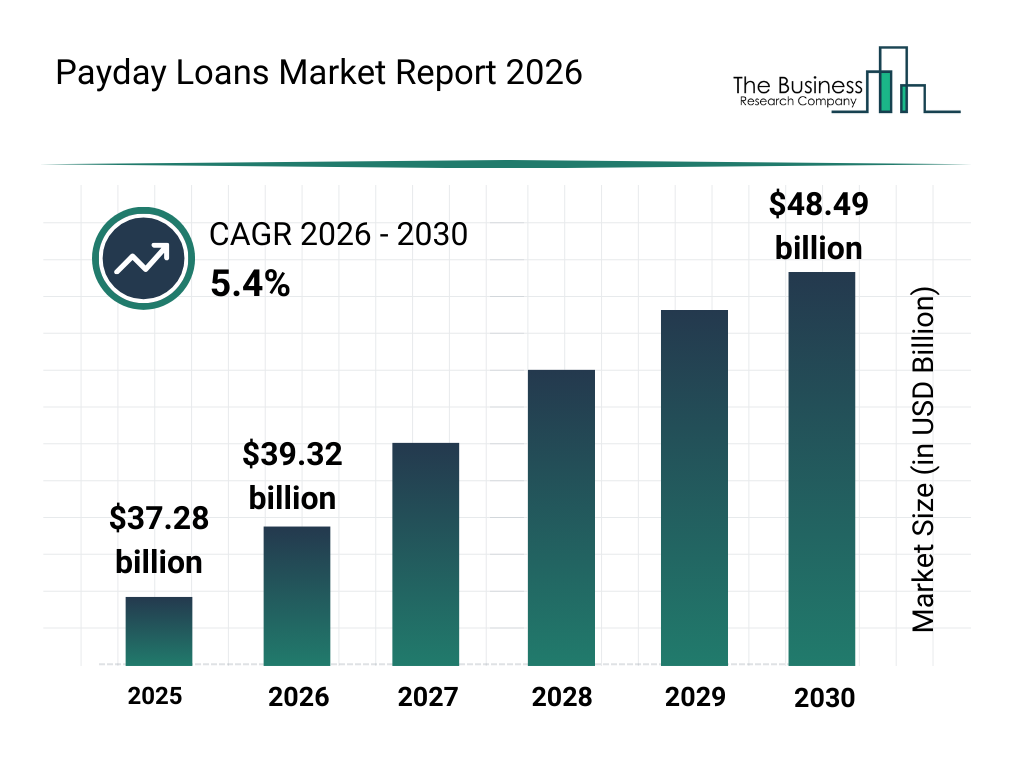
Payday Loans Market Size Forecast
- The global payday loans market reached $37.28 billion in 2025, showing steady demand for short-term credit services.
- The market is expected to grow to $39.32 billion in 2026, reflecting continued consumer reliance on fast cash loans.
- Projections show the industry expanding at a 5.4% compound annual growth rate (CAGR) between 2026 and 2030.
- The payday lending market could reach around $41.44 billion in 2027 as digital lending platforms expand.
- By 2028, the market size is forecast to increase to approximately $43.68 billion.
- Continued growth may push the industry to about $46.04 billion in 2029.
- The global payday loan market is projected to hit $48.49 billion by 2030, highlighting the ongoing demand for short-term lending options.
 (Reference: The Business Research Company)
Type Insights
- Single-payment payday loans dominate at 72% of total industry revenue, fueling repeat borrowing cycles.
- Installment payday loans contribute 18% of revenue, growing in popularity with structured repayments.
- Online payday loans hold 60-65% market share in North America, boosted by digital convenience.
- Salary-based advance platforms are projected to generate $4–5 billion in revenue.
- Secured payday loans account for 5% of total revenue, with lower rates via collateral.
- The average payday loan amount stands at $375, down from $500 for reduced risk.
- Single individuals dominate at 47% of the market, vulnerable due to single-income reliance.
Impact of Technology on Payday Lending
- Digital payday lending captures 57.60% market share, fueled by 24/7 access and speed.
- AI underwriting slashes processing time by 80%, enabling instant loan decisions.
- 65% of digital borrowers use mobile apps, the highest in urban demographics.
- Mobile payday apps grow at 15.1% CAGR through 2031, dominating transactions.
- 70% of lenders deploy chatbots for inquiries, boosting operational efficiency.
- Hybrid omnichannel models expand at 12.05% CAGR, blending AI with branches.
- Blockchain payday lending holds 3% of transactions, enhancing transparency.
- 85% of digital platforms implement advanced cybersecurity for data protection.
Marital Status Insights
- Single borrowers account for up to 65% of users in some studies, varying by income and location.
- Married borrowers comprise 25% of payday loan users, typically for family or household expenses.
- Divorced and separated individuals make up 18% of annual payday loan borrowers.
- 38% of single mothers have used payday loans for unexpected household costs.
Demographics and Customer Segmentation
- Millennials hold the largest share at 40–45% of payday loan users, driven by living costs and student debt.
- Generation X accounts for 34% of borrowers, using loans for medical or auto repairs.
- Baby Boomers represent 14%, increasingly borrowing due to retirement gaps and healthcare.
- Women make up 54% of borrowers, often for childcare and family needs.
- African Americans comprise 20% and Hispanics 15% of users, due to credit access barriers.
- 67% of users earn $30,000 or less yearly, underscoring low-income dependence.
- Unbanked and underbanked (10% of U.S. households) heavily rely on payday loans for credit.
Competitive Landscape and Key Companies
- Advance America leads with over 800 U.S. storefronts and robust online services.
- Check Into Cash expands via check cashing, installments, and digital payday options.
- Speedy Cash grows its share through omnichannel in-store, online, and app access.
- ACE Cash Express runs over 900 locations in relaxed-regulation states.
- Money Mart operates over 350 sites for the underbanked with loans and prepaid cards.
- Earnin, Payactiv, and DailyPay lead EWA apps in booming $23.5 billion market.
- Enova International and OneMain Holdings dominate among major payday players.
- CashNetUSA holds a significant market share with diverse online loan products.
Payday Loan Repayment Behavior
- 79.7% of borrowers say they paid back their payday loan on time, showing that most users meet their repayment deadline.
- Only 9.3% of borrowers report that they paid their payday loan late, which can lead to additional fees or charges.
- Around 11% of borrowers say they have both paid on time and paid late, showing that repayment habits can change based on financial pressure.
- The data shows that most payday loan users repay on time, but a small share still face late payment challenges.
 (Reference: NextBillion)
Revenue Breakdown by Loan Type
- Single-payment payday loans generate 72% of total industry revenue.
- Installment payday loans contribute 18% to overall revenue.
- Online payday loans drive revenue growth at 15% annually.
- Secured payday loans account for 5% of total revenue.
- Salary-based advance platforms forecast to produce $4–5 billion in revenue.
- Repeat customers account for 75% of all payday loan revenue.
- BNPL alternatives grow at up to 20% annually among young consumers.
Alarming Payday Loan Trends
- Average payday loan APRs peak at 652% in Idaho and 661% in Texas, with several states above 500%.
- Nearly 50% of payday borrowers default at least once within 2 years, often after just 2 loans.
- Typical repayment terms remain 14–30 days, far shorter than most borrowers need to recover.
- About 22% of borrowing sequences stretch to 7+ loans, and 15% to 10+ loans.
- Nearly 50% of payday borrowers incur an overdraft or NSF fee within 2 weeks of a loan transaction.
- Around 64% of payday borrowers pay at least one overdraft or NSF fee during their borrowing period.
- CFPB reports show the average borrower is in payday debt for 196 days per year, or 54% of the year.
Reasons People Use Payday Loans
- 48.5% of borrowers use payday loans for everyday bills like groceries, utilities, and rent.
- 15.8% rely on payday loans for emergency automotive expenses.
- 13% turn to payday loans for emergency medical expenses.
- 10.9% use payday loans to pay off other debt, including credit cards or auto loans.
- 5.6% borrow for large purchases like appliances or electronics.
- 3.6% use payday loans for entertainment purposes.
- 2.6% report other reasons for taking payday loans.
- Nearly 80% use loans for essentials like rent, utilities, and groceries.
Employment Status of Payday Loan Recipients
- 81.2% of payday loan recipients are full-time employed.
- 6.9% are part-time workers relying on supplemental payday credit.
- 5.1% are retired individuals still turning to payday loans.
- 2.9% are self-employed small business owners or freelancers.
- 1.6% are stay-at-home individuals using payday loans for support.
- 1.2% are unemployed, borrowing despite having no steady income.
- 0.9% are students dependent on short-term high-cost credit.
- 0.2% are temporary workers, the smallest borrower segment.
Alternatives to Payday Loans
- Federal credit union loans cap APR at 18%, far below the typical 400% payday rates.
- Official Payday Alternative Loans (PALs) charge up to 28% APR on $200–$2,000 with 1–12 month terms.
- Credit union small personal loans range from $500–$2,500 over 6–24 months at around 7–18% APR.
- CDFI Small Dollar Loan Program awarded $18 million to 66 CDFIs to expand low-cost small loans.
- EWA users report 85% reduced financial stress versus payday borrowers, with much lower fees.
- EWA providers typically charge small transaction or subscription fees instead of triple-digit APRs.
- BNPL and other alt-lending products grow around 20% annually as lower-cost credit options.
- Many credit unions and nonprofits bundle small loans with free financial counseling services.
Frequently Asked Questions (FAQs)
The average APR on a payday loan is approximately 391–396%.
There are about 23,000 payday loan stores across the U.S.
Online payday lending accounts for roughly 50% of all payday loan revenue.
Conclusion
The payday loan industry, despite its challenges and regulatory pressures, continues to serve a significant market need, particularly among those without traditional credit access. While high interest rates and repeat borrowing remain concerns, the industry is gradually adapting to shifts in consumer demand, regulatory frameworks, and technological advancements.
Alternatives like salary advance apps, BNPL, and credit union loans are beginning to offer viable options, helping consumers avoid the high costs of payday loans. The future of payday lending will likely be shaped by continued efforts to balance consumer protection with financial inclusion. For borrowers, understanding the full impact of payday loans and exploring safer financial products will be key to achieving long-term stability.
The post Payday Loan Industry Statistics 2026: Risk, Demand & Growth appeared first on CoinLaw.
You May Also Like

Scaling the Local Brand: How modular fintech tools allow neighborhood startups to compete with global giants

Trump’s enablers are 'colluding with his insanity': assessment