"Dead code" refers to parts of a codebase that are written but never executed, called, imported, or otherwise needed during the normal operation of the application. Cleaning up unused code improves clarity, performance, and long-term maintainability."Dead code" refers to parts of a codebase that are written but never executed, called, imported, or otherwise needed during the normal operation of the application. Cleaning up unused code improves clarity, performance, and long-term maintainability.

Everything You Need to Know About Dead Code

2025/09/10 14:50
3 min read
For feedback or concerns regarding this content, please contact us at crypto.news@mexc.com

What Is "Dead Code"?

Dead code refers to parts of a codebase that are written but never executed, called, imported, or otherwise needed during the normal operation of the application.

Over time, as features are added, changed, or removed, some code becomes obsolete but is accidentally left behind. This can lead to:

  • Increased bundle size
  • Slower build times
  • Harder maintenance and onboarding
  • Potential security risks

Cleaning up unused code improves clarity, performance, and long-term maintainability.

What Is Considered "Dead Code"?

Here are the common categories of unused code:

  1. Unused Variables

    Declared but never used in any operation.

  2. Unused Functions or Methods

    Defined but never called anywhere.

  3. Unused Imports

    Imported modules or packages that are never referenced.

  4. Unused Exports

    Functions or components exported from a module but not imported elsewhere.

  5. Unused Files

    Complete files (components, modules, etc.) that are never imported or required.

  6. Unused Dependencies

    Libraries listed in your package manager (e.g., package.json) that are not imported or used in the codebase.

Some exceptions:

  • Disabled Features

    Features that are temporarily disabled or taken out, but will be used in the future.

  • Helper functions

    Utility functions that help with common tasks can be reviewed regularly to check if it needs to be removed.

Tools for Scanning Dead Code

The following tools help detect and analyze unused code, imports, functions, variables, and dependencies. Choose tools based on your tech stack:

  • ts-prune
  • Detects unused exported functions, constants, and types in TypeScript projects.
  • On Maintenance (no further update)
  • depcheck
  • Checks for unused npm dependencies and missing ones.
  • knip.dev (We are using this!)
  • Knip finds and fixes unused dependencies, exports and files in your JavaScript and TypeScript projects. Less code and dependencies lead to improved performance, less maintenance and easier refactorings.

How to Scan and Remove Unused Code with knip

Follow these steps to identify and safely remove unused code from your project using knip:

  1. Install knip (if not already installed):
   yarn add -D knip    # or    npm install -D knip 
  1. Run the analysis:
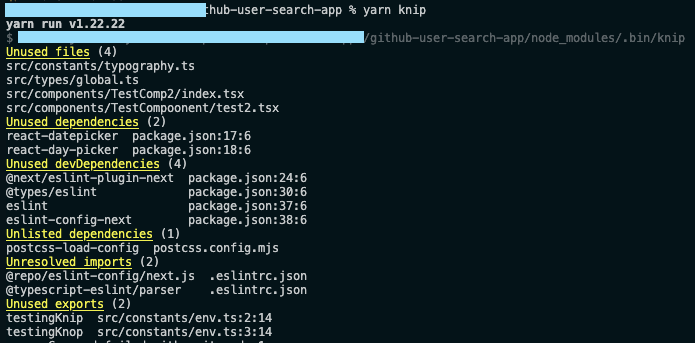
   yarn knip 

Note: Replace yarn with your preferred package manager (npm, pnpm, etc.).

\

  1. Review the list of unused files or exports:

  2. Go through the list from top-down, starting with high-level components, constants, and utilities.

  3. Search your codebase to verify whether each flagged file or export is truly unused.

    • If it's used elsewhere, skip it.
    • If it has no references, it’s safe to delete.

  4. Remove confirmed dead code

  5. Delete unused files, exports, or lines confidently after reviewing

    • Check with your teammates if the components/files is not used anymore or just temporarily not used

    • Validate your codebase:

    • Run linters and TypeScript checks to catch any issues:

        yarn lint   npx tsc --noEmit 
    • Start the development server to confirm everything still works:

        yarn dev 
    • Final step: Commit your changes with a clear message, e.g.:
   git commit -m "chore: remove unused code and dependencies" 

Getting rid of dead code might feel like a chore, but it’s totally worth it. Cleaner code means fewer headaches, faster builds, and easier debugging down the line. With the right tools and a step-by-step approach, it’s not that hard to keep your codebase in shape. If you’re working in a fast-paced company where keeping track of all the new code is challenging, making this part of your regular workflow is a must.

If you have any other better approach or just want to share your own process, feel free to share in the comment! I would love to hear your thought!

Disclaimer: The articles reposted on this site are sourced from public platforms and are provided for informational purposes only. They do not necessarily reflect the views of MEXC. All rights remain with the original authors. If you believe any content infringes on third-party rights, please contact crypto.news@mexc.com for removal. MEXC makes no guarantees regarding the accuracy, completeness, or timeliness of the content and is not responsible for any actions taken based on the information provided. The content does not constitute financial, legal, or other professional advice, nor should it be considered a recommendation or endorsement by MEXC.
Tags:

You May Also Like

XRPL Sidechain Proposal Targets Options Trading and Leverage

XRPL Sidechain Proposal Targets Options Trading and Leverage

The post XRPL Sidechain Proposal Targets Options Trading and Leverage appeared on BitcoinEthereumNews.com. James is dedicated to demystifying intricate technological
Share
BitcoinEthereumNews2026/03/03 00:31
UK Looks to US to Adopt More Crypto-Friendly Approach
UK Looks to US to Adopt More Crypto-Friendly Approach

The post UK Looks to US to Adopt More Crypto-Friendly Approach appeared on BitcoinEthereumNews.com. The UK and US are reportedly preparing to deepen cooperation on digital assets, with Britain looking to copy the Trump administration’s crypto-friendly stance in a bid to boost innovation.  UK Chancellor Rachel Reeves and US Treasury Secretary Scott Bessent discussed on Tuesday how the two nations could strengthen their coordination on crypto, the Financial Times reported on Tuesday, citing people familiar with the matter.  The discussions also involved representatives from crypto companies, including Coinbase, Circle Internet Group and Ripple, with executives from the Bank of America, Barclays and Citi also attending, according to the report. The agreement was made “last-minute” after crypto advocacy groups urged the UK government on Thursday to adopt a more open stance toward the industry, claiming its cautious approach to the sector has left the country lagging in innovation and policy.  Source: Rachel Reeves Deal to include stablecoins, look to unlock adoption Any deal between the countries is likely to include stablecoins, the Financial Times reported, an area of crypto that US President Donald Trump made a policy priority and in which his family has significant business interests. The Financial Times reported on Monday that UK crypto advocacy groups also slammed the Bank of England’s proposal to limit individual stablecoin holdings to between 10,000 British pounds ($13,650) and 20,000 pounds ($27,300), claiming it would be difficult and expensive to implement. UK banks appear to have slowed adoption too, with around 40% of 2,000 recently surveyed crypto investors saying that their banks had either blocked or delayed a payment to a crypto provider.  Many of these actions have been linked to concerns over volatility, fraud and scams. The UK has made some progress on crypto regulation recently, proposing a framework in May that would see crypto exchanges, dealers, and agents treated similarly to traditional finance firms, with…
Share
BitcoinEthereumNews2025/09/18 02:21
Will ETH Drop Below $1.8K Amid Escalating Macro Uncertainty?

Will ETH Drop Below $1.8K Amid Escalating Macro Uncertainty?

The post Will ETH Drop Below $1.8K Amid Escalating Macro Uncertainty? appeared on BitcoinEthereumNews.com. Home » ETH ‘; } function loadTrinityPlayer(targetWrapper
Share
BitcoinEthereumNews2026/03/03 00:16