TLDR TRON governance reduced transaction costs by 60%, cutting average transfer fees from 4.4 TRX to 2.1 TRX TRX trades at $0.3447, up 2.4% in 24 hours despite cooling trading volumes Network processes over $21 billion daily in USDT transfers, creating steady demand TRON Inc. expanded treasury by $110 million and launched Ledger Enterprise app [...] The post TRON (TRX) Price: Network Slashes Transactions Fees by 60% Driving 17% Rally appeared first on CoinCentral.TLDR TRON governance reduced transaction costs by 60%, cutting average transfer fees from 4.4 TRX to 2.1 TRX TRX trades at $0.3447, up 2.4% in 24 hours despite cooling trading volumes Network processes over $21 billion daily in USDT transfers, creating steady demand TRON Inc. expanded treasury by $110 million and launched Ledger Enterprise app [...] The post TRON (TRX) Price: Network Slashes Transactions Fees by 60% Driving 17% Rally appeared first on CoinCentral.

TRON (TRX) Price: Network Slashes Transactions Fees by 60% Driving 17% Rally

TLDR

  • TRON governance reduced transaction costs by 60%, cutting average transfer fees from 4.4 TRX to 2.1 TRX
  • TRX trades at $0.3447, up 2.4% in 24 hours despite cooling trading volumes
  • Network processes over $21 billion daily in USDT transfers, creating steady demand
  • TRON Inc. expanded treasury by $110 million and launched Ledger Enterprise app
  • Technical analysis shows support at $0.32 with resistance near $0.36

TRON (TRX) is trading at $0.3447 at press time, marking a 2.4% gain over the past 24 hours. The token has moved between $0.3094 and $0.3448 in the last week.
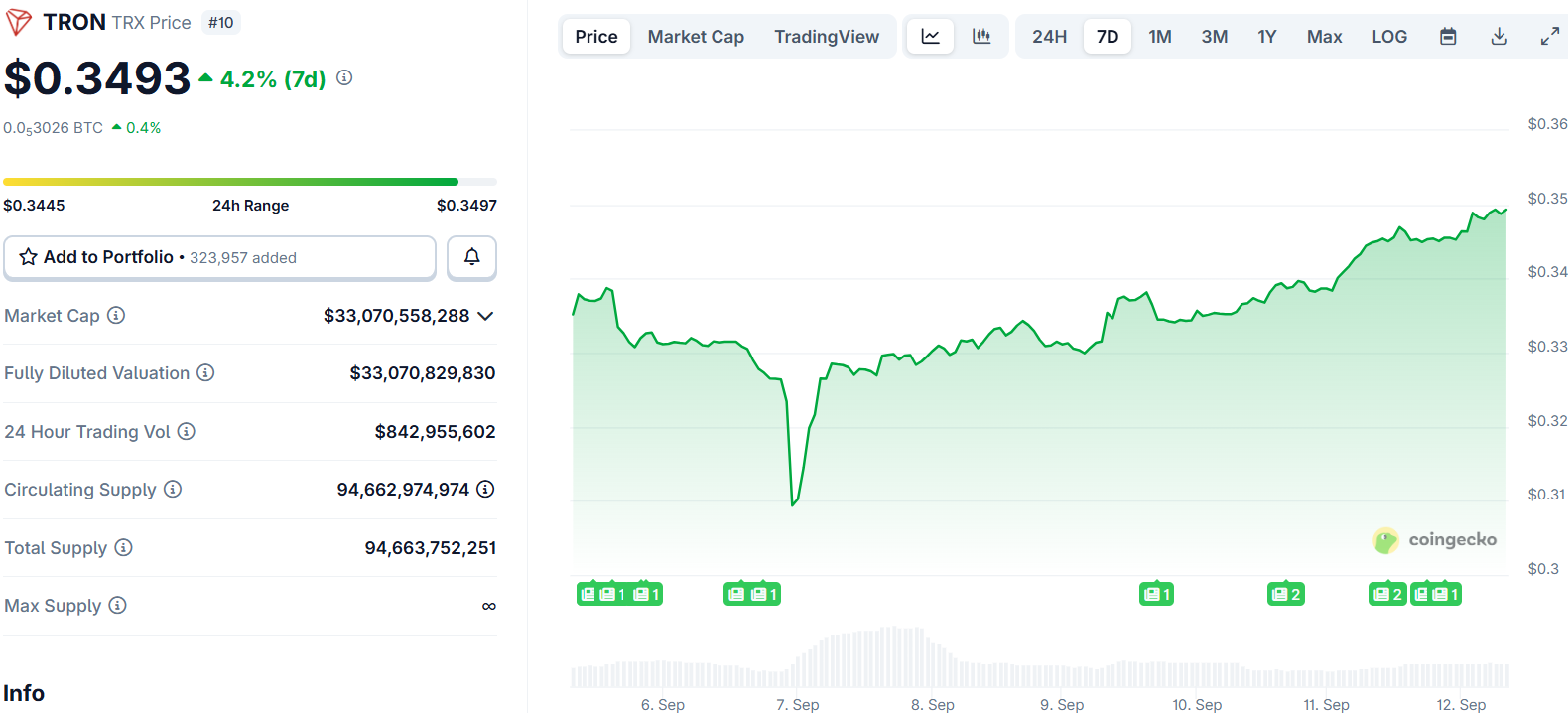
Tron (TRX) PriceTron (TRX) Price

The price recovery comes after TRON’s governance made a major change to network costs. Super Representatives voted on August 29 to lower the Energy Unit Price from 210 SUN to 100 SUN.

This decision cut transaction costs by 60% across the network. Average fees for TRC20 transfers dropped from 4.4 TRX to 2.1 TRX according to CryptoQuant data.

Total weekly fees fell from 272 million TRX in mid-August to 23.1 million TRX. The reduction makes TRON more appealing for users who make frequent transfers.

TRON processes more than $21 billion daily in USDT transfers. This represents about half of all global Tether volume.

Every transaction requires TRX for gas fees. This creates steady demand for the token regardless of market conditions.

The fee cut should strengthen TRON’s position as the top settlement layer for Tether. Lower costs may attract up to 45% more users who previously found the network too expensive.

Market data shows some cooling in trading activity. Spot trading volume fell 10.6% to $702 million over the past day.

Derivatives volume dropped 18.7% to $252 million according to Coinglass data. Open interest declined 1.3% during the same period.

Corporate Treasury Growth

TRON Inc. expanded its treasury by $110 million on September 2. The company’s largest shareholder backed this expansion.

The firm already holds over 365 million TRX worth around $126 million. TRON Inc. plans to raise $1 billion to grow its TRX holdings further.

This strategy follows MicroStrategy’s approach with Bitcoin. Corporate buying reduces available supply and shows long-term confidence.

Since TRON Inc. listed on Nasdaq through a reverse merger in July, TRX has gained about 10%. The listing happened on July 24, 2025.

Technical Market Position

TRX currently trades above the 20-day simple moving average at $0.3401. Most longer-term moving averages remain in buy territory.
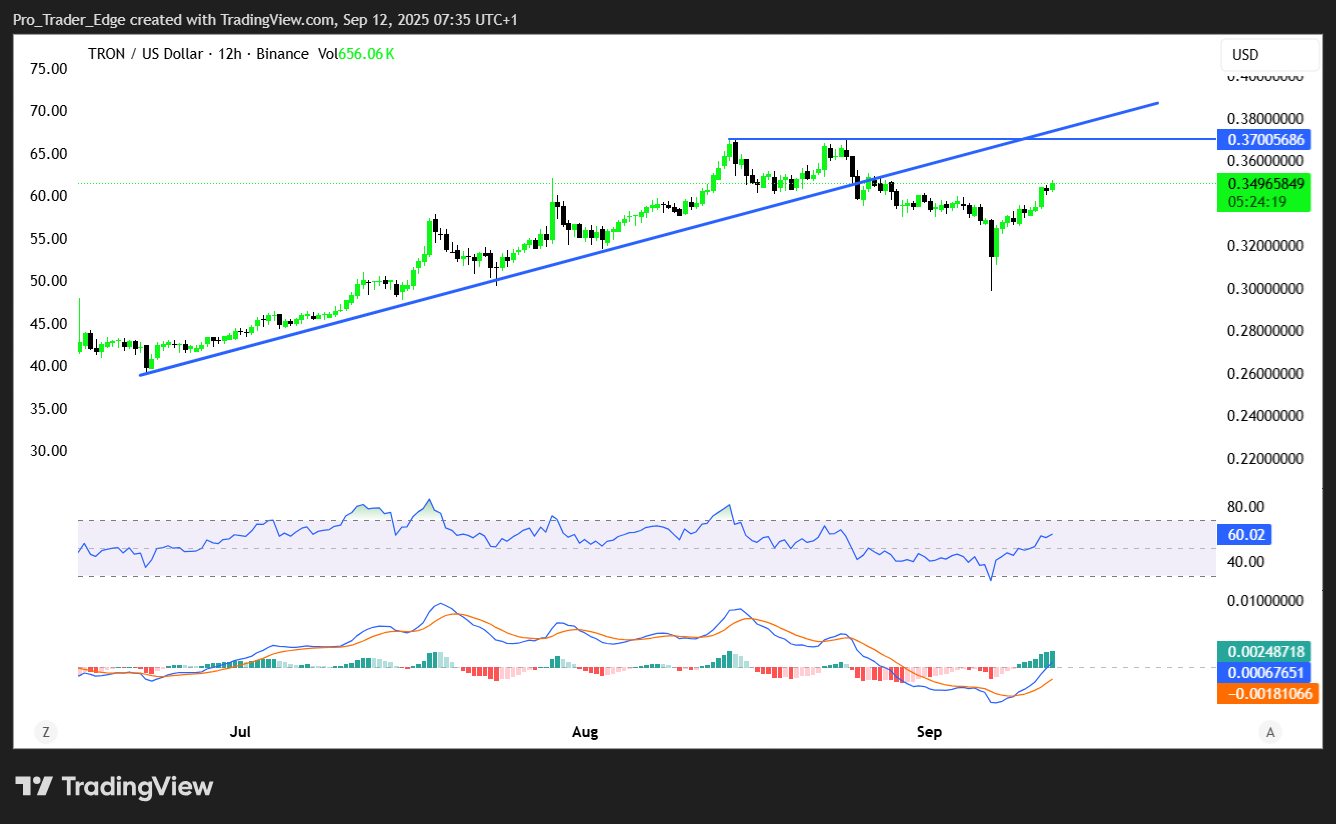
Source: TradingView

The token sits in the middle range of Bollinger Bands. Support levels appear at $0.32 while resistance sits near $0.36.

Momentum indicators show mixed signals. The MACD indicates a mild sell signal while RSI remains neutral at 54.

A break above $0.36 could open the path toward $0.38-$0.40. Failure to hold $0.32 support might lead to a pullback toward $0.30.

TRX remains just 20% below its all-time high of $0.4313 set in December 2024. The token has gained 125% since last year and 28% over recent months.

TRON launched a Ledger Enterprise mobile app on September 11 to improve secure USDT transfers on the network.

The post TRON (TRX) Price: Network Slashes Transactions Fees by 60% Driving 17% Rally appeared first on CoinCentral.


Market Opportunity
Tron Logo
Tron Price(TRX)
$0.3044
$0.3044$0.3044
-1.93%
USD
Tron (TRX) Live Price Chart
Disclaimer: The articles reposted on this site are sourced from public platforms and are provided for informational purposes only. They do not necessarily reflect the views of MEXC. All rights remain with the original authors. If you believe any content infringes on third-party rights, please contact service@support.mexc.com for removal. MEXC makes no guarantees regarding the accuracy, completeness, or timeliness of the content and is not responsible for any actions taken based on the information provided. The content does not constitute financial, legal, or other professional advice, nor should it be considered a recommendation or endorsement by MEXC.

You May Also Like

The Channel Factories We’ve Been Waiting For

The Channel Factories We’ve Been Waiting For

The post The Channel Factories We’ve Been Waiting For appeared on BitcoinEthereumNews.com. Visions of future technology are often prescient about the broad strokes while flubbing the details. The tablets in “2001: A Space Odyssey” do indeed look like iPads, but you never see the astronauts paying for subscriptions or wasting hours on Candy Crush.  Channel factories are one vision that arose early in the history of the Lightning Network to address some challenges that Lightning has faced from the beginning. Despite having grown to become Bitcoin’s most successful layer-2 scaling solution, with instant and low-fee payments, Lightning’s scale is limited by its reliance on payment channels. Although Lightning shifts most transactions off-chain, each payment channel still requires an on-chain transaction to open and (usually) another to close. As adoption grows, pressure on the blockchain grows with it. The need for a more scalable approach to managing channels is clear. Channel factories were supposed to meet this need, but where are they? In 2025, subnetworks are emerging that revive the impetus of channel factories with some new details that vastly increase their potential. They are natively interoperable with Lightning and achieve greater scale by allowing a group of participants to open a shared multisig UTXO and create multiple bilateral channels, which reduces the number of on-chain transactions and improves capital efficiency. Achieving greater scale by reducing complexity, Ark and Spark perform the same function as traditional channel factories with new designs and additional capabilities based on shared UTXOs.  Channel Factories 101 Channel factories have been around since the inception of Lightning. A factory is a multiparty contract where multiple users (not just two, as in a Dryja-Poon channel) cooperatively lock funds in a single multisig UTXO. They can open, close and update channels off-chain without updating the blockchain for each operation. Only when participants leave or the factory dissolves is an on-chain transaction…
Share
BitcoinEthereumNews2025/09/18 00:09
Talent Technology Company Cappfinity accelerates growth plans through Chief Talent Management Officer appointment

Talent Technology Company Cappfinity accelerates growth plans through Chief Talent Management Officer appointment

LONDON, Jan. 20, 2026 /PRNewswire/ — Cappfinity is pleased to announce the promotion of Stephanie Hopper to the role of Chief Talent Management Officer, marking
Share
AI Journal2026/01/20 15:30
TRX Technical Analysis Jan 20

TRX Technical Analysis Jan 20

The post TRX Technical Analysis Jan 20 appeared on BitcoinEthereumNews.com. TRX is consolidating at the $0.31 level while showing a short-term bullish tendency
Share
BitcoinEthereumNews2026/01/20 15:27