A recent slashing of Ethereum from different validators has reignited the debate around staking models, with many pointing to Cardano’s more resilient structure as a key differentiator. While Ethereum’s system penalizes validators for downtime or misbehavior, Cardano’s staking approach avoids such risks, offering delegators security without the fear of losing funds.  Why Simplicity And Resilience Are Cardano’s Key Advantages On September 10, a slashing of 11.7 ETH from 39 Ethereum validators highlights the advantages of Cardano’s staking structure. Crypto analyst Dori has highlighted on X the fundamental differences in staking requirements and risks between the two networks. On Ethereum, it is structurally impossible to stake 0.1 ETH directly on ETH, but an individual must stake a minimum of 32 ETH and operate a validator node themselves.  Related Reading: Ethereum Investors Double Down As Staking Activity Spikes Sharply – Here’s How Much However, platforms have been built on Ethereum to allow staking with as little as 0.1 ETH, and liquid tokens are issued. The critical difference is that, due to the slashing mechanism, Ethereum’s structure carries the risk of a cascading collapse. This has given rise to platforms like Ankr and Lido Finance, which pool ETH from many users, run validators, and issue liquid staking tokens such as ankrETH and stETH to solve the problem of locked-up funds. In this incident, an operational mistake by the operators of 39 validators led to a slashing penalty of 11.7 ETH, which is worth approximately $52,000. If a larger slashing event were to occur, it could lead to the de-pegging of the liquid staking tokens, potentially triggering a cascading collapse as DeFi ecosystem protocols built upon them. On Ethereum, iquid staking platforms were developed to remove obstacles to staking, and liquid tokens were distributed to address the issue of lock-ups. In contrast, Cardana’s staking model allows anyone to stake as little as 10 ADA in a stake pool without worrying about slashing. There are no lock-up periods, and a user’s staked funds are never at risk of being lost, even if their chosen stake pool misbehaves. Fundamentally Different Approaches To Staking Cardanians (CRDN) also stated that a critical flaw in Ethereum’s staking model has been exposed, highlighting the fundamental advantages of Cardano’s design. The data shows that the Ethereum staking exit queue has hit an all-time high, forcing users who unstake their ETH to wait an estimated 46 days to get their funds back. Related Reading: Cardano Secures The Crown: Now The Most Decentralized Blockchain On Earth – Here’s How However, Cardano’s ADA staking model offers a fundamentally different experience, with liquid staking and no entry or exit queues. When a user stakes their ADA, the funds remain in their wallet and are always available for use or transfer, and earn rewards without being locked up. “The design is fundamentally better,” the expert noted. Featured image from Adobe Stock, chart from Tradingview.comA recent slashing of Ethereum from different validators has reignited the debate around staking models, with many pointing to Cardano’s more resilient structure as a key differentiator. While Ethereum’s system penalizes validators for downtime or misbehavior, Cardano’s staking approach avoids such risks, offering delegators security without the fear of losing funds.  Why Simplicity And Resilience Are Cardano’s Key Advantages On September 10, a slashing of 11.7 ETH from 39 Ethereum validators highlights the advantages of Cardano’s staking structure. Crypto analyst Dori has highlighted on X the fundamental differences in staking requirements and risks between the two networks. On Ethereum, it is structurally impossible to stake 0.1 ETH directly on ETH, but an individual must stake a minimum of 32 ETH and operate a validator node themselves.  Related Reading: Ethereum Investors Double Down As Staking Activity Spikes Sharply – Here’s How Much However, platforms have been built on Ethereum to allow staking with as little as 0.1 ETH, and liquid tokens are issued. The critical difference is that, due to the slashing mechanism, Ethereum’s structure carries the risk of a cascading collapse. This has given rise to platforms like Ankr and Lido Finance, which pool ETH from many users, run validators, and issue liquid staking tokens such as ankrETH and stETH to solve the problem of locked-up funds. In this incident, an operational mistake by the operators of 39 validators led to a slashing penalty of 11.7 ETH, which is worth approximately $52,000. If a larger slashing event were to occur, it could lead to the de-pegging of the liquid staking tokens, potentially triggering a cascading collapse as DeFi ecosystem protocols built upon them. On Ethereum, iquid staking platforms were developed to remove obstacles to staking, and liquid tokens were distributed to address the issue of lock-ups. In contrast, Cardana’s staking model allows anyone to stake as little as 10 ADA in a stake pool without worrying about slashing. There are no lock-up periods, and a user’s staked funds are never at risk of being lost, even if their chosen stake pool misbehaves. Fundamentally Different Approaches To Staking Cardanians (CRDN) also stated that a critical flaw in Ethereum’s staking model has been exposed, highlighting the fundamental advantages of Cardano’s design. The data shows that the Ethereum staking exit queue has hit an all-time high, forcing users who unstake their ETH to wait an estimated 46 days to get their funds back. Related Reading: Cardano Secures The Crown: Now The Most Decentralized Blockchain On Earth – Here’s How However, Cardano’s ADA staking model offers a fundamentally different experience, with liquid staking and no entry or exit queues. When a user stakes their ADA, the funds remain in their wallet and are always available for use or transfer, and earn rewards without being locked up. “The design is fundamentally better,” the expert noted. Featured image from Adobe Stock, chart from Tradingview.com

Ethereum Validator Slashing Puts Cardano’s Resilience In Focus – Here’s Why

2025/09/13 09:00

A recent slashing of Ethereum from different validators has reignited the debate around staking models, with many pointing to Cardano’s more resilient structure as a key differentiator. While Ethereum’s system penalizes validators for downtime or misbehavior, Cardano’s staking approach avoids such risks, offering delegators security without the fear of losing funds. 

Why Simplicity And Resilience Are Cardano’s Key Advantages

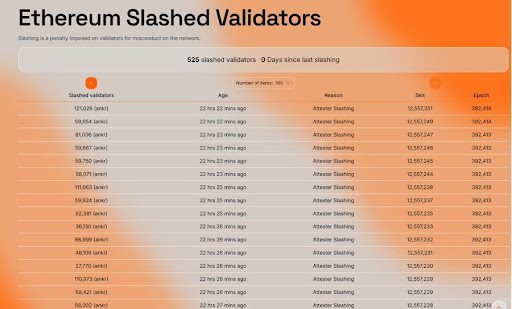
On September 10, a slashing of 11.7 ETH from 39 Ethereum validators highlights the advantages of Cardano’s staking structure. Crypto analyst Dori has highlighted on X the fundamental differences in staking requirements and risks between the two networks. On Ethereum, it is structurally impossible to stake 0.1 ETH directly on ETH, but an individual must stake a minimum of 32 ETH and operate a validator node themselves. 

However, platforms have been built on Ethereum to allow staking with as little as 0.1 ETH, and liquid tokens are issued. The critical difference is that, due to the slashing mechanism, Ethereum’s structure carries the risk of a cascading collapse. This has given rise to platforms like Ankr and Lido Finance, which pool ETH from many users, run validators, and issue liquid staking tokens such as ankrETH and stETH to solve the problem of locked-up funds.
Ethereum

In this incident, an operational mistake by the operators of 39 validators led to a slashing penalty of 11.7 ETH, which is worth approximately $52,000. If a larger slashing event were to occur, it could lead to the de-pegging of the liquid staking tokens, potentially triggering a cascading collapse as DeFi ecosystem protocols built upon them.

On Ethereum, iquid staking platforms were developed to remove obstacles to staking, and liquid tokens were distributed to address the issue of lock-ups. In contrast, Cardana’s staking model allows anyone to stake as little as 10 ADA in a stake pool without worrying about slashing. There are no lock-up periods, and a user’s staked funds are never at risk of being lost, even if their chosen stake pool misbehaves.

Fundamentally Different Approaches To Staking

Cardanians (CRDN) also stated that a critical flaw in Ethereum’s staking model has been exposed, highlighting the fundamental advantages of Cardano’s design. The data shows that the Ethereum staking exit queue has hit an all-time high, forcing users who unstake their ETH to wait an estimated 46 days to get their funds back.

However, Cardano’s ADA staking model offers a fundamentally different experience, with liquid staking and no entry or exit queues. When a user stakes their ADA, the funds remain in their wallet and are always available for use or transfer, and earn rewards without being locked up. “The design is fundamentally better,” the expert noted.

Ethereum
Market Opportunity
RISE Logo
RISE Price(RISE)
$0.006151
$0.006151$0.006151
+2.53%
USD
RISE (RISE) Live Price Chart
Disclaimer: The articles reposted on this site are sourced from public platforms and are provided for informational purposes only. They do not necessarily reflect the views of MEXC. All rights remain with the original authors. If you believe any content infringes on third-party rights, please contact service@support.mexc.com for removal. MEXC makes no guarantees regarding the accuracy, completeness, or timeliness of the content and is not responsible for any actions taken based on the information provided. The content does not constitute financial, legal, or other professional advice, nor should it be considered a recommendation or endorsement by MEXC.

You May Also Like

Aave DAO to Shut Down 50% of L2s While Doubling Down on GHO

Aave DAO to Shut Down 50% of L2s While Doubling Down on GHO

The post Aave DAO to Shut Down 50% of L2s While Doubling Down on GHO appeared on BitcoinEthereumNews.com. Aave DAO is gearing up for a significant overhaul by shutting down over 50% of underperforming L2 instances. It is also restructuring its governance framework and deploying over $100 million to boost GHO. This could be a pivotal moment that propels Aave back to the forefront of on-chain lending or sparks unprecedented controversy within the DeFi community. Sponsored Sponsored ACI Proposes Shutting Down 50% of L2s The “State of the Union” report by the Aave Chan Initiative (ACI) paints a candid picture. After a turbulent period in the DeFi market and internal challenges, Aave (AAVE) now leads in key metrics: TVL, revenue, market share, and borrowing volume. Aave’s annual revenue of $130 million surpasses the combined cash reserves of its competitors. Tokenomics improvements and the AAVE token buyback program have also contributed to the ecosystem’s growth. Aave global metrics. Source: Aave However, the ACI’s report also highlights several pain points. First, regarding the Layer-2 (L2) strategy. While Aave’s L2 strategy was once a key driver of success, it is no longer fit for purpose. Over half of Aave’s instances on L2s and alt-L1s are not economically viable. Based on year-to-date data, over 86.6% of Aave’s revenue comes from the mainnet, indicating that everything else is a side quest. On this basis, ACI proposes closing underperforming networks. The DAO should invest in key networks with significant differentiators. Second, ACI is pushing for a complete overhaul of the “friendly fork” framework, as most have been unimpressive regarding TVL and revenue. In some cases, attackers have exploited them to Aave’s detriment, as seen with Spark. Sponsored Sponsored “The friendly fork model had a good intention but bad execution where the DAO was too friendly towards these forks, allowing the DAO only little upside,” the report states. Third, the instance model, once a smart…
Share
BitcoinEthereumNews2025/09/18 02:28
Academic Publishing and Fairness: A Game-Theoretic Model of Peer-Review Bias

Academic Publishing and Fairness: A Game-Theoretic Model of Peer-Review Bias

Exploring how biases in the peer-review system impact researchers' choices, showing how principles of fairness relate to the production of scientific knowledge based on topic importance and hardness.
Share
Hackernoon2025/09/17 23:15
Why Is Crypto Up Today? – January 14, 2026

Why Is Crypto Up Today? – January 14, 2026

The crypto market is up today, with the cryptocurrency market capitalisation rising by 3.6% to $3.33 trillion. At the time of writing, 95 of the top 100 coins have
Share
CryptoNews2026/01/14 20:04
