

Institutions Are Using XRP As Collateral, Says Ripple Prime CEO
Ripple Prime is pitching XRP not just as a traded asset, but as working collateral inside institutional market structure. In a March 17 interview with Jake Claver, international CEO Mike Higgins said Ripple’s acquisition of Hidden Road, now rebranded as Ripple Prime, is designed to bring prime brokerage, clearing, custody and treasury functions into a single institutional stack.
Higgins framed Ripple Prime as an access layer for firms trading across both traditional and digital markets. The core idea, he said, is that those markets are no longer separate for much longer, and institutions will need balance-sheet access, collateral mobility and cross-margining tools that work across both.
The Role Of XRP Within Ripple Prime
That is where XRP enters the picture. Higgins said Ripple Prime has built “innovative ways around taking XRP as collateral” and using it to finance trades, allowing institutional clients to post digital assets without first liquidating them into dollars. In practice, that means a firm holding XRP can keep the position on its balance sheet while still accessing leverage or liquidity in markets that do not natively accept XRP.
He gave a concrete example using CME futures. “If you wanted to trade futures on the CME, the CME doesn’t take XRP as good collateral,” Higgins said. “Instead of transforming that and selling that into dollars to give to your clearer, what you can do through Ripple Prime is post your XRP as good margin. We give you dollar credit to trade on the CME, and so now you could be long spot, front-month future, capturing the basis trade.”
That comparison was central to his argument. Higgins likened the model to traditional commodity finance, where a bank would lend against oranges, gold or Treasuries rather than require a client to sell the underlying asset first. The difference now is that crypto-native collateral is starting to be recognized inside institutional risk systems. For holders of assets like XRP, he said, that avoids crystallizing profit and loss, preserves treasury positions and opens up additional return strategies.
He also argued that digital collateral has one structural advantage over traditional assets: it can be moved and liquidated around the clock. That matters not only for trading, but for risk management. “When you trade traditional assets, they have an open and a close every day and they have weekends or long periods of holidays,” Higgins said. “What you get the next day are these huge gaps. A smooth 24/7 market where you can move collateral, that velocity of collateral to meet collateral calls shrinks.”
In Higgins’ telling, the institutional case for tokenization is broader than a single asset. He pointed to Treasury operations, tokenized repo, onchain money-market products and, eventually, tokenized equities as part of the same transition. “You already have crypto as an asset class itself. You have stablecoin usage,” he said. “The world is inexorably moving in this direction and the pace of that is increasing now that we’ve already proven out the thesis of using the technologies with crypto.”
Still, he did not suggest a clean handoff from legacy finance to open DeFi. Higgins repeatedly stressed compliance, counterparty transparency and permissioned access as prerequisites for serious institutional adoption.
Public decentralized venues may be winning market share, he said, but large firms still need AML, KYC and balance-sheet visibility before they can deploy capital at scale. That leaves prime brokers in a familiar role: connecting fragmented pools of liquidity while managing credit, margin and settlement across venues.
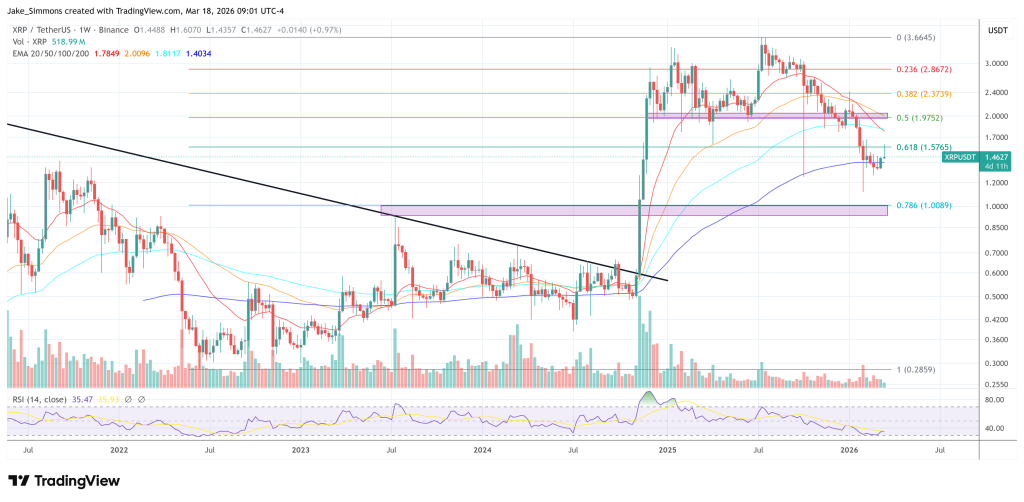
At press time, XRP traded at $1.46.


You May Also Like

Crypto Hack: Drift Protocol Drained Over $200M in Private Key Breach

WTI Crude Oil Climbs Toward $96 as Supply Fears Intensify




