

Canada Seeks Crypto Donation Ban to Block Foreign Interference Risk
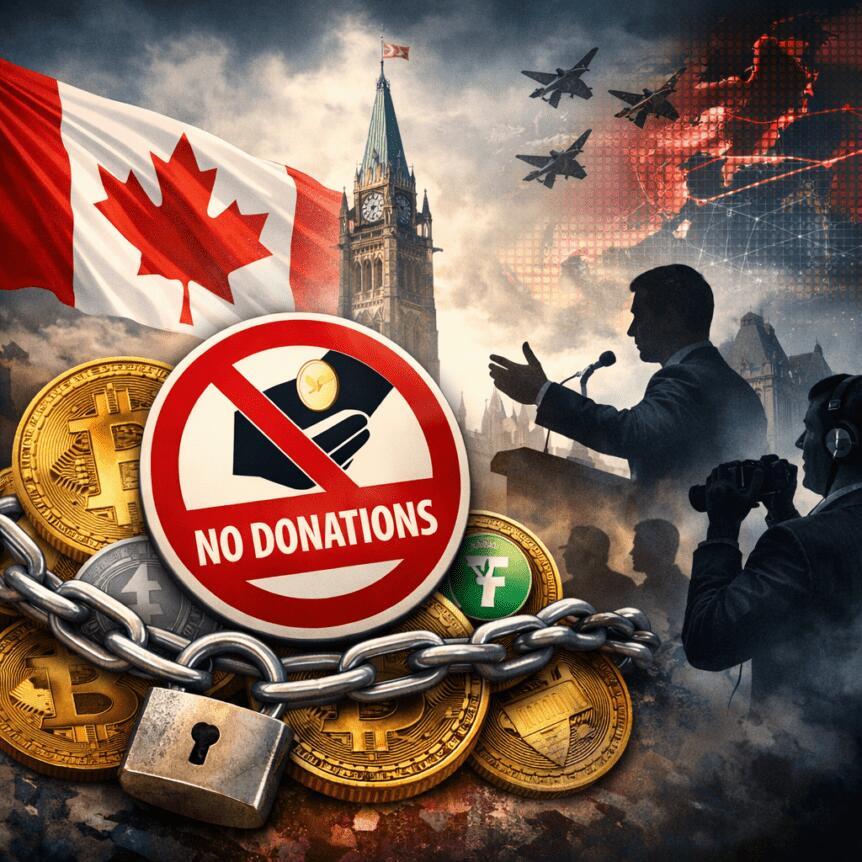
Canada’s federal government has unveiled a broad proposal to outlaw cryptocurrency donations to political parties and related election processes, part of a wider package designed to curb anonymous and hard-to-trace contributions. The Strong and Free Elections Act was introduced on Thursday to amend the Canada Elections Act, preventing parties and third parties involved in elections from accepting crypto, money orders, and prepaid cards as political contributions.
Stepping up the push against foreign interference and other election threats, the bill’s sponsor, Steven MacKinnon, said the measures aim to “block foreign interference and other threats to elections.” He noted that the legislation expands government coordination and investment in countering such risks, with the goal of preserving free, fair, and secure elections at all times.
Key takeaways
- The bill would prohibit political parties and election-process third parties from accepting donations in cryptocurrency, money orders, and prepaid cards, citing anonymity and traceability concerns.
- If enacted, contributions made via any of the banned methods must be returned, destroyed, or delivered to the chief electoral officer, with penalties up to twice the amount contributed plus fixed fines of $25,000 for individuals and $100,000 for corporations.
- Beyond donations, the legislation expands rules to address deepfakes that impersonate electoral candidates, adding an extra layer of protection for voters.
- The move follows a 2024 recommendation from the chief electoral officer to ban crypto political donations outright due to difficulties in identifying contributors.
- Canada has previously experimented with crypto campaign funding rules since 2019, but a similar ban attempt in 2024 stalled in Parliament before dying on the floor of the House of Commons.
What changes with the Strong and Free Elections Act?
The proposed amendments would revise the Canada Elections Act to close a notable loophole around fundraising. Under current practice, crypto donations have been permitted and treated similarly to property donations, a framework that many policymakers now view as insufficient for ensuring transparency. The new provisions would explicitly bar political actors from receiving crypto, money orders, or prepaid cards, tools often highlighted as vehicles for anonymous funding.
Enforcement provisions are designed to be concrete. Any prohibited contribution would need to be returned to the donor, destroyed, or passed to the chief electoral officer for appraisal and disposition. The penalties attached to violations reflect a deterrent approach: up to twice the amount of the contribution, in addition to statutory penalties of up to $25,000 for individuals and $100,000 for corporate entities.
In tandem with the fundraising clampdown, the bill broadens protections against disinformation by extending the prohibition on realistic political deepfakes that could mislead voters ahead of elections. The inclusion of deepfake safeguards reflects a broader concern raised in the lead-up to recent elections elsewhere, emphasizing the growing intersection of technology and electoral integrity.
Context, history, and what comes next
Canada’s stance on crypto political donations has evolved since the practice was permitted in 2019. If enacted, the Strong and Free Elections Act would mark a decisive shift in how digital assets are treated within the political finance framework. The current proposal follows earlier momentum in 2024, when a prior version of the bill—introduced by then-public-safety minister Dominic LeBlanc—failed to advance beyond the second reading in the House of Commons and ultimately died in that session.
Supporters point to the broader regulatory environment around crypto fundraising in other jurisdictions. For instance, the United Kingdom has signaled a similar intent to cap or pause crypto donations in political campaigns, following independent reviews and political pressure. The cross-border dimension underscores a shared concern among Western democracies about the potential for crypto-based contributions to bypass traditional oversight and donor-identification requirements.
Legislation must progress through the standard parliamentary process to become law. After first reading, the bill would require committee scrutiny, a second and third reading in the House of Commons, passage through the Senate, and finally royal assent from the Governor General. As of the introduction, observers will be watching for committee studies, proposed amendments, and any coalition dynamics that shape the bill’s fate in Canada’s Parliament.
For investors and participants in the crypto space, the proposal signals a continued emphasis on regulatory clarity for political fundraising. While the bill targets a narrow channel—donations to parties and election processes—it sits within a broader pattern of tightening controls around crypto-enabled political influence. Market participants should monitor how lawmakers weigh the balance between transparency, donor privacy, and the need to prevent foreign interference as the legislative process unfolds.
As the debate unfolds, readers should watch for updates on parliamentary progress, potential amendments to the scope of prohibited methods, and any alignment or divergence between Canada’s approach and developments in other major democracies. The coming months will clarify whether crypto fundraising becomes a regulated, clearly defined channel or a fully closed one in Canada’s political financing landscape.
This article was originally published as Canada Seeks Crypto Donation Ban to Block Foreign Interference Risk on Crypto Breaking News – your trusted source for crypto news, Bitcoin news, and blockchain updates.


You May Also Like

Metaplanet buys 5,075 Bitcoin in Q1 to become 3rd-largest treasury

The changing face of elder care in Malaysia — Sayed Mohammad Reza Yamani Sayed Umar

Covéa Chooses Shift Technology as Strategic Partner for Fraud and Risk Management



