BitcoinWorld Anti-CBDC Act: U.S. House Debates Crucial Inclusion in Crypto Bill A significant discussion is currently unfolding within the U.S. House of Representatives. Lawmakers are actively considering a proposal to integrate the Anti-CBDC act into a broader, comprehensive digital asset market structure bill. This move could have profound implications for the future of digital currencies in America. This development, initially reported by Cointelegraph, signals a critical juncture for cryptocurrency regulation. If this measure passes, the combined legislation would then advance to the Senate for further deliberation. What is the Anti-CBDC Act and Why is it Crucial? At its core, the Anti-CBDC act aims to prevent the U.S. government from issuing a central bank digital currency (CBDC). A CBDC is essentially a digital form of a country’s fiat currency, issued and backed by its central bank. Proponents of the Anti-CBDC act express significant concerns. They often highlight issues related to privacy, potential government surveillance, and the risk of increased financial control over citizens. The act seeks to safeguard individual financial freedom and limit government overreach in digital transactions. Many believe that a government-issued digital currency could pave the way for a ‘surveillance state,’ where every transaction is monitored. This perspective drives the urgent push for this protective legislation. A Pivotal Moment for Crypto Market Structure The proposed inclusion of the Anti-CBDC act is not happening in isolation. It is being considered as part of a larger digital asset market structure bill. This overarching legislation aims to provide a clear regulatory framework for the entire cryptocurrency industry. Establishing clear rules is vital for the growth and stability of the crypto market. Without proper guidelines, businesses and investors face uncertainty, which can hinder innovation and adoption. The market structure bill intends to address these regulatory gaps. Integrating the Anti-CBDC act into this bill means that the debate over central bank digital currencies is now firmly linked to the broader conversation about how digital assets will be regulated in the U.S. This connection elevates the importance of both legislative efforts. Past Battles and Future Prospects for the Anti-CBDC Act This isn’t the first time Republican lawmakers have attempted to ban the issuance of a central bank digital currency. Previously, they sought to include an anti-CBDC measure during a vote on the GENIUS Act, a stablecoin regulation bill. While that specific attempt did not succeed within the stablecoin bill, the commitment to the cause remained strong. Subsequently, the Anti-CBDC act successfully passed the House as a standalone bill. This earlier success demonstrates significant support for the measure. Now, by attempting to attach it to a broader digital asset bill, lawmakers are looking for a more direct path to enactment. This strategy could increase its chances of becoming law, as it would be part of a larger package deemed essential for the crypto industry. What are the Core Concerns Surrounding CBDCs? The opposition to CBDCs stems from several key concerns: Privacy: Critics fear that a CBDC could eliminate financial privacy, allowing governments to track every transaction. Surveillance: There’s a worry that a CBDC could enable a ‘surveillance state,’ giving authorities unprecedented insight into citizens’ spending habits. Control: Some argue that a CBDC could give governments the power to freeze funds, implement negative interest rates, or even program spending, limiting individual economic freedom. Disintermediation: There are concerns that CBDCs could bypass commercial banks, fundamentally altering the financial system. These points form the bedrock of the arguments in favor of the Anti-CBDC act, emphasizing the need for safeguards against potential governmental overreach. The Road Ahead: From House to Senate If the U.S. House of Representatives successfully incorporates the Anti-CBDC act into the digital asset market structure bill, the journey is far from over. The comprehensive legislation would then be sent to the Senate for its own round of deliberations, debates, and votes. The Senate process can be complex and time-consuming, with potential amendments and further negotiations. The outcome in the Senate is not guaranteed, and strong advocacy from both sides of the CBDC debate is expected. Ultimately, for the Anti-CBDC act to become law as part of this broader bill, it must pass both chambers of Congress and receive presidential assent. This legislative path highlights the critical nature of the current discussions in the House. The ongoing debate in the U.S. House over the inclusion of the Anti-CBDC act in the digital asset market structure bill marks a truly pivotal moment for the future of finance and individual liberties. This legislative effort underscores a growing concern among lawmakers about the potential implications of central bank digital currencies. The outcome of these discussions will not only shape the regulatory landscape for cryptocurrencies but also determine the extent of government involvement in digital money. It’s a debate that touches upon fundamental questions of privacy, control, and the very nature of money in the digital age. Keeping an eye on these developments is essential for anyone interested in the evolving world of digital assets. Frequently Asked Questions (FAQs) Q1: What is a Central Bank Digital Currency (CBDC)? A1: A CBDC is a digital form of a country’s fiat currency, issued and backed by its central bank. Unlike cryptocurrencies like Bitcoin, which are decentralized, a CBDC is centralized and controlled by the government. Q2: What is the primary goal of the Anti-CBDC act? A2: The primary goal of the Anti-CBDC act is to prevent the U.S. government from issuing a central bank digital currency, citing concerns about privacy, surveillance, and potential government control over individual finances. Q3: How does the Anti-CBDC act relate to the broader crypto market structure bill? A3: The Anti-CBDC act is being considered for inclusion in a larger bill designed to establish a comprehensive regulatory framework for digital assets in the U.S. This means the debate over CBDCs is now tied to the overall regulation of the crypto industry. Q4: What are the main concerns opponents have about CBDCs? A4: Opponents primarily worry about the erosion of financial privacy, the potential for government surveillance of transactions, and the risk of governments gaining excessive control over citizens’ spending and financial activities. Q5: What happens if the Anti-CBDC act is included in the market structure bill and passes the House? A5: If included and passed by the House, the combined legislation, including the Anti-CBDC act, would then proceed to the Senate for further deliberation, debate, and a vote before potentially becoming law. Q6: Has the Anti-CBDC act been debated before? A6: Yes, Republican lawmakers previously attempted to include an anti-CBDC measure in a stablecoin regulation bill. The Anti-CBDC act also passed the House as a standalone bill prior to this current consideration. If you found this article informative and believe in the importance of understanding legislative actions impacting digital currencies, please share it with your friends and on your social media platforms. Your support helps spread awareness and encourages a broader conversation about the future of finance. To learn more about the latest crypto market trends, explore our article on key developments shaping digital asset institutional adoption. This post Anti-CBDC Act: U.S. House Debates Crucial Inclusion in Crypto Bill first appeared on BitcoinWorld.BitcoinWorld Anti-CBDC Act: U.S. House Debates Crucial Inclusion in Crypto Bill A significant discussion is currently unfolding within the U.S. House of Representatives. Lawmakers are actively considering a proposal to integrate the Anti-CBDC act into a broader, comprehensive digital asset market structure bill. This move could have profound implications for the future of digital currencies in America. This development, initially reported by Cointelegraph, signals a critical juncture for cryptocurrency regulation. If this measure passes, the combined legislation would then advance to the Senate for further deliberation. What is the Anti-CBDC Act and Why is it Crucial? At its core, the Anti-CBDC act aims to prevent the U.S. government from issuing a central bank digital currency (CBDC). A CBDC is essentially a digital form of a country’s fiat currency, issued and backed by its central bank. Proponents of the Anti-CBDC act express significant concerns. They often highlight issues related to privacy, potential government surveillance, and the risk of increased financial control over citizens. The act seeks to safeguard individual financial freedom and limit government overreach in digital transactions. Many believe that a government-issued digital currency could pave the way for a ‘surveillance state,’ where every transaction is monitored. This perspective drives the urgent push for this protective legislation. A Pivotal Moment for Crypto Market Structure The proposed inclusion of the Anti-CBDC act is not happening in isolation. It is being considered as part of a larger digital asset market structure bill. This overarching legislation aims to provide a clear regulatory framework for the entire cryptocurrency industry. Establishing clear rules is vital for the growth and stability of the crypto market. Without proper guidelines, businesses and investors face uncertainty, which can hinder innovation and adoption. The market structure bill intends to address these regulatory gaps. Integrating the Anti-CBDC act into this bill means that the debate over central bank digital currencies is now firmly linked to the broader conversation about how digital assets will be regulated in the U.S. This connection elevates the importance of both legislative efforts. Past Battles and Future Prospects for the Anti-CBDC Act This isn’t the first time Republican lawmakers have attempted to ban the issuance of a central bank digital currency. Previously, they sought to include an anti-CBDC measure during a vote on the GENIUS Act, a stablecoin regulation bill. While that specific attempt did not succeed within the stablecoin bill, the commitment to the cause remained strong. Subsequently, the Anti-CBDC act successfully passed the House as a standalone bill. This earlier success demonstrates significant support for the measure. Now, by attempting to attach it to a broader digital asset bill, lawmakers are looking for a more direct path to enactment. This strategy could increase its chances of becoming law, as it would be part of a larger package deemed essential for the crypto industry. What are the Core Concerns Surrounding CBDCs? The opposition to CBDCs stems from several key concerns: Privacy: Critics fear that a CBDC could eliminate financial privacy, allowing governments to track every transaction. Surveillance: There’s a worry that a CBDC could enable a ‘surveillance state,’ giving authorities unprecedented insight into citizens’ spending habits. Control: Some argue that a CBDC could give governments the power to freeze funds, implement negative interest rates, or even program spending, limiting individual economic freedom. Disintermediation: There are concerns that CBDCs could bypass commercial banks, fundamentally altering the financial system. These points form the bedrock of the arguments in favor of the Anti-CBDC act, emphasizing the need for safeguards against potential governmental overreach. The Road Ahead: From House to Senate If the U.S. House of Representatives successfully incorporates the Anti-CBDC act into the digital asset market structure bill, the journey is far from over. The comprehensive legislation would then be sent to the Senate for its own round of deliberations, debates, and votes. The Senate process can be complex and time-consuming, with potential amendments and further negotiations. The outcome in the Senate is not guaranteed, and strong advocacy from both sides of the CBDC debate is expected. Ultimately, for the Anti-CBDC act to become law as part of this broader bill, it must pass both chambers of Congress and receive presidential assent. This legislative path highlights the critical nature of the current discussions in the House. The ongoing debate in the U.S. House over the inclusion of the Anti-CBDC act in the digital asset market structure bill marks a truly pivotal moment for the future of finance and individual liberties. This legislative effort underscores a growing concern among lawmakers about the potential implications of central bank digital currencies. The outcome of these discussions will not only shape the regulatory landscape for cryptocurrencies but also determine the extent of government involvement in digital money. It’s a debate that touches upon fundamental questions of privacy, control, and the very nature of money in the digital age. Keeping an eye on these developments is essential for anyone interested in the evolving world of digital assets. Frequently Asked Questions (FAQs) Q1: What is a Central Bank Digital Currency (CBDC)? A1: A CBDC is a digital form of a country’s fiat currency, issued and backed by its central bank. Unlike cryptocurrencies like Bitcoin, which are decentralized, a CBDC is centralized and controlled by the government. Q2: What is the primary goal of the Anti-CBDC act? A2: The primary goal of the Anti-CBDC act is to prevent the U.S. government from issuing a central bank digital currency, citing concerns about privacy, surveillance, and potential government control over individual finances. Q3: How does the Anti-CBDC act relate to the broader crypto market structure bill? A3: The Anti-CBDC act is being considered for inclusion in a larger bill designed to establish a comprehensive regulatory framework for digital assets in the U.S. This means the debate over CBDCs is now tied to the overall regulation of the crypto industry. Q4: What are the main concerns opponents have about CBDCs? A4: Opponents primarily worry about the erosion of financial privacy, the potential for government surveillance of transactions, and the risk of governments gaining excessive control over citizens’ spending and financial activities. Q5: What happens if the Anti-CBDC act is included in the market structure bill and passes the House? A5: If included and passed by the House, the combined legislation, including the Anti-CBDC act, would then proceed to the Senate for further deliberation, debate, and a vote before potentially becoming law. Q6: Has the Anti-CBDC act been debated before? A6: Yes, Republican lawmakers previously attempted to include an anti-CBDC measure in a stablecoin regulation bill. The Anti-CBDC act also passed the House as a standalone bill prior to this current consideration. If you found this article informative and believe in the importance of understanding legislative actions impacting digital currencies, please share it with your friends and on your social media platforms. Your support helps spread awareness and encourages a broader conversation about the future of finance. To learn more about the latest crypto market trends, explore our article on key developments shaping digital asset institutional adoption. This post Anti-CBDC Act: U.S. House Debates Crucial Inclusion in Crypto Bill first appeared on BitcoinWorld.

Anti-CBDC Act: U.S. House Debates Crucial Inclusion in Crypto Bill

BitcoinWorld
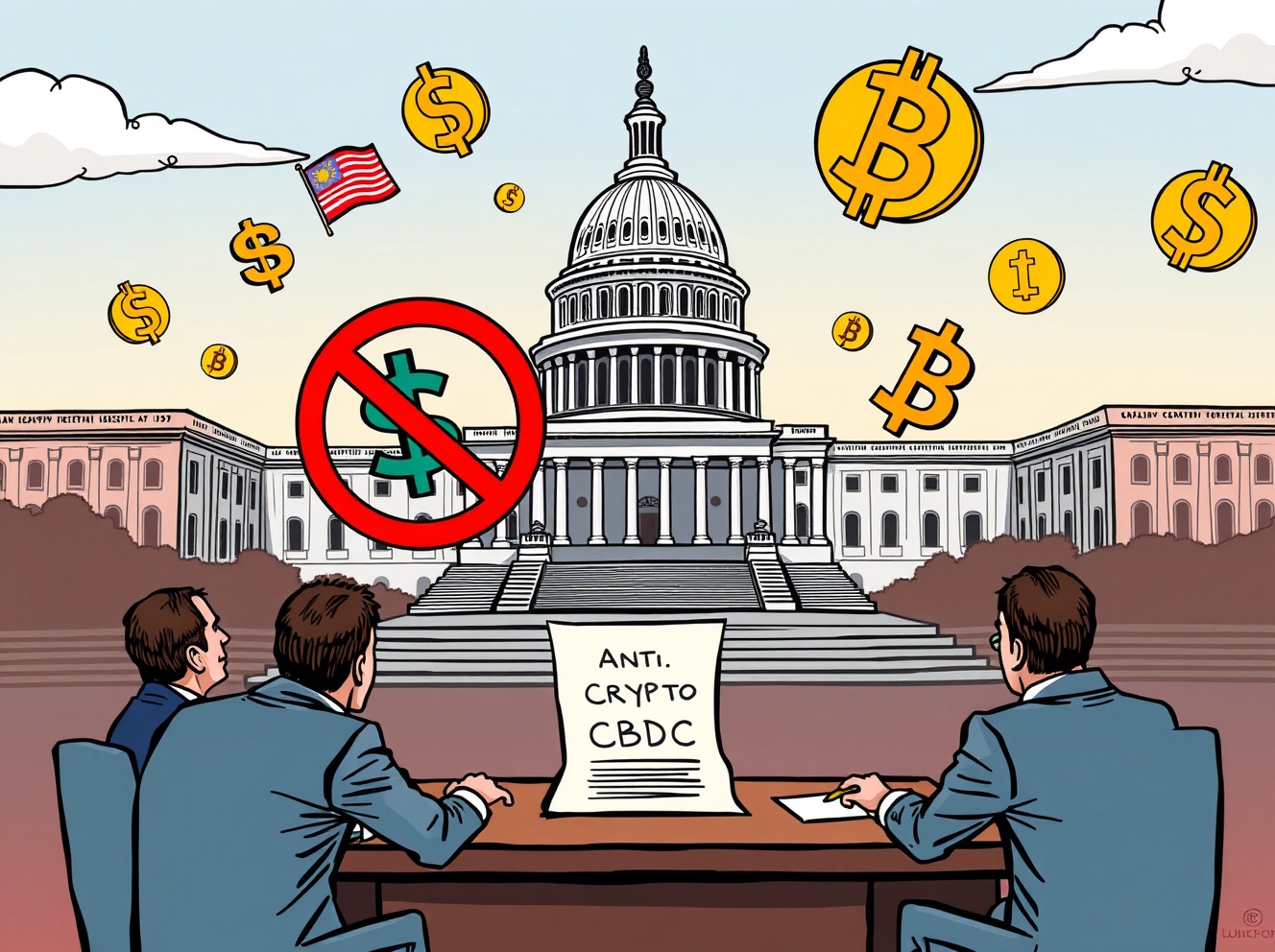
Anti-CBDC Act: U.S. House Debates Crucial Inclusion in Crypto Bill

A significant discussion is currently unfolding within the U.S. House of Representatives. Lawmakers are actively considering a proposal to integrate the Anti-CBDC act into a broader, comprehensive digital asset market structure bill. This move could have profound implications for the future of digital currencies in America.

This development, initially reported by Cointelegraph, signals a critical juncture for cryptocurrency regulation. If this measure passes, the combined legislation would then advance to the Senate for further deliberation.

What is the Anti-CBDC Act and Why is it Crucial?

At its core, the Anti-CBDC act aims to prevent the U.S. government from issuing a central bank digital currency (CBDC). A CBDC is essentially a digital form of a country’s fiat currency, issued and backed by its central bank.

Proponents of the Anti-CBDC act express significant concerns. They often highlight issues related to privacy, potential government surveillance, and the risk of increased financial control over citizens. The act seeks to safeguard individual financial freedom and limit government overreach in digital transactions.

Many believe that a government-issued digital currency could pave the way for a ‘surveillance state,’ where every transaction is monitored. This perspective drives the urgent push for this protective legislation.

A Pivotal Moment for Crypto Market Structure

The proposed inclusion of the Anti-CBDC act is not happening in isolation. It is being considered as part of a larger digital asset market structure bill. This overarching legislation aims to provide a clear regulatory framework for the entire cryptocurrency industry.

Establishing clear rules is vital for the growth and stability of the crypto market. Without proper guidelines, businesses and investors face uncertainty, which can hinder innovation and adoption. The market structure bill intends to address these regulatory gaps.

Integrating the Anti-CBDC act into this bill means that the debate over central bank digital currencies is now firmly linked to the broader conversation about how digital assets will be regulated in the U.S. This connection elevates the importance of both legislative efforts.

Past Battles and Future Prospects for the Anti-CBDC Act

This isn’t the first time Republican lawmakers have attempted to ban the issuance of a central bank digital currency. Previously, they sought to include an anti-CBDC measure during a vote on the GENIUS Act, a stablecoin regulation bill.

While that specific attempt did not succeed within the stablecoin bill, the commitment to the cause remained strong. Subsequently, the Anti-CBDC act successfully passed the House as a standalone bill. This earlier success demonstrates significant support for the measure.

Now, by attempting to attach it to a broader digital asset bill, lawmakers are looking for a more direct path to enactment. This strategy could increase its chances of becoming law, as it would be part of a larger package deemed essential for the crypto industry.

What are the Core Concerns Surrounding CBDCs?

The opposition to CBDCs stems from several key concerns:

  • Privacy: Critics fear that a CBDC could eliminate financial privacy, allowing governments to track every transaction.
  • Surveillance: There’s a worry that a CBDC could enable a ‘surveillance state,’ giving authorities unprecedented insight into citizens’ spending habits.
  • Control: Some argue that a CBDC could give governments the power to freeze funds, implement negative interest rates, or even program spending, limiting individual economic freedom.
  • Disintermediation: There are concerns that CBDCs could bypass commercial banks, fundamentally altering the financial system.

These points form the bedrock of the arguments in favor of the Anti-CBDC act, emphasizing the need for safeguards against potential governmental overreach.

The Road Ahead: From House to Senate

If the U.S. House of Representatives successfully incorporates the Anti-CBDC act into the digital asset market structure bill, the journey is far from over. The comprehensive legislation would then be sent to the Senate for its own round of deliberations, debates, and votes.

The Senate process can be complex and time-consuming, with potential amendments and further negotiations. The outcome in the Senate is not guaranteed, and strong advocacy from both sides of the CBDC debate is expected.

Ultimately, for the Anti-CBDC act to become law as part of this broader bill, it must pass both chambers of Congress and receive presidential assent. This legislative path highlights the critical nature of the current discussions in the House.

The ongoing debate in the U.S. House over the inclusion of the Anti-CBDC act in the digital asset market structure bill marks a truly pivotal moment for the future of finance and individual liberties. This legislative effort underscores a growing concern among lawmakers about the potential implications of central bank digital currencies.

The outcome of these discussions will not only shape the regulatory landscape for cryptocurrencies but also determine the extent of government involvement in digital money. It’s a debate that touches upon fundamental questions of privacy, control, and the very nature of money in the digital age. Keeping an eye on these developments is essential for anyone interested in the evolving world of digital assets.

Frequently Asked Questions (FAQs)

Q1: What is a Central Bank Digital Currency (CBDC)?
A1: A CBDC is a digital form of a country’s fiat currency, issued and backed by its central bank. Unlike cryptocurrencies like Bitcoin, which are decentralized, a CBDC is centralized and controlled by the government.

Q2: What is the primary goal of the Anti-CBDC act?
A2: The primary goal of the Anti-CBDC act is to prevent the U.S. government from issuing a central bank digital currency, citing concerns about privacy, surveillance, and potential government control over individual finances.

Q3: How does the Anti-CBDC act relate to the broader crypto market structure bill?
A3: The Anti-CBDC act is being considered for inclusion in a larger bill designed to establish a comprehensive regulatory framework for digital assets in the U.S. This means the debate over CBDCs is now tied to the overall regulation of the crypto industry.

Q4: What are the main concerns opponents have about CBDCs?
A4: Opponents primarily worry about the erosion of financial privacy, the potential for government surveillance of transactions, and the risk of governments gaining excessive control over citizens’ spending and financial activities.

Q5: What happens if the Anti-CBDC act is included in the market structure bill and passes the House?
A5: If included and passed by the House, the combined legislation, including the Anti-CBDC act, would then proceed to the Senate for further deliberation, debate, and a vote before potentially becoming law.

Q6: Has the Anti-CBDC act been debated before?
A6: Yes, Republican lawmakers previously attempted to include an anti-CBDC measure in a stablecoin regulation bill. The Anti-CBDC act also passed the House as a standalone bill prior to this current consideration.

If you found this article informative and believe in the importance of understanding legislative actions impacting digital currencies, please share it with your friends and on your social media platforms. Your support helps spread awareness and encourages a broader conversation about the future of finance.

To learn more about the latest crypto market trends, explore our article on key developments shaping digital asset institutional adoption.

This post Anti-CBDC Act: U.S. House Debates Crucial Inclusion in Crypto Bill first appeared on BitcoinWorld.


Market Opportunity
Threshold Logo
Threshold Price(T)
$0.009307
$0.009307$0.009307
-0.74%
USD
Threshold (T) Live Price Chart
Disclaimer: The articles reposted on this site are sourced from public platforms and are provided for informational purposes only. They do not necessarily reflect the views of MEXC. All rights remain with the original authors. If you believe any content infringes on third-party rights, please contact service@support.mexc.com for removal. MEXC makes no guarantees regarding the accuracy, completeness, or timeliness of the content and is not responsible for any actions taken based on the information provided. The content does not constitute financial, legal, or other professional advice, nor should it be considered a recommendation or endorsement by MEXC.

You May Also Like

CEO Sandeep Nailwal Shared Highlights About RWA on Polygon

CEO Sandeep Nailwal Shared Highlights About RWA on Polygon

The post CEO Sandeep Nailwal Shared Highlights About RWA on Polygon appeared on BitcoinEthereumNews.com. Polygon CEO Sandeep Nailwal highlighted Polygon’s lead in global bonds, Spiko US T-Bill, and Spiko Euro T-Bill. Polygon published an X post to share that its roadmap to GigaGas was still scaling. Sentiments around POL price were last seen to be bearish. Polygon CEO Sandeep Nailwal shared key pointers from the Dune and RWA.xyz report. These pertain to highlights about RWA on Polygon. Simultaneously, Polygon underlined its roadmap towards GigaGas. Sentiments around POL price were last seen fumbling under bearish emotions. Polygon CEO Sandeep Nailwal on Polygon RWA CEO Sandeep Nailwal highlighted three key points from the Dune and RWA.xyz report. The Chief Executive of Polygon maintained that Polygon PoS was hosting RWA TVL worth $1.13 billion across 269 assets plus 2,900 holders. Nailwal confirmed from the report that RWA was happening on Polygon. The Dune and https://t.co/W6WSFlHoQF report on RWA is out and it shows that RWA is happening on Polygon. Here are a few highlights: – Leading in Global Bonds: Polygon holds 62% share of tokenized global bonds (driven by Spiko’s euro MMF and Cashlink euro issues) – Spiko U.S.… — Sandeep | CEO, Polygon Foundation (※,※) (@sandeepnailwal) September 17, 2025 The X post published by Polygon CEO Sandeep Nailwal underlined that the ecosystem was leading in global bonds by holding a 62% share of tokenized global bonds. He further highlighted that Polygon was leading with Spiko US T-Bill at approximately 29% share of TVL along with Ethereum, adding that the ecosystem had more than 50% share in the number of holders. Finally, Sandeep highlighted from the report that there was a strong adoption for Spiko Euro T-Bill with 38% share of TVL. He added that 68% of returns were on Polygon across all the chains. Polygon Roadmap to GigaGas In a different update from Polygon, the community…
Share
BitcoinEthereumNews2025/09/18 01:10
Qatar wealth fund commits $25bn to Goldman investments

Qatar wealth fund commits $25bn to Goldman investments

The Qatar Investment Authority (QIA) has signed a preliminary agreement with Goldman Sachs, committing $25 billion in investments to US managed funds and co-investment
Share
Agbi2026/01/21 13:38
Positive view remains intact above 185.00, with bullish RSI momentum

Positive view remains intact above 185.00, with bullish RSI momentum

The post Positive view remains intact above 185.00, with bullish RSI momentum appeared on BitcoinEthereumNews.com. The EUR/JPY cross loses ground near 185.25 during
Share
BitcoinEthereumNews2026/01/21 13:24