Four days ago, Bitcoin’s hashrate hit an all-time high of 976 exahash per second (EH/s), but it has since cooled, settling in the 900 EH/s range. Mining Metrics Flash Mixed Signals as Block Times Stretch to 11:04 On Aug. 8, 2025, the network’s computing power reached a whopping 976 EH/s based on the seven-day simple […]Four days ago, Bitcoin’s hashrate hit an all-time high of 976 exahash per second (EH/s), but it has since cooled, settling in the 900 EH/s range. Mining Metrics Flash Mixed Signals as Block Times Stretch to 11:04 On Aug. 8, 2025, the network’s computing power reached a whopping 976 EH/s based on the seven-day simple […]

Bitcoin Hashrate Cools After Record as Difficulty Bites

2025/08/13 02:27

Four days ago, Bitcoin’s hashrate hit an all-time high of 976 exahash per second (EH/s), but it has since cooled, settling in the 900 EH/s range.

Mining Metrics Flash Mixed Signals as Block Times Stretch to 11:04

On Aug. 8, 2025, the network’s computing power reached a whopping 976 EH/s based on the seven-day simple moving average (SMA). As of today, the hashrate sits near 900 EH/s—down 76 EH/s over four days—coinciding with a 1.42% difficulty increase at block height 909216. Notably, the estimated revenue for 1 petahash per second (PH/s) of SHA256 output is higher.
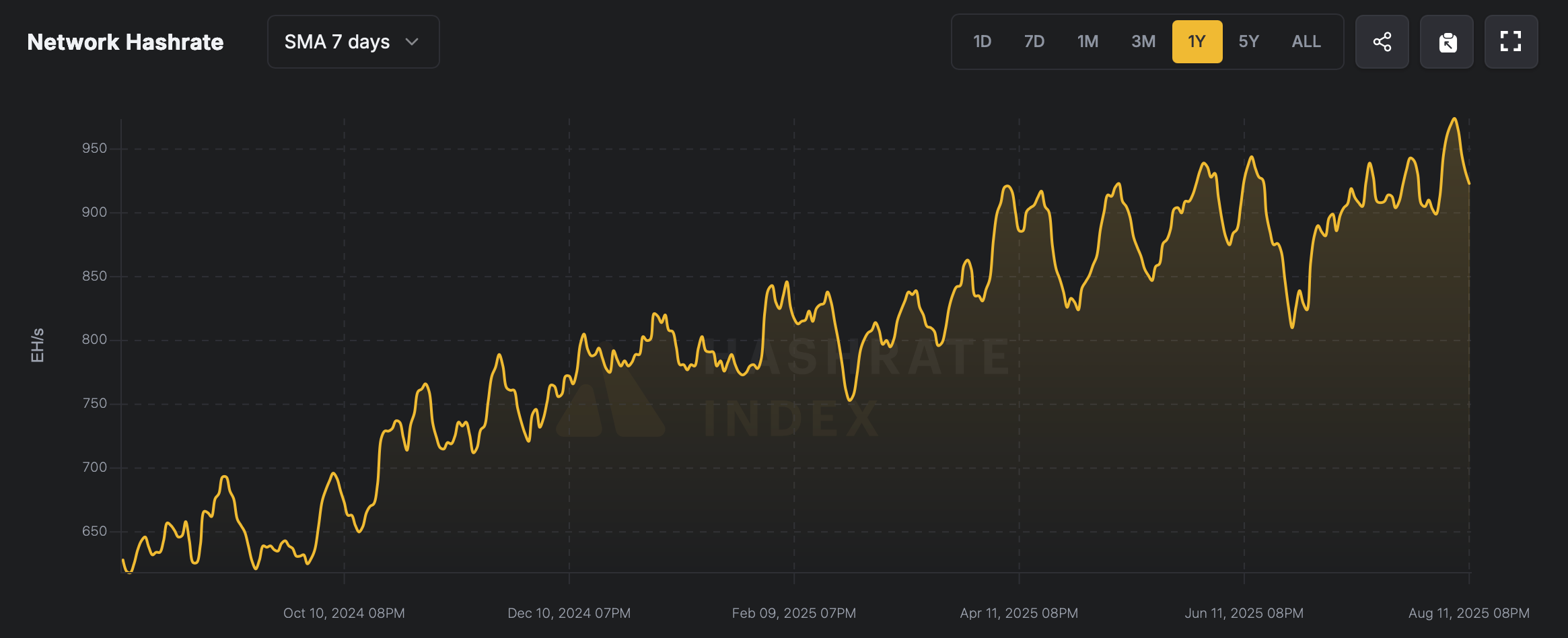
Bitcoin Hashrate Cools After Record as Difficulty BitesBitcoin total hashrate using the seven-day SMA and one-year timeframe via hashrateindex.com stats.

At that time, the estimated hashprice was $57.30 per PH/s, and today it’s 2.55% higher at $58.76, according to hashrateindex.com stats. Yesterday, as BTC pushed past the $120,000 range, the hashprice climbed to $59.78 per petahash. The current revenue remains 4.72% below its July 14 mark, when the hashprice reached $61.67. The increase in network difficulty appears to be the culprit pushing the hashrate lower.
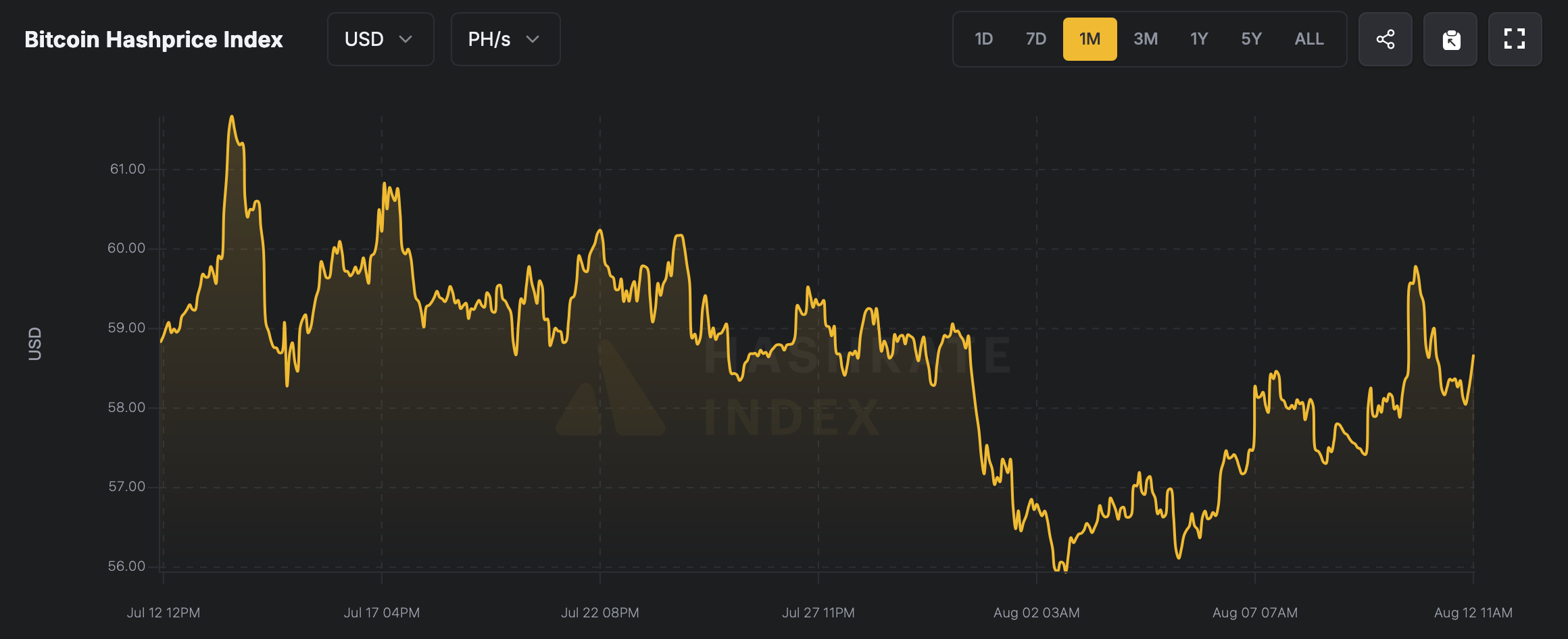
Bitcoin Hashrate Cools After Record as Difficulty BitesBitcoin hashprice over the last 30 days via hashrateindex.com.

With a lower hashrate, block intervals are running slower than the 10-minute target. As of 1:20 p.m. Eastern on Tuesday afternoon, the average block time is 11 minutes, 4 seconds. Slower intervals could set up a downward adjustment at the next difficulty retarget on Aug. 24, 2025. With more than 1,500 blocks left and projections subject to change, an estimated 9.64% cut to mining difficulty is on the table, at least for now.

A softer difficulty setting would ease pressure and could entice sidelined rigs back online, stabilizing block cadence. If price momentum holds, rising unit revenue could offset weaker output and steady participation; if it fades, consolidation among operators may quicken. Currently, the five leading mining pools by blocks mined are Foundry, Antpool, Viabtc, F2pool, and Spider Pool. Combined, the collection of entities control 78.39% of the total hashrate.

Disclaimer: The articles reposted on this site are sourced from public platforms and are provided for informational purposes only. They do not necessarily reflect the views of MEXC. All rights remain with the original authors. If you believe any content infringes on third-party rights, please contact service@support.mexc.com for removal. MEXC makes no guarantees regarding the accuracy, completeness, or timeliness of the content and is not responsible for any actions taken based on the information provided. The content does not constitute financial, legal, or other professional advice, nor should it be considered a recommendation or endorsement by MEXC.

You May Also Like

CME Group to launch options on XRP and SOL futures

CME Group to launch options on XRP and SOL futures

The post CME Group to launch options on XRP and SOL futures appeared on BitcoinEthereumNews.com. CME Group will offer options based on the derivative markets on Solana (SOL) and XRP. The new markets will open on October 13, after regulatory approval.  CME Group will expand its crypto products with options on the futures markets of Solana (SOL) and XRP. The futures market will start on October 13, after regulatory review and approval.  The options will allow the trading of MicroSol, XRP, and MicroXRP futures, with expiry dates available every business day, monthly, and quarterly. The new products will be added to the existing BTC and ETH options markets. ‘The launch of these options contracts builds on the significant growth and increasing liquidity we have seen across our suite of Solana and XRP futures,’ said Giovanni Vicioso, CME Group Global Head of Cryptocurrency Products. The options contracts will have two main sizes, tracking the futures contracts. The new market will be suitable for sophisticated institutional traders, as well as active individual traders. The addition of options markets singles out XRP and SOL as liquid enough to offer the potential to bet on a market direction.  The options on futures arrive a few months after the launch of SOL futures. Both SOL and XRP had peak volumes in August, though XRP activity has slowed down in September. XRP and SOL options to tap both institutions and active traders Crypto options are one of the indicators of market attitudes, with XRP and SOL receiving a new way to gauge sentiment. The contracts will be supported by the Cumberland team.  ‘As one of the biggest liquidity providers in the ecosystem, the Cumberland team is excited to support CME Group’s continued expansion of crypto offerings,’ said Roman Makarov, Head of Cumberland Options Trading at DRW. ‘The launch of options on Solana and XRP futures is the latest example of the…
Share
BitcoinEthereumNews2025/09/18 00:56