Ethereum co-founder Vitalik Buterin framed the network’s next scaling step as both audacious and tightly risk-controlled, saying “Fusaka will fix this” while underscoring that “safety first is of the utmost importance.” In a detailed post, Buterin described Fusaka’s core feature—PeerDAS—as “trying to do something pretty unprecedented: have a live blockchain that does not require any […]Ethereum co-founder Vitalik Buterin framed the network’s next scaling step as both audacious and tightly risk-controlled, saying “Fusaka will fix this” while underscoring that “safety first is of the utmost importance.” In a detailed post, Buterin described Fusaka’s core feature—PeerDAS—as “trying to do something pretty unprecedented: have a live blockchain that does not require any […]

Buterin Teases Most Radical Ethereum Shift Yet: ‘Fusaka Will Fix This’

Ethereum co-founder Vitalik Buterin framed the network’s next scaling step as both audacious and tightly risk-controlled, saying “Fusaka will fix this” while underscoring that “safety first is of the utmost importance.” In a detailed post, Buterin described Fusaka’s core feature—PeerDAS—as “trying to do something pretty unprecedented: have a live blockchain that does not require any single node to download the full data.”

He added that PeerDAS relies on probabilistic sampling of data “chunks,” and, if more than half of those chunks are available, nodes can retrieve them and reconstruct the remainder via erasure coding. “This is all new technology, and the core devs are wise to be super cautious on testing,” Buterin wrote, noting that blob supply will ramp “conservatively at first,” then more aggressively if conditions permit.

Buterin Calls Fusaka the Key To Ethereum L2 Scaling

Buterin’s remarks arrive just as Ethereum’s new blob market shows signs of strain. Head of Data at Dragonfly Hildebert Moulié reported that the chain “hit 6 blobs/block for the first time,” attributing the recent surge primarily to rollups and projects including Base and Worldcoin. According to the same thread, Base submitted roughly 35% of blobs and used about 42% of blobspace, with Worldcoin contributing around 20% of submissions and 25% of usage; Arbitrum, OP Mainnet, Soneium, Scroll and others comprised most of the remainder.

The analyst added that L2s now account for about $200,000 per week in mainnet fees for submissions, validators require more than 70 GB of storage for blobs (over 1.2 TB if unpruned), and that many blobs are not fully utilized—particularly on smaller rollups posting more frequently than they can fill 128 KB payloads. The first sustained base-fee spike since the Pectra hard fork was also observed, although hildobby cautioned that “blob price discovery” still requires a more prolonged saturation of demand.

PeerDAS is the architectural response. Buterin explained that each node requests only a small number of chunks to verify that over half of the data is available; if so, the node “theoretically can download those chunks, and use erasure coding to recover the rest.”

In its initial incarnation, two non-custodial roles still require full-block data to exist somewhere on the network—initial broadcast and emergency reconstruction when a publisher reveals only a fraction of a block—though “we only need one honest actor” for those tasks, and future “cell-level messaging and distributed block building will allow even these two functions to be distributed.” The endgame, he suggested, is to unlock sustained L2 scaling and, as L1 block gas limits rise, to eventually route more L1 execution data into blobs as well.

This pivot lands amid a rapidly evolving blob marketplace. After Pectra, Ethereum increased the blob target and maximum per block, expanding daily data capacity and paving the way for higher throughput from rollups; research desks have linked that shift to a complex interaction between L1 base fees, blob fees, and L2 submission behavior.

The Fusaka timetable adds urgency. Core developers have signaled a mainnet activation for December 3, 2025, following staged testnet rollouts, placing Buterin’s “safety first” emphasis in clear relief. PeerDAS will debut under strict limits, with blob counts increased “conservatively at first,” a posture designed to avoid fee whiplash and to observe how diverse L2s actually consume the added capacity.

Outside the protocol notes, empirical work is accumulating around how networks might use blobspace more efficiently. A 2024 study on “blob sharing” argued that smaller rollups frequently under-fill blobs and could cut posting costs by more than 85% by cooperatively packing data into shared blobs, smoothing the base fee and lowering the total number of blobs submitted.

Ethereum researchers have since expanded that argument, modeling how sharing reduces blocks with more than the target number of blobs and thereby dampens the exponential blob-fee adjustments that kick in when usage overshoots targets. Those findings dovetail with Moulié’s observation that “many blobs aren’t full,” implying large savings are available through better coordination as the market matures.

The conceptual roots of PeerDAS stretch back through Ethereum research notes on data-availability sampling and Buterin’s own writings on “The Surge.” PeerDAS itself implements one-dimensional sampling with erasure coding and succinct per-cell proofs, enabling nodes to validate availability without naively downloading everything. That’s what makes the approach “pretty unprecedented” in a live, high-value blockchain: it seeks to reconcile decentralization and throughput by reducing per-node bandwidth and storage requirements while preserving strong guarantees that data actually exists.

Still, the shift is not without risks. Buterin’s insistence on a careful rollout reflects the reality that Ethereum’s blob economy is young, volatile, and sensitive to sudden changes in demand. As L2s jostle for capacity, fee dynamics can invert quickly, and incomplete blobs, spiky usage, and MEV side effects complicate forecasting. The promise of Fusaka is that PeerDAS can bend those dynamics toward sustainable growth by letting the network scale data availability without forcing any single node to shoulder the whole chain—and by doing so in a way that keeps security assumptions explicit and testable.

At press time, ETH traded at $4,028.
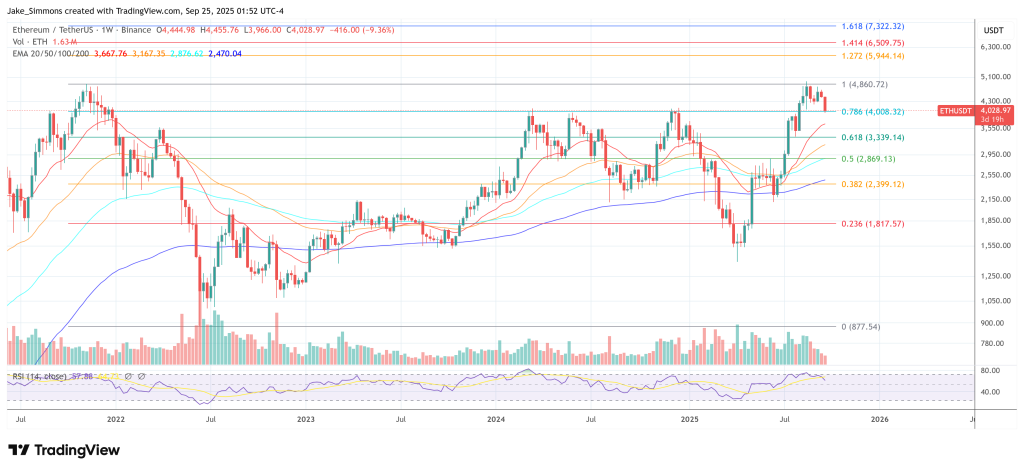
Ethereum price
Market Opportunity
Core DAO Logo
Core DAO Price(CORE)
$0.1156
$0.1156$0.1156
+2.03%
USD
Core DAO (CORE) Live Price Chart
Disclaimer: The articles reposted on this site are sourced from public platforms and are provided for informational purposes only. They do not necessarily reflect the views of MEXC. All rights remain with the original authors. If you believe any content infringes on third-party rights, please contact service@support.mexc.com for removal. MEXC makes no guarantees regarding the accuracy, completeness, or timeliness of the content and is not responsible for any actions taken based on the information provided. The content does not constitute financial, legal, or other professional advice, nor should it be considered a recommendation or endorsement by MEXC.

You May Also Like

Crucial US Stock Market Update: What Wednesday’s Mixed Close Reveals

Crucial US Stock Market Update: What Wednesday’s Mixed Close Reveals

BitcoinWorld Crucial US Stock Market Update: What Wednesday’s Mixed Close Reveals The financial world often keeps us on our toes, and Wednesday was no exception. Investors watched closely as the US stock market concluded the day with a mixed performance across its major indexes. This snapshot offers a crucial glimpse into current investor sentiment and economic undercurrents, prompting many to ask: what exactly happened? Understanding the Latest US Stock Market Movements On Wednesday, the closing bell brought a varied picture for the US stock market. While some indexes celebrated gains, others registered slight declines, creating a truly mixed bag for investors. The Dow Jones Industrial Average showed resilience, climbing by a notable 0.57%. This positive movement suggests strength in some of the larger, more established companies. Conversely, the S&P 500, a broader benchmark often seen as a barometer for the overall market, experienced a modest dip of 0.1%. The technology-heavy Nasdaq Composite also saw a slight retreat, sliding by 0.33%. This particular index often reflects investor sentiment towards growth stocks and the tech sector. These divergent outcomes highlight the complex dynamics currently at play within the American economy. It’s not simply a matter of “up” or “down” for the entire US stock market; rather, it’s a nuanced landscape where different sectors and company types are responding to unique pressures and opportunities. Why Did the US Stock Market See Mixed Results? When the US stock market delivers a mixed performance, it often points to a tug-of-war between various economic factors. Several elements could have contributed to Wednesday’s varied closings. For instance, positive corporate earnings reports from certain industries might have bolstered the Dow. At the same time, concerns over inflation, interest rate policies by the Federal Reserve, or even global economic uncertainties could have pressured growth stocks, affecting the S&P 500 and Nasdaq. Key considerations often include: Economic Data: Recent reports on employment, manufacturing, or consumer spending can sway market sentiment. Corporate Announcements: Strong or weak earnings forecasts from influential companies can significantly impact their respective sectors. Interest Rate Expectations: The prospect of higher or lower interest rates directly influences borrowing costs for businesses and consumer spending, affecting future profitability. Geopolitical Events: Global tensions or trade policies can introduce uncertainty, causing investors to become more cautious. Understanding these underlying drivers is crucial for anyone trying to make sense of daily market fluctuations in the US stock market. Navigating Volatility in the US Stock Market A mixed close, while not a dramatic downturn, serves as a reminder that market volatility is a constant companion for investors. For those involved in the US stock market, particularly individuals managing their portfolios, these days underscore the importance of a well-thought-out strategy. It’s important not to react impulsively to daily movements. Instead, consider these actionable insights: Diversification: Spreading investments across different sectors and asset classes can help mitigate risk when one area underperforms. Long-Term Perspective: Focusing on long-term financial goals rather than short-term gains can help weather daily market swings. Stay Informed: Keeping abreast of economic news and company fundamentals provides context for market behavior. Consult Experts: Financial advisors can offer personalized guidance based on individual risk tolerance and objectives. Even small movements in major indexes can signal shifts that require attention, guiding future investment decisions within the dynamic US stock market. What’s Next for the US Stock Market? Looking ahead, investors will be keenly watching for further economic indicators and corporate announcements to gauge the direction of the US stock market. Upcoming inflation data, statements from the Federal Reserve, and quarterly earnings reports will likely provide more clarity. The interplay of these factors will continue to shape investor confidence and, consequently, the performance of the Dow, S&P 500, and Nasdaq. Remaining informed and adaptive will be key to understanding the market’s trajectory. Conclusion: Wednesday’s mixed close in the US stock market highlights the intricate balance of forces influencing financial markets. While the Dow showed strength, the S&P 500 and Nasdaq experienced slight declines, reflecting a nuanced economic landscape. This reminds us that understanding the ‘why’ behind these movements is as important as the movements themselves. As always, a thoughtful, informed approach remains the best strategy for navigating the complexities of the market. Frequently Asked Questions (FAQs) Q1: What does a “mixed close” mean for the US stock market? A1: A mixed close indicates that while some major stock indexes advanced, others declined. It suggests that different sectors or types of companies within the US stock market are experiencing varying influences, rather than a uniform market movement. Q2: Which major indexes were affected on Wednesday? A2: On Wednesday, the Dow Jones Industrial Average gained 0.57%, while the S&P 500 edged down 0.1%, and the Nasdaq Composite slid 0.33%, illustrating the mixed performance across the US stock market. Q3: What factors contribute to a mixed stock market performance? A3: Mixed performances in the US stock market can be influenced by various factors, including specific corporate earnings, economic data releases, shifts in interest rate expectations, and broader geopolitical events that affect different market segments uniquely. Q4: How should investors react to mixed market signals? A4: Investors are generally advised to maintain a long-term perspective, diversify their portfolios, stay informed about economic news, and avoid impulsive decisions. Consulting a financial advisor can also provide personalized guidance for navigating the US stock market. Q5: What indicators should investors watch for future US stock market trends? A5: Key indicators to watch include upcoming inflation reports, statements from the Federal Reserve regarding monetary policy, and quarterly corporate earnings reports. These will offer insights into the future direction of the US stock market. Did you find this analysis of the US stock market helpful? Share this article with your network on social media to help others understand the nuances of current financial trends! To learn more about the latest stock market trends, explore our article on key developments shaping the US stock market‘s future performance. This post Crucial US Stock Market Update: What Wednesday’s Mixed Close Reveals first appeared on BitcoinWorld.
Share
Coinstats2025/09/18 05:30
Forbes' 2026 Crypto Investment Trends Outlook: Institutionalization, Tokenization, Stablecoins, and the AI Machine Economy

Forbes' 2026 Crypto Investment Trends Outlook: Institutionalization, Tokenization, Stablecoins, and the AI Machine Economy

PANews reported on January 2nd that Nina Bambysheva, Forbes' currency markets editor and analyst, published an article analyzing five major trends in crypto investment
Share
PANews2026/01/02 20:15
Zcash Price Faces Breakdown Risk

Zcash Price Faces Breakdown Risk

The post Zcash Price Faces Breakdown Risk appeared on BitcoinEthereumNews.com. Zcash price has maintained an apparent uptrend, fueling expectations of an impending
Share
BitcoinEthereumNews2026/01/02 20:35
