September proved to be a volatile month for XRP (XRP) and the broader crypto market. Still, the altcoin rose 3.66%, a notable reversal from August’s 8.15% decline.  As October begins, seasonality skews bearish. Over the past 12 years, XRP has closed in the red during seven Octobers. Even so, several potential catalysts could challenge that pattern in 2025. Seasonality vs Catalysts: XRP Sets up for a Pivotal October  According to data from CryptoRank, XRP’s average October return stands at -4.58%, making it one of the weakest months for the altcoin besides February and June. This year, the pattern held in February, when XRP fell 29.3%. However, the coin defied seasonality in June, rising 2.95% and breaking a seven-year red streak. XRP Monthly Returns. Source: CryptoRank With ‘Uptober’ approaching, analysts see a chance that XRP could once again buck the trend and deliver gains. Central to this potential shift are impending decisions by the US Securities and Exchange Commission (SEC) on multiple spot XRP exchange-traded fund (ETF) applications. The SEC is scheduled to rule on ETF filings from several asset managers between October 18 and 25. These include Grayscale, 21Shares, Bitwise, Canary Capital, WisdomTree, CoinShares, and Franklin Templeton.  These deadlines follow a wave of applications, with many issuers vying for approval. If approved, it could unlock significant institutional inflows, potentially propelling XRP’s price higher. Furthermore, the recent success of the REX-Osprey XRP ETF has fueled optimism for the potential of spot ETFs. Beyond ETFs, advancements in the XRP Ledger (XRPL) ecosystem are accelerating adoption. In late September, Securitize integrated with XRPL to enhance utility and access. Furthermore, Ripple and Securitize launched a smart contract that lets holders of BlackRock’s BUIDL and VanEck’s VBILL instantly swap their shares for Ripple USD (RLUSD) 24/7 on-chain—creating a stablecoin off-ramp and deeper liquidity.  “Making RLUSD available as an exchange option for tokenized funds is a natural next step as we continue to bridge traditional finance and crypto. RLUSD is for institutional use, offering regulatory clarity, stability, and real utility. As adoption grows, partnerships with trusted platforms like Securitize are key to unlocking new liquidity and enterprise-grade use cases,” Ripple’s SVP of Stablecoins, Jack McDonald, noted. In the decentralized finance (DeFi) space, Flare Network’s fXRP, a DeFi-compatible one-to-one representation of the XRP, launched on the mainnet. Notably, its week-1 minting cap of 5 million FXRP was completely utilized before the timeline, a clear signal of early demand and utility. Similarly, Midas’ mXRP liquid staking token, issued on XRPL’s EVM sidechain via Axelar, amassed $26 million in total value locked (TVL) within six days, highlighting untapped DeFi potential. Thus, despite October’s historically weak XRP trends, 2025 brings credible upside catalysts: clustered SEC spot-ETF deadlines, growing XRPL adoption, and early DeFi traction.  If the SEC greenlights spot XRP ETFs, October could mark a pivotal transition from regulatory uncertainty to mainstream integration, potentially reshaping XRP’s trajectory. However, downside volatility could likely return if denials or delays arrive or macro tightens. September proved to be a volatile month for XRP (XRP) and the broader crypto market. Still, the altcoin rose 3.66%, a notable reversal from August’s 8.15% decline.  As October begins, seasonality skews bearish. Over the past 12 years, XRP has closed in the red during seven Octobers. Even so, several potential catalysts could challenge that pattern in 2025. Seasonality vs Catalysts: XRP Sets up for a Pivotal October  According to data from CryptoRank, XRP’s average October return stands at -4.58%, making it one of the weakest months for the altcoin besides February and June. This year, the pattern held in February, when XRP fell 29.3%. However, the coin defied seasonality in June, rising 2.95% and breaking a seven-year red streak. XRP Monthly Returns. Source: CryptoRank With ‘Uptober’ approaching, analysts see a chance that XRP could once again buck the trend and deliver gains. Central to this potential shift are impending decisions by the US Securities and Exchange Commission (SEC) on multiple spot XRP exchange-traded fund (ETF) applications. The SEC is scheduled to rule on ETF filings from several asset managers between October 18 and 25. These include Grayscale, 21Shares, Bitwise, Canary Capital, WisdomTree, CoinShares, and Franklin Templeton.  These deadlines follow a wave of applications, with many issuers vying for approval. If approved, it could unlock significant institutional inflows, potentially propelling XRP’s price higher. Furthermore, the recent success of the REX-Osprey XRP ETF has fueled optimism for the potential of spot ETFs. Beyond ETFs, advancements in the XRP Ledger (XRPL) ecosystem are accelerating adoption. In late September, Securitize integrated with XRPL to enhance utility and access. Furthermore, Ripple and Securitize launched a smart contract that lets holders of BlackRock’s BUIDL and VanEck’s VBILL instantly swap their shares for Ripple USD (RLUSD) 24/7 on-chain—creating a stablecoin off-ramp and deeper liquidity.  “Making RLUSD available as an exchange option for tokenized funds is a natural next step as we continue to bridge traditional finance and crypto. RLUSD is for institutional use, offering regulatory clarity, stability, and real utility. As adoption grows, partnerships with trusted platforms like Securitize are key to unlocking new liquidity and enterprise-grade use cases,” Ripple’s SVP of Stablecoins, Jack McDonald, noted. In the decentralized finance (DeFi) space, Flare Network’s fXRP, a DeFi-compatible one-to-one representation of the XRP, launched on the mainnet. Notably, its week-1 minting cap of 5 million FXRP was completely utilized before the timeline, a clear signal of early demand and utility. Similarly, Midas’ mXRP liquid staking token, issued on XRPL’s EVM sidechain via Axelar, amassed $26 million in total value locked (TVL) within six days, highlighting untapped DeFi potential. Thus, despite October’s historically weak XRP trends, 2025 brings credible upside catalysts: clustered SEC spot-ETF deadlines, growing XRPL adoption, and early DeFi traction.  If the SEC greenlights spot XRP ETFs, October could mark a pivotal transition from regulatory uncertainty to mainstream integration, potentially reshaping XRP’s trajectory. However, downside volatility could likely return if denials or delays arrive or macro tightens. 

Can XRP Overcome Bearish October History With Key Catalysts Ahead?

September proved to be a volatile month for XRP (XRP) and the broader crypto market. Still, the altcoin rose 3.66%, a notable reversal from August’s 8.15% decline. 

As October begins, seasonality skews bearish. Over the past 12 years, XRP has closed in the red during seven Octobers. Even so, several potential catalysts could challenge that pattern in 2025.

Seasonality vs Catalysts: XRP Sets up for a Pivotal October 

According to data from CryptoRank, XRP’s average October return stands at -4.58%, making it one of the weakest months for the altcoin besides February and June.

This year, the pattern held in February, when XRP fell 29.3%. However, the coin defied seasonality in June, rising 2.95% and breaking a seven-year red streak.
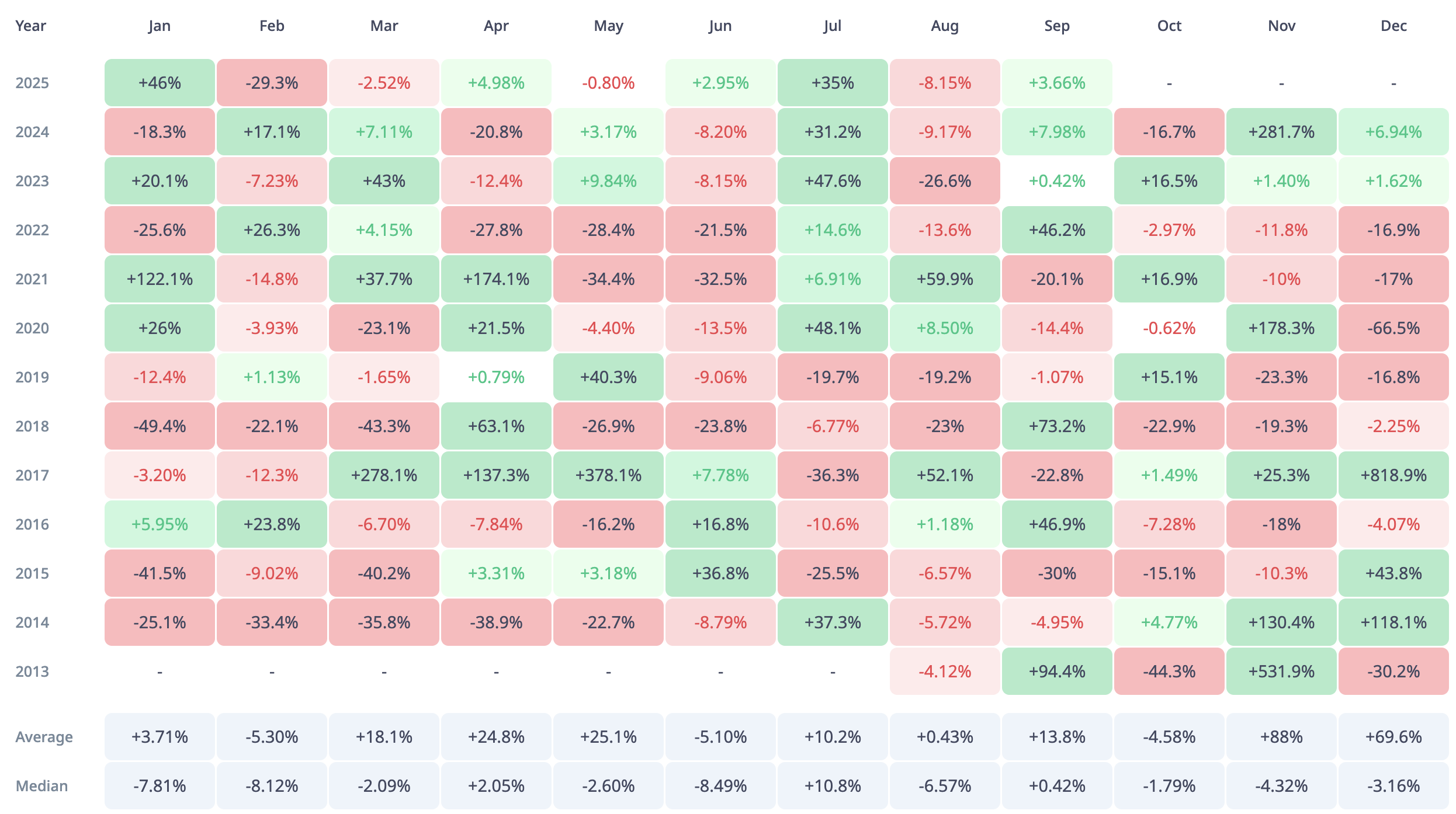
XRP Monthly ReturnsXRP Monthly Returns. Source: CryptoRank

With ‘Uptober’ approaching, analysts see a chance that XRP could once again buck the trend and deliver gains. Central to this potential shift are impending decisions by the US Securities and Exchange Commission (SEC) on multiple spot XRP exchange-traded fund (ETF) applications.

The SEC is scheduled to rule on ETF filings from several asset managers between October 18 and 25. These include Grayscale, 21Shares, Bitwise, Canary Capital, WisdomTree, CoinShares, and Franklin Templeton. 

These deadlines follow a wave of applications, with many issuers vying for approval. If approved, it could unlock significant institutional inflows, potentially propelling XRP’s price higher. Furthermore, the recent success of the REX-Osprey XRP ETF has fueled optimism for the potential of spot ETFs.

Beyond ETFs, advancements in the XRP Ledger (XRPL) ecosystem are accelerating adoption. In late September, Securitize integrated with XRPL to enhance utility and access.

Furthermore, Ripple and Securitize launched a smart contract that lets holders of BlackRock’s BUIDL and VanEck’s VBILL instantly swap their shares for Ripple USD (RLUSD) 24/7 on-chain—creating a stablecoin off-ramp and deeper liquidity. 

In the decentralized finance (DeFi) space, Flare Network’s fXRP, a DeFi-compatible one-to-one representation of the XRP, launched on the mainnet. Notably, its week-1 minting cap of 5 million FXRP was completely utilized before the timeline, a clear signal of early demand and utility.

Similarly, Midas’ mXRP liquid staking token, issued on XRPL’s EVM sidechain via Axelar, amassed $26 million in total value locked (TVL) within six days, highlighting untapped DeFi potential.

Thus, despite October’s historically weak XRP trends, 2025 brings credible upside catalysts: clustered SEC spot-ETF deadlines, growing XRPL adoption, and early DeFi traction. 

If the SEC greenlights spot XRP ETFs, October could mark a pivotal transition from regulatory uncertainty to mainstream integration, potentially reshaping XRP’s trajectory. However, downside volatility could likely return if denials or delays arrive or macro tightens. 

Market Opportunity
XRP Logo
XRP Price(XRP)
$2.1067
$2.1067$2.1067
+0.38%
USD
XRP (XRP) Live Price Chart
Disclaimer: The articles reposted on this site are sourced from public platforms and are provided for informational purposes only. They do not necessarily reflect the views of MEXC. All rights remain with the original authors. If you believe any content infringes on third-party rights, please contact service@support.mexc.com for removal. MEXC makes no guarantees regarding the accuracy, completeness, or timeliness of the content and is not responsible for any actions taken based on the information provided. The content does not constitute financial, legal, or other professional advice, nor should it be considered a recommendation or endorsement by MEXC.

You May Also Like

VivoPower To Load Up On XRP At 65% Discount: Here’s How

VivoPower To Load Up On XRP At 65% Discount: Here’s How

VivoPower International, a Nasdaq-listed B-Corp now pivoting to an XRP-centric treasury, said on September 16 it has structured its mining and treasury operations so that it can acquire the token “at up to a 65% discount” to prevailing market prices—by mining other proof-of-work assets and swapping those mined tokens. VivoPower Doubles Down On XRP The […]
Share
Bitcoinist2025/09/18 10:00
WIF price reclaims 200-day moving average

WIF price reclaims 200-day moving average

WIF (WIF) price is entering a critical technical phase as price action reclaims the 200-day moving average, a level that often separates bearish control from bullish
Share
Crypto.news2026/01/13 23:44
China Blocks Nvidia’s RTX Pro 6000D as Local Chips Rise

China Blocks Nvidia’s RTX Pro 6000D as Local Chips Rise

The post China Blocks Nvidia’s RTX Pro 6000D as Local Chips Rise appeared on BitcoinEthereumNews.com. China Blocks Nvidia’s RTX Pro 6000D as Local Chips Rise China’s internet regulator has ordered the country’s biggest technology firms, including Alibaba and ByteDance, to stop purchasing Nvidia’s RTX Pro 6000D GPUs. According to the Financial Times, the move shuts down the last major channel for mass supplies of American chips to the Chinese market. Why Beijing Halted Nvidia Purchases Chinese companies had planned to buy tens of thousands of RTX Pro 6000D accelerators and had already begun testing them in servers. But regulators intervened, halting the purchases and signaling stricter controls than earlier measures placed on Nvidia’s H20 chip. Image: Nvidia An audit compared Huawei and Cambricon processors, along with chips developed by Alibaba and Baidu, against Nvidia’s export-approved products. Regulators concluded that Chinese chips had reached performance levels comparable to the restricted U.S. models. This assessment pushed authorities to advise firms to rely more heavily on domestic processors, further tightening Nvidia’s already limited position in China. China’s Drive Toward Tech Independence The decision highlights Beijing’s focus on import substitution — developing self-sufficient chip production to reduce reliance on U.S. supplies. “The signal is now clear: all attention is focused on building a domestic ecosystem,” said a representative of a leading Chinese tech company. Nvidia had unveiled the RTX Pro 6000D in July 2025 during CEO Jensen Huang’s visit to Beijing, in an attempt to keep a foothold in China after Washington restricted exports of its most advanced chips. But momentum is shifting. Industry sources told the Financial Times that Chinese manufacturers plan to triple AI chip production next year to meet growing demand. They believe “domestic supply will now be sufficient without Nvidia.” What It Means for the Future With Huawei, Cambricon, Alibaba, and Baidu stepping up, China is positioning itself for long-term technological independence. Nvidia, meanwhile, faces…
Share
BitcoinEthereumNews2025/09/18 01:37