The U.S. Commodity Futures Trading Commission (CFTC) is exploring a significant shift in how collateral is used within derivatives markets, by permitting tokenized assets, including stablecoins, as acceptable collateral. This move aims to modernize and expand the role of digital assets in regulated financial markets, aligning with recent legislative developments and industry support, potentially transforming [...]The U.S. Commodity Futures Trading Commission (CFTC) is exploring a significant shift in how collateral is used within derivatives markets, by permitting tokenized assets, including stablecoins, as acceptable collateral. This move aims to modernize and expand the role of digital assets in regulated financial markets, aligning with recent legislative developments and industry support, potentially transforming [...]

CFTC to Examine Stablecoins as Collateral for Derivatives Trading
Cftc To Examine Stablecoins As Collateral For Derivatives Trading

The U.S. Commodity Futures Trading Commission (CFTC) is exploring a significant shift in how collateral is used within derivatives markets, by permitting tokenized assets, including stablecoins, as acceptable collateral. This move aims to modernize and expand the role of digital assets in regulated financial markets, aligning with recent legislative developments and industry support, potentially transforming the landscape of crypto-backed derivatives trading.

  • The CFTC is welcoming public feedback on using tokenized assets, such as stablecoins, as collateral in derivatives markets until October 20.
  • If adopted, stablecoins like USDC and USDT would be treated on par with traditional collateral such as cash or U.S. Treasurys.
  • Major crypto firms and stablecoin issuers are publicly supporting the proposed initiative, emphasizing benefits like reduced costs and enhanced liquidity.
  • The move is part of broader efforts to integrate stablecoins into regulated markets, following recent legislation like the GENIUS Act.
  • This initiative signals a broader evolution in U.S. crypto regulation, as agencies seek to establish clearer rules for digital assets in financial systems.

US Regulator Eyes Tokenized Assets for Derivatives Collateral

The U.S. Commodity Futures Trading Commission (CFTC) has announced it is actively considering permitting tokenized assets—such as stablecoins—to serve as collateral in derivatives markets. CFTC acting chair Caroline Pham emphasized that her agency would collaborate with industry stakeholders, inviting feedback until October 20 to shape the regulatory framework for tokenized collateral.

Under this proposed approach, stablecoins like USDC and Tether (USDT) could be treated similarly to traditional collateral such as cash or U.S. Treasurys, in a move that could significantly broaden their use in regulated derivatives trading. The legislation earlier this year provided a legal framework for stablecoins, encouraging their adoption among financial institutions amid growing mainstream interest.

Source: Caroline Pham

Crypto Industry Leaders Endorse the Initiative

Prominent figures from major crypto firms and stablecoin issuers have expressed support for the CFTC’s plans. Circle Internet Group president Heath Tarbert noted that the GENIUS Act facilitates a blockchain-based payment ecosystem, where licensed American stablecoins can be used as collateral in traditional financial markets, including derivatives.

“Using trusted stablecoins like USDC as collateral will lower costs, reduce risk, and unlock liquidity across global markets 24/7/365,” Tarbert remarked. The legislation, signed into law by President Donald Trump in July, is poised to clarify stablecoin regulations, pending final regulatory rules.

Meanwhile, Coinbase’s chief legal officer Paul Grewal underscored the strategic importance of tokenized collateral, stating, “Tokenized collateral and stablecoins can unlock U.S. derivatives markets and position us ahead of global competitors.”
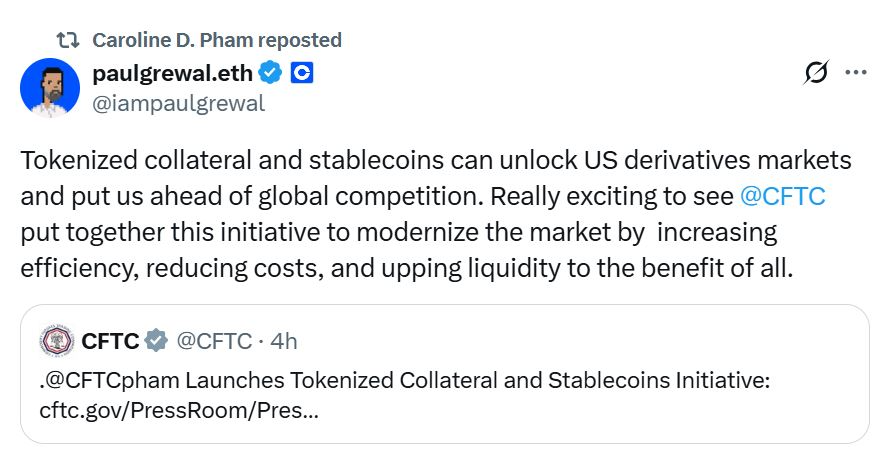
Source: Paul Grewal

Ripple’s senior vice president Jack McDonald also praised the effort, emphasizing that establishing clear rules and governance around stablecoins will foster greater trust, transparency, and resilience within the markets. “Establishing clear rules for valuation, custody, and settlement will give institutions the certainty they need,” he said.

Strategic Foundations and Future Directions

Acting Chair Pham highlighted that this tokenized asset initiative builds on earlier discussions from the CFTC’s Crypto CEO Forum and fits into broader efforts, including the recent crypto sprint to implement recommendations from the President’s Working Group on Digital Asset Markets.

The forum in February called for industry input on digital asset pilot programs and the use of tokenized non-cash collateral, with subsequent proposals emphasizing the potential of distributed ledger technology (DLT) to expand collateral options.

Changing Crypto Regulatory Landscape

Pham’s announcement coincides with broader regulatory shifts, as SEC Chair Paul Atkins revealed efforts to develop an innovation exemption—intended to temporarily shield crypto firms from older securities rules while new regulations are crafted. His agency is also advancing “Project Crypto,” aimed at modernizing securities rules and enabling onchain operations in U.S. markets.

This article was originally published as CFTC to Examine Stablecoins as Collateral for Derivatives Trading on Crypto Breaking News – your trusted source for crypto news, Bitcoin news, and blockchain updates.

Market Opportunity
Union Logo
Union Price(U)
$0.003312
$0.003312$0.003312
-4.41%
USD
Union (U) Live Price Chart
Disclaimer: The articles reposted on this site are sourced from public platforms and are provided for informational purposes only. They do not necessarily reflect the views of MEXC. All rights remain with the original authors. If you believe any content infringes on third-party rights, please contact service@support.mexc.com for removal. MEXC makes no guarantees regarding the accuracy, completeness, or timeliness of the content and is not responsible for any actions taken based on the information provided. The content does not constitute financial, legal, or other professional advice, nor should it be considered a recommendation or endorsement by MEXC.

You May Also Like

Is Doge Losing Steam As Traders Choose Pepeto For The Best Crypto Investment?

Is Doge Losing Steam As Traders Choose Pepeto For The Best Crypto Investment?

The post Is Doge Losing Steam As Traders Choose Pepeto For The Best Crypto Investment? appeared on BitcoinEthereumNews.com. Crypto News 17 September 2025 | 17:39 Is dogecoin really fading? As traders hunt the best crypto to buy now and weigh 2025 picks, Dogecoin (DOGE) still owns the meme coin spotlight, yet upside looks capped, today’s Dogecoin price prediction says as much. Attention is shifting to projects that blend culture with real on-chain tools. Buyers searching “best crypto to buy now” want shipped products, audits, and transparent tokenomics. That frames the true matchup: dogecoin vs. Pepeto. Enter Pepeto (PEPETO), an Ethereum-based memecoin with working rails: PepetoSwap, a zero-fee DEX, plus Pepeto Bridge for smooth cross-chain moves. By fusing story with tools people can use now, and speaking directly to crypto presale 2025 demand, Pepeto puts utility, clarity, and distribution in front. In a market where legacy meme coin leaders risk drifting on sentiment, Pepeto’s execution gives it a real seat in the “best crypto to buy now” debate. First, a quick look at why dogecoin may be losing altitude. Dogecoin Price Prediction: Is Doge Really Fading? Remember when dogecoin made crypto feel simple? In 2013, DOGE turned a meme into money and a loose forum into a movement. A decade on, the nonstop momentum has cooled; the backdrop is different, and the market is far more selective. With DOGE circling ~$0.268, the tape reads bearish-to-neutral for the next few weeks: hold the $0.26 shelf on daily closes and expect choppy range-trading toward $0.29–$0.30 where rallies keep stalling; lose $0.26 decisively and momentum often bleeds into $0.245 with risk of a deeper probe toward $0.22–$0.21; reclaim $0.30 on a clean daily close and the downside bias is likely neutralized, opening room for a squeeze into the low-$0.30s. Source: CoinMarketcap / TradingView Beyond the dogecoin price prediction, DOGE still centers on payments and lacks native smart contracts; ZK-proof verification is proposed,…
Share
BitcoinEthereumNews2025/09/18 00:14
Trouble for US Crypto Reform?

Trouble for US Crypto Reform?

The post Trouble for US Crypto Reform? appeared on BitcoinEthereumNews.com. The US Senate has delayed a critical step on the Digital Asset Market Structure CLARITY
Share
BitcoinEthereumNews2026/01/13 07:43
Wormhole launches reserve tying protocol revenue to token

Wormhole launches reserve tying protocol revenue to token

The post Wormhole launches reserve tying protocol revenue to token appeared on BitcoinEthereumNews.com. Wormhole is changing how its W token works by creating a new reserve designed to hold value for the long term. Announced on Wednesday, the Wormhole Reserve will collect onchain and offchain revenues and other value generated across the protocol and its applications (including Portal) and accumulate them into W, locking the tokens within the reserve. The reserve is part of a broader update called W 2.0. Other changes include a 4% targeted base yield for tokenholders who stake and take part in governance. While staking rewards will vary, Wormhole said active users of ecosystem apps can earn boosted yields through features like Portal Earn. The team stressed that no new tokens are being minted; rewards come from existing supply and protocol revenues, keeping the cap fixed at 10 billion. Wormhole is also overhauling its token release schedule. Instead of releasing large amounts of W at once under the old “cliff” model, the network will shift to steady, bi-weekly unlocks starting October 3, 2025. The aim is to avoid sharp periods of selling pressure and create a more predictable environment for investors. Lockups for some groups, including validators and investors, will extend an additional six months, until October 2028. Core contributor tokens remain under longer contractual time locks. Wormhole launched in 2020 as a cross-chain bridge and now connects more than 40 blockchains. The W token powers governance and staking, with a capped supply of 10 billion. By redirecting fees and revenues into the new reserve, Wormhole is betting that its token can maintain value as demand for moving assets and data between chains grows. This is a developing story. This article was generated with the assistance of AI and reviewed by editor Jeffrey Albus before publication. Get the news in your inbox. Explore Blockworks newsletters: Source: https://blockworks.co/news/wormhole-launches-reserve
Share
BitcoinEthereumNews2025/09/18 01:55