The post Coinbase Breach Actor Behind the $300M Heist Shifts $5M in Fresh Moves appeared on BitcoinEthereumNews.com. The threat actor behind the Coinbase customer breach resurfaced on October 2, moving fresh capital across stablecoin rails before bridging funds away within minutes, according to blockchain investigator ZachXBT. He reported that roughly 5 million DAI was swapped into an equivalent amount of USDC and sat for only about 35 minutes before being bridged, with a portion routed through Circle’s Cross-Chain Transfer Protocol (CCTP). This was not the first time the actor signaled activity on-chain. On May 21, the same wallet complex transferred more than $42.5 million from Bitcoin to Ethereum through THORChain. On the occasion, the hack left a message trolling ZachXBT. Latest movement by Coinbase’s threat actor | Source: DeBank A $300 Million Breach Coinbase disclosed on May 15 that a data breach had occurred, affecting less than 1% of its monthly active users, according to the exchange. A group of overseas support agents with privileged access was bribed and recruited by outside actors. Those insiders exposed names, contact details, identity documents, and partially masked financial data, which was enough to supercharge impersonation campaigns. Coinbase emphasized that core infrastructure, including authentication secrets, private keys, and Prime wallets, remained uncompromised, and it pledged to compensate affected users. CEO Brian Armstrong stated that the attackers attempted to extort $20 million in Bitcoin. However, the company refused the ransom and instead announced a $20 million reward fund for information leading to arrests and convictions. Coinbase response to the data breach and thefts | Source: X The US Department of Justice initiated an investigation immediately afterward, and Coinbase’s preliminary estimate for remediation and reimbursements ranges from $180 million to $400 million. That insider-enabled data trove became the raw material for industrial-grade social engineering. Alliance DAO’s Qiao Wang described a highly scripted playbook. Impostors posing as Coinbase staff flagged “compromised” accounts, steering targets… The post Coinbase Breach Actor Behind the $300M Heist Shifts $5M in Fresh Moves appeared on BitcoinEthereumNews.com. The threat actor behind the Coinbase customer breach resurfaced on October 2, moving fresh capital across stablecoin rails before bridging funds away within minutes, according to blockchain investigator ZachXBT. He reported that roughly 5 million DAI was swapped into an equivalent amount of USDC and sat for only about 35 minutes before being bridged, with a portion routed through Circle’s Cross-Chain Transfer Protocol (CCTP). This was not the first time the actor signaled activity on-chain. On May 21, the same wallet complex transferred more than $42.5 million from Bitcoin to Ethereum through THORChain. On the occasion, the hack left a message trolling ZachXBT. Latest movement by Coinbase’s threat actor | Source: DeBank A $300 Million Breach Coinbase disclosed on May 15 that a data breach had occurred, affecting less than 1% of its monthly active users, according to the exchange. A group of overseas support agents with privileged access was bribed and recruited by outside actors. Those insiders exposed names, contact details, identity documents, and partially masked financial data, which was enough to supercharge impersonation campaigns. Coinbase emphasized that core infrastructure, including authentication secrets, private keys, and Prime wallets, remained uncompromised, and it pledged to compensate affected users. CEO Brian Armstrong stated that the attackers attempted to extort $20 million in Bitcoin. However, the company refused the ransom and instead announced a $20 million reward fund for information leading to arrests and convictions. Coinbase response to the data breach and thefts | Source: X The US Department of Justice initiated an investigation immediately afterward, and Coinbase’s preliminary estimate for remediation and reimbursements ranges from $180 million to $400 million. That insider-enabled data trove became the raw material for industrial-grade social engineering. Alliance DAO’s Qiao Wang described a highly scripted playbook. Impostors posing as Coinbase staff flagged “compromised” accounts, steering targets…

Coinbase Breach Actor Behind the $300M Heist Shifts $5M in Fresh Moves

For feedback or concerns regarding this content, please contact us at crypto.news@mexc.com

The threat actor behind the Coinbase customer breach resurfaced on October 2, moving fresh capital across stablecoin rails before bridging funds away within minutes, according to blockchain investigator ZachXBT.

He reported that roughly 5 million DAI was swapped into an equivalent amount of USDC and sat for only about 35 minutes before being bridged, with a portion routed through Circle’s Cross-Chain Transfer Protocol (CCTP).

This was not the first time the actor signaled activity on-chain. On May 21, the same wallet complex transferred more than $42.5 million from Bitcoin to Ethereum through THORChain. On the occasion, the hack left a message trolling ZachXBT.

Latest movement by Coinbase’s threat actor | Source: DeBank

A $300 Million Breach

Coinbase disclosed on May 15 that a data breach had occurred, affecting less than 1% of its monthly active users, according to the exchange.

A group of overseas support agents with privileged access was bribed and recruited by outside actors.

Those insiders exposed names, contact details, identity documents, and partially masked financial data, which was enough to supercharge impersonation campaigns.

Coinbase emphasized that core infrastructure, including authentication secrets, private keys, and Prime wallets, remained uncompromised, and it pledged to compensate affected users.

CEO Brian Armstrong stated that the attackers attempted to extort $20 million in Bitcoin.

However, the company refused the ransom and instead announced a $20 million reward fund for information leading to arrests and convictions.

Coinbase response to the data breach and thefts | Source: X

The US Department of Justice initiated an investigation immediately afterward, and Coinbase’s preliminary estimate for remediation and reimbursements ranges from $180 million to $400 million.

That insider-enabled data trove became the raw material for industrial-grade social engineering. Alliance DAO’s Qiao Wang described a highly scripted playbook.

Impostors posing as Coinbase staff flagged “compromised” accounts, steering targets into “verification,” and then captured assets by supplying pre-generated seed phrases for supposed security wallets.

The con blended urgency, authenticity cues from stolen personal data, and technical theater to extract custody.

Meanwhile, market voices, such as Wintermute’s Evgeny Gaevoy, argued that rigid KYC/AML frameworks can paradoxically increase civilian exposure by centralizing sensitive identity data, which, once leaked, fuels more crime.

Normalized Thefts

The October 2 transfers also re-exposed how compliant, allowlisted infrastructures are used in flight.

ZachXBT said part of the funds moved through Circle’s official CCTP, a legitimate bridge that burns USDC on one chain and mints it on another.

That matters because it converts bridging into an issuance workflow rather than an asset swap, potentially complicating freeze-and-seize options if controls are not wired to fire rapidly.

ZachXBT vented recently about how the crypto industry is dependent on government agencies. He said:

“For an industry that was founded on principles of independence from the government it’s embarrassing how reliant we are on them to find a solution for victims.

There’s no other industry that has normalized thefts to the same extent.” In his statement, the investigator emphasized “major problems” without a solution, and these issues continue to worsen.

Among the problems listed, he questioned what would happen when the majority of law enforcement agents are incapable of tracking funds on-chain.

He further questioned when there are jurisdiction barriers, and when there is a lack of action from stablecoin issuers to freeze funds quickly.

Viewed narrowly, the latest movement from the Coinbase threat actor is a status update. Hackers remain active, opportunistic, and confident in outrunning asset-level controls.

Viewed broadly, it is a stress test of the “full stack.” Exchanges’ internal access controls, customer-support vendor management, data-handling hygiene, law enforcement speed, and the responsiveness of stablecoin issuers and bridges when red flags are triggered.

Source: https://www.thecoinrepublic.com/2025/10/02/coinbase-breach-actor-behind-the-300m-heist-shifts-5m-in-fresh-moves/

Disclaimer: The articles reposted on this site are sourced from public platforms and are provided for informational purposes only. They do not necessarily reflect the views of MEXC. All rights remain with the original authors. If you believe any content infringes on third-party rights, please contact crypto.news@mexc.com for removal. MEXC makes no guarantees regarding the accuracy, completeness, or timeliness of the content and is not responsible for any actions taken based on the information provided. The content does not constitute financial, legal, or other professional advice, nor should it be considered a recommendation or endorsement by MEXC.

You May Also Like

Tether Backs Ark Labs’ $5.2 Million Bet on Bitcoin’s Stablecoin Revival

Tether Backs Ark Labs’ $5.2 Million Bet on Bitcoin’s Stablecoin Revival

The post Tether Backs Ark Labs’ $5.2 Million Bet on Bitcoin’s Stablecoin Revival appeared on BitcoinEthereumNews.com. In brief Ark Labs secured backing from Tether
Share
BitcoinEthereumNews2026/03/12 21:44
MySQL Single Leader Replication with Node.js and Docker

MySQL Single Leader Replication with Node.js and Docker

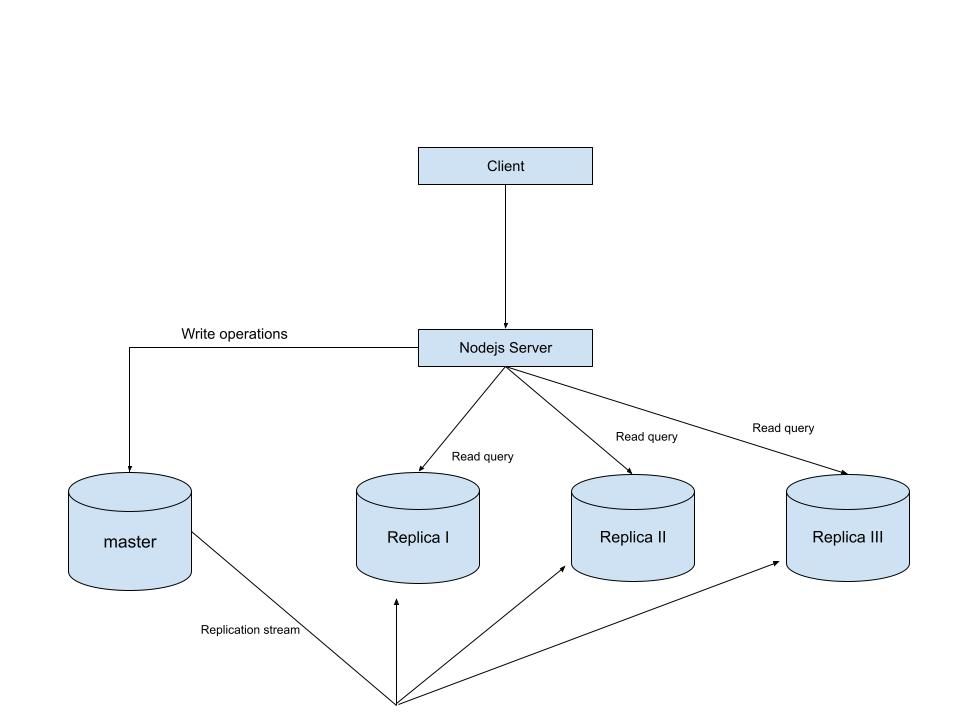
Modern applications demand high availability and the ability to scale reads without compromising performance. One of the most common strategies to achieve this is Replication. In this setup, we configured a single database to act as the leader (master) and handle all write operations, while three replicas handle read operations. In this article, we’ll walk through how to set up MySQL single-leader replication on your local machine using Docker. Once the replication is working, we’ll connect it to a Node.js application using Sequelize ORM, so that reads are routed to the replica and writes go to the master. By the end, you’ll have a working environment where you can see replication in real time Prerequisites knowledge of database replication Background knowledge of docker and docker compose Background knowledge of Nodejs and how to run a NodeJS server An Overview of what we are building Setup Setup our database servers on docker compose in the root of our project directory, create a file named docker-compose.yml with the following content to setup our mysql primary and replica databases. \ \ name: "learn-replica" volumes: mysqlMasterDatabase: mysqlSlaveDatabase: mysqlSlaveDatabaseII: mysqlSlaveDatabaseIII: networks: mysql-replication-network: services: mysql-master: image: mysql:latest container_name: mysql-master command: --server-id=1 --log-bin=ON environment: MYSQL_ROOT_PASSWORD: master MYSQL_DATABASE: replicaDb ports: - "3306:3306" volumes: - mysqlMasterDatabase:/var/lib/mysql networks: - mysql-replication-network mysql-slave: image: mysql:latest container_name: mysql-slave command: --server-id=2 --log-bin=ON environment: MYSQL_ROOT_PASSWORD: slave MYSQL_DATABASE: replicaDb MYSQL_ROOT_HOST: "%" ports: - "3307:3306" volumes: - mysqlSlaveDatabase:/var/lib/mysql depends_on: - mysql-master networks: - mysql-replication-network mysql-slaveII: image: mysql:latest container_name: mysql-slaveII command: --server-id=2 --log-bin=ON environment: MYSQL_ROOT_PASSWORD: slave MYSQL_DATABASE: replicaDb MYSQL_ROOT_HOST: "%" ports: - "3308:3306" volumes: - mysqlSlaveDatabaseII:/var/lib/mysql depends_on: - mysql-master networks: - mysql-replication-network mysql-slaveIII: image: mysql:latest container_name: mysql-slaveIII command: --server-id=3 --log-bin=ON environment: MYSQL_ROOT_PASSWORD: slave MYSQL_DATABASE: replicaDb MYSQL_ROOT_HOST: "%" ports: - "3309:3306" volumes: - mysqlSlaveDatabaseIII:/var/lib/mysql depends_on: - mysql-master networks: - mysql-replication-network In this setup, I’m creating a master database container called mysql-master and 3 replica containers called mysql-slave, mysql-slaveII and mysql-slaveIII. I won’t go too deep into the docker-compose.yml file since it’s just a basic setup, but I do want to walk you through the command line instructions used in all four services because that’s where things get interesting.
command: --server-id=1 --log-bin=ON The --server-id option gives each MySQL server in your replication setup its own name tag. Each one has to be unique and without it, replication won’t work at all. Another cool option not included here is binlog_format=ROW. This tells MySQL how to keep track of changes before passing them along to the replicas. By default, MySQL already uses row-based replication, but you can explicitly set it to ROW to be sure or switch it to STATEMENT if you’d rather log the actual SQL statements instead of row-by-row changes. \ Run our containers on docker Now, in the terminal, we can run the following command to spin up our database containers: docker-compose up -d \ Setting Up Our Master (Primary) Server To configure our master server, we would have to first access the running instance on docker using the following command docker exec -it mysql-master bash This command opens an interactive Bash shell inside the running Docker container named mysql-master, allowing us to run commands directly inside that container. \ Now that we’re inside the container, we can access the MySQL server and start running commands. type: mysql -uroot -p This will log you into MySQL as the root user. You’ll be prompted to enter the password you set in your docker-compose.yml file. \ Next, we need to create a special user that our replicas will use to connect to the master server and pull data. Inside the MySQL prompt, run the following commands: \ CREATE USER 'repl_user'@'%' IDENTIFIED BY 'replication_pass'; GRANT REPLICATION SLAVE ON . TO 'repl_user'@'%'; FLUSH PRIVILEGES; Here’s what’s happening: CREATE USER makes a new MySQL user called repl_user with the password replication_pass. GRANT REPLICATION SLAVE gives this user permission to act as a replication client. FLUSH PRIVILEGES tells MySQL to reload the user permissions so they take effect immediately. \ Time to Configure the Replica (Secondary) Servers a. First, let’s access the replica containers the same way we did with the master. Run this command in your terminal for each of the replica containers: \ docker exec -it <replica_container_name> bash mysql -uroot -p <replica_container_name> should be replace with the name of the replica container you are trying to setup b. Now it’s time to tell our replica where to get its data from. While inside the replica’s MySQL shell, run the following command to configure replication using the master’s details: CHANGE REPLICATION SOURCE TO SOURCE_HOST='mysql-master', SOURCE_USER='repl_user', SOURCE_PASSWORD='replication_pass', GET_SOURCE_PUBLIC_KEY=1; With the replication settings in place, let’s fire up the replica and get it syncing with the master. Still inside the MySQL shell on the replica, run: START REPLICA; This starts the replication process. To make sure everything is working, check the replica’s status with:
SHOW REPLICA STATUS\G; Look for Replica_IO_Running and Replica_SQL_Running — if both say Yes, congratulations! 🎉 Your replica is now successfully connected to the master and replicating data in real time.
Testing Our Replication Setup from the Node.js App Now that our replication is successfully set up, we can configure our Node.js server to observe the real-time effect of data being replicated from the master server to the replica server whenever we write to it. We start by installing the following dependencies:
npm i express mysql2 sequelize \ Now create a folder called src in the root directory and add the following files inside that folder connection.js, index.js and model.js. Our current directory should look like this We can now set up our connections to our master and replica server in the connection.js file as shown below
const Sequelize = require("sequelize"); const sequelize = new Sequelize({ dialect: "mysql", replication: { write: { host: "127.0.0.1", username: "root", password: "master", database: "replicaDb", }, read: [ { host: "127.0.0.1", username: "root", password: "slave", database: "replicaDb", port: 3307 }, { host: "127.0.0.1", username: "root", password: "slave", database: "replicaDb", port: 3308 }, { host: "127.0.0.1", username: "root", password: "slave", database: "replicaDb", port: 3309 }, ], }, }); async function connectdb() { try { await sequelize.authenticate(); } catch (error) { console.error("❌ unable to connect to the follower database", error); } } connectdb(); module.exports = { sequelize, }; \ We can now create a User table in the model.js file
const {DataTypes} = require("sequelize"); const { sequelize } = require("./connection"); const User = sequelize.define("User", { name: { type: DataTypes.STRING, allowNull: false, }, email: { type: DataTypes.STRING, unique: true, allowNull: false, }, }); module.exports = User \ and finally in our index.js file we can start our server and listen for connections on port 3000. from the code sample below, all inserts or updates will be routed by sequelize to the master server. while all read queries will be routed to the read replicas.
const express = require("express"); const { sequelize } = require("./connection"); const User = require("./model"); const app = express(); app.use(express.json()); async function main() { await sequelize.sync({ alter: true }); app.get("/", (req, res) => { res.status(200).json({ message: "first step to setting server up", }); }); app.post("/user", async (req, res) => { const { email, name } = req.body; let newUser = await User.build({ name, email, }); // This INSERT will go to the write (master) connection newUser = newUser.save({ returning: false }); res.status(201).json({ message: "User successfully created", }); }); app.get("/user", async (req, res) => { // This SELECT query will go to one of the read replicas const users = await User.findAll(); res.status(200).json(users); }); app.listen(3000, () => { console.log("server has connected"); }); } main(); When you make a POST request to the /users endpoint, take a moment to check both the master and replica servers to observe how data is replicated in real time. Right now, we are relying on Sequelize to automatically route requests, which works for development but isn’t robust enough for a production environment. In particular, if the master node goes down, Sequelize cannot automatically redirect requests to a newly elected leader. In the next part of this series, we’ll explore strategies to handle these challenges
Share
Hackernoon2025/09/18 14:44
Nvidia shares fall 3%

Nvidia shares fall 3%

The post Nvidia shares fall 3% appeared on BitcoinEthereumNews.com. Home » AI » Nvidia shares fall 3% Chipmaker extends decline as investors continue to take profits from recent highs. Photo: Budrul Chukrut/SOPA Images/LightRocket via Getty Images Key Takeaways Nvidia’s stock decreased by 3% today. The decline extends Nvidia’s recent losing streak. Nvidia shares fell 3% today, extending the chipmaker’s recent decline. The stock dropped further during trading as the artificial intelligence chip leader continued its pullback from recent highs. Disclaimer Source: https://cryptobriefing.com/nvidia-shares-fall-2-8/
Share
BitcoinEthereumNews2025/09/18 03:13