Connecticut Governor Ned Lamont has officially signed into law a comprehensive “Bitcoin Reserve Ban” that prohibits the state from accepting, holding, or investing in digital asset. The legislation, known as H.B. 7082, passed unanimously through both the state House of Representatives and Senate without a single opposing vote. Source: cga.ct.gov The new law explicitly bars Connecticut and its political subdivisions from accepting virtual currency as payment or establishing any form of digital asset reserve . This positions Connecticut as one of the most restrictive states regarding cryptocurrency adoption, contrasting sharply with the growing trend of Bitcoin reserve legislation across the United States. The timing appears particularly significant, as 26 states have introduced 47 Bitcoin reserve bills, with Texas, New Hampshire, and Arizona already having approved state-level Bitcoin reserve frameworks. Connecticut’s decision effectively removes it from the national conversation around strategic crypto adoption for public treasuries. The legislation extends beyond investment restrictions to comprehensive regulations governing the transmission of money. Crypto businesses must now provide extensive disclosures about material risks, including warnings about fraud potential, market volatility, and the irreversible nature of transactions. Additional protections require parental verification for users under 18 years old. 🚨 NEW: Connecticut Governor Ned Lamont officially signed into law the state's 'Bitcoin Reserve Ban' today. Connecticut is now prohibited from accepting, holding, or investing in digital assets. https://t.co/vIXIkprdHI — Bitcoin Laws (@Bitcoin_Laws) July 1, 2025 States Rally Around Bitcoin Adoption Despite Federal Uncertainty Crypto adoption at the state level is aggressively growing and starkly contrasts with this new Connecticut move. Texas leads the movement with Governor Greg Abbott signing Senate Bill 21 , establishing America’s first state-funded Bitcoin reserve entirely separate from the state treasury. ✅ Texas has officially joined the small but growing list of U.S. states moving toward on-chain finance, passing a bill that protects Bitcoin reserves. #Texas #Bitcoin https://t.co/kBh6nFgROs — Cryptonews.com (@cryptonews) June 22, 2025 Texas Comptroller Glenn Hegar will oversee the fund, with companion legislation HB 4488 protecting reserves from routine fund reallocations. Senator Charles Schwertner led the initiative, arguing, “ the state of Texas should have the option of evaluating the best performing asset over the last 10 years. “ New Hampshire also achieved a historic milestone by becoming the first state to pass laws allowing public funds to be invested in Bitcoin reserves . Governor Kelly Ayotte signed legislation permitting up to a 5% allocation in digital assets with a market capitalization exceeding $500 billion, effectively targeting Bitcoin exclusively. California is also not left out with its progressive adoption through Assembly Bill 1180 , which unanimously passed with 78 Assembly Members supporting pilot programs for digital asset fee payments. The Department of Financial Protection and Innovation will create frameworks for cryptocurrency-based government transactions by 2025. Arizona, however, presents a complex picture, with Governor Katie Hobbs vetoing comprehensive Bitcoin reserve legislation while simultaneously signing HB 2749, which creates frameworks for managing unclaimed digital assets. The state maintains multiple active bills, including revised HB2324, which recently passed Senate reconsideration. Corporate adoption accelerates regardless of state-level policies, with 252 entities now holding Bitcoin, representing approximately 16.57% of the total supply. Source: BitcoinTreasuries Strategy maintains the largest position at 597,325 BTC worth $63.93 billion, with the most recent purchase being 4,980 Bitcoin for $531.1 million, at an average price of approximately $106,801 per bitcoin. Source: SaylorTracker Regulatory Patchwork Creates Compliance Challenges Notably, the new Connecticut law mandates extensive compliance measures, including customer identification protocols, transaction receipt requirements, and robust risk disclosure frameworks that exceed federal minimums. Money transmission licensees must maintain virtual currency holdings equal to customer obligations while prohibiting unauthorized use of controlled assets. The legislation establishes that virtual currency held by licensees becomes property interests of claimants, creating additional legal protections for consumers. Several states have abandoned their efforts to reserve Bitcoin, creating an inconsistent national landscape. Florida withdrew House Bill 487 and Senate Bill 550 during legislative sessions, joining Wyoming , South Dakota, North Dakota , Pennsylvania, Montana, and Oklahoma in failed adoption attempts. Positively, some other states are still in the process. For instance, Michigan introduced House Bill 4087 , which allows for a 10% treasury allocation to cryptocurrencies. 🇺🇸 The Michigan House Bill was introduced by Representatives Bryan Posthumus and Ron Robinson to push for a strategic Bitcoin reserve. #BitcoinReserve #Michigan https://t.co/fXJSPOQ6gs — Cryptonews.com (@cryptonews) February 14, 2025 At the same time, Ohio advanced Senate Bill 57 , which creates exclusive Bitcoin reserve funds with mandatory five-year holding periods. Similarly, North Carolina also passed legislation permitting a 5% investment allocation pending validation by third-party oversight. Additionally, West Virginia’s Inflation Protection Act proposes a 10% treasury allocation to digital assets with a market capitalization exceeding $750 billion, effectively limiting investments to Bitcoin and select stablecoins. The legislation positions precious metals and cryptocurrencies as inflation hedges against government spending deficits. Oklahoma has also approved the Strategic Bitcoin Reserve Act through the House Committee with a 12-2 vote, allowing for a 10% public fund allocation to digital assets that meet market capitalization thresholds. The state previously passed Bitcoin Rights legislation protecting self-custody rights and transaction freedoms.Connecticut Governor Ned Lamont has officially signed into law a comprehensive “Bitcoin Reserve Ban” that prohibits the state from accepting, holding, or investing in digital asset. The legislation, known as H.B. 7082, passed unanimously through both the state House of Representatives and Senate without a single opposing vote. Source: cga.ct.gov The new law explicitly bars Connecticut and its political subdivisions from accepting virtual currency as payment or establishing any form of digital asset reserve . This positions Connecticut as one of the most restrictive states regarding cryptocurrency adoption, contrasting sharply with the growing trend of Bitcoin reserve legislation across the United States. The timing appears particularly significant, as 26 states have introduced 47 Bitcoin reserve bills, with Texas, New Hampshire, and Arizona already having approved state-level Bitcoin reserve frameworks. Connecticut’s decision effectively removes it from the national conversation around strategic crypto adoption for public treasuries. The legislation extends beyond investment restrictions to comprehensive regulations governing the transmission of money. Crypto businesses must now provide extensive disclosures about material risks, including warnings about fraud potential, market volatility, and the irreversible nature of transactions. Additional protections require parental verification for users under 18 years old. 🚨 NEW: Connecticut Governor Ned Lamont officially signed into law the state's 'Bitcoin Reserve Ban' today. Connecticut is now prohibited from accepting, holding, or investing in digital assets. https://t.co/vIXIkprdHI — Bitcoin Laws (@Bitcoin_Laws) July 1, 2025 States Rally Around Bitcoin Adoption Despite Federal Uncertainty Crypto adoption at the state level is aggressively growing and starkly contrasts with this new Connecticut move. Texas leads the movement with Governor Greg Abbott signing Senate Bill 21 , establishing America’s first state-funded Bitcoin reserve entirely separate from the state treasury. ✅ Texas has officially joined the small but growing list of U.S. states moving toward on-chain finance, passing a bill that protects Bitcoin reserves. #Texas #Bitcoin https://t.co/kBh6nFgROs — Cryptonews.com (@cryptonews) June 22, 2025 Texas Comptroller Glenn Hegar will oversee the fund, with companion legislation HB 4488 protecting reserves from routine fund reallocations. Senator Charles Schwertner led the initiative, arguing, “ the state of Texas should have the option of evaluating the best performing asset over the last 10 years. “ New Hampshire also achieved a historic milestone by becoming the first state to pass laws allowing public funds to be invested in Bitcoin reserves . Governor Kelly Ayotte signed legislation permitting up to a 5% allocation in digital assets with a market capitalization exceeding $500 billion, effectively targeting Bitcoin exclusively. California is also not left out with its progressive adoption through Assembly Bill 1180 , which unanimously passed with 78 Assembly Members supporting pilot programs for digital asset fee payments. The Department of Financial Protection and Innovation will create frameworks for cryptocurrency-based government transactions by 2025. Arizona, however, presents a complex picture, with Governor Katie Hobbs vetoing comprehensive Bitcoin reserve legislation while simultaneously signing HB 2749, which creates frameworks for managing unclaimed digital assets. The state maintains multiple active bills, including revised HB2324, which recently passed Senate reconsideration. Corporate adoption accelerates regardless of state-level policies, with 252 entities now holding Bitcoin, representing approximately 16.57% of the total supply. Source: BitcoinTreasuries Strategy maintains the largest position at 597,325 BTC worth $63.93 billion, with the most recent purchase being 4,980 Bitcoin for $531.1 million, at an average price of approximately $106,801 per bitcoin. Source: SaylorTracker Regulatory Patchwork Creates Compliance Challenges Notably, the new Connecticut law mandates extensive compliance measures, including customer identification protocols, transaction receipt requirements, and robust risk disclosure frameworks that exceed federal minimums. Money transmission licensees must maintain virtual currency holdings equal to customer obligations while prohibiting unauthorized use of controlled assets. The legislation establishes that virtual currency held by licensees becomes property interests of claimants, creating additional legal protections for consumers. Several states have abandoned their efforts to reserve Bitcoin, creating an inconsistent national landscape. Florida withdrew House Bill 487 and Senate Bill 550 during legislative sessions, joining Wyoming , South Dakota, North Dakota , Pennsylvania, Montana, and Oklahoma in failed adoption attempts. Positively, some other states are still in the process. For instance, Michigan introduced House Bill 4087 , which allows for a 10% treasury allocation to cryptocurrencies. 🇺🇸 The Michigan House Bill was introduced by Representatives Bryan Posthumus and Ron Robinson to push for a strategic Bitcoin reserve. #BitcoinReserve #Michigan https://t.co/fXJSPOQ6gs — Cryptonews.com (@cryptonews) February 14, 2025 At the same time, Ohio advanced Senate Bill 57 , which creates exclusive Bitcoin reserve funds with mandatory five-year holding periods. Similarly, North Carolina also passed legislation permitting a 5% investment allocation pending validation by third-party oversight. Additionally, West Virginia’s Inflation Protection Act proposes a 10% treasury allocation to digital assets with a market capitalization exceeding $750 billion, effectively limiting investments to Bitcoin and select stablecoins. The legislation positions precious metals and cryptocurrencies as inflation hedges against government spending deficits. Oklahoma has also approved the Strategic Bitcoin Reserve Act through the House Committee with a 12-2 vote, allowing for a 10% public fund allocation to digital assets that meet market capitalization thresholds. The state previously passed Bitcoin Rights legislation protecting self-custody rights and transaction freedoms.

Connecticut Goes Anti-Crypto as Governor Lamont Signs Bill Banning State Digital Asset Investments

Connecticut Governor Ned Lamont has officially signed into law a comprehensive “Bitcoin Reserve Ban” that prohibits the state from accepting, holding, or investing in digital asset.

The legislation, known as H.B. 7082, passed unanimously through both the state House of Representatives and Senate without a single opposing vote.
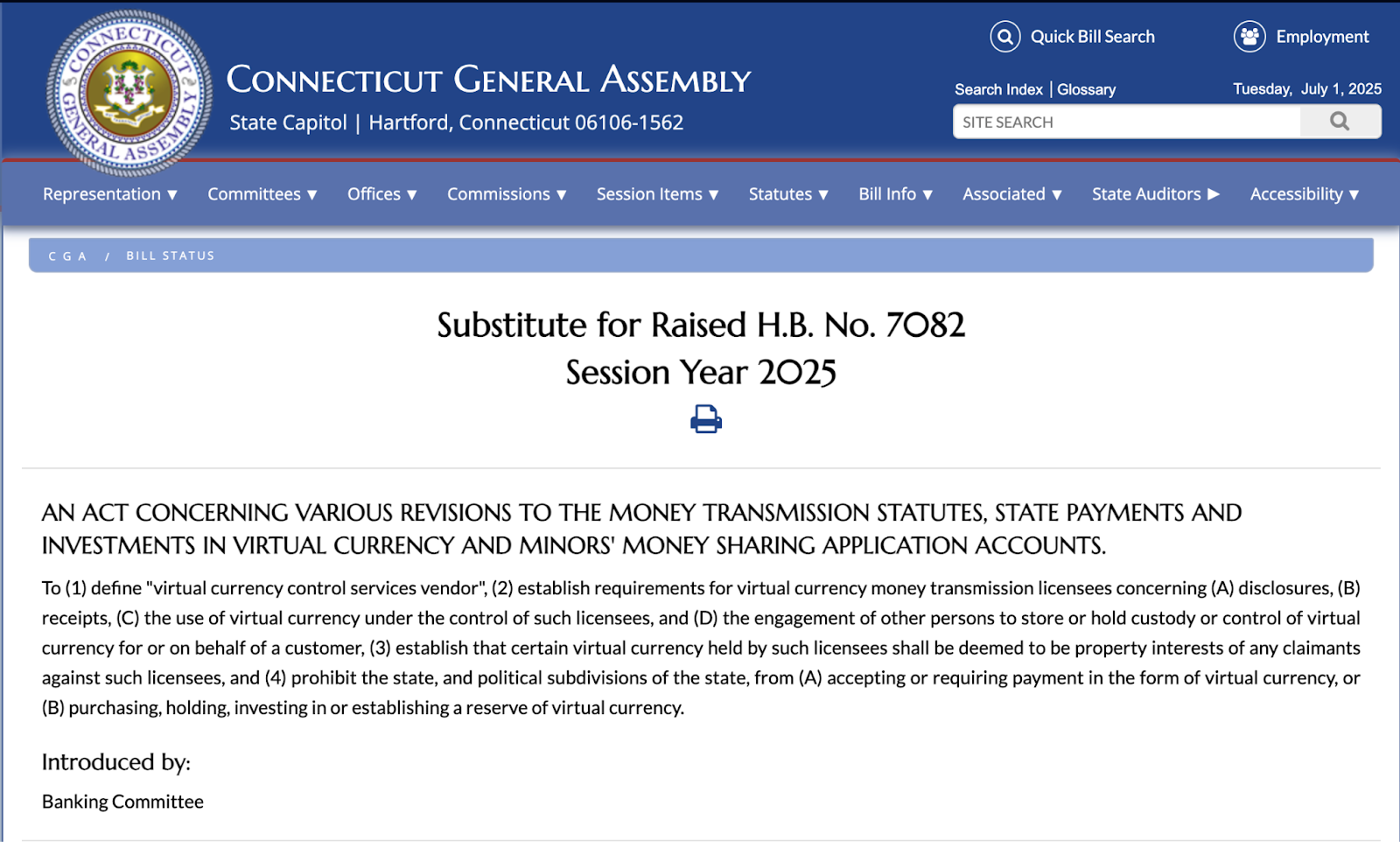
Connecticut Goes Anti-Crypto as Governor Lamont Signs Bill Banning State Digital Asset InvestmentsSource: cga.ct.gov

The new law explicitly bars Connecticut and its political subdivisions from accepting virtual currency as payment or establishing any form of digital asset reserve.

This positions Connecticut as one of the most restrictive states regarding cryptocurrency adoption, contrasting sharply with the growing trend of Bitcoin reserve legislation across the United States.

The timing appears particularly significant, as 26 states have introduced 47 Bitcoin reserve bills, with Texas, New Hampshire, and Arizona already having approved state-level Bitcoin reserve frameworks.

Connecticut’s decision effectively removes it from the national conversation around strategic crypto adoption for public treasuries.

The legislation extends beyond investment restrictions to comprehensive regulations governing the transmission of money.

Crypto businesses must now provide extensive disclosures about material risks, including warnings about fraud potential, market volatility, and the irreversible nature of transactions.

Additional protections require parental verification for users under 18 years old.

States Rally Around Bitcoin Adoption Despite Federal Uncertainty

Crypto adoption at the state level is aggressively growing and starkly contrasts with this new Connecticut move.

Texas leads the movement with Governor Greg Abbott signing Senate Bill 21, establishing America’s first state-funded Bitcoin reserve entirely separate from the state treasury.

Texas Comptroller Glenn Hegar will oversee the fund, with companion legislation HB 4488 protecting reserves from routine fund reallocations.

Senator Charles Schwertner led the initiative, arguing, “the state of Texas should have the option of evaluating the best performing asset over the last 10 years.

New Hampshire also achieved a historic milestone by becoming the first state to pass laws allowing public funds to be invested in Bitcoin reserves.

Governor Kelly Ayotte signed legislation permitting up to a 5% allocation in digital assets with a market capitalization exceeding $500 billion, effectively targeting Bitcoin exclusively.

California is also not left out with its progressive adoption through Assembly Bill 1180, which unanimously passed with 78 Assembly Members supporting pilot programs for digital asset fee payments.

The Department of Financial Protection and Innovation will create frameworks for cryptocurrency-based government transactions by 2025.

Arizona, however, presents a complex picture, with Governor Katie Hobbs vetoing comprehensive Bitcoin reserve legislation while simultaneously signing HB 2749, which creates frameworks for managing unclaimed digital assets.

The state maintains multiple active bills, including revised HB2324, which recently passed Senate reconsideration.

Corporate adoption accelerates regardless of state-level policies, with 252 entities now holding Bitcoin, representing approximately 16.57% of the total supply.

Connecticut Goes Anti-Crypto as Governor Lamont Signs Bill Banning State Digital Asset InvestmentsSource: BitcoinTreasuries

Strategy maintains the largest position at 597,325 BTC worth $63.93 billion, with the most recent purchase being 4,980 Bitcoin for $531.1 million, at an average price of approximately $106,801 per bitcoin.

Connecticut Goes Anti-Crypto as Governor Lamont Signs Bill Banning State Digital Asset InvestmentsSource: SaylorTracker

Regulatory Patchwork Creates Compliance Challenges

Notably, the new Connecticut law mandates extensive compliance measures, including customer identification protocols, transaction receipt requirements, and robust risk disclosure frameworks that exceed federal minimums.

Money transmission licensees must maintain virtual currency holdings equal to customer obligations while prohibiting unauthorized use of controlled assets.

The legislation establishes that virtual currency held by licensees becomes property interests of claimants, creating additional legal protections for consumers.

Several states have abandoned their efforts to reserve Bitcoin, creating an inconsistent national landscape.

Florida withdrew House Bill 487 and Senate Bill 550 during legislative sessions, joining Wyoming, South Dakota, North Dakota, Pennsylvania, Montana, and Oklahoma in failed adoption attempts.

Positively, some other states are still in the process. For instance, Michigan introduced House Bill 4087, which allows for a 10% treasury allocation to cryptocurrencies.

At the same time, Ohio advanced Senate Bill 57, which creates exclusive Bitcoin reserve funds with mandatory five-year holding periods.

Similarly, North Carolina also passed legislation permitting a 5% investment allocation pending validation by third-party oversight.

Additionally, West Virginia’s Inflation Protection Act proposes a 10% treasury allocation to digital assets with a market capitalization exceeding $750 billion, effectively limiting investments to Bitcoin and select stablecoins.

The legislation positions precious metals and cryptocurrencies as inflation hedges against government spending deficits.

Oklahoma has also approved the Strategic Bitcoin Reserve Act through the House Committee with a 12-2 vote, allowing for a 10% public fund allocation to digital assets that meet market capitalization thresholds.

The state previously passed Bitcoin Rights legislation protecting self-custody rights and transaction freedoms.

Market Opportunity
B Logo
B Price(B)
$0,1931
$0,1931$0,1931
-1,02%
USD
B (B) Live Price Chart
Disclaimer: The articles reposted on this site are sourced from public platforms and are provided for informational purposes only. They do not necessarily reflect the views of MEXC. All rights remain with the original authors. If you believe any content infringes on third-party rights, please contact service@support.mexc.com for removal. MEXC makes no guarantees regarding the accuracy, completeness, or timeliness of the content and is not responsible for any actions taken based on the information provided. The content does not constitute financial, legal, or other professional advice, nor should it be considered a recommendation or endorsement by MEXC.

You May Also Like

Bitcoin Has Taken Gold’s Role In Today’s World, Eric Trump Says

Bitcoin Has Taken Gold’s Role In Today’s World, Eric Trump Says

Eric Trump on Tuesday described Bitcoin as a “modern-day gold,” calling it a liquid store of value that can act as a hedge to real estate and other assets. Related Reading: XRP’s Biggest Rally Yet? Analyst Projects $20+ In October 2025 According to reports, the remark came during a TV appearance on CNBC’s Squawk Box, tied to the launch of American Bitcoin, the mining and treasury firm he helped start. Company Holdings And Strategy Based on public filings and company summaries, American Bitcoin has accumulated 2,443 BTC on its balance sheet. That stash has been valued in the low hundreds of millions of dollars at recent spot prices. The firm mixes large-scale mining with the goal of holding Bitcoin as a strategic reserve, which it says will help it grow both production and asset holdings over time. Eric Trump’s comments were direct. He told viewers that institutions are treating Bitcoin more like a store of value than a fringe idea, and he warned firms that resist blockchain adoption. The tone was strong at times, and the line about Bitcoin being a modern equivalent of gold was used to frame American Bitcoin’s role as both miner and holder.   Eric Trump has said: bitcoin is modern-day gold — unusual_whales (@unusual_whales) September 16, 2025 How The Company Went Public American Bitcoin moved toward a public listing via an all-stock merger with Gryphon Digital Mining earlier this year, a deal that kept most of the original shareholders in control and positioned the new entity for a Nasdaq debut. Reports show that mining partner Hut 8 holds a large ownership stake, leaving the Trump family and other backers with a minority share. The listing brought fresh attention and capital to the firm as it began trading under the ticker ABTC. Market watchers say the firm’s public debut highlights two trends: mining companies are trying to grow by both producing and holding Bitcoin, and political ties are bringing more headlines to crypto firms. Some analysts point out that holding large amounts of Bitcoin on the balance sheet exposes a company to price swings, while supporters argue it aligns incentives between miners and investors. Related Reading: Ethereum Bulls Target $8,500 With Big Money Backing The Move – Details Reaction And Possible Risks Based on coverage of the launch, investors have reacted with both enthusiasm and caution. Supporters praise the prospect of a US-based miner that aims to be transparent and aggressive about building a reserve. Critics point to governance questions, possible conflicts tied to high-profile backers, and the usual risks of a volatile asset being held on corporate balance sheets. Eric Trump’s remark that Bitcoin has taken gold’s role in today’s world reflects both his belief in its value and American Bitcoin’s strategy of mining and holding. Whether that view sticks will depend on how investors and institutions respond in the months ahead. Featured image from Meta, chart from TradingView
Share
NewsBTC2025/09/18 06:00
Fed Makes First Rate Cut of the Year, Lowers Rates by 25 Bps

Fed Makes First Rate Cut of the Year, Lowers Rates by 25 Bps

The post Fed Makes First Rate Cut of the Year, Lowers Rates by 25 Bps appeared on BitcoinEthereumNews.com. The Federal Reserve has made its first Fed rate cut this year following today’s FOMC meeting, lowering interest rates by 25 basis points (bps). This comes in line with expectations, while the crypto market awaits Fed Chair Jerome Powell’s speech for guidance on the committee’s stance moving forward. FOMC Makes First Fed Rate Cut This Year With 25 Bps Cut In a press release, the committee announced that it has decided to lower the target range for the federal funds rate by 25 bps from between 4.25% and 4.5% to 4% and 4.25%. This comes in line with expectations as market participants were pricing in a 25 bps cut, as against a 50 bps cut. This marks the first Fed rate cut this year, with the last cut before this coming last year in December. Notably, the Fed also made the first cut last year in September, although it was a 50 bps cut back then. All Fed officials voted in favor of a 25 bps cut except Stephen Miran, who dissented in favor of a 50 bps cut. This rate cut decision comes amid concerns that the labor market may be softening, with recent U.S. jobs data pointing to a weak labor market. The committee noted in the release that job gains have slowed, and that the unemployment rate has edged up but remains low. They added that inflation has moved up and remains somewhat elevated. Fed Chair Jerome Powell had also already signaled at the Jackson Hole Conference that they were likely to lower interest rates with the downside risk in the labor market rising. The committee reiterated this in the release that downside risks to employment have risen. Before the Fed rate cut decision, experts weighed in on whether the FOMC should make a 25 bps cut or…
Share
BitcoinEthereumNews2025/09/18 04:36
UK Looks to US to Adopt More Crypto-Friendly Approach

UK Looks to US to Adopt More Crypto-Friendly Approach

The post UK Looks to US to Adopt More Crypto-Friendly Approach appeared on BitcoinEthereumNews.com. The UK and US are reportedly preparing to deepen cooperation on digital assets, with Britain looking to copy the Trump administration’s crypto-friendly stance in a bid to boost innovation.  UK Chancellor Rachel Reeves and US Treasury Secretary Scott Bessent discussed on Tuesday how the two nations could strengthen their coordination on crypto, the Financial Times reported on Tuesday, citing people familiar with the matter.  The discussions also involved representatives from crypto companies, including Coinbase, Circle Internet Group and Ripple, with executives from the Bank of America, Barclays and Citi also attending, according to the report. The agreement was made “last-minute” after crypto advocacy groups urged the UK government on Thursday to adopt a more open stance toward the industry, claiming its cautious approach to the sector has left the country lagging in innovation and policy.  Source: Rachel Reeves Deal to include stablecoins, look to unlock adoption Any deal between the countries is likely to include stablecoins, the Financial Times reported, an area of crypto that US President Donald Trump made a policy priority and in which his family has significant business interests. The Financial Times reported on Monday that UK crypto advocacy groups also slammed the Bank of England’s proposal to limit individual stablecoin holdings to between 10,000 British pounds ($13,650) and 20,000 pounds ($27,300), claiming it would be difficult and expensive to implement. UK banks appear to have slowed adoption too, with around 40% of 2,000 recently surveyed crypto investors saying that their banks had either blocked or delayed a payment to a crypto provider.  Many of these actions have been linked to concerns over volatility, fraud and scams. The UK has made some progress on crypto regulation recently, proposing a framework in May that would see crypto exchanges, dealers, and agents treated similarly to traditional finance firms, with…
Share
BitcoinEthereumNews2025/09/18 02:21