House Republicans scrambled to win over holdouts on Wednesday to pass a procedural motion for several crypto bills by a vote of 217–212.House Republicans scrambled to win over holdouts on Wednesday to pass a procedural motion for several crypto bills by a vote of 217–212.

Crypto Week survives scare as House members scramble to advance procedural motion in a 217–212 vote

  • House lawmakers passed a procedural motion to move several crypto bills to the floor for deliberation after hours of debate.
  • The development follows a dispute among Republican lawmakers over the merging of the CLARITY and Anti-CBDC Surveillance bills.
  • The GENIUS and CLARITY bills could receive a floor vote on Thursday after the Anti-CBDC bill was attached to the NDAA Act.

House Republicans scrambled to win over holdouts on Wednesday to pass a procedural motion for several crypto bills by a vote of 217–212. The longest House vote in history, which lasted nearly ten hours, will see the GENIUS and CLARITY bills head to the floor for final passage deliberations on Thursday.

House lawmakers pass procedural motion to keep Crypto Week hopes alive

The House Crypto Week faced a crucial test again on Wednesday after lawmakers scrambled to pass a procedural motion that would allow the GENIUS, CLARITY, and Anti-CBDC Surveillance bills to move forward. After lingering for nearly 10 hours, in what became the longest vote in the House, the procedural motion passed by a vote of 217–212, marking success in Republican efforts to bring the bills to the floor for final passage.
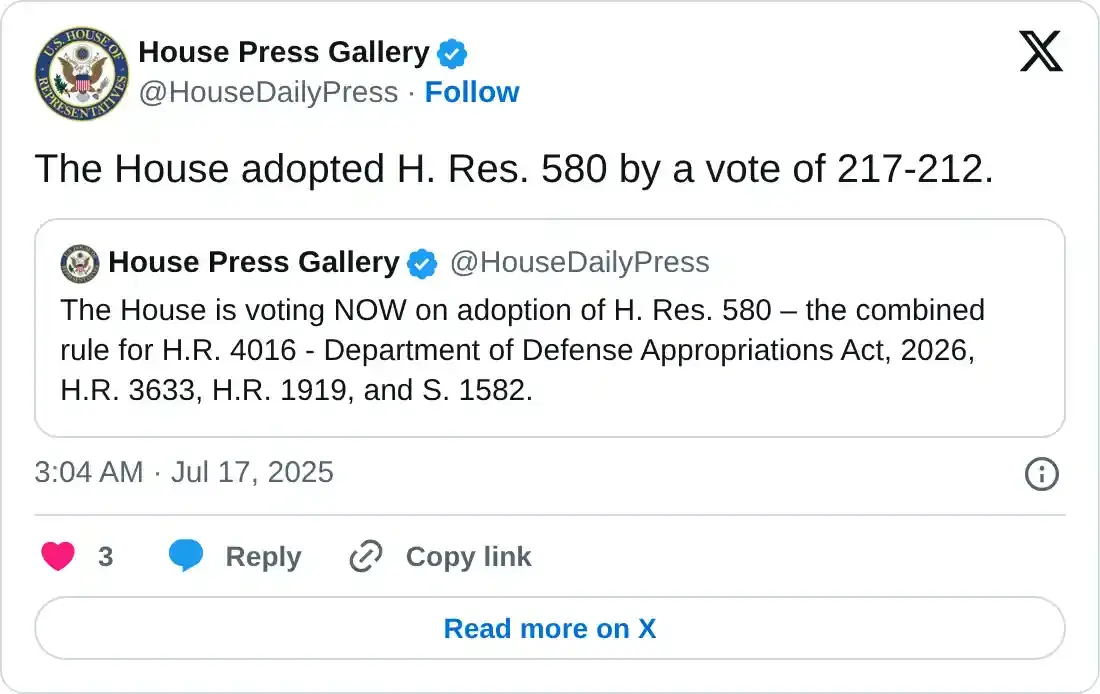
https://x.com/HouseDailyPress/status/1945680877196906923

The success came after most Republicans reversed their previous stance from a "no" to a "yes" within a few hours.

The development shook crypto community members, who had anticipated swift engagement from lawmakers after Tuesday's failed effort.

Through an initial 215–211 vote on Wednesday, lawmakers narrowly approved reconsideration of the procedural motion for the bills, but debates in the House stalled progress on the vote.

The setback came after nine Republicans initially withheld support, pushing for the CLARITY and Anti-CBDC Surveillance State bills to be joined into one. Insiders noted that joining both bills was part of a deal between former President Trump and 12 GOP lawmakers during a meeting late Tuesday. The agreement was expected to secure their backing for the procedural vote.

"It looks like some of the 12 Republicans who voted no yesterday [Tuesday] — but flipped to yes after meeting with Trump last night — did so on the promise that strong anti-CBDC language would be added to CLARITY, since GENIUS isn't open for amendments'" wrote Crypto in America's Eleanor Terret on X.

This comes after lawmakers initially attempted to bring the three crypto bills to the House floor for final deliberation on Tuesday. The attempt failed in a 196-223 vote, with 12 Republicans voting against the motion.

GOP members who initially refused to support the motion cited concerns over a central bank digital currency (CBDC) and the lack of a combined legislative package.

However, efforts to merge the market structure bill with the Anti-CBDC legislation also faced pushback from Republicans who wrote the CLARITY Act. This group expressed that merging the bills could make it difficult for CLARITY to pass, as the inclusion of anti-CBDC language could force Democrats to withdraw their support.

"The authors and a handful of other Financial Services Committee members have made it clear they believe adding anti-CBDC provisions to CLARITY [...] could jeopardize the bipartisan market structure legislation," Terret added.

After several meetings, Rep. Tom Emmer said the Anti-CBDC bill will be added to the National Defense Authorization Act (NDAA).

"Attaching our Anti-CBDC Surveillance State Act to the NDAA will ensure unelected bureaucrats are NEVER allowed to trade Americans' financial privacy for a CCP-style surveillance tool," said Majority Whip Tom Emmer in an X post.

The GENIUS and CLARITY bills could be set for a floor vote as early as Thursday for final passage.

The GENIUS bill specifically targets the regulation of stablecoins, while the CLARITY bill, also known as the market structure bill, aims to provide clear guidance for the broader cryptocurrency market. The Anti-CBDC Surveillance State bill, on the other hand, aims to restrict the Federal Reserve (Fed) from developing, issuing, or using a Central Bank Digital Currency (CBDC) for monetary purposes.


Market Opportunity
Housecoin Logo
Housecoin Price(HOUSE)
$0.002011
$0.002011$0.002011
-0.39%
USD
Housecoin (HOUSE) Live Price Chart
Disclaimer: The articles reposted on this site are sourced from public platforms and are provided for informational purposes only. They do not necessarily reflect the views of MEXC. All rights remain with the original authors. If you believe any content infringes on third-party rights, please contact service@support.mexc.com for removal. MEXC makes no guarantees regarding the accuracy, completeness, or timeliness of the content and is not responsible for any actions taken based on the information provided. The content does not constitute financial, legal, or other professional advice, nor should it be considered a recommendation or endorsement by MEXC.

You May Also Like

U.S. Moves Grip on Crypto Regulation Intensifies

U.S. Moves Grip on Crypto Regulation Intensifies

The post U.S. Moves Grip on Crypto Regulation Intensifies appeared on BitcoinEthereumNews.com. The United States is contending with the intricacies of cryptocurrency regulation as newly enacted legislation stirs debate over centralized versus decentralized finance. The recent passage of the GENIUS Act under Bo Hines’ leadership is perceived to skew favor towards centralized entities, potentially disadvantaging decentralized innovations. Continue Reading:U.S. Moves Grip on Crypto Regulation Intensifies Source: https://en.bitcoinhaber.net/u-s-moves-grip-on-crypto-regulation-intensifies
Share
BitcoinEthereumNews2025/09/18 01:09
Shocking OpenVPP Partnership Claim Draws Urgent Scrutiny

Shocking OpenVPP Partnership Claim Draws Urgent Scrutiny

The post Shocking OpenVPP Partnership Claim Draws Urgent Scrutiny appeared on BitcoinEthereumNews.com. The cryptocurrency world is buzzing with a recent controversy surrounding a bold OpenVPP partnership claim. This week, OpenVPP (OVPP) announced what it presented as a significant collaboration with the U.S. government in the innovative field of energy tokenization. However, this claim quickly drew the sharp eye of on-chain analyst ZachXBT, who highlighted a swift and official rebuttal that has sent ripples through the digital asset community. What Sparked the OpenVPP Partnership Claim Controversy? The core of the issue revolves around OpenVPP’s assertion of a U.S. government partnership. This kind of collaboration would typically be a monumental endorsement for any private cryptocurrency project, especially given the current regulatory climate. Such a partnership could signify a new era of mainstream adoption and legitimacy for energy tokenization initiatives. OpenVPP initially claimed cooperation with the U.S. government. This alleged partnership was said to be in the domain of energy tokenization. The announcement generated considerable interest and discussion online. ZachXBT, known for his diligent on-chain investigations, was quick to flag the development. He brought attention to the fact that U.S. Securities and Exchange Commission (SEC) Commissioner Hester Peirce had directly addressed the OpenVPP partnership claim. Her response, delivered within hours, was unequivocal and starkly contradicted OpenVPP’s narrative. How Did Regulatory Authorities Respond to the OpenVPP Partnership Claim? Commissioner Hester Peirce’s statement was a crucial turning point in this unfolding story. She clearly stated that the SEC, as an agency, does not engage in partnerships with private cryptocurrency projects. This response effectively dismantled the credibility of OpenVPP’s initial announcement regarding their supposed government collaboration. Peirce’s swift clarification underscores a fundamental principle of regulatory bodies: maintaining impartiality and avoiding endorsements of private entities. Her statement serves as a vital reminder to the crypto community about the official stance of government agencies concerning private ventures. Moreover, ZachXBT’s analysis…
Share
BitcoinEthereumNews2025/09/18 02:13
OpenVPP accused of falsely advertising cooperation with the US government; SEC commissioner clarifies no involvement

OpenVPP accused of falsely advertising cooperation with the US government; SEC commissioner clarifies no involvement

PANews reported on September 17th that on-chain sleuth ZachXBT tweeted that OpenVPP ( $OVPP ) announced this week that it was collaborating with the US government to advance energy tokenization. SEC Commissioner Hester Peirce subsequently responded, stating that the company does not collaborate with or endorse any private crypto projects. The OpenVPP team subsequently hid the response. Several crypto influencers have participated in promoting the project, and the accounts involved have been questioned as typical influencer accounts.
Share
PANews2025/09/17 23:58