After a long period of depression, the market hopes to prove that Ethereum is still a low-value asset through this rebound, and the Pectra upgrade seems to provide evidence for this narrative. PANews attempts to outline the current true state of Ethereum through a comprehensive interpretation of Ethereum data. An Ethereum that is undergoing value reconstruction is gradually emerging.After a long period of depression, the market hopes to prove that Ethereum is still a low-value asset through this rebound, and the Pectra upgrade seems to provide evidence for this narrative. PANews attempts to outline the current true state of Ethereum through a comprehensive interpretation of Ethereum data. An Ethereum that is undergoing value reconstruction is gradually emerging.

Data interpretation of Ethereum after the surge and rebound: the ecological cold and hot faults behind the value reconstruction

2025/05/19 16:11

Author: Frank, PANews

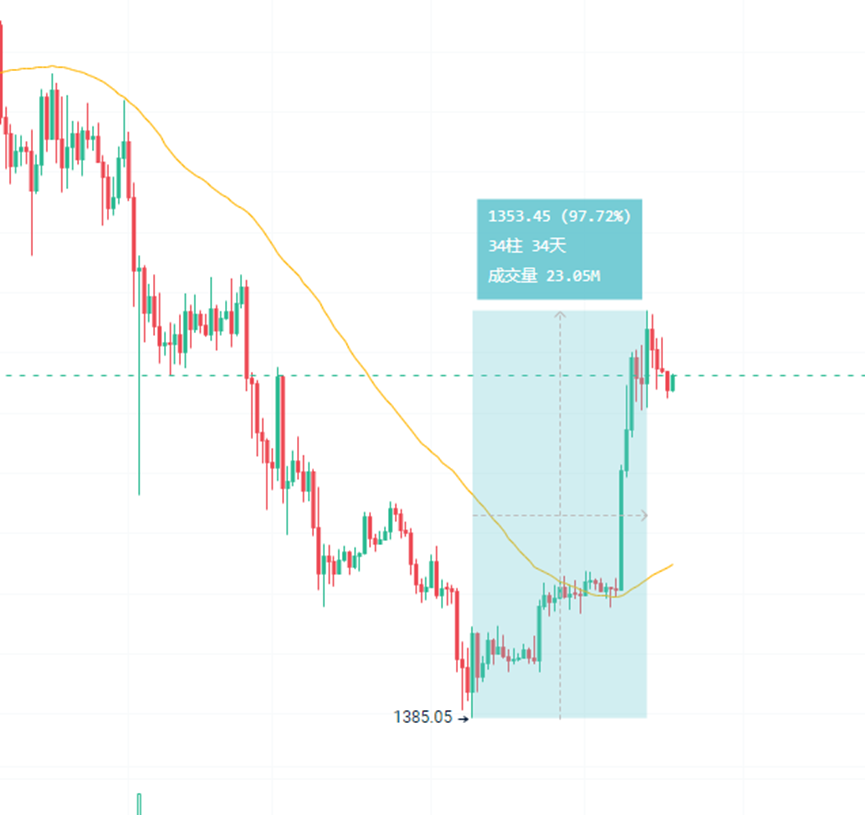
When the price of Ethereum rebounded from a low of $1,385 to $2,700, the 97.7% increase was accompanied by a capital split. Institutional funds remained cautious in the ETF market, but the open interest of derivative contracts hit a record high of $32.2 billion. After a long period of depression, the market hopes to prove that Ethereum is still a value trough through this rebound, and the Pectra upgrade seems to provide evidence for this narrative. PANews attempts to outline the current true state of Ethereum through a comprehensive interpretation of Ethereum data. An Ethereum that is undergoing value reconstruction is gradually emerging.

Market and Funds: Caution of ETFs and Enthusiasm of Contracts

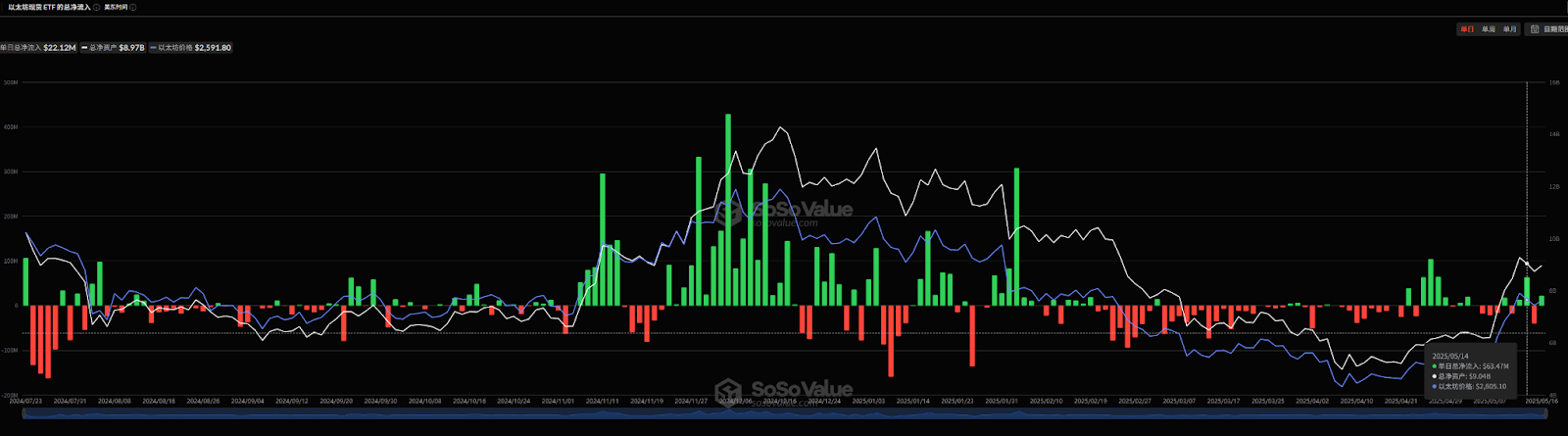
As of May 18, the total net asset value of the US ETH ETF reached 8.97 billion US dollars, accounting for 2.89% of the total market value of Ethereum. Compared with the 5.95% of Bitcoin ETF, this proportion is still low. Overall, it seems that Bitcoin is still more popular in the ETF market.
Data interpretation of Ethereum after the surge and rebound: the ecological cold and hot faults behind the value reconstruction

In addition, from February to the end of April, the funds of Ethereum ETF were mostly in outflow. It was not until April 21 that it began to flow back again, but the overall return data was not obvious. The net inflow of Ethereum ETF in April was about 66.25 million US dollars, and the net inflow so far in May was about 30 million US dollars.
Data interpretation of Ethereum after the surge and rebound: the ecological cold and hot faults behind the value reconstruction

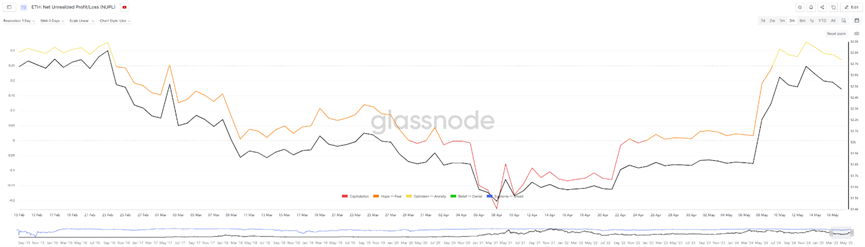
According to data from Glassnode, it was not until the end of April that Ethereum's "Net Unrealized Profit/Loss" (NUPL) value reversed to a positive number again. Prior to that, from April 1 to 22, the NUPL value was always negative. During this period, the price of Ethereum fell below $1,800, with the lowest price dropping to $1,385. That is to say, when the price of Ethereum fell below $1,800, the overall holding addresses were basically in a loss state. However, this negative data sometimes also indicates a signal of the market bottom, because the selling pressure is close to exhaustion at this stage. However, as of May 17, the NUPL value reached a maximum of 0.328. Judging from the range of values, it is still in the early stage of the bull market or the recovery period, and has not yet reached an extremely optimistic stage.
Data interpretation of Ethereum after the surge and rebound: the ecological cold and hot faults behind the value reconstruction

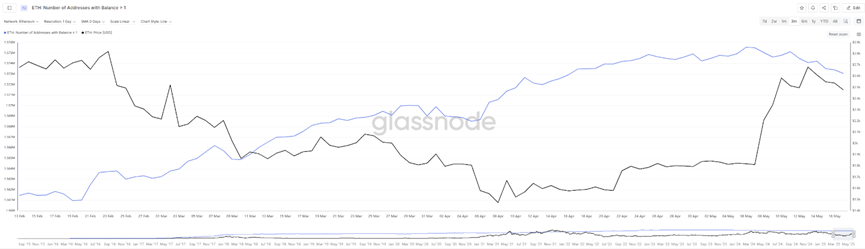
Another interesting data is that the number of addresses with a balance greater than 1 on the Ethereum chain has fallen as the price rebounded. In the previous price decline, this data has been rising, indicating that many investors still choose to buy at the bottom in the downward phase. When the price rose to $1,800, some addresses chose to take profits and exit. However, the decline in this proportion is not very high, only about one thousandth. As the price rebounds, the current percentage of profitable addresses in Ethereum has reached 60%.
Data interpretation of Ethereum after the surge and rebound: the ecological cold and hot faults behind the value reconstruction

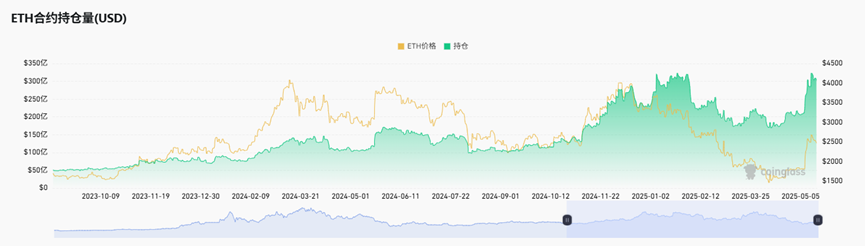
Although the recent price rebound is still far from the historical high, the contract open interest has reached a historical high recently. On May 14, the Ethereum contract open interest reached 32.249 billion US dollars, which is almost the highest contract open interest level in history. The last time the contract volume reached this value was in January-February 2025, when the price of Ethereum fluctuated between 3,000 and 3,800 US dollars. It can also be seen that the market is still very keen to bet on Ethereum.

Overall, looking at the market and funding data, Ethereum began to see a positive inflow of funds at the bottom of its price range at the end of April, and its price subsequently rose sharply, with the highest increase reaching 97.7%, nearly doubling. However, judging from the inflow of funds, especially the flow of ETF funds, the proportion of increased funds from traditional institutions is still not high.
Data interpretation of Ethereum after the surge and rebound: the ecological cold and hot faults behind the value reconstruction

TVL rebounds, but low gas fails to activate transaction volume

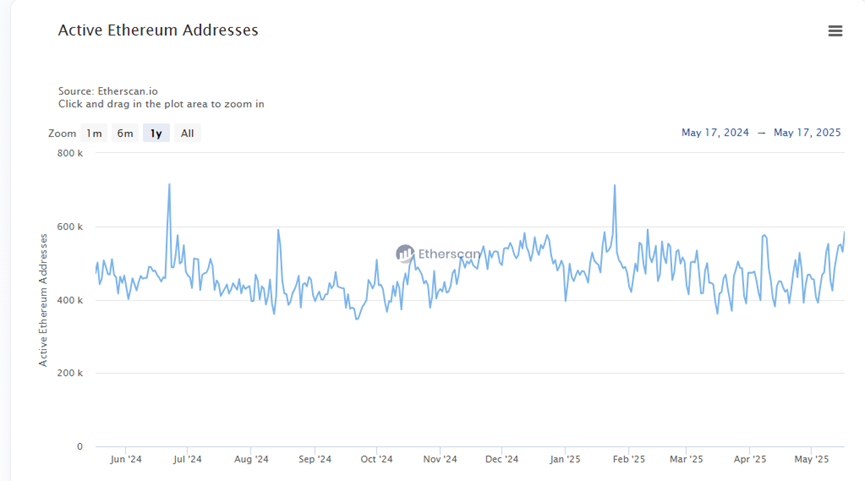
From the perspective of on-chain activity, the change in Ethereum active addresses is not obvious, and the current value is still fluctuating between 400,000 and 600,000 per day. This fluctuation pattern has been maintained for more than a year, but the recent fluctuation curve has broken through the 600,000 range.
Data interpretation of Ethereum after the surge and rebound: the ecological cold and hot faults behind the value reconstruction

Another important data, TVL, has a more obvious trend of change. TVL in US dollars has rebounded since April 22, rising from around US$4.5 billion to around US$64.6 billion. However, considering the sharp rise in Ethereum prices during this period, this change may not reflect the real situation on the chain. After switching the ETH amount, it can be seen that since April 9, the ETH pledged on the Ethereum chain has dropped significantly, from a high of 30.26 million to a low of 24 million, a drop of 20%.

The reason for this phenomenon may be that during the rapid rise in Ethereum prices, some funds chose to take profits or avoid uncompensated losses, resulting in a reduction in the amount of tokens.

As for the changes in Gas, as of May 16, 2025, the average Gas price of Ethereum is 3.572 Gwei, a sharp drop of 21.57% from the previous day and a sharp drop of 51.76% from last year. The Gas fee has generally been on a downward trend in the past 30 days. It briefly soared to 10.61 Gwei on May 8, but has been maintained below 8 Gwei recently, and it was as low as 1.6 Gwei on May 3. This change is related to EIP-7691 in the Pectra upgrade, which aims to reduce L2 fees by expanding the blob space.

However, the extremely low gas fee does not seem to have stimulated an increase in on-chain transactions. In terms of the number of daily transactions, no significant changes have been seen.

DEX transactions and asset landscape: Stablecoin dominance and ecological transformation

According to the on-chain staking data, Ethereum's staking has been in a net outflow state from April 15 to May 5. In particular, Coinbase's staking has outflowed 30% in the past six months. Currently, Lido is still the validator with the most staking, with a staking amount of 9.11 million.
Data interpretation of Ethereum after the surge and rebound: the ecological cold and hot faults behind the value reconstruction

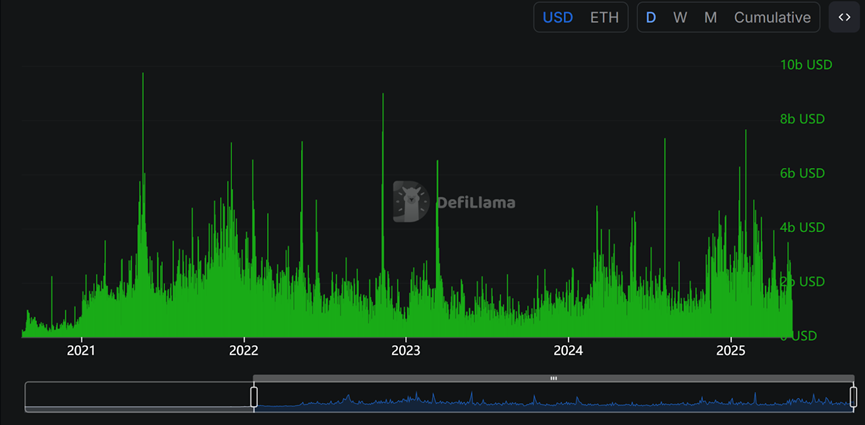
In terms of on-chain DEX transaction volume, the Ethereum mainnet has clearly entered an active period after entering 2025. The activity in this cycle is significantly higher than the performance in 2024, close to the peak period from 2021 to 2022. However, judging from the revenue data, the recent increase in trading activity mainly comes from stablecoin-related transactions. USDT has generated $568 million in fees on Ethereum in the past 30 days. As of May 18, Ethereum is still the public chain with the largest issuance of stablecoins, accounting for more than 50%, and the total issuance has reached $127.3 billion, which is twice the Ethereum DeFi TVL.
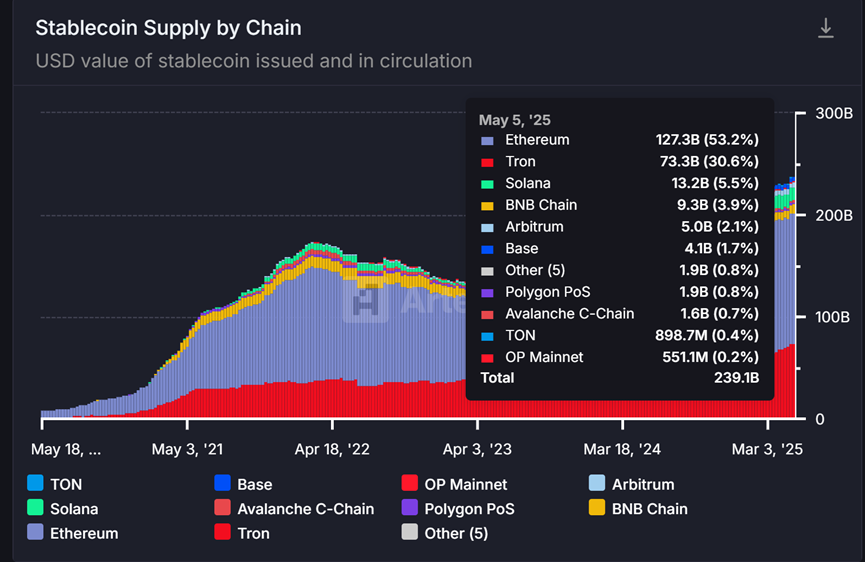
Data interpretation of Ethereum after the surge and rebound: the ecological cold and hot faults behind the value reconstruction

By analyzing the types of funds on the Ethereum chain, it can be seen that nearly half of the transactions on the Ethereum chain are completed by stablecoins and ETH transfers. And the proportion of stablecoin transactions is obviously increasing, while the proportion of DeFi and ERC-20 token transactions is actually still declining. This also shows that Ethereum is still transforming into the role of an asset value storage center on the chain, while the development of MEME and application categories seems to be restricted. From this point of view, Ethereum's strategy of trying to boost activity by reducing handling fees and increasing transaction speed may be difficult to work.
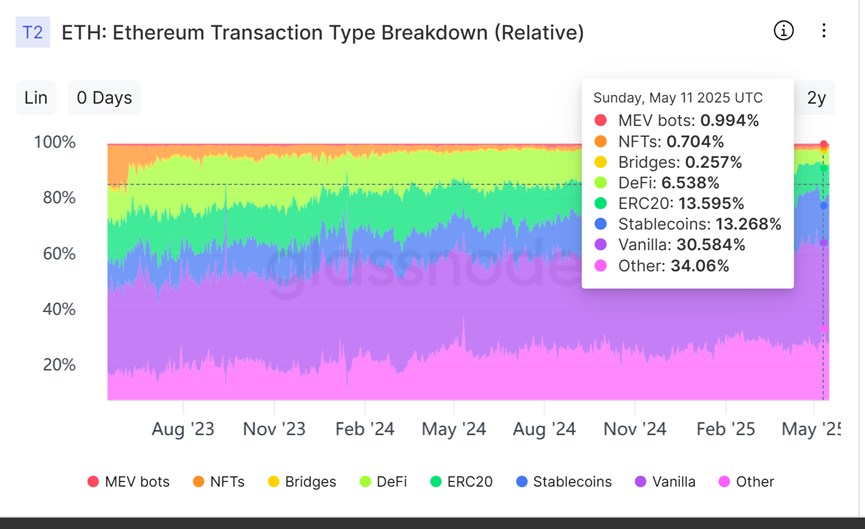
Data interpretation of Ethereum after the surge and rebound: the ecological cold and hot faults behind the value reconstruction

In addition, although the average single transfer amount on Ethereum has also declined recently, it is still between thousands of dollars and 10,000 US dollars. This data is far ahead of all public chains, and Solana's data is generally only tens of dollars. This shows that Ethereum is an absolute exclusive chain for large investors.

In general, the reason behind Ethereum’s recent price rebound is more like the result of the pain of transition. On the one hand, the Ethereum ecosystem has been trying to optimize performance through continuous technical updates and upgrades, but this effort seems to have failed. On the other hand, it is a place where large-scale funds and stablecoin transactions are concentrated, and the big players seem to be very satisfied with the current quiet state of Ethereum on the chain.

Therefore, the rise and fall of a single indicator can no longer simply define the "good" or "bad" of Ethereum. The market may need to go beyond the previous growth narrative and re-examine and understand the core role and long-term value of Ethereum in a multi-chain landscape. Instead of being obsessed with judging whether it is "rising" or "declining", it is better to realize that after all the noise and iterations, a more mature and "stable" Ethereum may be the inevitable direction and final appearance of its evolution.

Market Opportunity
Succinct Logo
Succinct Price(PROVE)
$0.3584
$0.3584$0.3584
-4.04%
USD
Succinct (PROVE) Live Price Chart
Disclaimer: The articles reposted on this site are sourced from public platforms and are provided for informational purposes only. They do not necessarily reflect the views of MEXC. All rights remain with the original authors. If you believe any content infringes on third-party rights, please contact service@support.mexc.com for removal. MEXC makes no guarantees regarding the accuracy, completeness, or timeliness of the content and is not responsible for any actions taken based on the information provided. The content does not constitute financial, legal, or other professional advice, nor should it be considered a recommendation or endorsement by MEXC.

You May Also Like

More On-Chain Activity as Over 131,000 Cardano Transactions Feature NIGHT Tokens

More On-Chain Activity as Over 131,000 Cardano Transactions Feature NIGHT Tokens

The launch of NIGHT, the native token of Midnight, has significantly impacted the number of transactions across the broader Cardano ecosystem. Cardano founder Charles
Share
Coinstats2025/12/18 15:13
What is Ethereum’s Fusaka Upgrade? Everything You Need to Know

What is Ethereum’s Fusaka Upgrade? Everything You Need to Know

Over the past few weeks, one of the most talked-about topics within the crypto community has been Ethereum’s Fusaka upgrade. What exactly is this upgrade, and how does it affect the Ethereum blockchain and the average crypto investor? This article will be the only explainer guide you need to understand the details of this upgrade within the Ethereum ecosystem. Why Does Ethereum Undergo Upgrades? To understand what the Fusaka upgrade will achieve, it is essential to comprehend what Ethereum’s upgrades aim to accomplish. The layer-1 Ethereum network was originally designed as a proof-of-work (PoW) blockchain. This implied that miners were actively behind the block mining process. While this consensus mechanism ensured security for the L1 blockchain, it also triggered slower transactions. The Ethereum development team unveiled a detailed roadmap, outlining various upgrades that will fix most of the network’s issues. These problems include its scalability issue, which refers to the network’s ability to process transactions faster. Currently, the Ethereum blockchain processes fewer transactions per second compared to most blockchains using the proof-of-stake (PoS) consensus mechanism. Over the past decade, Ethereum’s developers have implemented most of these upgrades, enhancing the blockchain’s overall performance. Here is a list of the upgrades that Ethereum has undergone: Frontier: July 2015 Frontier Thawing: September 2015 Homestead: March 2016 DAO Fork: July 2016 Tangerine Whistle: October 2016 Spurious Dragon: November 2016 Byzantium: October 2017 Constantinople: February 2019 Petersburg: February 2019 Istanbul: December 2019 Muir Glacier: January 2020 Berlin: April 2021 London: August 2021 Arrow Glacier: December 2021 Gray Glacier: June 2022 The Merge: September 2022 Bellatrix: September 2022 Paris: September 2022 Shanghai: April 2023 Capella: April 2023 Dencun (Cancun-Deneb): March 2024 Pectra (Prague-Electra): May 2025 Most of these upgrades (forks) addressed various Ethereum Improvement Proposals (EIPs) geared towards driving the blockchain’s growth. For instance, the Merge enabled the transition from the PoW model to a proof of stake (PoS) algorithm. This brought staking and network validators into the Ethereum mainnet. Still, this upgrade failed to unlock the much-needed scalability. For most of Ethereum’s existence, it has housed layer-2 networks, which leverage Ethereum’s infrastructure to tackle the scalability issue. While benefiting from the L1 blockchain’s security and decentralization, these L2 networks enable users to execute lightning-fast transactions. Last year’s Dencun upgrade made transacting on layer-2 networks even easier with the introduction of proto-danksharding (EIP-4844). Poised to address the scalability issue, this upgrade introduces data blobs. You can think of these blobs as temporary, large data containers that enable cheaper, yet temporary, storage of transactions on L2 networks. The effect? It reduces gas fees, facilitating cheaper transaction costs on these L2 rollups. The Pectra upgrade, unveiled earlier this year, also included EIPs addressing the scalability issue plaguing the Ethereum ecosystem. The upcoming upgrade, Fusaka, will help the decade-old blockchain network to become more efficient by improving the blob capacity. What is Ethereum’s Fusaka Upgrade? Fusaka is an upgrade that addresses Ethereum’s scalability issue, thereby making the blockchain network more efficient. As mentioned earlier, Fusaka will bolster the blob capacity for layer-2 blockchains, which refers to the amount of temporary data the network can process. This will help facilitate faster transactions on these L2 scaling solutions. It is worth noting that upon Fusaka’s completion, users will be able to save more when performing transactions across layer-2 networks like Polygon, Arbitrum, and Base. The upgrade has no direct positive impact on the L1 blockchain itself. On September 18th, Christine Kim, representing Ethereum core developers, confirmed the launch date for Fusaka via an X post. Following an All Core Developers Consensus (ACDC) call, the developer announced that the Ethereum Fusaka upgrade will take place on December 3rd. Ahead of the upgrade, there will be three public testnets. Fusaka will first be deployed on Holesky around October 1st. If that goes smoothly, it will move to Sepolia on October 14th. Finally, it will be on the Hoodi testnet on October 28th. Each stage provides developers and node operators with an opportunity to identify and address bugs, run stress tests, and verify that the network can effectively handle the new features. Running through all three testnets ensures that by the time the upgrade is ready for mainnet, it will have been thoroughly tested in different environments. Crucial to the Fusaka upgrade are the Blob Parameter Only (BPO) forks, which will enhance the blob capacity without requiring end-users of the blockchain network to undergo any software changes. For several months, the Ethereum development team has been working towards unveiling the BPO-1 and BPO-2 forks. Blockchain developers have pooled resources to develop Fusaka through devnets. Following performances from devnet-5, developers within the ecosystem confirmed that the BPO upgrades will come shortly after the Fusaka mainnet debut. Approximately two weeks after the mainnet launch, on December 17th, the BPO-1 fork will increase the blob target/max from 6/9 to 10/15. Then, two weeks later, on January 7th, 2026, the BPO-2 fork is expected to expand capacity further to a metric of 14/21. Ultimately, the Fusaka upgrade would have doubled the blob capacity, marking a pivotal move for the Ethereum ecosystem. Impact on the Ethereum Ecosystem Admittedly, the Ethereum ecosystem is expected to see more developers and users join the bandwagon. With the introduction of faster and cheaper transactions, developers and business owners can explore more efficient ways to build on the L1 blockchain. This means we can see initiatives like crypto payment solutions and more decentralized finance (DeFi) projects enter the Ethereum bandwagon. Users, on the other hand, will benefit as they execute cheaper on-chain transactions. Despite the benefits from this initiative, some in the crypto community worry about the reduction in Ethereum’s gwei (the smallest unit of the Ether coin). Shortly after the Dencun upgrade, Ethereum’s median gas fee dropped to 1.7 gwei. Fast-forward to the present, and the median gas fee sits at 0.41 gwei, according to public data on Dune. This drop hints at the drastic reduction in gas fees, which could affect those staking their crypto holdings on the L1 blockchain, making it less attractive to stakers. Since the Fusaka upgrade aims to reduce the L2 network gas fee further, some observers may worry that crypto stakers will receive fewer block rewards. Time will tell if the Ethereum development team will explore new incentives for those participating in staking. Will Ether’s Price Pump? There is no guarantee that Ether (ETH) will jump following Fusaka’s launch in December. This is because the second-largest cryptocurrency saw no significant price movement during past major upgrades. According to data from CoinMarketCap, ETH sold for approximately $4,400 at the time of writing. Notably, the coin saw its current all-time high (ATH) of $4,900 roughly a month ago. The price pump was fueled by consistent Ether acquisitions by exchange-traded fund (ETF) buyers and crypto treasury firms. Source: CoinMarketCap Although these upgrades do not guarantee a surge in ETH’s price, they have a lasting impact on the underlying Ethereum blockchain. Conclusion Over the past 10 years, the Ethereum network has had no rest as it constantly ships out new upgrades to make its mainnet more scalable. The Fusaka upgrade aims to make Ethereum layer-2 networks cheaper to use. To ensure its smooth usage, several testnets are lined up. Stay tuned for updates on how Ethereum will be post-Fusaka. The post What is Ethereum’s Fusaka Upgrade? Everything You Need to Know appeared first on Cointab.
Share
Coinstats2025/09/20 06:57
Vitalik Buterin Suggests Simplifying Ethereum to Boost User Understanding

Vitalik Buterin Suggests Simplifying Ethereum to Boost User Understanding

The post Vitalik Buterin Suggests Simplifying Ethereum to Boost User Understanding appeared on BitcoinEthereumNews.com. Ethereum trustlessness requires broader
Share
BitcoinEthereumNews2025/12/18 15:13