The post Dow Jones futures remain steady as traders expect brief government shutdown appeared on BitcoinEthereumNews.com. Dow Jones futures hover near 46,700 during European hours on Thursday, ahead of the regular session opening in the United States (US). However, the S&P 500 futures advance 0.17% to stay above 6,750, while Nasdaq 100 futures rise 0.37% to break above 25,100. US index futures show mixed performance as traders largely shrug off concerns over the ongoing US government shutdown. However, the shutdown put thousands of federal jobs at risk after partisan divisions blocked Congress and the White House from reaching a funding agreement. The US Bureau of Labor Statistics halted virtually all activity, which may cause the delay of the September US Nonfarm Payrolls (NFP) report due on Friday. On Wednesday, the US ADP Employment Change showed the private sector payrolls declined by 32,000 in September, while annual pay growth was 4.5%. This figure followed the 3,000 decrease (revised from a 54,000 increase) reported in August and came in below the market expectation of 50,000. On Wednesday’s regular session, the Dow Jones rose 0.09%, while the S&P 500 advanced 0.34% and the Nasdaq Composite gained 0.42%. Health-care stocks led the rally, with Regeneron climbing 6.7%, Moderna up 6.8%, and AbbVie gaining 5.5%. Additional support came from optimism over Pfizer’s 2.2% rise following its deal with the White House on Medicaid drug pricing. US stocks also draw support as the labor market weakness boosts bets on further Federal Reserve (Fed) rate cuts. The CME FedWatch Tool suggests that markets are now pricing in a 99% chance of a Fed rate cut in October and an 87% possibility of another reduction in December. Dow Jones FAQs The Dow Jones Industrial Average, one of the oldest stock market indices in the world, is compiled of the 30 most traded stocks in the US. The index is price-weighted rather than weighted by… The post Dow Jones futures remain steady as traders expect brief government shutdown appeared on BitcoinEthereumNews.com. Dow Jones futures hover near 46,700 during European hours on Thursday, ahead of the regular session opening in the United States (US). However, the S&P 500 futures advance 0.17% to stay above 6,750, while Nasdaq 100 futures rise 0.37% to break above 25,100. US index futures show mixed performance as traders largely shrug off concerns over the ongoing US government shutdown. However, the shutdown put thousands of federal jobs at risk after partisan divisions blocked Congress and the White House from reaching a funding agreement. The US Bureau of Labor Statistics halted virtually all activity, which may cause the delay of the September US Nonfarm Payrolls (NFP) report due on Friday. On Wednesday, the US ADP Employment Change showed the private sector payrolls declined by 32,000 in September, while annual pay growth was 4.5%. This figure followed the 3,000 decrease (revised from a 54,000 increase) reported in August and came in below the market expectation of 50,000. On Wednesday’s regular session, the Dow Jones rose 0.09%, while the S&P 500 advanced 0.34% and the Nasdaq Composite gained 0.42%. Health-care stocks led the rally, with Regeneron climbing 6.7%, Moderna up 6.8%, and AbbVie gaining 5.5%. Additional support came from optimism over Pfizer’s 2.2% rise following its deal with the White House on Medicaid drug pricing. US stocks also draw support as the labor market weakness boosts bets on further Federal Reserve (Fed) rate cuts. The CME FedWatch Tool suggests that markets are now pricing in a 99% chance of a Fed rate cut in October and an 87% possibility of another reduction in December. Dow Jones FAQs The Dow Jones Industrial Average, one of the oldest stock market indices in the world, is compiled of the 30 most traded stocks in the US. The index is price-weighted rather than weighted by…

Dow Jones futures remain steady as traders expect brief government shutdown

Dow Jones futures hover near 46,700 during European hours on Thursday, ahead of the regular session opening in the United States (US). However, the S&P 500 futures advance 0.17% to stay above 6,750, while Nasdaq 100 futures rise 0.37% to break above 25,100.

US index futures show mixed performance as traders largely shrug off concerns over the ongoing US government shutdown. However, the shutdown put thousands of federal jobs at risk after partisan divisions blocked Congress and the White House from reaching a funding agreement.

The US Bureau of Labor Statistics halted virtually all activity, which may cause the delay of the September US Nonfarm Payrolls (NFP) report due on Friday. On Wednesday, the US ADP Employment Change showed the private sector payrolls declined by 32,000 in September, while annual pay growth was 4.5%. This figure followed the 3,000 decrease (revised from a 54,000 increase) reported in August and came in below the market expectation of 50,000.

On Wednesday’s regular session, the Dow Jones rose 0.09%, while the S&P 500 advanced 0.34% and the Nasdaq Composite gained 0.42%. Health-care stocks led the rally, with Regeneron climbing 6.7%, Moderna up 6.8%, and AbbVie gaining 5.5%. Additional support came from optimism over Pfizer’s 2.2% rise following its deal with the White House on Medicaid drug pricing.

US stocks also draw support as the labor market weakness boosts bets on further Federal Reserve (Fed) rate cuts. The CME FedWatch Tool suggests that markets are now pricing in a 99% chance of a Fed rate cut in October and an 87% possibility of another reduction in December.

Dow Jones FAQs

The Dow Jones Industrial Average, one of the oldest stock market indices in the world, is compiled of the 30 most traded stocks in the US. The index is price-weighted rather than weighted by capitalization. It is calculated by summing the prices of the constituent stocks and dividing them by a factor, currently 0.152. The index was founded by Charles Dow, who also founded the Wall Street Journal. In later years it has been criticized for not being broadly representative enough because it only tracks 30 conglomerates, unlike broader indices such as the S&P 500.

Many different factors drive the Dow Jones Industrial Average (DJIA). The aggregate performance of the component companies revealed in quarterly company earnings reports is the main one. US and global macroeconomic data also contributes as it impacts on investor sentiment. The level of interest rates, set by the Federal Reserve (Fed), also influences the DJIA as it affects the cost of credit, on which many corporations are heavily reliant. Therefore, inflation can be a major driver as well as other metrics which impact the Fed decisions.

Dow Theory is a method for identifying the primary trend of the stock market developed by Charles Dow. A key step is to compare the direction of the Dow Jones Industrial Average (DJIA) and the Dow Jones Transportation Average (DJTA) and only follow trends where both are moving in the same direction. Volume is a confirmatory criteria. The theory uses elements of peak and trough analysis. Dow’s theory posits three trend phases: accumulation, when smart money starts buying or selling; public participation, when the wider public joins in; and distribution, when the smart money exits.

There are a number of ways to trade the DJIA. One is to use ETFs which allow investors to trade the DJIA as a single security, rather than having to buy shares in all 30 constituent companies. A leading example is the SPDR Dow Jones Industrial Average ETF (DIA). DJIA futures contracts enable traders to speculate on the future value of the index and Options provide the right, but not the obligation, to buy or sell the index at a predetermined price in the future. Mutual funds enable investors to buy a share of a diversified portfolio of DJIA stocks thus providing exposure to the overall index.

Source: https://www.fxstreet.com/news/dow-jones-futures-remain-steady-as-traders-expect-brief-government-shutdown-202510020917
Market Opportunity
NEAR Logo
NEAR Price(NEAR)
$1.0188
$1.0188$1.0188
+0.29%
USD
NEAR (NEAR) Live Price Chart
Disclaimer: The articles reposted on this site are sourced from public platforms and are provided for informational purposes only. They do not necessarily reflect the views of MEXC. All rights remain with the original authors. If you believe any content infringes on third-party rights, please contact service@support.mexc.com for removal. MEXC makes no guarantees regarding the accuracy, completeness, or timeliness of the content and is not responsible for any actions taken based on the information provided. The content does not constitute financial, legal, or other professional advice, nor should it be considered a recommendation or endorsement by MEXC.

You May Also Like

Pippin (PIPPIN) Price Prediction 2026–2030: Can PIPPIN Hit $0.70 Soon?

Pippin (PIPPIN) Price Prediction 2026–2030: Can PIPPIN Hit $0.70 Soon?

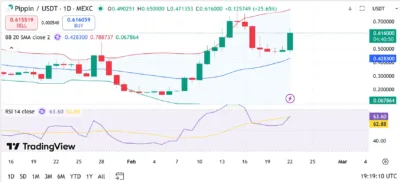
PIPPIN has surged sharply on the daily timeframe, printing a powerful bullish candle with over 25% gains. RSI is holding above 60, signaling strengthening momentum
Share
Coinstats2026/02/23 04:29
Will Cardano Reach $10 by 2030? Analysts Break Down ADA’s Growth Cycles

Will Cardano Reach $10 by 2030? Analysts Break Down ADA’s Growth Cycles

The post Will Cardano Reach $10 by 2030? Analysts Break Down ADA’s Growth Cycles appeared first on Coinpedia Fintech News Cardano (ADA) is trading at $0.9024 with a market cap of $32.91 billion. Experts say ADA has the potential to climb much higher, with some placing long-term targets as high as $10. The token continues to benefit from stronger visibility, rising liquidity, and increasing inflows from both institutional and retail markets. Can Cardano Hit $10 …
Share
CoinPedia2025/09/18 17:19
Crypto whale loses $6M to sneaky phishing scheme targeting staked Ethereum

Crypto whale loses $6M to sneaky phishing scheme targeting staked Ethereum

The post Crypto whale loses $6M to sneaky phishing scheme targeting staked Ethereum appeared on BitcoinEthereumNews.com. A crypto whale lost more than $6 million in staked Ethereum (stETH) and Aave-wrapped Bitcoin (aEthWBTC) after approving malicious signatures in a phishing scheme on Sept. 18, according to blockchain security firm Scam Sniffer. According to the firm, the attackers disguised their move as a routine wallet confirmation through “Permit” signatures, which tricked the victim into authorizing fund transfers without triggering obvious red flags. Yu Xian, founder of blockchain security company SlowMist, noted that the victim did not recognize the danger because the transaction required no gas fees. He wrote: “From the victim’s perspective, he just clicked a few times to confirm the wallet’s pop-up signature requests, didn’t spend a single penny of gas, and $6.28 million was gone.” How Permit exploits work Permit approvals were originally designed to simplify token transfers. Instead of submitting an on-chain approval and paying fees, a user can sign an off-chain message authorizing a spender. That efficiency, however, has created a new attack surface for malicious players. Once a user signs such a permit, attackers can combine two functions—Permit and TransferFrom—to drain assets directly. Because the authorization takes place off-chain, wallet dashboards show no unusual activity until the funds move. As a result, the assets are gone when the approval executes on-chain, and tokens are redirected to the attacker’s wallet. This loophole has made permit exploits increasingly attractive for malicious actors, who can siphon millions without needing complex hacks or high-cost gas wars. Phishing losses The latest theft highlights a wider trend of escalating phishing campaigns. Scam Sniffer reported that in August alone, attackers stole $12.17 million from more than 15,200 victims. That figure represented a 72% jump in losses compared with July. According to the firm, the most significant share of August’s damages came from three large accounts that accounted for nearly half…
Share
BitcoinEthereumNews2025/09/19 02:31