ECB advisor Jürgen Schaaf warns that the rapid rise of dollar-backed stablecoins threatens Europe’s financial stability and the euro’s global standing unless strategic action is taken. In a new blog post on the European Central Bank’s website titled “From Hype…ECB advisor Jürgen Schaaf warns that the rapid rise of dollar-backed stablecoins threatens Europe’s financial stability and the euro’s global standing unless strategic action is taken. In a new blog post on the European Central Bank’s website titled “From Hype…

ECB advisor sounds alarm on growing dominance of dollar-denominated stablecoins

ECB advisor Jürgen Schaaf warns that the rapid rise of dollar-backed stablecoins threatens Europe’s financial stability and the euro’s global standing unless strategic action is taken.

Summary
  • US dollar-backed stablecoins make up 99% of the market, while euro-based stablecoins remain negligible.
  • Growing adoption of stablecoins for payments, settlements, and savings could weaken the ECB’s control over monetary policy.
  • Interest-bearing stablecoins risk diverting deposits from traditional banks, threatening credit availability in Europe.
  • Schaaf’s call to action includes supporting euro-based stablecoins, advancing the digital euro, and innovating cross-border payments with distributed ledger technology.

In a new blog post on the European Central Bank’s website titled “From Hype to Hazard: What Stablecoins Mean for Europe,” ECB advisor Jürgen Schaaf says that stablecoins pose a strategic threat to the euro’s global standing, warning that “without a strategic response, European monetary sovereignty and financial stability could erode.”

Stablecoins, led by Tether (USDT) and Circle’s USD Coin (USDC), now account for 99% of the stablecoin market cap, nearly all denominated in US dollars. Euro-denominated stablecoins remain marginal, with a combined market cap of less than €350 million.
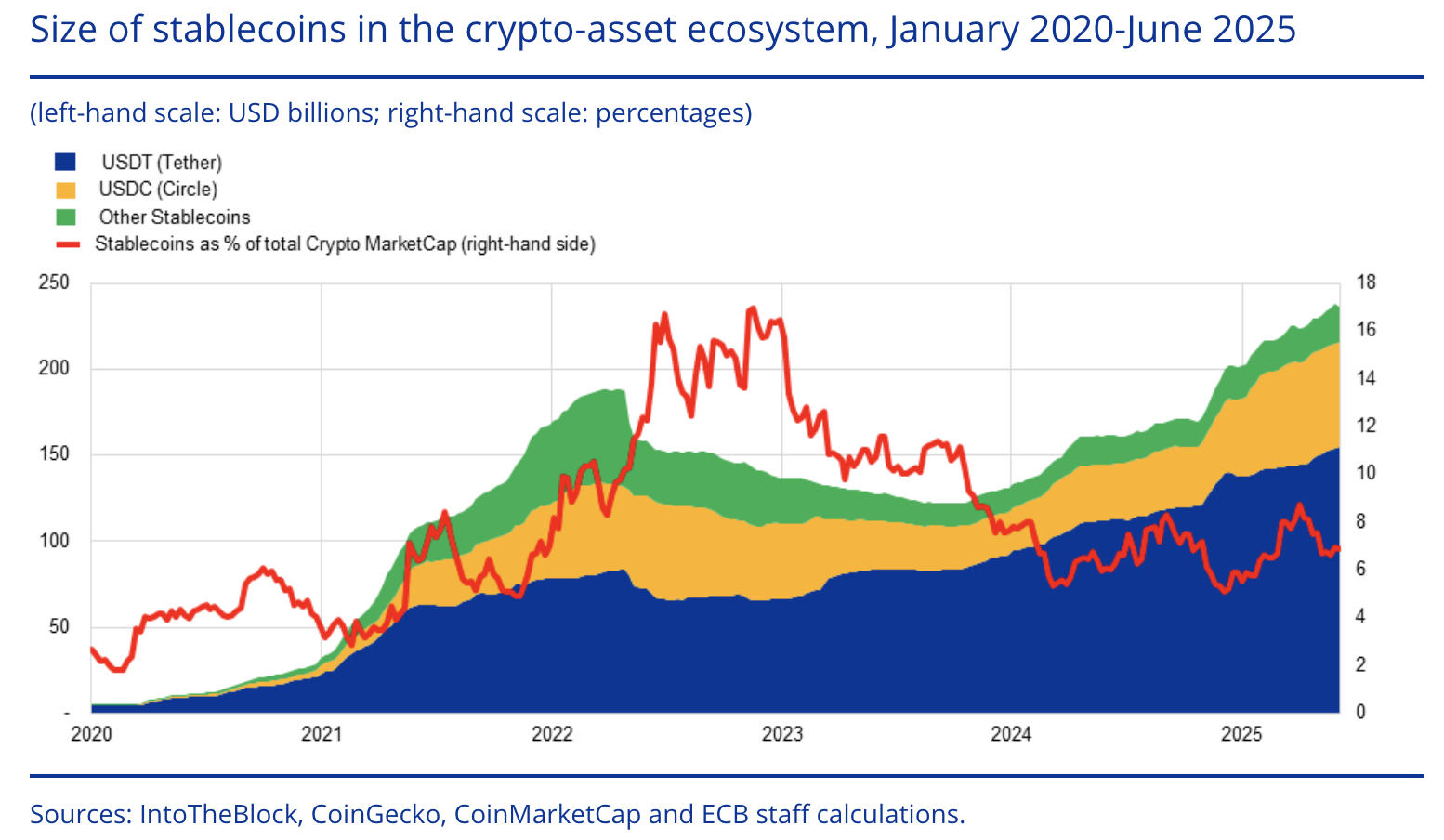
ECB advisor sounds alarm on growing dominance of dollar-denominated stablecoins - 1

The danger, Schaaf warns, is not just speculative. As stablecoins become more widely adopted for payments, settlement, and even savings, they increasingly bypass traditional financial systems—potentially undercutting the ECB’s ability to implement effective monetary policy.

“The larger their footprint, the harder these [dollar-dominated stablecoins] would be to unwind,” Schaaf writes. “This would mean higher financing costs relative to the United States, reduced monetary policy autonomy and geopolitical dependency” for Europe.

Stablecoins’ growing real-world impact and risks to banks

Schaaf points out that stablecoins are already being tested for real-world applications beyond crypto trading, including remittances, e-commerce, and institutional settlement. U.S. firms such as Amazon and Walmart are exploring stablecoin integrations, while global payment giants Visa and Mastercard are rolling them into international services.

Moreover, stablecoins begin to offer interest-like features, such as yield from lending or liquidity provision, which poses a threat to traditional banking models, especially in deposit-heavy economies like the euro area.

“If interest-bearing stablecoins became common… they could divert deposits from traditional banks, which could jeopardise financial intermediation and hamper credit availability,” Schaaf writes.

Schaaf’s call to action to protecting the euro

To tackle the risks posed by stablecoins, Schaaf lays out several practical steps Europe should take to protect its financial system and strengthen the euro’s global role.

His main suggestion is to support well-regulated, euro-based stablecoins. Such stablecoins, he argues, could not only “serve legitimate market needs” but also help “reinforce the international role of the euro,” offering a viable alternative to the growing dominance of dollar-based tokens.

Another key part of the plan is the digital euro, which Schaaf sees as “a robust line of defence of European monetary sovereignty,” especially for everyday payments like shopping and online purchases.

Schaaf also points to the need for innovation in larger, behind-the-scenes payments between banks and financial institutions. Cross-border payments are still slow and expensive. Schaaf argues that distributed ledger technology (DLT) could fix this by allowing faster, more direct settlement of tokenised assets using central bank money. He highlights two new projects from the European Central Bank—Pontes and Appia—as important steps forward.

Finally, Schaaf stresses the importance of global cooperation. Without common rules, he warns, “we risk fuelling instability, regulatory arbitrage and global US dollar dominance.”

Market Opportunity
Hyperliquid Logo
Hyperliquid Price(HYPE)
$24.13
$24.13$24.13
-0.33%
USD
Hyperliquid (HYPE) Live Price Chart
Disclaimer: The articles reposted on this site are sourced from public platforms and are provided for informational purposes only. They do not necessarily reflect the views of MEXC. All rights remain with the original authors. If you believe any content infringes on third-party rights, please contact service@support.mexc.com for removal. MEXC makes no guarantees regarding the accuracy, completeness, or timeliness of the content and is not responsible for any actions taken based on the information provided. The content does not constitute financial, legal, or other professional advice, nor should it be considered a recommendation or endorsement by MEXC.

You May Also Like

Watch Out: Numerous Economic Developments and Altcoin Events This Week! Here’s the Day-by-Day, Hour-by-Hour List

Watch Out: Numerous Economic Developments and Altcoin Events This Week! Here’s the Day-by-Day, Hour-by-Hour List

The post Watch Out: Numerous Economic Developments and Altcoin Events This Week! Here’s the Day-by-Day, Hour-by-Hour List appeared on BitcoinEthereumNews.com.
Share
BitcoinEthereumNews2025/12/22 03:39
UK and US Seal $42 Billion Tech Pact Driving AI and Energy Future

UK and US Seal $42 Billion Tech Pact Driving AI and Energy Future

The post UK and US Seal $42 Billion Tech Pact Driving AI and Energy Future appeared on BitcoinEthereumNews.com. Key Highlights Microsoft and Google pledge billions as part of UK US tech partnership Nvidia to deploy 120,000 GPUs with British firm Nscale in Project Stargate Deal positions UK as an innovation hub rivaling global tech powers UK and US Seal $42 Billion Tech Pact Driving AI and Energy Future The UK and the US have signed a “Technological Prosperity Agreement” that paves the way for joint projects in artificial intelligence, quantum computing, and nuclear energy, according to Reuters. Donald Trump and King Charles review the guard of honour at Windsor Castle, 17 September 2025. Image: Kirsty Wigglesworth/Reuters The agreement was unveiled ahead of U.S. President Donald Trump’s second state visit to the UK, marking a historic moment in transatlantic technology cooperation. Billions Flow Into the UK Tech Sector As part of the deal, major American corporations pledged to invest $42 billion in the UK. Microsoft leads with a $30 billion investment to expand cloud and AI infrastructure, including the construction of a new supercomputer in Loughton. Nvidia will deploy 120,000 GPUs, including up to 60,000 Grace Blackwell Ultra chips—in partnership with the British company Nscale as part of Project Stargate. Google is contributing $6.8 billion to build a data center in Waltham Cross and expand DeepMind research. Other companies are joining as well. CoreWeave announced a $3.4 billion investment in data centers, while Salesforce, Scale AI, BlackRock, Oracle, and AWS confirmed additional investments ranging from hundreds of millions to several billion dollars. UK Positions Itself as a Global Innovation Hub British Prime Minister Keir Starmer said the deal could impact millions of lives across the Atlantic. He stressed that the UK aims to position itself as an investment hub with lighter regulations than the European Union. Nvidia spokesman David Hogan noted the significance of the agreement, saying it would…
Share
BitcoinEthereumNews2025/09/18 02:22
Aave DAO to Shut Down 50% of L2s While Doubling Down on GHO

Aave DAO to Shut Down 50% of L2s While Doubling Down on GHO

The post Aave DAO to Shut Down 50% of L2s While Doubling Down on GHO appeared on BitcoinEthereumNews.com. Aave DAO is gearing up for a significant overhaul by shutting down over 50% of underperforming L2 instances. It is also restructuring its governance framework and deploying over $100 million to boost GHO. This could be a pivotal moment that propels Aave back to the forefront of on-chain lending or sparks unprecedented controversy within the DeFi community. Sponsored Sponsored ACI Proposes Shutting Down 50% of L2s The “State of the Union” report by the Aave Chan Initiative (ACI) paints a candid picture. After a turbulent period in the DeFi market and internal challenges, Aave (AAVE) now leads in key metrics: TVL, revenue, market share, and borrowing volume. Aave’s annual revenue of $130 million surpasses the combined cash reserves of its competitors. Tokenomics improvements and the AAVE token buyback program have also contributed to the ecosystem’s growth. Aave global metrics. Source: Aave However, the ACI’s report also highlights several pain points. First, regarding the Layer-2 (L2) strategy. While Aave’s L2 strategy was once a key driver of success, it is no longer fit for purpose. Over half of Aave’s instances on L2s and alt-L1s are not economically viable. Based on year-to-date data, over 86.6% of Aave’s revenue comes from the mainnet, indicating that everything else is a side quest. On this basis, ACI proposes closing underperforming networks. The DAO should invest in key networks with significant differentiators. Second, ACI is pushing for a complete overhaul of the “friendly fork” framework, as most have been unimpressive regarding TVL and revenue. In some cases, attackers have exploited them to Aave’s detriment, as seen with Spark. Sponsored Sponsored “The friendly fork model had a good intention but bad execution where the DAO was too friendly towards these forks, allowing the DAO only little upside,” the report states. Third, the instance model, once a smart…
Share
BitcoinEthereumNews2025/09/18 02:28