The Ethereum Foundation (EF) has formalized a new leadership structure for its privacy program, elevating privacy from a set of parallel initiatives to a coordinated “Privacy @ EF” cluster that is explicitly organized around real-world use cases and deployability. Ethereum Makes Privacy A Priority In an October 1 post titled “Privacy Cluster Leadership Announcement,” EF […]The Ethereum Foundation (EF) has formalized a new leadership structure for its privacy program, elevating privacy from a set of parallel initiatives to a coordinated “Privacy @ EF” cluster that is explicitly organized around real-world use cases and deployability. Ethereum Makes Privacy A Priority In an October 1 post titled “Privacy Cluster Leadership Announcement,” EF […]

Ethereum Foundation Unveils Next Phase Of Its Privacy Revolution

The Ethereum Foundation (EF) has formalized a new leadership structure for its privacy program, elevating privacy from a set of parallel initiatives to a coordinated “Privacy @ EF” cluster that is explicitly organized around real-world use cases and deployability.

Ethereum Makes Privacy A Priority

In an October 1 post titled “Privacy Cluster Leadership Announcement,” EF said it is “organizing for scale and impact,” naming longtime ecosystem builder Igor Barinov as the coordinator of Privacy @ EF and Andy Guzman as the new coordinator of the PSE (Privacy & Scaling Explorations) team, succeeding Sam Richards. “Together, Igor and Andy will help ensure Ethereum’s privacy work is impactful, coherent, and accountable,” the Foundation wrote.

The announcement reframes EF’s privacy mission as three concrete pillars—“Private Reads,” “Private Writes,” and “Private Proving”—that directly map to user and institutional needs. Private Reads targets surveillance-resistant querying, authentication, and browsing; Private Writes focuses on shielding actions such as payments, governance, and transfers; and Private Proving aims to make proofs “efficient, portable, and usable across contexts like identities, data portability, and client-side proving.”

EF links these pillars to practical compliance and safety requirements, arguing they are “necessary for institutions to comply with data protection standards,” help individuals avoid metadata leaks, and “shield our private financial information.”The Foundation is explicit that privacy will no longer be treated as an abstract research track divorced from shipping software.

“For Ethereum to become a foundation for civilizational infrastructure, privacy cannot be abstract research alone. It must be organized, resourced, and deployed at scale,” the post states—an unusually direct articulation of the program’s end goal and a signal that the cluster will be judged on delivery as much as on research output.

The post closes with a blunt credo—“Privacy is normal, and Ethereum is for privacy”—and an open invitation for builders to connect with Barinov and Guzman and to explore a catalog of “700+ projects” in the on-chain privacy space.

Barinov, best known for founding Blockscout, Gnosis Chain, and zkBob, brings a mix of infrastructure, open-source stewardship, and applied privacy product experience. Guzman, who has been with PSE/EF since 2022, moves from strategy and product leadership into the top operational role for PSE, which EF describes as spanning applied cryptography, research, and engineering.

Substantively, the cluster model is designed to integrate ongoing work on privacy-preserving computation with Ethereum’s public verifiability guarantees. While the post does not enumerate specific deliverables or dates, its emphasis on “portable” and “usable” proving, institutional compliance, and metadata-minimizing reads implies a roadmap that extends beyond shielded transfers toward end-to-end private user journeys—identity, access, payments, and governance—compatible with L1/L2 designs and client-side proving patterns that have been maturing across the ecosystem.

At press time, ETH traded $4,380.
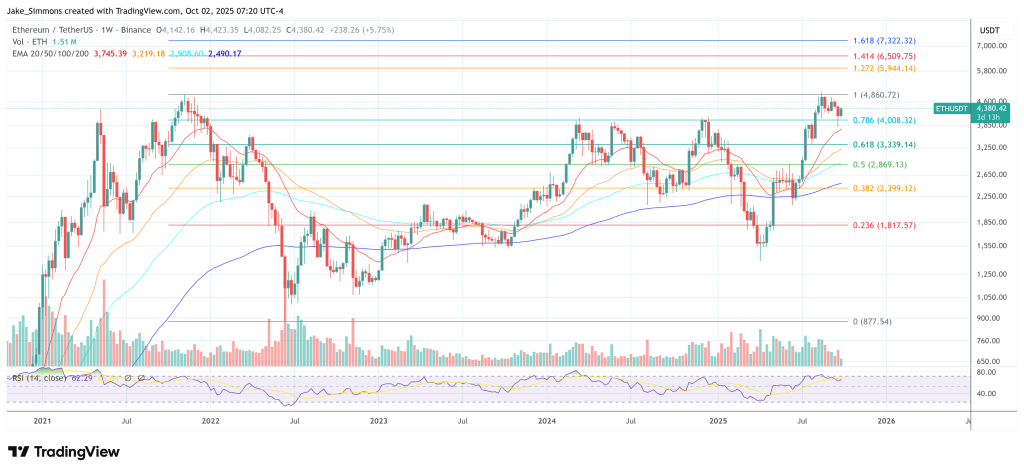
Ethereum price
Market Opportunity
RealLink Logo
RealLink Price(REAL)
$0.07608
$0.07608$0.07608
+0.63%
USD
RealLink (REAL) Live Price Chart
Disclaimer: The articles reposted on this site are sourced from public platforms and are provided for informational purposes only. They do not necessarily reflect the views of MEXC. All rights remain with the original authors. If you believe any content infringes on third-party rights, please contact service@support.mexc.com for removal. MEXC makes no guarantees regarding the accuracy, completeness, or timeliness of the content and is not responsible for any actions taken based on the information provided. The content does not constitute financial, legal, or other professional advice, nor should it be considered a recommendation or endorsement by MEXC.

You May Also Like

China Bans Nvidia’s RTX Pro 6000D Chip Amid AI Hardware Push

China Bans Nvidia’s RTX Pro 6000D Chip Amid AI Hardware Push

TLDR China instructs major firms to cancel orders for Nvidia’s RTX Pro 6000D chip. Nvidia shares drop 1.5% after China’s ban on key AI hardware. China accelerates development of domestic AI chips, reducing U.S. tech reliance. Crypto and AI sectors may seek alternatives due to limited Nvidia access in China. China has taken a bold [...] The post China Bans Nvidia’s RTX Pro 6000D Chip Amid AI Hardware Push appeared first on CoinCentral.
Share
Coincentral2025/09/18 01:09
How To Earn Crypto Cashback With Cold Wallet’s Every Transaction

How To Earn Crypto Cashback With Cold Wallet’s Every Transaction

The post How To Earn Crypto Cashback With Cold Wallet’s Every Transaction appeared on BitcoinEthereumNews.com. Crypto has long promised opportunity, but for most users, participation feels more like a penalty than a reward. Every swap, bridge, or simple transaction comes with fees that chip away at your balance. For newcomers, this becomes a barrier to entry, and for long-time users, it creates fatigue. Cold Wallet changes that equation by giving something back every time you act on-chain. Instead of paying fees into a void, you get rewarded with $CWT tokens that build your balance over time.  With over $7.11 million already raised in its presale, currently at stage 18 and priced at $0.01058 per token, Cold Wallet is proving that a fairer system isn’t just possible, it’s already here. At launch, $CWT is projected to list at $0.3517, adding even more incentive for early adopters to get involved now.  Cashback Built Into Every Action Cold Wallet introduces a simple but powerful concept: use the blockchain as usual, and you get cashback for it. Whether you’re paying gas fees, swapping between tokens, or bridging funds across networks, the wallet automatically rewards you with $CWT. There’s no staking contract to manage, no forms to fill out, and no hidden lock-ups to trap your funds. The system works in real time, making the experience seamless and effortless.  Cashback rates are tied to your tier, and with higher holdings of $CWT, you can reclaim even more of your transaction costs, up to 100% of gas fees at the top tier. For everyday users, this means turning unavoidable expenses into an income stream. For power users, it transforms frequent activity into a compounding advantage, giving them a reason to engage more often without the usual frustration of draining fees. The Role of $CWT in the Ecosystem At the heart of Cold Wallet’s cashback model is the $CWT token. Far from…
Share
BitcoinEthereumNews2025/09/26 21:27
Scott Bessent says yuan drop against euro is Europe’s problem, not America’s

Scott Bessent says yuan drop against euro is Europe’s problem, not America’s

The post Scott Bessent says yuan drop against euro is Europe’s problem, not America’s appeared on BitcoinEthereumNews.com. U.S. Treasury Secretary Scott Bessent said in Madrid on Thursday that the slump in China’s currency isn’t a problem for the United States, it’s Europe that should be worried. Speaking during a joint interview with Reuters and Bloomberg, Scott made the comments after meetings with Chinese Vice Premier He Lifeng as part of the U.S.-China trade discussions, which also included talks on TikTok. He made it clear that the yuan, also known as the renminbi, has actually strengthened against the U.S. dollar this year, but collapsed to a record low against the euro. “The RMB is actually stronger this year versus the dollar. Now it’s at an all-time low versus the euro, which is a problem for the Europeans,” Scott, rejecting the idea that Beijing was trying to devalue its currency to gain an unfair edge against Washington. He said Chinese officials haven’t tried anything of the sort with the U.S. and explained the reality behind the currency’s movement: “It’s a closed currency. So they manage the level.” Yuan collapse helps Chinese exports flood europe Since January, the yuan has plunged from 7.5 per euro to over 8.4, triggering concerns across Europe. Meanwhile, against the dollar, it’s gained slightly from 7.3 to 7.1. This divergence has created a lopsided trade dynamic, because while the U.S. has seen its imports from China drop 14% due to aggressive tariffs, Europe has recorded a 6.9% increase in trade with China. So, Scott said the U.S. tariffs are doing what they were meant to do, cutting down the trade deficit. But the redirected flow of Chinese goods is now landing in European markets instead, where the yuan’s weakness is making Chinese exports even cheaper in euro terms. The weakening of the yuan is hitting Europe at a sensitive time, as the European Central Bank…
Share
BitcoinEthereumNews2025/09/19 10:16