

Ethereum Price Holds Amid Bitmine Accumulation, ETF Inflows, and On-Chain Warnings

Ethereum is once again at the center of major institutional movement, following a week filled with billion-dollar buys, record ETF inflows, and validator congestion. The largest headline belongs to Bitmine Immersion Technologies, which purchased an impressive 2.1 million ETH, which is about 9.3 billion. The purchase, which sought to acquire 5% of the total Ethereum supply, instantly shot up Ethereum by approximately 3% and trading volume by 38 per cent, assuring that large money is still defining the Ethereum market.
This institutional surge isn’t limited to direct purchases. Ethereum spot ETFs recorded $638 million in net inflows between September 8 and 12, marking the fourth consecutive week of positive investor sentiment. Fidelity’s FETH led the way with $381 million in inflows, followed by BlackRock’s ETHA. With Ethereum ETFs now holding over $30 billion in net assets, the blockchain is becoming increasingly cemented as a core holding for traditional investors, even as short-term technical indicators point to a potential market pullback.
While institutional demand continues to absorb Ethereum’s liquid supply, retail interest is surging in a different corner of the crypto space: BullZilla ($BZIL). Currently one of the best crypto presales in 2025, BullZilla offers retail investors exposure to a meme-powered token with DeFi mechanics, staking utility, and strong ROI projections. With over $420,000 raised, 25.8 billion tokens sold, and a scheduled price increase of 11.27%, BullZilla is rapidly becoming a retail favorite amid Ethereum’s institution-driven consolidation.
Institutions Are Buying: Bitmine and ETF Inflows Signal a Shift
Bitmine’s bold strategy mirrors the early days of MicroStrategy’s Bitcoin play, but on a larger scale. Chairman Thomas Lee has called the move a long-term bet on reducing circulating supply and stabilizing Ethereum’s price through scarcity.
This acquisition comes amid a fourth consecutive week of inflows into Ethereum spot ETFs. Data from SoSoValue shows $638 million in net ETF inflows between September 8 and 12. Leading the charge is Fidelity’s FETH, with $381 million in new inflows, pushing its total to $2.86 billion. BlackRock’s ETHA followed closely with $165 million, while Grayscale and Bitwise funds saw modest but steady contributions.
Combined, institutional investors are locking away billions of dollars in ETH, thereby removing liquid supply from the market. As of now, Ethereum ETFs hold over $30.35 billion in assets, further cementing Ethereum’s role as a maturing, long-term investment vehicle, not just a speculative asset.
Validator Bottlenecks and On-Chain Stress Raise Short-Term Concerns
While long-term fundamentals strengthen, Ethereum’s short-term structure shows cracks. Validator queues have grown significantly following the exit of Kiln, a primary staking provider that managed 1.6 million ETH. Currently:
- 2.63 million ETH (~$12.3B) is stuck in exit queues (45-day delay)
- 634,000 ETH (~$3B) is waiting to activate (11-day delay)
This congestion stems from shifting validator dynamics, especially after the SwissBorg hack triggered security concerns. While most withdrawn ETH is expected to be restaked, the bottleneck highlights the scalability challenges that Ethereum must address to maintain network efficiency.
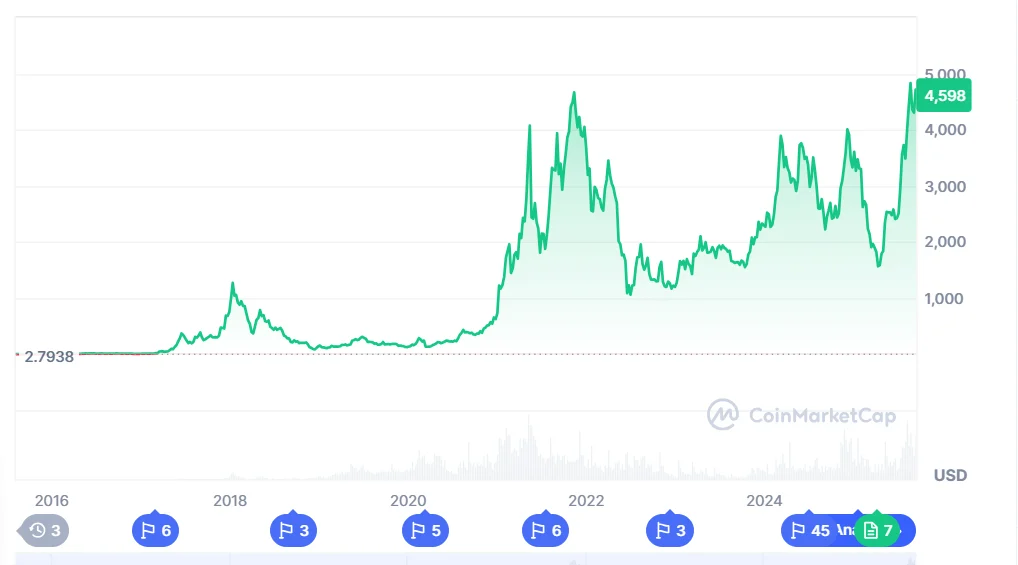
At the same time, on-chain signals point to a potential short-term correction. Profit-taking indicators show 98.14% of the ETH supply is in profit, near overheated levels. The taker buy/sell ratio dipped to 0.91 on September 13, historically a bearish sign. Ethereum’s price currently trades around $4,620, with rising wedge patterns on the chart suggesting a possible dip toward $4,485 or $4,382 if support levels fail.
BullZilla Presale Gains Momentum Amid Retail Resurgence
While Ethereum continues to attract institutional money, retail investors are flocking to high-growth opportunities like BullZilla ($BZIL). Often described as the best crypto presale in 2025, BullZilla blends meme appeal with DeFi mechanics, staking utility, and real tokenomics.

Currently in Stage 3 of its presale, BullZilla has raised over $420,000, sold 25.8 billion tokens, and attracted 1,500+ holders. With an 11.27% price increase locked in for the next stage and a projected ROI of 8,822.49% by launch, retail interest continues to accelerate.
BullZilla Presale Snapshot
| Metric | Value |
| Current Price | $0.00005908 |
| Tokens Sold | 25.8 Billion |
| Presale Raised | $420,000+ |
| Upcoming Price Surge | +11.27% in Stage 3B |
| ROI to Listing | 8,822.49% |
| Token Holders | 1,500+ |

Conclusion: Ethereum Faces a New Era of Centralization and Growth
Ethereum’s current moment is a double-edged sword. On one hand, the surge in institutional participation, led by Bitmine, Fidelity, and BlackRock, validates Ethereum’s role in the future of finance. On the other hand, validator strain, potential concerns about centralization, and short-term price signals paint a more complex picture.
While institutions claim the long game, retail investors aren’t sitting idle. Platforms like Bull Zilla are giving them high-ROI entry points into the evolving DeFi landscape. Whether Ethereum can balance decentralization with corporate influence remains to be seen, but one thing is clear: the rules of engagement in the Ethereum market are changing fast.

For More Information:
BZIL Official Website
Join BZIL Telegram Channel
Follow BZIL on X (Formerly Twitter)
Frequently Asked Questions About Ethereum’s Institutional Rise
What impact did Bitmine’s ETH purchase have on Ethereum?
Bitmine acquired 2.1M ETH (~$9.3B), lifting Ethereum’s price and reducing circulating supply.
Why are ETH ETFs seeing record inflows?
Institutional confidence is rising. ETFs offer regulated, custodial exposure to Ethereum’s DeFi and staking ecosystem.
What’s causing Ethereum’s validator bottleneck?
The exit of staking provider Kiln and increased staking demand have overwhelmed the network.
Is Ethereum at risk of a price correction?
Yes. On-chain metrics like profit-taking ratios and the taker buy/sell ratio suggest short-term downside risk.
What is BullZilla and why is it trending?
BullZilla is a meme-DeFi token currently in presale. It offers staking, utility, and high ROI projections, attracting retail investors.
How much has BullZilla raised?
Over $420,000, with 25.8B tokens sold across 1,500+ holders.
Can Ethereum stay decentralized with large holders like Bitmine?
That’s a growing concern. Concentrated holdings may impact governance and liquidity.
Article Summary
Ethereum is experiencing a new wave of institutional adoption, led by Bitmine’s acquisition of 2.1 million ETH and a $638 million weekly inflow into ETH spot ETFs. While the long-term prospects look strong, the network faces short-term stress from validator bottlenecks, potential concerns about centralization, and risks associated with chart-based corrections. On-chain metrics indicate ETH may be nearing a pullback, even as ETF demand surges. In the meantime, the momentum in retail has been the BullZilla Presale that has collected more than 420,000 and sold 25.8 billion tokens with a huge ROI potential. With Ethereum existing between institutionalization and grassroots development, the next few weeks could determine its balance in terms of scale, decentralization, and investor feelings.
Disclaimer
The article is informational and is not a form of financial advice. Investments in cryptocurrencies are unstable and risky. It is always good to do your own research and use the services of an authorized financial advisor before making investment decisions. The publisher and author do not take responsibility of financial losses incurred.
This article is not intended as financial advice. Educational purposes only.
You May Also Like

The Channel Factories We’ve Been Waiting For

Why Is the Bitcoin Price Constantly Falling? Analysis Firm Says “The Selling Process Has Reached Saturation,” Shares Its Expectations
