As the Sui staking market is ready to take off, Haedal’s innovative products and strong data make it one of the preferred investment targets for DeFi.As the Sui staking market is ready to take off, Haedal’s innovative products and strong data make it one of the preferred investment targets for DeFi.

Haedal Protocol Analysis: The No. 1 player in Sui’s liquidity staking track, with TVL crushing competitors

2025/04/28 20:00

Author: nicoleliu.eth

Compiled by: Tim, PANews

PANews Editor's Note: Sui Ecosystem Liquidity Staking Protocol Haedal will conduct TGE on April 29, and users can receive airdrops. The author of this article is a founding partner of Comma3 Ventures, which has participated in the seed round investment of Haedal Protocol. Haedal Protocol is a hidden gem project in the field of liquidity staking in the Sui ecosystem. As the Sui staking market is ready to take off, Haedal's innovative products and strong data make it one of the preferred investment targets for DeFi.

Here’s why it’s worth investing and what you need to pay attention to 👇 (all data as of April 15)

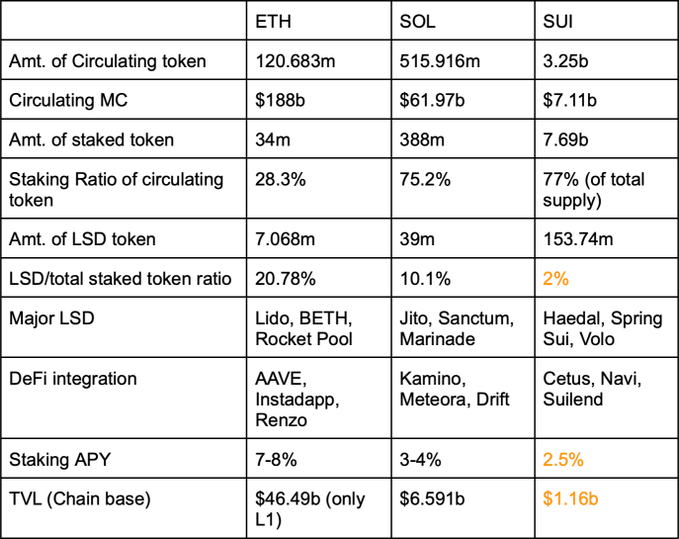
The liquid staking market of the Sui network is not yet prosperous, with the total value of staked SUI being $307.48 million, of which only 2% is liquid. In comparison: 10.1% of the total value of staked SOL in the Solana network is liquid, while 30.5% of the total value of staked ETH in the Ethereum network is liquid, out of a total value of $10.25 billion. As the Sui ecosystem develops, the Haedal staking protocol, which currently has a TVL of $120 million, is expected to become the leader in liquid staking in the ecosystem.
Haedal Protocol Analysis: The No. 1 player in Sui’s liquidity staking track, with TVL crushing competitors

A major problem with Sui’s liquid staking derivatives market is that its staking annualized yield is low, around 2.5%, compared to Solana’s 7-8% APY and Ethereum’s 3-4%.

Haedal significantly improves the staking performance of the Sui network by adopting a dynamic validator selection mechanism and an innovative Hae3 framework: including three major components: HMM, HaeVault and HaeDAO, and its performance surpasses other LSD protocols.

Haedal monitors the status of all network verification nodes and selects the node with the highest APR when staking. When canceling the pledge, Haedal will give priority to withdrawing funds from the verification nodes with lower APR. This strategy can continuously ensure that the liquidity staked tokens maintain a high annualized rate of return.

HMM (Haedal Market Maker) optimizes the liquidity of various DEXs on the Sui blockchain by combining oracle pricing and real-time market data, and charges a transaction fee of 0.04%.

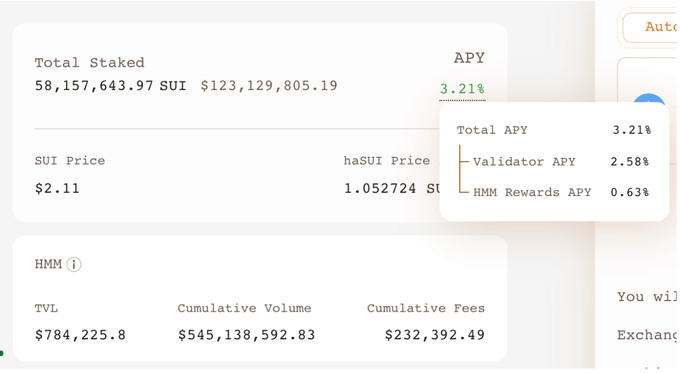
From February to March, trading volume increased from $59.13 million to $284.15 million, generating $236,000 in fees, with an average TVL of $800,000 during the period. After using 50% of the revenue for incentives, haSUI's annualized rate of return increased by 24.4%, from 2.58% to 3.21%.
Haedal Protocol Analysis: The No. 1 player in Sui’s liquidity staking track, with TVL crushing competitors

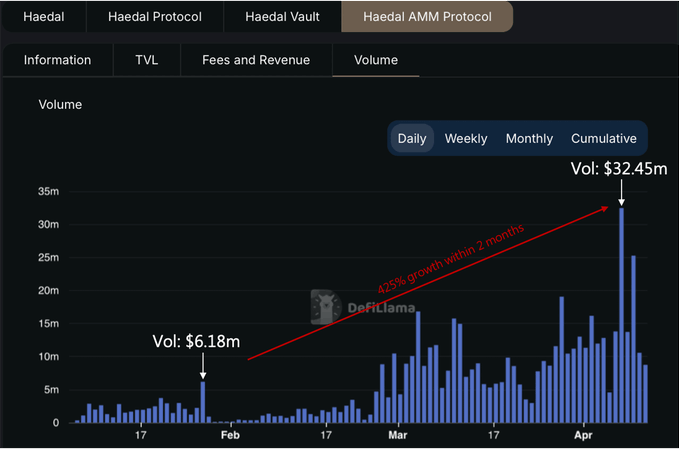
Cetus Protocol is the largest DEX in the Sui ecosystem, with a daily trading volume of $92 million. Haedal was launched on January 6, 2025, and currently has a daily trading volume of $5.69 million, equivalent to 6.12% of Cetus's trading volume. By adopting an oracle pricing mechanism, HMM is poised to achieve rapid revenue growth by capturing arbitrage trading volume.
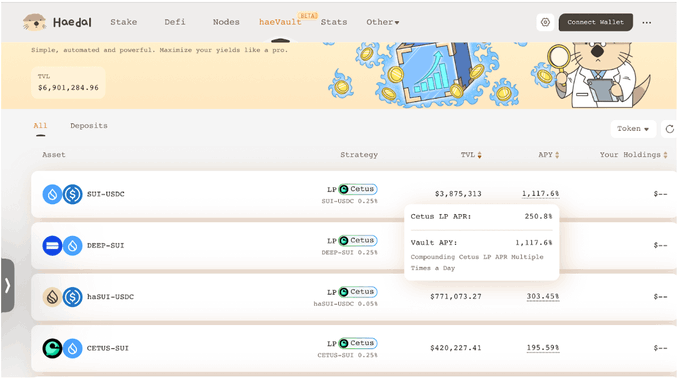
Haedal Protocol Analysis: The No. 1 player in Sui’s liquidity staking track, with TVL crushing competitors Haedal Vault simplifies the liquidity provision process for users with idle funds, eliminating the tedious operations of managing LP positions, allowing users to easily deposit funds and obtain higher returns.

HaeVault improves returns through ultra-narrow rebalancing strategies. Taking the SUI-USDC trading pair as an example, the annualized rate of return provided by the Cetus platform is 250.8% (based on Cetus data), while HaeVault achieves an annualized rate of return of 1117%. After deducting 16% of the fee, the net rate of return is still as high as 938%.
Haedal Protocol Analysis: The No. 1 player in Sui’s liquidity staking track, with TVL crushing competitors

Hae3 is deeply integrated into the Sui DeFi ecosystem (TVL exceeds $1 billion). Among them, the HMM protocol captures DEX fee income, the Haedal vault optimizes the income of liquidity providers, and HaeDAO grants governance decision-making power.

Volo and Suilend, which focus on basic staking and lending operations, lack this synergy, making Haedal a superior yield optimizer.
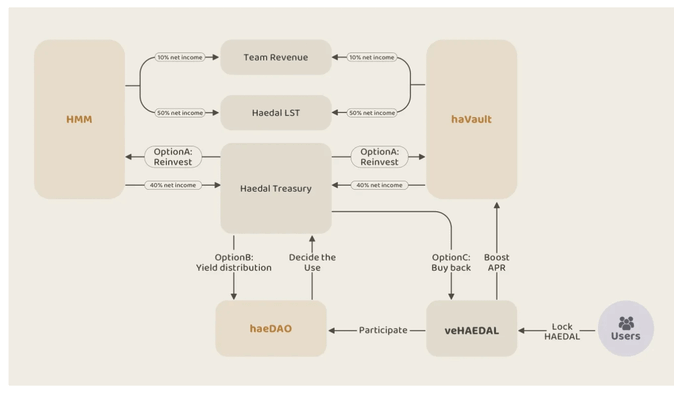
Haedal Protocol analysis: No. 1 player in Sui’s liquidity staking track, TVL crushes competitors

The use cases of HAEDAL tokens further solidify their value. Locking them into veTokens can be used to participate in HaeDAO governance or to increase the annualized rate of return of the treasury. In addition, potential airdrop opportunities (which are very common in the Sui ecosystem) also add additional advantages.

Haedal's core indicators are strong: TVL reached $117.36 million (compared to Suilend's $117.4 million and Volo's $50 million), the number of daily active wallets exceeded 44,000, and the number of holders reached 794,000. Currently, Haedal is temporarily in the leading position in the three key indicators of transaction volume, annualized rate of return and holder size.

Support from VC institutions such as Hashed, Comma3, OKX Ventures and Animoca Brands further illustrates its potential.
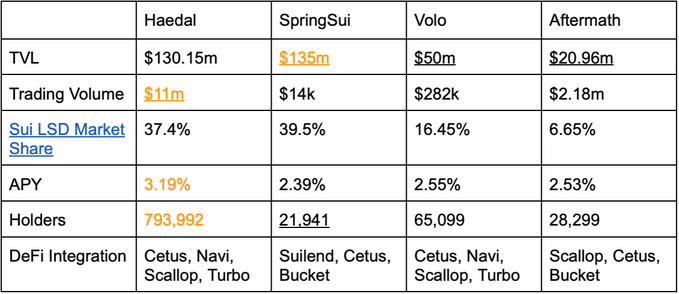
Haedal Protocol analysis: No. 1 player in Sui’s liquidity staking track, TVL crushes competitors

Haedal stands out with its high-growth market (LSD penetration is only 2%, with a 10-fold growth potential), innovative products and solid fundamentals. As the Sui ecosystem expands, the protocol is in a favorable position in the field of liquidity staking and is expected to become an industry leader.

Market Opportunity
SUI Logo
SUI Price(SUI)
$1.5031
$1.5031$1.5031
+1.12%
USD
SUI (SUI) Live Price Chart
Disclaimer: The articles reposted on this site are sourced from public platforms and are provided for informational purposes only. They do not necessarily reflect the views of MEXC. All rights remain with the original authors. If you believe any content infringes on third-party rights, please contact service@support.mexc.com for removal. MEXC makes no guarantees regarding the accuracy, completeness, or timeliness of the content and is not responsible for any actions taken based on the information provided. The content does not constitute financial, legal, or other professional advice, nor should it be considered a recommendation or endorsement by MEXC.

You May Also Like

The Channel Factories We’ve Been Waiting For

The Channel Factories We’ve Been Waiting For

The post The Channel Factories We’ve Been Waiting For appeared on BitcoinEthereumNews.com. Visions of future technology are often prescient about the broad strokes while flubbing the details. The tablets in “2001: A Space Odyssey” do indeed look like iPads, but you never see the astronauts paying for subscriptions or wasting hours on Candy Crush.  Channel factories are one vision that arose early in the history of the Lightning Network to address some challenges that Lightning has faced from the beginning. Despite having grown to become Bitcoin’s most successful layer-2 scaling solution, with instant and low-fee payments, Lightning’s scale is limited by its reliance on payment channels. Although Lightning shifts most transactions off-chain, each payment channel still requires an on-chain transaction to open and (usually) another to close. As adoption grows, pressure on the blockchain grows with it. The need for a more scalable approach to managing channels is clear. Channel factories were supposed to meet this need, but where are they? In 2025, subnetworks are emerging that revive the impetus of channel factories with some new details that vastly increase their potential. They are natively interoperable with Lightning and achieve greater scale by allowing a group of participants to open a shared multisig UTXO and create multiple bilateral channels, which reduces the number of on-chain transactions and improves capital efficiency. Achieving greater scale by reducing complexity, Ark and Spark perform the same function as traditional channel factories with new designs and additional capabilities based on shared UTXOs.  Channel Factories 101 Channel factories have been around since the inception of Lightning. A factory is a multiparty contract where multiple users (not just two, as in a Dryja-Poon channel) cooperatively lock funds in a single multisig UTXO. They can open, close and update channels off-chain without updating the blockchain for each operation. Only when participants leave or the factory dissolves is an on-chain transaction…
Share
BitcoinEthereumNews2025/09/18 00:09
SOLANA NETWORK Withstands 6 Tbps DDoS Without Downtime

SOLANA NETWORK Withstands 6 Tbps DDoS Without Downtime

The post SOLANA NETWORK Withstands 6 Tbps DDoS Without Downtime appeared on BitcoinEthereumNews.com. In a pivotal week for crypto infrastructure, the Solana network
Share
BitcoinEthereumNews2025/12/16 20:44
Why The Green Bay Packers Must Take The Cleveland Browns Seriously — As Hard As That Might Be

Why The Green Bay Packers Must Take The Cleveland Browns Seriously — As Hard As That Might Be

The post Why The Green Bay Packers Must Take The Cleveland Browns Seriously — As Hard As That Might Be appeared on BitcoinEthereumNews.com. Jordan Love and the Green Bay Packers are off to a 2-0 start. Getty Images The Green Bay Packers are, once again, one of the NFL’s better teams. The Cleveland Browns are, once again, one of the league’s doormats. It’s why unbeaten Green Bay (2-0) is a 8-point favorite at winless Cleveland (0-2) Sunday according to betmgm.com. The money line is also Green Bay -500. Most expect this to be a Packers’ rout, and it very well could be. But Green Bay knows taking anyone in this league for granted can prove costly. “I think if you look at their roster, the paper, who they have on that team, what they can do, they got a lot of talent and things can turn around quickly for them,” Packers safety Xavier McKinney said. “We just got to kind of keep that in mind and know we not just walking into something and they just going to lay down. That’s not what they going to do.” The Browns certainly haven’t laid down on defense. Far from. Cleveland is allowing an NFL-best 191.5 yards per game. The Browns gave up 141 yards to Cincinnati in Week 1, including just seven in the second half, but still lost, 17-16. Cleveland has given up an NFL-best 45.5 rushing yards per game and just 2.1 rushing yards per attempt. “The biggest thing is our defensive line is much, much improved over last year and I think we’ve got back to our personality,” defensive coordinator Jim Schwartz said recently. “When we play our best, our D-line leads us there as our engine.” The Browns rank third in the league in passing defense, allowing just 146.0 yards per game. Cleveland has also gone 30 straight games without allowing a 300-yard passer, the longest active streak in the NFL.…
Share
BitcoinEthereumNews2025/09/18 00:41