The Cardano Foundation released last week its 2024 Financial Insights Report directly on the Cardano blockchain using its newly launched tool, Reeve. This marks the first time the Foundation takes advantage of on-chain infrastructure to publish verifiable financial data. The…The Cardano Foundation released last week its 2024 Financial Insights Report directly on the Cardano blockchain using its newly launched tool, Reeve. This marks the first time the Foundation takes advantage of on-chain infrastructure to publish verifiable financial data. The…

Interview | Cardano Foundation CEO on Reeve launch, staking risks, and governance roadmap

The Cardano Foundation released last week its 2024 Financial Insights Report directly on the Cardano blockchain using its newly launched tool, Reeve. This marks the first time the Foundation takes advantage of on-chain infrastructure to publish verifiable financial data.

The 2024 report notes that $29.2 million was allocated across Cardano’s (ADA) three core focus areas, including adoption, operational resilience, and education, up from $19.2 million in 20223. An additional $7.1 million was allocated toward operational capacity, supporting governance, infrastructure, and legal efforts. As of year-end, the Foundation held $659.1 million in assets, mostly denominated in ADA, and generated its primary income from staking 599.2 million ADA tokens.

The shift to on-chain financial reporting was accomplished through Reeve, a user-friendly interface that allows anyone to access, verify, and interpret the Foundation’s financial data without requiring deep technical expertise. It’s part of a broader effort to expand decentralized governance capabilities, anchored by the recent Chang hard fork, a major step toward enabling fully on-chain decision-making within the Cardano ecosystem.

What I found interesting is that Reeve looks to be more than just a reporting dashboard. Rather, it’s a signal that the blockchain community is maturing. For years, critics have pointed to the opacity of Web3 foundations. Now, with Reeve and the Chang upgrade working in tandem, Cardano appears intent on addressing that criticism head-on with verifiable, on-chain evidence.

That said, transparency doesn’t erase the challenges of sustainability. A treasury heavily reliant on ADA staking rewards is still exposed to market swings. And while Cardano’s cash flow strategy seems prudent, it raises the broader question: what does long-term financial resilience look like for blockchain foundations that depend so heavily on their own tokens?

In the Q&A that follows, Frederik Gregaard, CEO of the Cardano Foundation, speaks with crypto.news about the Foundation’s reasons for moving financial reporting on-chain, the implications of the Chang upgrade, how it measures impact, risk management strategies for its crypto-heavy treasury, and the long-term sustainability of staking rewards as a revenue model.

The full Q&A with Frederik Gregaard is below:

crypto.news: The Foundation chose to publish its financial report on the Cardano blockchain using Reeve, emphasizing verifiability and accountability. What prompted this move to on-chain financial reporting? What advantages does an on-chain report bring in terms of transparency, and are there tools to help less-technical stakeholders audit and understand the data?

Frederik Gregaard: The Foundation moved to on-chain reporting to demonstrate its commitment to transparency and accountability as stewards of an open-source ecosystem. Reeve enables organizations to publish financial statements on‑chain, establishing a new standard for transparency, accountability, and trust in financial reporting. By publishing its 2024 accounting on‑chain, stakeholders can easily access statements via Reeve’s user-friendly interface to view, filter, and download readable versions of the data–no deep expertise required. We are looking forward to enterprises globally using Reeve. 

      CN: The report mentions the Chang hard fork as a key step toward enabling decentralized governance on Cardano. How significant is the Chang upgrade for Cardano’s roadmap to community-led governance, and when can the community expect to see fully on-chain governance mechanisms (such as voting or treasury decisions) in action as a result of this fork?

      FG: Chang Hard Fork represents one of the most significant milestones since Cardano’s inception. With this transition to a fully decentralized governance model, we’re on the path to becoming the world’s largest decentralized ecosystem. Cardano now runs on a secure, decentralized governance system that gives every ADA holder a voice. More information can be found here.

          CN: In 2024, the Foundation allocated $29.2 million to its core focus areas (adoption, operational resilience, education), an increase from a reported $19.2 million in 2023. What drove this increase in spending year-over-year, and how do you measure the impact of these investments? 

          FG: The $29.1mn are the total operational expenses for 2024. The allocation to the core focus areas forms part of the overall operational expenses and amounts to $22.1mn. The resulting increase compared to 2023 of $2.9mn reflects the Foundation’s intensified efforts around the Chang hard fork, expanded educational programs, and new enterprise partnerships.

            The Foundation measures impact through tangible deliverables like the people engaging in the Cardano Blockchain Certified Associate program, the impact our partnerships create–e.g. by reaching tens of thousands of employees at organizations like Petrobras and SERPRO–, and the number of concrete adoption use cases, such as our partnership with Masumi to build a decentralized AI agent network. The launch of Reeve is also an example of the great results coming out of the investments.

            CN: The Foundation’s assets stood at $659.1 million as of the end of 2024, with 8.3% allocated in cash and the rest in crypto. Given a crypto-heavy treasury, how does the Foundation approach risk management? Do you have guidelines for diversifying assets or converting crypto to fiat to fund operations, and how do you avoid negatively impacting the market when using ADA holdings for expenses?

            We’ve built our investment approach to keep the Foundation funded well into the future in line with our statutory purpose, understanding that blockchain adoption is a gradual process. We follow a cash flow matching strategy that lets us plan crypto-to-fiat conversions well in advance, helping us avoid forced sales or sudden market disruptions. Our financial planning is based on multiple market scenarios and reviewed on a regular basis. When selling ADA or converting it into fiat, we proceed carefully and gradually to minimize any impact on the market.

            CN: The report indicates the Foundation’s primary income source is derived from staking its 599.2 million ADA holdings. How sustainable is it for a non-profit to rely on staking rewards as a main driver of revenue? What would happen if ADA’s price or network yield changes significantly? Are there plans to develop other revenue streams or funding sources?

            FG: Our core mission is to support blockchain adoption, and our treasury strategy is built around this goal. While staking rewards provide a key source of income, we diversify our investments and actively explore additional revenue streams to strengthen the Foundation’s long-term financial resilience.

              Disclaimer: The articles reposted on this site are sourced from public platforms and are provided for informational purposes only. They do not necessarily reflect the views of MEXC. All rights remain with the original authors. If you believe any content infringes on third-party rights, please contact service@support.mexc.com for removal. MEXC makes no guarantees regarding the accuracy, completeness, or timeliness of the content and is not responsible for any actions taken based on the information provided. The content does not constitute financial, legal, or other professional advice, nor should it be considered a recommendation or endorsement by MEXC.

              You May Also Like

              Building a DEXScreener Clone: A Step-by-Step Guide

              Building a DEXScreener Clone: A Step-by-Step Guide

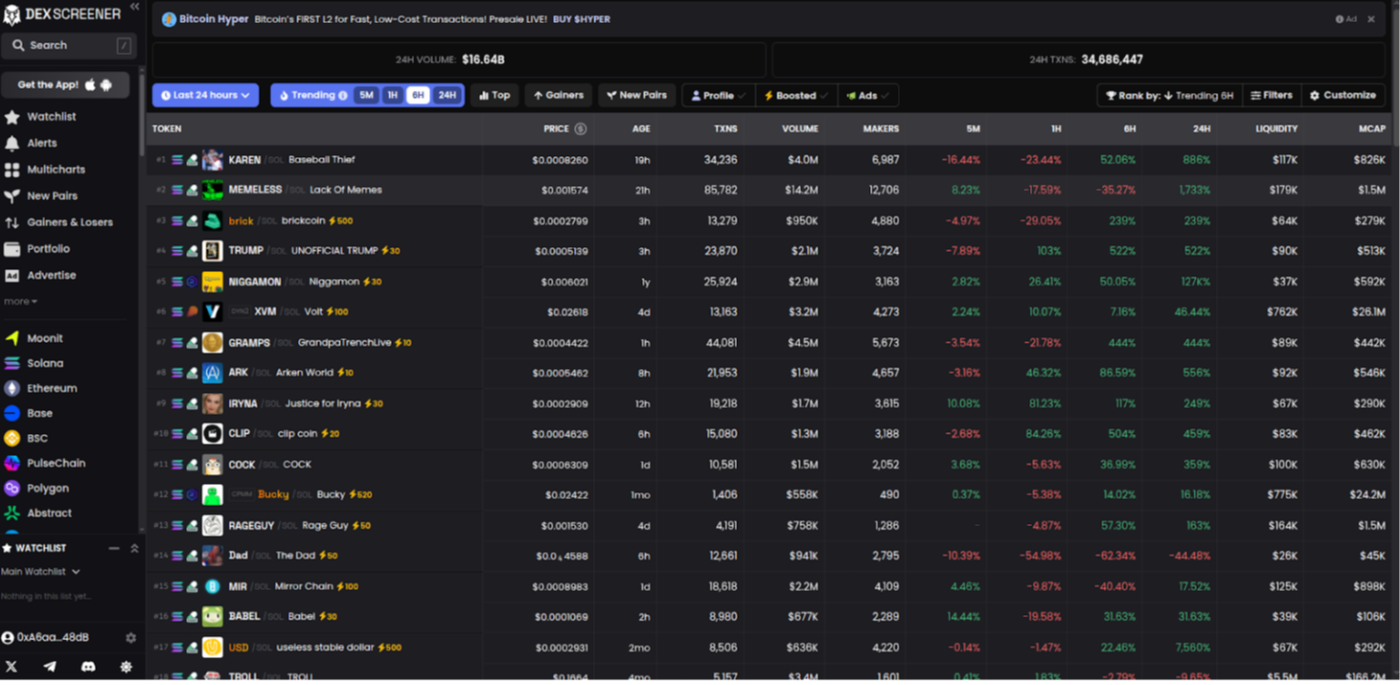
              DEX Screener is used by crypto traders who need access to on-chain data like trading volumes, liquidity, and token prices. This information allows them to analyze trends, monitor new listings, and make informed investment decisions. In this tutorial, I will build a DEXScreener clone from scratch, covering everything from the initial design to a functional app. We will use Streamlit, a Python framework for building full-stack apps.
              Share
              Hackernoon2025/09/18 15:05
              Which DOGE? Musk's Cryptic Post Explodes Confusion

              Which DOGE? Musk's Cryptic Post Explodes Confusion

              A viral chart documenting a sharp decline in U.S. federal employment during President Trump's second term has sparked unexpected confusion in cryptocurrency markets
              Share
              Coinstats2025/12/20 01:13
              Google's AP2 protocol has been released. Does encrypted AI still have a chance?

              Google's AP2 protocol has been released. Does encrypted AI still have a chance?

              Following the MCP and A2A protocols, the AI Agent market has seen another blockbuster arrival: the Agent Payments Protocol (AP2), developed by Google. This will clearly further enhance AI Agents' autonomous multi-tasking capabilities, but the unfortunate reality is that it has little to do with web3AI. Let's take a closer look: What problem does AP2 solve? Simply put, the MCP protocol is like a universal hook, enabling AI agents to connect to various external tools and data sources; A2A is a team collaboration communication protocol that allows multiple AI agents to cooperate with each other to complete complex tasks; AP2 completes the last piece of the puzzle - payment capability. In other words, MCP opens up connectivity, A2A promotes collaboration efficiency, and AP2 achieves value exchange. The arrival of AP2 truly injects "soul" into the autonomous collaboration and task execution of Multi-Agents. Imagine AI Agents connecting Qunar, Meituan, and Didi to complete the booking of flights, hotels, and car rentals, but then getting stuck at the point of "self-payment." What's the point of all that multitasking? So, remember this: AP2 is an extension of MCP+A2A, solving the last mile problem of AI Agent automated execution. What are the technical highlights of AP2? The core innovation of AP2 is the Mandates mechanism, which is divided into real-time authorization mode and delegated authorization mode. Real-time authorization is easy to understand. The AI Agent finds the product and shows it to you. The operation can only be performed after the user signs. Delegated authorization requires the user to set rules in advance, such as only buying the iPhone 17 when the price drops to 5,000. The AI Agent monitors the trigger conditions and executes automatically. The implementation logic is cryptographically signed using Verifiable Credentials (VCs). Users can set complex commission conditions, including price ranges, time limits, and payment method priorities, forming a tamper-proof digital contract. Once signed, the AI Agent executes according to the conditions, with VCs ensuring auditability and security at every step. Of particular note is the "A2A x402" extension, a technical component developed by Google specifically for crypto payments, developed in collaboration with Coinbase and the Ethereum Foundation. This extension enables AI Agents to seamlessly process stablecoins, ETH, and other blockchain assets, supporting native payment scenarios within the Web3 ecosystem. What kind of imagination space can AP2 bring? After analyzing the technical principles, do you think that's it? Yes, in fact, the AP2 is boring when it is disassembled alone. Its real charm lies in connecting and opening up the "MCP+A2A+AP2" technology stack, completely opening up the complete link of AI Agent's autonomous analysis+execution+payment. From now on, AI Agents can open up many application scenarios. For example, AI Agents for stock investment and financial management can help us monitor the market 24/7 and conduct independent transactions. Enterprise procurement AI Agents can automatically replenish and renew without human intervention. AP2's complementary payment capabilities will further expand the penetration of the Agent-to-Agent economy into more scenarios. Google obviously understands that after the technical framework is established, the ecological implementation must be relied upon, so it has brought in more than 60 partners to develop it, almost covering the entire payment and business ecosystem. Interestingly, it also involves major Crypto players such as Ethereum, Coinbase, MetaMask, and Sui. Combined with the current trend of currency and stock integration, the imagination space has been doubled. Is web3 AI really dead? Not entirely. Google's AP2 looks complete, but it only achieves technical compatibility with Crypto payments. It can only be regarded as an extension of the traditional authorization framework and belongs to the category of automated execution. There is a "paradigm" difference between it and the autonomous asset management pursued by pure Crypto native solutions. The Crypto-native solutions under exploration are taking the "decentralized custody + on-chain verification" route, including AI Agent autonomous asset management, AI Agent autonomous transactions (DeFAI), AI Agent digital identity and on-chain reputation system (ERC-8004...), AI Agent on-chain governance DAO framework, AI Agent NPC and digital avatars, and many other interesting and fun directions. Ultimately, once users get used to AI Agent payments in traditional fields, their acceptance of AI Agents autonomously owning digital assets will also increase. And for those scenarios that AP2 cannot reach, such as anonymous transactions, censorship-resistant payments, and decentralized asset management, there will always be a time for crypto-native solutions to show their strength? The two are more likely to be complementary rather than competitive, but to be honest, the key technological advancements behind AI Agents currently all come from web2AI, and web3AI still needs to keep up the good work!
              Share
              PANews2025/09/18 07:00