Ondo Finance is set to launch its USDY tokenized Treasury product on Sei, adding to a growing list of supported networks that includes Ethereum, Solana, Mantle, and Sui. According to a press release shared with crypto.news, Ondo Finance’s flagship tokenized…Ondo Finance is set to launch its USDY tokenized Treasury product on Sei, adding to a growing list of supported networks that includes Ethereum, Solana, Mantle, and Sui. According to a press release shared with crypto.news, Ondo Finance’s flagship tokenized…

Ondo Finance’s USDY to launch on Sei Network

Ondo Finance is set to launch its USDY tokenized Treasury product on Sei, adding to a growing list of supported networks that includes Ethereum, Solana, Mantle, and Sui.

According to a press release shared with crypto.news, Ondo Finance’s flagship tokenized US Treasury product, United States Dollar Yield (USDY), is launching on the Sei (SEI) Network. This marks the first time a tokenized Treasury Bill product will be natively integrated into the ultra-fast Layer-1 blockchain with TVL exceeding $670M and 821% YoY growth. 

USDY, which combines the accessibility of stablecoins with the yield and investor protections of traditional finance, currently boasts a market cap of over $681 million and offers a 4.25% APY, updated monthly. With the Sei integration, global (non-U.S.) users gain access to high-quality, composable yield directly on a blockchain known for its parallelized execution and near-instant finality.

“Sei’s breakthrough infrastructure with near instant finality and parallelized execution makes it uniquely suited for institutional-grade financial products, and USDY represents the exact kind of high-quality, composable yield primitive that will unlock new possibilities for developers building the next generation of onchain applications,” said Justin Barlow, Executive Director at the Sei Development Foundation.

USDY’s expansion to Sei comes as part of a broader multichain strategy. The token is already live across several major blockchains, most notably Ethereum (ETH), which holds 63.46% of USDY’s circulating supply, according to DeFiLlama. Solana (SOL) follows with 25.9%, while Mantle (MNT) accounts for 3.93%, Sui (SUI) holds 2.56%, and other networks, including Aptos (APT), Osmosis (OSMO), and Arbitrum (ARB) collectively host smaller portions.
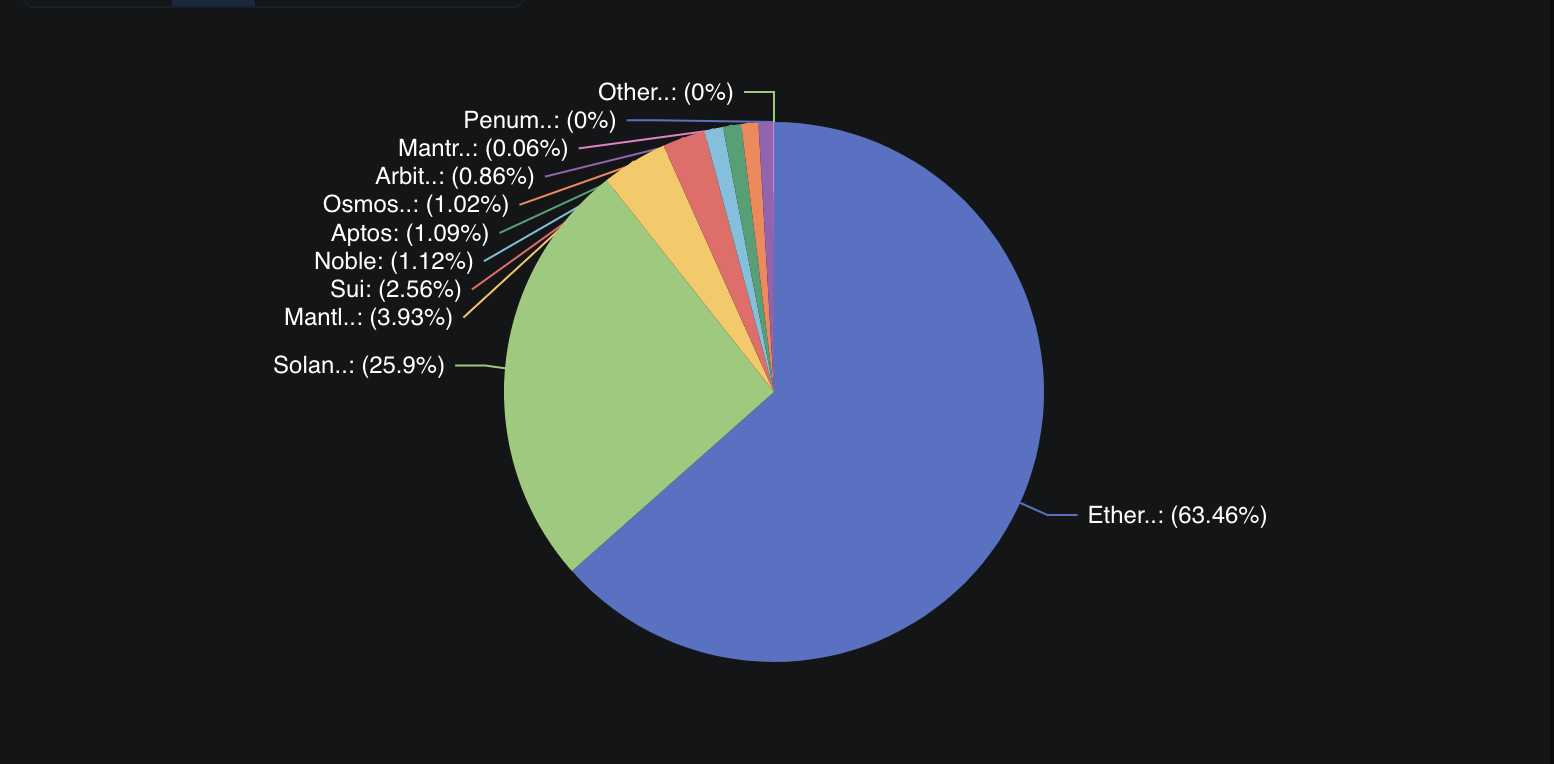
Ondo Finance's USDY to launch on Sei Network - 1

It’s also worth noting that USDY is now fully fungible across Ethereum, Mantle, and Arbitrum — eliminating the need for wrapping or swapping between chains — following the integration of LayerZero’s omnichain standard in November last year. Support for additional networks is planned.

Market Opportunity
SEI Logo
SEI Price(SEI)
$0,1108
$0,1108$0,1108
-0,62%
USD
SEI (SEI) Live Price Chart
Disclaimer: The articles reposted on this site are sourced from public platforms and are provided for informational purposes only. They do not necessarily reflect the views of MEXC. All rights remain with the original authors. If you believe any content infringes on third-party rights, please contact service@support.mexc.com for removal. MEXC makes no guarantees regarding the accuracy, completeness, or timeliness of the content and is not responsible for any actions taken based on the information provided. The content does not constitute financial, legal, or other professional advice, nor should it be considered a recommendation or endorsement by MEXC.

You May Also Like

Trump’s Crypto Gains Risk Backlash Post-Presidency, Ethereum Veteran Advises Urgency

Trump’s Crypto Gains Risk Backlash Post-Presidency, Ethereum Veteran Advises Urgency

The post Trump’s Crypto Gains Risk Backlash Post-Presidency, Ethereum Veteran Advises Urgency appeared on BitcoinEthereumNews.com. President Trump’s administration
Share
BitcoinEthereumNews2025/12/21 01:29
China Blocks Nvidia’s RTX Pro 6000D as Local Chips Rise

China Blocks Nvidia’s RTX Pro 6000D as Local Chips Rise

The post China Blocks Nvidia’s RTX Pro 6000D as Local Chips Rise appeared on BitcoinEthereumNews.com. China Blocks Nvidia’s RTX Pro 6000D as Local Chips Rise China’s internet regulator has ordered the country’s biggest technology firms, including Alibaba and ByteDance, to stop purchasing Nvidia’s RTX Pro 6000D GPUs. According to the Financial Times, the move shuts down the last major channel for mass supplies of American chips to the Chinese market. Why Beijing Halted Nvidia Purchases Chinese companies had planned to buy tens of thousands of RTX Pro 6000D accelerators and had already begun testing them in servers. But regulators intervened, halting the purchases and signaling stricter controls than earlier measures placed on Nvidia’s H20 chip. Image: Nvidia An audit compared Huawei and Cambricon processors, along with chips developed by Alibaba and Baidu, against Nvidia’s export-approved products. Regulators concluded that Chinese chips had reached performance levels comparable to the restricted U.S. models. This assessment pushed authorities to advise firms to rely more heavily on domestic processors, further tightening Nvidia’s already limited position in China. China’s Drive Toward Tech Independence The decision highlights Beijing’s focus on import substitution — developing self-sufficient chip production to reduce reliance on U.S. supplies. “The signal is now clear: all attention is focused on building a domestic ecosystem,” said a representative of a leading Chinese tech company. Nvidia had unveiled the RTX Pro 6000D in July 2025 during CEO Jensen Huang’s visit to Beijing, in an attempt to keep a foothold in China after Washington restricted exports of its most advanced chips. But momentum is shifting. Industry sources told the Financial Times that Chinese manufacturers plan to triple AI chip production next year to meet growing demand. They believe “domestic supply will now be sufficient without Nvidia.” What It Means for the Future With Huawei, Cambricon, Alibaba, and Baidu stepping up, China is positioning itself for long-term technological independence. Nvidia, meanwhile, faces…
Share
BitcoinEthereumNews2025/09/18 01:37
Academic Publishing and Fairness: A Game-Theoretic Model of Peer-Review Bias

Academic Publishing and Fairness: A Game-Theoretic Model of Peer-Review Bias

Exploring how biases in the peer-review system impact researchers' choices, showing how principles of fairness relate to the production of scientific knowledge based on topic importance and hardness.
Share
Hackernoon2025/09/17 23:15