Polkadot (DOT) is preparing to launch a new stablecoin, pUSD, through the RFC-155 proposal. The Polkadot community is championing pUSD as a key solution to unleash its DeFi potential, cut dependence on USDT/USDC, and boost ecosystem autonomy. However, some are concerned that they might repeat past mistakes. pUSD is an over-collateralized stablecoin fully backed by DOT, deployed on Asset Hub, and using the Honzon protocol developed by Acala. Acala is the former issuer of aUSD, a stablecoin project that failed disastrously. Can pUSD Stablecoin Avoid the Same Fate as aUSD? Reusing Honzon – the framework Acala previously relied on to issue aUSD is raising concerns. That incident eroded trust in the Acala team, with some even accusing them of “blaming a hack” while failing to compensate users adequately. “Acala’s stablecoin (aUSD) launch was a complete disaster and it really killed my trust in the team. I don’t see myself supporting their project anymore. What I’d love to see is a proper, reliable, native solution. Honestly, it’s frustrating that with all the talent in the Polkadot/Substrate space, nobody has managed to build something better yet.” – A community member shared. Approval rate of the proposal at the time of writing. Source: Polkadot Even those who support Polkadot launching its native stablecoin still see Honzon and Acala as lessons that cannot be ignored. They propose the project should “move forward independently from the Acala team.” In addition, they call for the Technical Council to take clear responsibility for governance. “With these assurances, I would be prepared to vote AYE. Without them, the risk of repeating past mistakes is too great.” Another member noted. Too Many Risks Setting aside concerns about Honzon and the Acala team, Polkadot’s pUSD also faces skepticism within the community. One primary reason is the structure that DOT solely backs it. While the exact overcollateralization ratio remains unclear, this could trigger liquidation cascades and add selling pressure on the token. Although the pUSD model is safer than Terra’s UST because it is overcollateralized, relying only on DOT as collateral introduces significant risks. Previously, MakerDAO’s DAI also started as ETH-only collateral. But today, MakerDAO supports Multi-Collateral DAI (MCD). They allow users to back DAI with crypto assets such as ETH, WBTC, LINK, UNI, stETH, and even Real World Assets (RWAs) like US Treasuries. “Backed only by DOT, which could trigger liquidation cascades and add additional selling pressure on the token. Remember the notorious DAI depeg in 2020, which forced MakerDAO to diversify its collateral.” A user on X commented. Additionally, another X user pointed out that the Polkadot ecosystem already has more advanced native solutions like HOLLAR. The Hydration runtime builds this stablecoin, optimizes it for appchains, and positions it as superior to the legacy aUSD architecture. Therefore, many argue that instead of repeating a “regular” EVM model, Polkadot should leverage its unique strengths. This would enable the creation of a stable, secure solution worthy of its ecosystem’s potential. pUSD is undoubtedly a strategic move by Polkadot to unlock DeFi potential. It could bring significant benefits if it proves secure and sees widespread adoption in the ecosystem. However, the ghost of aUSD’s failure continues to cast doubt within the community. To avoid repeating the same mistakes, Polkadot must work to dispel those lingering concerns. The fact that the DOT supply is capped at 2.1 billion, as reported by BeInCrypto, could help fuel the ecosystem’s growth.Polkadot (DOT) is preparing to launch a new stablecoin, pUSD, through the RFC-155 proposal. The Polkadot community is championing pUSD as a key solution to unleash its DeFi potential, cut dependence on USDT/USDC, and boost ecosystem autonomy. However, some are concerned that they might repeat past mistakes. pUSD is an over-collateralized stablecoin fully backed by DOT, deployed on Asset Hub, and using the Honzon protocol developed by Acala. Acala is the former issuer of aUSD, a stablecoin project that failed disastrously. Can pUSD Stablecoin Avoid the Same Fate as aUSD? Reusing Honzon – the framework Acala previously relied on to issue aUSD is raising concerns. That incident eroded trust in the Acala team, with some even accusing them of “blaming a hack” while failing to compensate users adequately. “Acala’s stablecoin (aUSD) launch was a complete disaster and it really killed my trust in the team. I don’t see myself supporting their project anymore. What I’d love to see is a proper, reliable, native solution. Honestly, it’s frustrating that with all the talent in the Polkadot/Substrate space, nobody has managed to build something better yet.” – A community member shared. Approval rate of the proposal at the time of writing. Source: Polkadot Even those who support Polkadot launching its native stablecoin still see Honzon and Acala as lessons that cannot be ignored. They propose the project should “move forward independently from the Acala team.” In addition, they call for the Technical Council to take clear responsibility for governance. “With these assurances, I would be prepared to vote AYE. Without them, the risk of repeating past mistakes is too great.” Another member noted. Too Many Risks Setting aside concerns about Honzon and the Acala team, Polkadot’s pUSD also faces skepticism within the community. One primary reason is the structure that DOT solely backs it. While the exact overcollateralization ratio remains unclear, this could trigger liquidation cascades and add selling pressure on the token. Although the pUSD model is safer than Terra’s UST because it is overcollateralized, relying only on DOT as collateral introduces significant risks. Previously, MakerDAO’s DAI also started as ETH-only collateral. But today, MakerDAO supports Multi-Collateral DAI (MCD). They allow users to back DAI with crypto assets such as ETH, WBTC, LINK, UNI, stETH, and even Real World Assets (RWAs) like US Treasuries. “Backed only by DOT, which could trigger liquidation cascades and add additional selling pressure on the token. Remember the notorious DAI depeg in 2020, which forced MakerDAO to diversify its collateral.” A user on X commented. Additionally, another X user pointed out that the Polkadot ecosystem already has more advanced native solutions like HOLLAR. The Hydration runtime builds this stablecoin, optimizes it for appchains, and positions it as superior to the legacy aUSD architecture. Therefore, many argue that instead of repeating a “regular” EVM model, Polkadot should leverage its unique strengths. This would enable the creation of a stable, secure solution worthy of its ecosystem’s potential. pUSD is undoubtedly a strategic move by Polkadot to unlock DeFi potential. It could bring significant benefits if it proves secure and sees widespread adoption in the ecosystem. However, the ghost of aUSD’s failure continues to cast doubt within the community. To avoid repeating the same mistakes, Polkadot must work to dispel those lingering concerns. The fact that the DOT supply is capped at 2.1 billion, as reported by BeInCrypto, could help fuel the ecosystem’s growth.

Polkadot Bets on pUSD Stablecoin — But Can It Escape aUSD’s Shadow?

Polkadot (DOT) is preparing to launch a new stablecoin, pUSD, through the RFC-155 proposal. The Polkadot community is championing pUSD as a key solution to unleash its DeFi potential, cut dependence on USDT/USDC, and boost ecosystem autonomy.

However, some are concerned that they might repeat past mistakes. pUSD is an over-collateralized stablecoin fully backed by DOT, deployed on Asset Hub, and using the Honzon protocol developed by Acala. Acala is the former issuer of aUSD, a stablecoin project that failed disastrously.

Can pUSD Stablecoin Avoid the Same Fate as aUSD?

Reusing Honzon – the framework Acala previously relied on to issue aUSD is raising concerns. That incident eroded trust in the Acala team, with some even accusing them of “blaming a hack” while failing to compensate users adequately.
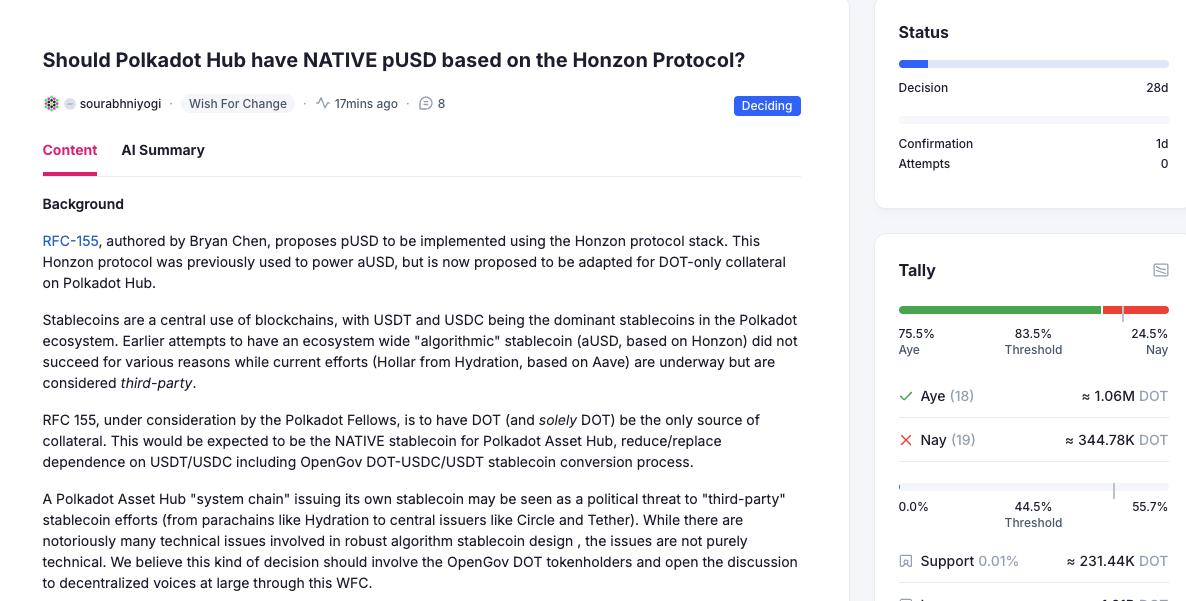
Approval rate of the proposal at the time of writing. Source: PolkadotApproval rate of the proposal at the time of writing. Source: Polkadot

Even those who support Polkadot launching its native stablecoin still see Honzon and Acala as lessons that cannot be ignored. They propose the project should “move forward independently from the Acala team.” In addition, they call for the Technical Council to take clear responsibility for governance.

Too Many Risks

Setting aside concerns about Honzon and the Acala team, Polkadot’s pUSD also faces skepticism within the community. One primary reason is the structure that DOT solely backs it.

While the exact overcollateralization ratio remains unclear, this could trigger liquidation cascades and add selling pressure on the token. Although the pUSD model is safer than Terra’s UST because it is overcollateralized, relying only on DOT as collateral introduces significant risks.

Previously, MakerDAO’s DAI also started as ETH-only collateral. But today, MakerDAO supports Multi-Collateral DAI (MCD). They allow users to back DAI with crypto assets such as ETH, WBTC, LINK, UNI, stETH, and even Real World Assets (RWAs) like US Treasuries.

Additionally, another X user pointed out that the Polkadot ecosystem already has more advanced native solutions like HOLLAR. The Hydration runtime builds this stablecoin, optimizes it for appchains, and positions it as superior to the legacy aUSD architecture. Therefore, many argue that instead of repeating a “regular” EVM model, Polkadot should leverage its unique strengths. This would enable the creation of a stable, secure solution worthy of its ecosystem’s potential.

pUSD is undoubtedly a strategic move by Polkadot to unlock DeFi potential. It could bring significant benefits if it proves secure and sees widespread adoption in the ecosystem. However, the ghost of aUSD’s failure continues to cast doubt within the community.

To avoid repeating the same mistakes, Polkadot must work to dispel those lingering concerns. The fact that the DOT supply is capped at 2.1 billion, as reported by BeInCrypto, could help fuel the ecosystem’s growth.

Market Opportunity
Shadow Logo
Shadow Price(SHADOW)
$1.58
$1.58$1.58
-10.53%
USD
Shadow (SHADOW) Live Price Chart
Disclaimer: The articles reposted on this site are sourced from public platforms and are provided for informational purposes only. They do not necessarily reflect the views of MEXC. All rights remain with the original authors. If you believe any content infringes on third-party rights, please contact service@support.mexc.com for removal. MEXC makes no guarantees regarding the accuracy, completeness, or timeliness of the content and is not responsible for any actions taken based on the information provided. The content does not constitute financial, legal, or other professional advice, nor should it be considered a recommendation or endorsement by MEXC.

You May Also Like

How to earn from cloud mining: IeByte’s upgraded auto-cloud mining platform unlocks genuine passive earnings

How to earn from cloud mining: IeByte’s upgraded auto-cloud mining platform unlocks genuine passive earnings

The post How to earn from cloud mining: IeByte’s upgraded auto-cloud mining platform unlocks genuine passive earnings appeared on BitcoinEthereumNews.com. contributor Posted: September 17, 2025 As digital assets continue to reshape global finance, cloud mining has become one of the most effective ways for investors to generate stable passive income. Addressing the growing demand for simplicity, security, and profitability, IeByte has officially upgraded its fully automated cloud mining platform, empowering both beginners and experienced investors to earn Bitcoin, Dogecoin, and other mainstream cryptocurrencies without the need for hardware or technical expertise. Why cloud mining in 2025? Traditional crypto mining requires expensive hardware, high electricity costs, and constant maintenance. In 2025, with blockchain networks becoming more competitive, these barriers have grown even higher. Cloud mining solves this by allowing users to lease professional mining power remotely, eliminating the upfront costs and complexity. IeByte stands at the forefront of this transformation, offering investors a transparent and seamless path to daily earnings. IeByte’s upgraded auto-cloud mining platform With its latest upgrade, IeByte introduces: Full Automation: Mining contracts can be activated in just one click, with all processes handled by IeByte’s servers. Enhanced Security: Bank-grade encryption, cold wallets, and real-time monitoring protect every transaction. Scalable Options: From starter packages to high-level investment contracts, investors can choose the plan that matches their goals. Global Reach: Already trusted by users in over 100 countries. Mining contracts for 2025 IeByte offers a wide range of contracts tailored for every investor level. From entry-level plans with daily returns to premium high-yield packages, the platform ensures maximum accessibility. Contract Type Duration Price Daily Reward Total Earnings (Principal + Profit) Starter Contract 1 Day $200 $6 $200 + $6 + $10 bonus Bronze Basic Contract 2 Days $500 $13.5 $500 + $27 Bronze Basic Contract 3 Days $1,200 $36 $1,200 + $108 Silver Advanced Contract 1 Day $5,000 $175 $5,000 + $175 Silver Advanced Contract 2 Days $8,000 $320 $8,000 + $640 Silver…
Share
BitcoinEthereumNews2025/09/17 23:48
BlockchainFX or Based Eggman $GGs Presale: Which 2025 Crypto Presale Is Traders’ Top Pick?

BlockchainFX or Based Eggman $GGs Presale: Which 2025 Crypto Presale Is Traders’ Top Pick?

Traders compare Blockchain FX and Based Eggman ($GGs) as token presales compete for attention. Explore which presale crypto stands out in the 2025 crypto presale list and attracts whale capital.
Share
Blockchainreporter2025/09/18 00:30
Will HYPE Explode To New Heights?

Will HYPE Explode To New Heights?

The post Will HYPE Explode To New Heights? appeared on BitcoinEthereumNews.com. Hyperliquid Price Prediction 2026-2030: Will HYPE Explode To New Heights? Skip to
Share
BitcoinEthereumNews2025/12/23 15:04