Resolv's goal is to build an efficient revenue cycle that continuously returns value to RESOLV holders.Resolv's goal is to build an efficient revenue cycle that continuously returns value to RESOLV holders.

Resolv: 340 million TVL + 50,000 users endorsement, a Delta neutral stablecoin protocol with a dual token model

2025/05/08 18:30

Author: Pink Brains

Compiled by: Tim, PANews

Interest-bearing stablecoins have become the focus of the current cycle with their three characteristics of real returns, low volatility, and airdrop opportunities. Resolv is about to become the next stablecoin protocol to issue tokens.

Here are the key things you need to know about Resolv and the RESOLV token:

Resolv: 340 million TVL + 50,000 users endorsement, a Delta neutral stablecoin protocol with a dual token model

Resolv is a stablecoin protocol that aims to solve the following specific problem: How to build a stablecoin that can obtain real and sustainable returns without taking unnecessary risks? Their answer is: scalable structure, transparency and yield mechanism.

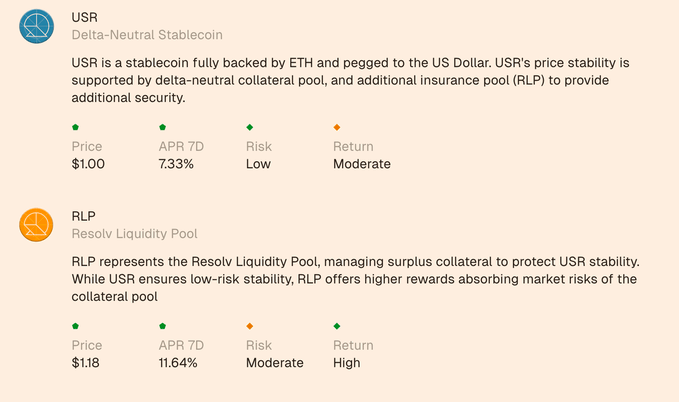
Resolv's core product is the stablecoin USR, which is backed by ETH and BTC. The platform uses a Delta-neutral strategy (mainly hedging with perpetual contracts) to transform highly volatile assets into productive collateral while maintaining price stability. This is not a pioneering model (such as Ethena's USDe), but Resolv has also found a point of fit between product and market.

Resolv divides risk into two parts:

  • stUSR: Low-risk, interest-earning stablecoin
  • RLP: A medium-risk, high-return position that earns returns by taking on protocol performance risk

This dual structure is crucial as it allows capital to make autonomous choices based on risk appetite, which is also the common way traditional finance handles returns.
Resolv: 340 million TVL + 50,000 users endorsement, a Delta neutral stablecoin protocol with a dual token model

Where does the income come from?

Resolv has three ways to realize stablecoin income:

1. ETH/BTC staking via Lido and Binance

2. Perpetual contracts on Binance, Hyperliquid, and Deribit

3. US dollar neutral strategy (Superstate USCC)

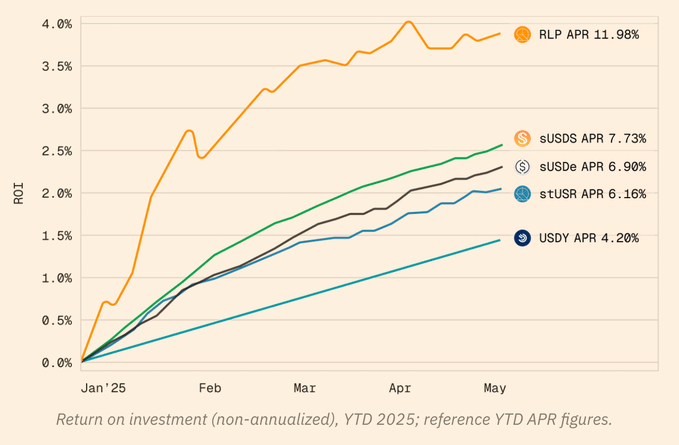
stUSR offers a yield comparable to sUSDe and sUSDS, while enhancing the insurance mechanism through RLP.

At the same time, RLP’s high yield is also reflected in another aspect. By capturing the upside of the Resolv strategy, it outperforms stablecoins backed by U.S. Treasuries such as $USDY.
Resolv: 340 million TVL + 50,000 users endorsement, a Delta neutral stablecoin protocol with a dual token model

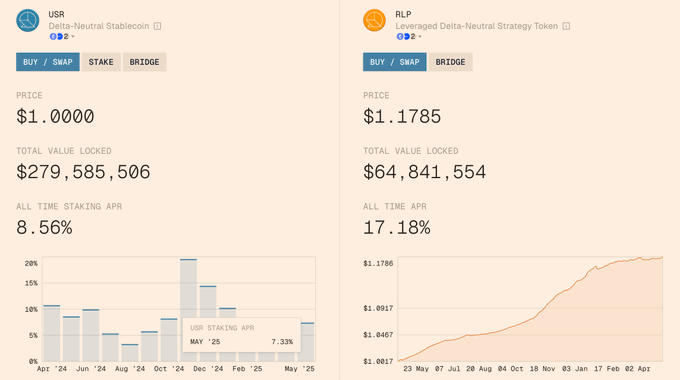
Since its public launch in September 2024, Resolv has achieved the following: $344.1 million TVL (across Ethereum, Base, and BNB chains); over $1.7 billion in total minting and redemption; over $10 million in actual earnings distributed; over 50,000 users (56% of monthly active users)

In addition, USR and stUSR are jointly managed by top DeFi protocols (such as Pendle, Morpho, Euler, Curve, Hyperliquid, etc.) and other capital allocators.

This is quite impressive performance for a newly launched stablecoin protocol.
Resolv: 340 million TVL + 50,000 users endorsement, a Delta neutral stablecoin protocol with a dual token model

Now, Resolv plans to launch its native token, RESOLV, in the first two weeks of this month.

RESOLV Token Economics:

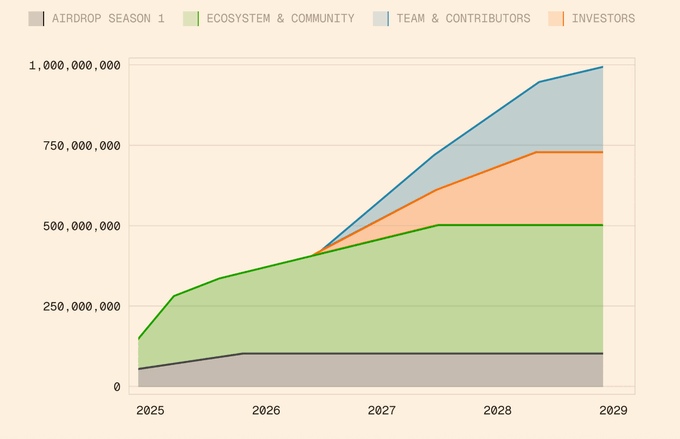
  • Total supply: 1 billion
  • Season 1 airdrop: 10% (unlocked at TGE)
  • Ecosystem and community: 40.9% (10% unlocked at TGE, remaining tokens released linearly over 24 months)
  • Team: 26.7% (1 year lock-up period, followed by 30 months of linear release)
  • Investors: 22.4% (1-year lock-up period, followed by linear unlocking over 24 months)
Resolv: 340 million TVL + 50,000 users endorsement, a Delta neutral stablecoin protocol with a dual token model

Token Utility:

  • Governance (treasury strategy + incentive plan);
  • Double rewards (token issuance + external partner benefits);
  • Points multiplier; obtain the qualification of future airdrops from partners;

After TGE, what are Resolv’s next plans?

Resolv aims to be an architecture that seamlessly integrates stable yield into every layer of on-chain finance.

1. Optimizing the Segregated Vault for Delta Neutral Returns

2. Allocate funds to treasury bonds and stablecoins backed by RWA

3. Altcoin Vault

4. External income (treasury cooperation, swap instruments and redemption)

Resolv's goal is to build an efficient revenue cycle that continuously returns value to RESOLV holders.
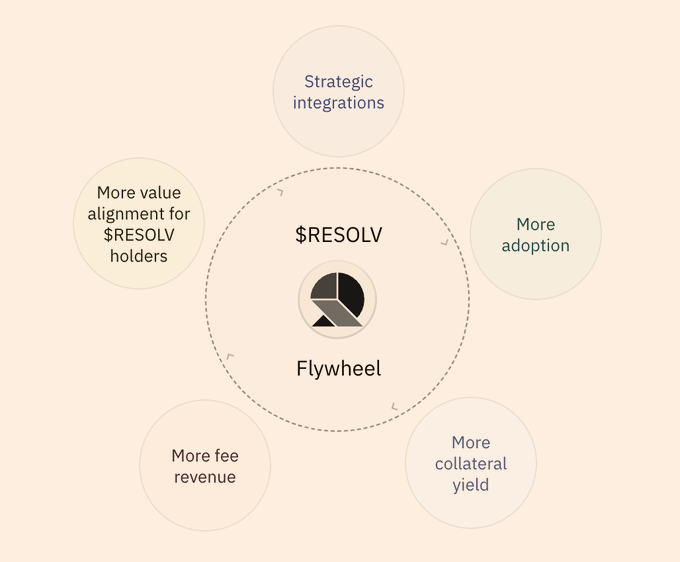
Resolv: 340 million TVL + 50,000 users endorsement, a Delta neutral stablecoin protocol with a dual token model

Resolv is not just a stablecoin, it is evolving into an on-chain currency. If you have been using USR and stUSR to gain experience points, now is the time to reap the rewards! TGE and airdrops are coming soon, stay tuned!

Market Opportunity
TokenFi Logo
TokenFi Price(TOKEN)
$0.002654
$0.002654$0.002654
-1.04%
USD
TokenFi (TOKEN) Live Price Chart
Disclaimer: The articles reposted on this site are sourced from public platforms and are provided for informational purposes only. They do not necessarily reflect the views of MEXC. All rights remain with the original authors. If you believe any content infringes on third-party rights, please contact service@support.mexc.com for removal. MEXC makes no guarantees regarding the accuracy, completeness, or timeliness of the content and is not responsible for any actions taken based on the information provided. The content does not constitute financial, legal, or other professional advice, nor should it be considered a recommendation or endorsement by MEXC.

You May Also Like

The Channel Factories We’ve Been Waiting For

The Channel Factories We’ve Been Waiting For

The post The Channel Factories We’ve Been Waiting For appeared on BitcoinEthereumNews.com. Visions of future technology are often prescient about the broad strokes while flubbing the details. The tablets in “2001: A Space Odyssey” do indeed look like iPads, but you never see the astronauts paying for subscriptions or wasting hours on Candy Crush.  Channel factories are one vision that arose early in the history of the Lightning Network to address some challenges that Lightning has faced from the beginning. Despite having grown to become Bitcoin’s most successful layer-2 scaling solution, with instant and low-fee payments, Lightning’s scale is limited by its reliance on payment channels. Although Lightning shifts most transactions off-chain, each payment channel still requires an on-chain transaction to open and (usually) another to close. As adoption grows, pressure on the blockchain grows with it. The need for a more scalable approach to managing channels is clear. Channel factories were supposed to meet this need, but where are they? In 2025, subnetworks are emerging that revive the impetus of channel factories with some new details that vastly increase their potential. They are natively interoperable with Lightning and achieve greater scale by allowing a group of participants to open a shared multisig UTXO and create multiple bilateral channels, which reduces the number of on-chain transactions and improves capital efficiency. Achieving greater scale by reducing complexity, Ark and Spark perform the same function as traditional channel factories with new designs and additional capabilities based on shared UTXOs.  Channel Factories 101 Channel factories have been around since the inception of Lightning. A factory is a multiparty contract where multiple users (not just two, as in a Dryja-Poon channel) cooperatively lock funds in a single multisig UTXO. They can open, close and update channels off-chain without updating the blockchain for each operation. Only when participants leave or the factory dissolves is an on-chain transaction…
Share
BitcoinEthereumNews2025/09/18 00:09
USDC Treasury mints 250 million new USDC on Solana

USDC Treasury mints 250 million new USDC on Solana

PANews reported on September 17 that according to Whale Alert , at 23:48 Beijing time, USDC Treasury minted 250 million new USDC (approximately US$250 million) on the Solana blockchain .
Share
PANews2025/09/17 23:51
US S&P Global Manufacturing PMI declines to 51.8, Services PMI falls to 52.9 in December

US S&P Global Manufacturing PMI declines to 51.8, Services PMI falls to 52.9 in December

The post US S&P Global Manufacturing PMI declines to 51.8, Services PMI falls to 52.9 in December appeared on BitcoinEthereumNews.com. The business activity in
Share
BitcoinEthereumNews2025/12/16 23:24