In a wide-ranging September interview with Bitcoin Magazine, MicroStrategy executive chairman Michael Saylor condensed five years of corporate experimentation into a stark, almost mechanical blueprint for what he calls Bitcoin’s “endgame”: accumulate an unprecedented stockpile of the asset as digital capital, then manufacture a new tier of credit markets on top of it. “The endgame […]In a wide-ranging September interview with Bitcoin Magazine, MicroStrategy executive chairman Michael Saylor condensed five years of corporate experimentation into a stark, almost mechanical blueprint for what he calls Bitcoin’s “endgame”: accumulate an unprecedented stockpile of the asset as digital capital, then manufacture a new tier of credit markets on top of it. “The endgame […]

Saylor Unveils His Bitcoin Endgame That Could Upend Global Finance

In a wide-ranging September interview with Bitcoin Magazine, MicroStrategy executive chairman Michael Saylor condensed five years of corporate experimentation into a stark, almost mechanical blueprint for what he calls Bitcoin’s “endgame”: accumulate an unprecedented stockpile of the asset as digital capital, then manufacture a new tier of credit markets on top of it.

“The endgame is we accumulate a trillion dollars worth of BTC and then we grow that capital by issuing more credit,” Saylor said. He cast the maneuver not as a speculative side bet but as the next logical phase of corporate finance, with Bitcoin reconstituted as “digital energy” and balance sheets reimagined as engines that spin yield from over-collateralized, Bitcoin-backed instruments.

Saylor’s Bitcoin Endgame Plan

Saylor’s framing is deliberately elemental. He stitched BTC into a centuries-long lineage of civilization-scale energy breakthroughs—from fire and steel to petroleum and electricity—arguing that the asset’s monetary properties are best understood as a way to move economic “energy” across time and space at light speed.

“Bitcoin is hope because Bitcoin represents digital energy,” he said. “A way to convey energy through time, through space… the next paradigm shift.” To Saylor, the institutional misunderstanding of that shift is not a bug but the core of the opportunity. “I would say 95% of the decision makers in the finance world still don’t really embrace or understand the idea of digital energy,” he argued, adding that society’s digestion lag is typical of paradigm shifts: “Bitcoin is evolving faster than society can digest it.”

At the heart of the playbook is a simple balance-sheet identity, scaled. Treat Bitcoin as the monetary base—“digital gold”—then securitize it as “digital credit” in forms familiar to capital markets: converts, preferreds, money-market-like paper, longer-duration bonds. “If I create a company that buys Bitcoin and I accumulate a billion dollars of Bitcoin, I have a billion dollars of digital capital. What can I do with it? I can issue digital credit,” he said.

In Saylor’s model, the equity of a firm that repeatedly performs this cycle becomes “digital equity,” engineered to outperform the underlying asset through conservative leverage and tenor management: “If I want to create a company that’s going to perform 2x Bitcoin, I take the Bitcoin, I issue Bitcoin-backed credit… I create digital equity and the digital equity outperforms the underlying capital asset.”

He insists the competitive set is not other Bitcoin treasuries but the vast inventory of 20th-century credit—mortgage, corporate, and sovereign—priced off low or repressed yields and often secured by depreciating or illiquid collateral. “What they’re competing against is the existing credit instruments in the capital market,” Saylor said.

The pitch to savers is equally blunt: the “better bank” is one that strips out duration and pays a spread over the fiat status quo, funded by over-collateralized Bitcoin. He sketched it in operational terms: raise equity, buy Bitcoin, then sell short-duration, BTC-secured credit “that just strips the duration to one month… and give people 500 basis points more yield than the risk-free rate in the capital market where you’re selling the credit.”

The scale he envisions is not modest. Saylor walked through jurisdictions where financial repression or chronically low policy rates amplify the spread, arguing that mature markets with suppressed yields are the ripest soil for “pure-play digital credit issuers.” Switzerland and Japan were his canonical examples.

The aspiration, however, is global. “What if there’s a hundred trillion dollars of digital credit and… 200 trillion worth of digital capital,” he asked, emphasizing that such a structure could remain over-collateralized rather than drift into fractional banking. He also pressed the geopolitical logic: corporate treasuries and well-capitalized exchanges, miners, and custodians become the “first line of economic defense,” lobbying and normalizing Bitcoin within domestic rule-sets the way incumbent industries do. “If you want to win the monetary war you need the institutions that control all the capital and… the support of the government,” he said.

Bitcoin Treasury Companies Will Be Banks

Saylor was explicit that corporate adoption is already compounding. He traced the cohort of publicly traded balance sheets holding BTC from a single firm in 2020—MicroStrategy—to “two or three… then 10… then 20… then 40… about a year ago there were 60… three months ago there were 120 and right now there’s more than 180,” with the target trajectory moving from “100 to a thousand to 10,000 to 100,000.” He blended that diffusion story with the platform thesis—Bitcoin built natively into iOS, Android, Windows, and consumer hardware—arguing that operating-system-level support is the other clear signal that “digital energy” has fused with the fabric of commerce.

Asked about the distributional critique—that corporations crowd out individuals—Saylor inverted the premise, claiming institutional flows have largely accrued to early holders. “When we got involved, Bitcoin was trading $9,000 a coin… today Bitcoin’s $115,000,” he said, attributing much of the appreciation to corporate and ETF demand. “That means that 93% of the gain… went to the individuals that owned the Bitcoin before the corporations got involved.”

The rhetoric can be martial—Saylor calls it a “protocol war”—but his operational discipline hinges on avoiding the traps that wrecked miners in the last cycle. Short and expensive liabilities layered onto depreciating hardware was, in his view, the fatal mismatch. The treasury archetype he champions favors mid-to-longer duration capital structures tied to an appreciating base asset. “If you take a mid-duration or long-duration loan and buy an asset appreciating 30 to 60% a year, you’ll probably be fine,” he said, dismissing M&A diversification as value-destructive opacity compared to the “perfect partner” of simply buying more BTC at “one times revenue.”

Saylor On US Policy

Saylor also pushed the policy and infrastructure horizon, predicting a phased legitimization of tokenized assets while stressing that the “greatest regulatory clarity” remains BTC’s status as a digital commodity that can sit on balance sheets and collateralize credit. He summarized the new political posture in Washington as supportive of making the US a “global Bitcoin superpower”—not by nationalizing miners or acquiring equity stakes, but by mainstreaming custody, collateralization, lending, operating-system integration, and tax treatment. “They want the finance companies in the United States to lead the way… and the finance companies in the United States to lead the way in digital assets and digital capital and Bitcoin adoption,” he said.

For a community accustomed to debating halvings, hash rate, or on-chain heuristics, Saylor’s endgame centers elsewhere: indexes, coupons, tenors, and yield curves—all re-denominated atop a new monetary base. It is a corporate finance thesis at Bitcoin’s core. And it doubles as a provocation to boards and CFOs in every currency regime: “For every company in the world in any capital market, they’re always better off to buy Bitcoin as their capital asset,” he said. The rest is execution at scale. “Get to a trillion dollars of collateral growing 30% a year, be issuing $100 billion of credit a year, growing 20, 30% a year,” Saylor concluded. “We’re building a better bank.”

At press time, Bitcoin traded at $116,492.
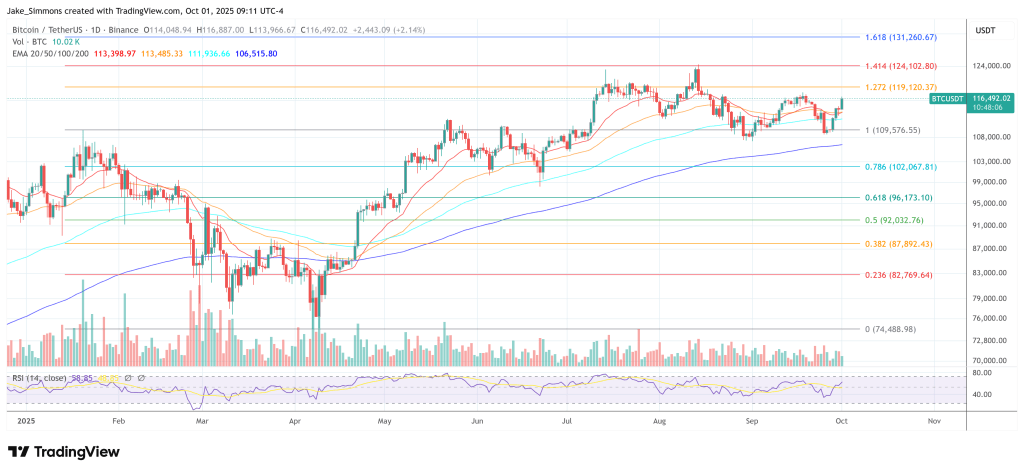
Bitcoin price
Market Opportunity
FINANCE Logo
FINANCE Price(FINANCE)
$0.0001854
$0.0001854$0.0001854
+4.62%
USD
FINANCE (FINANCE) Live Price Chart
Disclaimer: The articles reposted on this site are sourced from public platforms and are provided for informational purposes only. They do not necessarily reflect the views of MEXC. All rights remain with the original authors. If you believe any content infringes on third-party rights, please contact service@support.mexc.com for removal. MEXC makes no guarantees regarding the accuracy, completeness, or timeliness of the content and is not responsible for any actions taken based on the information provided. The content does not constitute financial, legal, or other professional advice, nor should it be considered a recommendation or endorsement by MEXC.

You May Also Like

Unprecedented Surge: Gold Price Hits Astounding New Record High

Unprecedented Surge: Gold Price Hits Astounding New Record High

BitcoinWorld Unprecedented Surge: Gold Price Hits Astounding New Record High While the world often buzzes with the latest movements in Bitcoin and altcoins, a traditional asset has quietly but powerfully commanded attention: gold. This week, the gold price has once again made headlines, touching an astounding new record high of $3,704 per ounce. This significant milestone reminds investors, both traditional and those deep in the crypto space, of gold’s enduring appeal as a store of value and a hedge against uncertainty. What’s Driving the Record Gold Price Surge? The recent ascent of the gold price to unprecedented levels is not a random event. Several powerful macroeconomic forces are converging, creating a perfect storm for the precious metal. Geopolitical Tensions: Escalating conflicts and global instability often drive investors towards safe-haven assets. Gold, with its long history of retaining value during crises, becomes a preferred choice. Inflation Concerns: Persistent inflation in major economies erodes the purchasing power of fiat currencies. Consequently, investors seek assets like gold that historically maintain their value against rising prices. Central Bank Policies: Many central banks globally are accumulating gold at a significant pace. This institutional demand provides a strong underlying support for the gold price. Furthermore, expectations around interest rate cuts in the future also make non-yielding assets like gold more attractive. These factors collectively paint a picture of a cautious market, where investors are looking for stability amidst a turbulent economic landscape. Understanding Gold’s Appeal in Today’s Market For centuries, gold has held a unique position in the financial world. Its latest record-breaking performance reinforces its status as a critical component of a diversified portfolio. Gold offers a tangible asset that is not subject to the same digital vulnerabilities or regulatory shifts that can impact cryptocurrencies. While digital assets offer exciting growth potential, gold provides a foundational stability that appeals to a broad spectrum of investors. Moreover, the finite supply of gold, much like Bitcoin’s capped supply, contributes to its perceived value. The current market environment, characterized by economic uncertainty and fluctuating currency values, only amplifies gold’s intrinsic benefits. It serves as a reliable hedge when other asset classes, including stocks and sometimes even crypto, face downward pressure. How Does This Record Gold Price Impact Investors? A soaring gold price naturally raises questions for investors. For those who already hold gold, this represents a significant validation of their investment strategy. For others, it might spark renewed interest in this ancient asset. Benefits for Investors: Portfolio Diversification: Gold often moves independently of other asset classes, offering crucial diversification benefits. Wealth Preservation: It acts as a robust store of value, protecting wealth against inflation and economic downturns. Liquidity: Gold markets are highly liquid, allowing for relatively easy buying and selling. Challenges and Considerations: Opportunity Cost: Investing in gold means capital is not allocated to potentially higher-growth assets like equities or certain cryptocurrencies. Volatility: While often seen as stable, gold prices can still experience significant fluctuations, as evidenced by its rapid ascent. Considering the current financial climate, understanding gold’s role can help refine your overall investment approach. Looking Ahead: The Future of the Gold Price What does the future hold for the gold price? While no one can predict market movements with absolute certainty, current trends and expert analyses offer some insights. Continued geopolitical instability and persistent inflationary pressures could sustain demand for gold. Furthermore, if global central banks continue their gold acquisition spree, this could provide a floor for prices. However, a significant easing of inflation or a de-escalation of global conflicts might reduce some of the immediate upward pressure. Investors should remain vigilant, observing global economic indicators and geopolitical developments closely. The ongoing dialogue between traditional finance and the emerging digital asset space also plays a role. As more investors become comfortable with both gold and cryptocurrencies, a nuanced understanding of how these assets complement each other will be crucial for navigating future market cycles. The recent surge in the gold price to a new record high of $3,704 per ounce underscores its enduring significance in the global financial landscape. It serves as a powerful reminder of gold’s role as a safe haven asset, a hedge against inflation, and a vital component for portfolio diversification. While digital assets continue to innovate and capture headlines, gold’s consistent performance during times of uncertainty highlights its timeless value. Whether you are a seasoned investor or new to the market, understanding the drivers behind gold’s ascent is crucial for making informed financial decisions in an ever-evolving world. Frequently Asked Questions (FAQs) Q1: What does a record-high gold price signify for the broader economy? A record-high gold price often indicates underlying economic uncertainty, inflation concerns, and geopolitical instability. Investors tend to flock to gold as a safe haven when they lose confidence in traditional currencies or other asset classes. Q2: How does gold compare to cryptocurrencies as a safe-haven asset? Both gold and some cryptocurrencies (like Bitcoin) are often considered safe havens. Gold has a centuries-long history of retaining value during crises, offering tangibility. Cryptocurrencies, while newer, offer decentralization and can be less susceptible to traditional financial system failures, but they also carry higher volatility and regulatory risks. Q3: Should I invest in gold now that its price is at a record high? Investing at a record high requires careful consideration. While the price might continue to climb due to ongoing market conditions, there’s also a risk of a correction. It’s crucial to assess your personal financial goals, risk tolerance, and consider diversifying your portfolio rather than putting all your capital into a single asset. Q4: What are the main factors that influence the gold price? The gold price is primarily influenced by global economic uncertainty, inflation rates, interest rate policies by central banks, the strength of the U.S. dollar, and geopolitical tensions. Demand from jewelers and industrial uses also play a role, but investment and central bank demand are often the biggest drivers. Q5: Is gold still a good hedge against inflation? Historically, gold has proven to be an effective hedge against inflation. When the purchasing power of fiat currencies declines, gold tends to hold its value or even increase, making it an attractive asset for preserving wealth during inflationary periods. To learn more about the latest crypto market trends, explore our article on key developments shaping Bitcoin’s price action. This post Unprecedented Surge: Gold Price Hits Astounding New Record High first appeared on BitcoinWorld.
Share
Coinstats2025/09/18 02:30
Ripple CTO Explains How The XRP Ledger ‘Will Take Over The World’

Ripple CTO Explains How The XRP Ledger ‘Will Take Over The World’

On a Token Relations webinar for the XRP ecosystem on Dec. 20, Ripple CTO David Schwartz was asked the sort of question that usually produces a tidy dashboard answer
Share
Bitcoinist2025/12/24 06:00
Pump.fun (PUMP) Has Spiked by 200%: Can the Rally Survive?

Pump.fun (PUMP) Has Spiked by 200%: Can the Rally Survive?

Between July and now, the price of Pumpfun (PUMP) has spiked by more than 200%. The rally has been strong, and the sentiment is still high. However, do we expect to continue seeing these highs, or is the price showing signs of crashing already? We will consider this by taking insights from a video by
Share
Coinstats2025/09/18 01:30