Anatoly Yakovenko, co-founder CEO of Solana Labs, has unveiled plans for a new decentralized exchange (DEX) named Percolator, designed as a sharded perpetuals protocol built directly on the Solana blockchain.  The platform aims to provide a self-custodial and high-speed solution for perpetual futures trading, allowing crypto traders to speculate on price movements without the limitation of expiry dates. Solana’s Percolator Documentation Released The documentation for Percolator was released on GitHub, where it is described as “implementation-ready.” It introduces two primary components: a Router and a Slab program.  The Router manages collateral, portfolio margins, and cross-slab routing, while the Slab program functions as a matching engine overseen by liquidity providers (LPs). Each slab operates independently, enabling what Yakovenko refers to as “fully self-contained matching and settlement.”  Related Reading: Analyst Uses AI To Show How The XRP Price Could Rally To $1,700 This design ensures that any issues arising from a particular slab do not affect users who have not interacted with it. Yakovenko emphasized the advantages of this architecture, stating: This design keeps each LP’s slab fully self-contained and innovable, while the Router guarantees atomic routing, portfolio netting, and capability-scoped safety.  The project’s GitHub repository already shows completed data structures for order books and memory pools, although the development of liquidation systems is still in progress. However, no official launch date has been announced. Competition In Derivatives Market Intensifies Currently, the Solana Foundation has not disclosed whether Percolator will receive formal ecosystem support or if it will emerge as a community-driven protocol.  Should it succeed, Percolator would add to the expanding repertoire of native financial primitives being developed on the Solana blockchain, which already includes decentralized options, lending protocols, and tokenized asset platforms.  At present, the code for Percolator remains under review on GitHub, and developers engaged with the repository indicate that the project is “deep in testing.” This suggests that a launch could be imminent, provided that the liquidation and governance components are finalized. The introduction of Percolator comes at a critical time, as competitors like Hyperliquid (HYPE) are expanding their presence in the derivatives-focused DEX space.  Related Reading: ‘Buy Of The Century’: Cardano Could Be The 2026 Game-Changer Under $0.20 — Analyst Hyperliquid recently implemented permissionless, builder-deployed perpetual contracts through its HIP-3 upgrade, allowing users to stake a minimum of 500,000 HYPE tokens—approximately $18 million—to launch their own perpetual markets with independent margin rules. Hyperliquid accounted for 35% of all blockchain revenue in July, attracting users away from platforms like Solana, Ethereum (ETH), and BNB Chain. Asset manager VanEck recently noted that Hyperliquid has successfully retained high-value users, thanks in part to its “simple, highly functional product.” As of press time, SOL is trading at $187.70, marking a 20% loss over the past fourteen and thirty days. This puts SOL 35% below its all-time high of $293, which was reached earlier this year.  Featured image from DALL-E, chart from TradingView.comAnatoly Yakovenko, co-founder CEO of Solana Labs, has unveiled plans for a new decentralized exchange (DEX) named Percolator, designed as a sharded perpetuals protocol built directly on the Solana blockchain.  The platform aims to provide a self-custodial and high-speed solution for perpetual futures trading, allowing crypto traders to speculate on price movements without the limitation of expiry dates. Solana’s Percolator Documentation Released The documentation for Percolator was released on GitHub, where it is described as “implementation-ready.” It introduces two primary components: a Router and a Slab program.  The Router manages collateral, portfolio margins, and cross-slab routing, while the Slab program functions as a matching engine overseen by liquidity providers (LPs). Each slab operates independently, enabling what Yakovenko refers to as “fully self-contained matching and settlement.”  Related Reading: Analyst Uses AI To Show How The XRP Price Could Rally To $1,700 This design ensures that any issues arising from a particular slab do not affect users who have not interacted with it. Yakovenko emphasized the advantages of this architecture, stating: This design keeps each LP’s slab fully self-contained and innovable, while the Router guarantees atomic routing, portfolio netting, and capability-scoped safety.  The project’s GitHub repository already shows completed data structures for order books and memory pools, although the development of liquidation systems is still in progress. However, no official launch date has been announced. Competition In Derivatives Market Intensifies Currently, the Solana Foundation has not disclosed whether Percolator will receive formal ecosystem support or if it will emerge as a community-driven protocol.  Should it succeed, Percolator would add to the expanding repertoire of native financial primitives being developed on the Solana blockchain, which already includes decentralized options, lending protocols, and tokenized asset platforms.  At present, the code for Percolator remains under review on GitHub, and developers engaged with the repository indicate that the project is “deep in testing.” This suggests that a launch could be imminent, provided that the liquidation and governance components are finalized. The introduction of Percolator comes at a critical time, as competitors like Hyperliquid (HYPE) are expanding their presence in the derivatives-focused DEX space.  Related Reading: ‘Buy Of The Century’: Cardano Could Be The 2026 Game-Changer Under $0.20 — Analyst Hyperliquid recently implemented permissionless, builder-deployed perpetual contracts through its HIP-3 upgrade, allowing users to stake a minimum of 500,000 HYPE tokens—approximately $18 million—to launch their own perpetual markets with independent margin rules. Hyperliquid accounted for 35% of all blockchain revenue in July, attracting users away from platforms like Solana, Ethereum (ETH), and BNB Chain. Asset manager VanEck recently noted that Hyperliquid has successfully retained high-value users, thanks in part to its “simple, highly functional product.” As of press time, SOL is trading at $187.70, marking a 20% loss over the past fourteen and thirty days. This puts SOL 35% below its all-time high of $293, which was reached earlier this year.  Featured image from DALL-E, chart from TradingView.com

Solana Co-Founder Ventures Into Perpetual DEX Development: What You Should Know

2025/10/21 15:00

Anatoly Yakovenko, co-founder CEO of Solana Labs, has unveiled plans for a new decentralized exchange (DEX) named Percolator, designed as a sharded perpetuals protocol built directly on the Solana blockchain. 

The platform aims to provide a self-custodial and high-speed solution for perpetual futures trading, allowing crypto traders to speculate on price movements without the limitation of expiry dates.

Solana’s Percolator Documentation Released

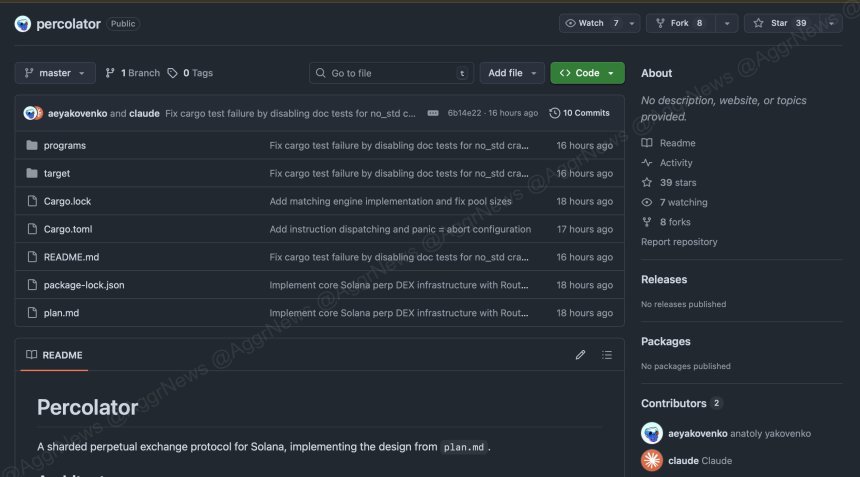
The documentation for Percolator was released on GitHub, where it is described as “implementation-ready.” It introduces two primary components: a Router and a Slab program. 

The Router manages collateral, portfolio margins, and cross-slab routing, while the Slab program functions as a matching engine overseen by liquidity providers (LPs). Each slab operates independently, enabling what Yakovenko refers to as “fully self-contained matching and settlement.” 

This design ensures that any issues arising from a particular slab do not affect users who have not interacted with it. Yakovenko emphasized the advantages of this architecture, stating:

The project’s GitHub repository already shows completed data structures for order books and memory pools, although the development of liquidation systems is still in progress. However, no official launch date has been announced.

Competition In Derivatives Market Intensifies

Currently, the Solana Foundation has not disclosed whether Percolator will receive formal ecosystem support or if it will emerge as a community-driven protocol. 

Should it succeed, Percolator would add to the expanding repertoire of native financial primitives being developed on the Solana blockchain, which already includes decentralized options, lending protocols, and tokenized asset platforms. 

At present, the code for Percolator remains under review on GitHub, and developers engaged with the repository indicate that the project is “deep in testing.” This suggests that a launch could be imminent, provided that the liquidation and governance components are finalized.
Solana

The introduction of Percolator comes at a critical time, as competitors like Hyperliquid (HYPE) are expanding their presence in the derivatives-focused DEX space. 

Hyperliquid recently implemented permissionless, builder-deployed perpetual contracts through its HIP-3 upgrade, allowing users to stake a minimum of 500,000 HYPE tokens—approximately $18 million—to launch their own perpetual markets with independent margin rules.

Hyperliquid accounted for 35% of all blockchain revenue in July, attracting users away from platforms like Solana, Ethereum (ETH), and BNB Chain. Asset manager VanEck recently noted that Hyperliquid has successfully retained high-value users, thanks in part to its “simple, highly functional product.”

Solana

As of press time, SOL is trading at $187.70, marking a 20% loss over the past fourteen and thirty days. This puts SOL 35% below its all-time high of $293, which was reached earlier this year. 

Featured image from DALL-E, chart from TradingView.com 

Disclaimer: The articles reposted on this site are sourced from public platforms and are provided for informational purposes only. They do not necessarily reflect the views of MEXC. All rights remain with the original authors. If you believe any content infringes on third-party rights, please contact service@support.mexc.com for removal. MEXC makes no guarantees regarding the accuracy, completeness, or timeliness of the content and is not responsible for any actions taken based on the information provided. The content does not constitute financial, legal, or other professional advice, nor should it be considered a recommendation or endorsement by MEXC.

You May Also Like

Shiba Inu Price Stalls Near Lows – What Could Matter in 2026 For SHIB To Takeoff?

Shiba Inu Price Stalls Near Lows – What Could Matter in 2026 For SHIB To Takeoff?

Shiba Inu has had a tough year, and its not hiding on the chart. TheCryptoBasic shared on X that the SHIB price has printed its first-ever weekly death cross in
Share
Coinstats2025/12/25 06:00
Born Again’ Season 3 Way Before Season 2

Born Again’ Season 3 Way Before Season 2

The post Born Again’ Season 3 Way Before Season 2 appeared on BitcoinEthereumNews.com. Daredevil Born Again Marvel MCU fans were thrilled that Charlie Cox’s Daredevil was being brought back to life after his unceremonious execution after his show’s Netflix run, where everything was transitioning to Disney Plus. Born Again felt like a moment that would never come, and when it did, it mostly satisfied fans, with few exceptions. Now, according to a new IGN interview with head of TV Brad Winderbaum, Marvel has greenlit Daredevil: Born Again for season 3, well before season 2 airs in March 2026. Originally, the plan was an 18-episode run across two seasons, but Marvel seems to have much larger plans for Matt Murdoch and his series. This is a combination of two things. First, the positive fan reception to season 1. While there were some hiccups here, where the middle of the season had parts of the previously canned version of the show they had to work around, the first and last few episodes were incredible, and that’s the team making all of season 2 and presumably season 3 going forward. So, that’s great news. Second, this is a move by Marvel to reduce the cost of its endless supply of Disney Plus shows by focusing on more “street level” content. MCU series have been all over the place in terms of their focus and their budgets, culminating in the ridiculous $212 million budget for six episodes of the VFX-heavy Secret Invasion, one of the worst things Marvel has ever produced. Now? The name of the game is lower costs. Agatha All Along was a prime example of this, one of the MCU’s cheapest projects ever but one of its best shows. Disney is investing deeper into the “Daredevil-verse” here, as season 2 of Born Again features Jessica Jones, who might be destined to return for her…
Share
BitcoinEthereumNews2025/09/19 02:29
Ripple Collaborates with DBS and Franklin Templeton to Introduce RLUSD-Backed Trading and Lending Solutions

Ripple Collaborates with DBS and Franklin Templeton to Introduce RLUSD-Backed Trading and Lending Solutions

Ripple partners with DBS and Franklin Templeton to launch RLUSD-backed trading and lending solutions for institutional investors.   Ripple has teamed up with DBS and Franklin Templeton to launch a new trading and lending platform powered by Ripple’s RLUSD stablecoin. This collaboration aims to create a more efficient financial ecosystem for institutional investors.  Through this […] The post Ripple Collaborates with DBS and Franklin Templeton to Introduce RLUSD-Backed Trading and Lending Solutions appeared first on Live Bitcoin News.
Share
LiveBitcoinNews2025/09/18 19:00