The stablecoin market just hit a historic milestone, but the real story isn't the number—it's who's coming for Tether and Circle's dominance.The stablecoin market just hit a historic milestone, but the real story isn't the number—it's who's coming for Tether and Circle's dominance.

Stablecoins Cross $300 Billion as the Duopoly Begins to Crack

2025/10/03 18:33
5 min read
Stablecoins Cross $300 Billion as the Duopoly Begins to Crack

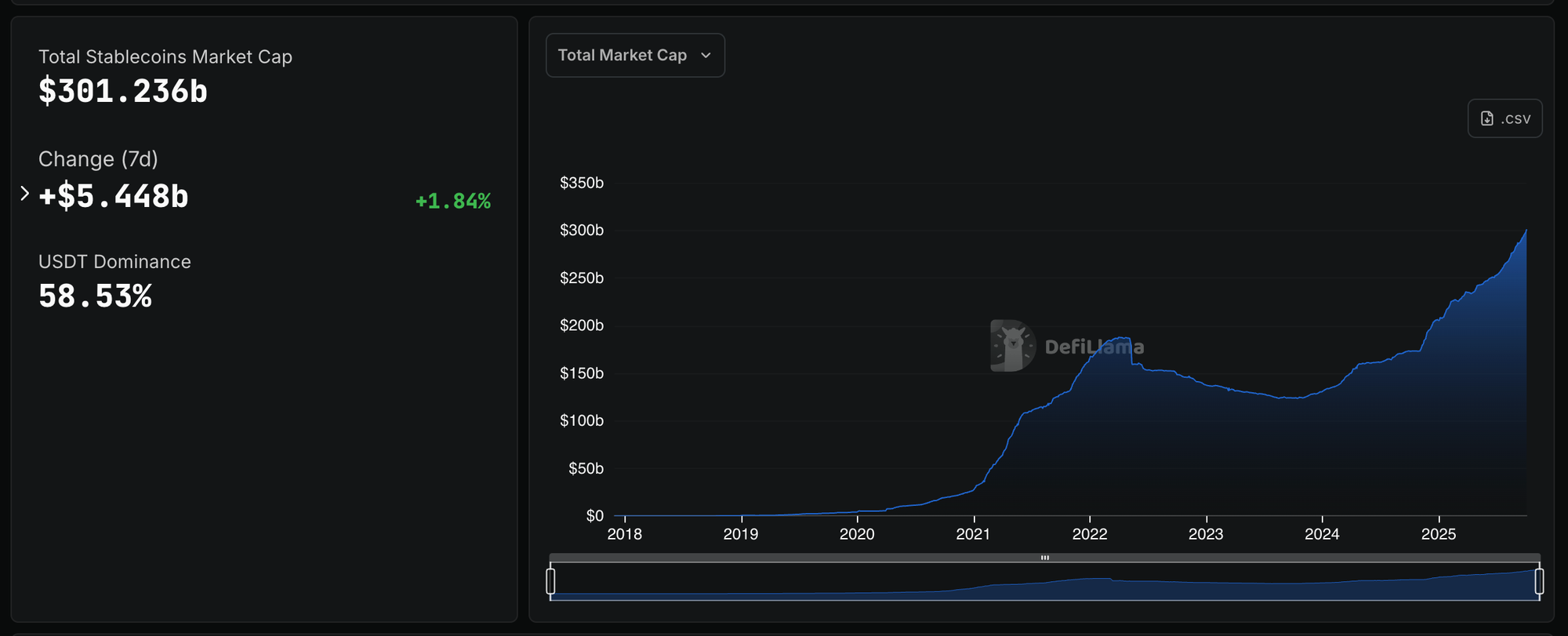
The total stablecoin market capitalization surpassed $300 billion for the first time this week, according to DeFiLlama data. Tether's USDT commands 58.44% of the market at $176.3 billion, Circle's USDC holds over $74 billion, and the third-largest stablecoin, the yield-bearing USDe, Ethena's synthetic dollar, stands at $14.83 billion.
Stablecoins Cross $300 Billion as the Duopoly Begins to Crack

On the surface, it's a straightforward growth story: more capital flowing into crypto's base liquidity layer as institutional adoption accelerates. But the composition of that $300 billion tells a more interesting story: the Tether-Circle duopoly that has defined stablecoin markets for years is starting to fracture.

End of Two-Horse Race

Industry analyst Nic Carter recently declared "the end of the stablecoin duopoly," pointing to two forces reshaping the competitive landscape: yield-bearing stablecoins that offer returns on deposits, and new regulatory frameworks enabling traditional banks to issue their own dollar-pegged tokens.

The emergence of USDe as the third-largest stablecoin illustrates the first dynamic. When users can earn yields on their stablecoin holdings, even smaller issuers can compete for liquidity against entrenched players. It's a fundamental shift in value proposition that stablecoins are no longer just stable but productive assets.

The second force is potentially more disruptive. The GENIUS Act in the United States has opened pathways for regulated financial institutions to launch stablecoins, and major banks are already mobilizing. JP Morgan and Citigroup announced a joint stablecoin venture. In Europe, ING joined UniCredit and seven other banks on a MiCA-compliant euro stablecoin slated for a 2026 launch.

Carter argues that while no single bank could challenge Tether's scale, bank consortia represent credible competition. These aren't crypto-native upstarts—they're institutions with existing customer bases, regulatory relationships, and balance sheets that dwarf current stablecoin issuers.

Banks as Issuers, Not Just Infrastructure

What's striking is how quickly the narrative has shifted from "banks versus crypto" to "banks as stablecoin issuers." Citigroup now projects the stablecoin market will reach $4 trillion by 2030, with a base case of $1.9 trillion. More importantly, Citi's analysts frame stablecoins not as disruptors to banking but as integral to it, working alongside tokenized deposits to modernize payments and capital markets infrastructure.

This view has found political support. Treasury Secretary Scott Bessent has argued that stablecoins strengthen the dollar's global position by improving access to dollar-denominated assets. The Trump administration has explicitly embraced stablecoins as part of its strategy to maintain U.S. dominance in digital assets.

The regulatory shift extends beyond the U.S. Following America's lead, other governments are exploring stablecoin issuance as a tool to expand their currencies' international circulation. What was once a crypto phenomenon is becoming a sovereign currency strategy.

USAT and the Race to Scale

Against this backdrop, Tether CEO Paolo Ardoino's projection that USAT could reach $1 trillion market cap within three to five years takes on additional significance. Speaking at TOKEN2049 Thursday, Ardoino framed the target as realistic given USDT's growth trajectory, with USAT positioned to capitalize on improving U.S. regulatory clarity.

The timing matters. If bank consortia launch in 2026 as planned, and if yield-bearing stablecoins continue gaining share, Tether's window to establish USAT as the dominant U.S. stablecoin may be narrow. The company's distribution play through Rumble's 51 million monthly active users – with a crypto wallet launching later this year – suggests urgency in building market presence before traditional finance competitors scale up.

If the stablecoin market reaches Citi's $4 trillion projection by 2030, multiple trillion-dollar stablecoins become mathematically plausible.

What $300 Billion Really Means

The $300 billion milestone is significant not because it's a round number, but because it represents crypto's maturation into a market that traditional finance can no longer ignore. That capital isn't sitting idle – it's the liquidity layer that enables trading, DeFi protocols, cross-border payments, and increasingly, the bridge between traditional and tokenized assets.

But as that market grows, the competitive dynamics are fundamentally changing. The crypto-native first-movers face incoming competition from institutions with regulatory moats, existing customer relationships, and strategic imperatives to participate in digital dollar infrastructure. Yield is becoming table stakes. Compliance frameworks are converging globally.

The duopoly isn't dead yet. Tether and Circle still command over 80% market share. But the $300 billion market is about to get much more crowded, and significantly more competitive. The question isn't whether stablecoins will continue growing. It's who will control that growth, and whether crypto-native issuers can defend their lead against an incoming wave of institutional capital and traditional finance distribution power.

The next $300 billion will look very different from the first.


Elsewhere

“Tokenization is a Freight Train That Will Eat the Entire Financial System,” Says Robinhood CEO
Crypto and traditional finance are on a collision course, according to Vlad Tenev, whose comments sent Robinhood’s stock soaring as the company doubles down on a blockchain-first future.
Stablecoins Cross $300 Billion as the Duopoly Begins to Crack
Tether CEO Sets $1 Trillion Target for US Stablecoin as Industry Eyes American Market Reopening
Paolo Ardoino projects USAT could reach trillion-dollar market cap within five years, citing USDT’s rapid growth trajectory as confidence in US regulatory environment builds.
Stablecoins Cross $300 Billion as the Duopoly Begins to Crack
Bitcoin Breaks $120K as “Uptober” Momentum Fuels Crypto’s $400 Billion Weekly Surge
Your daily access to the backroom
Stablecoins Cross $300 Billion as the Duopoly Begins to Crack
Mantle Secures Trump-Backed World Liberty Financial Stablecoin as It Launches Tokenization Service
Blockchain unveils compliance-focused platform for institutional asset issuance as WLFI commits USD1 deployment, marking latest salvo in competition for tokenized asset market share.
Stablecoins Cross $300 Billion as the Duopoly Begins to Crack
CME Group to Launch 24/7 Crypto Futures Trading in Early 2026
World’s largest derivatives exchange will eliminate trading gaps for Bitcoin and crypto products as volumes hit record levels, pending regulatory approval.
Stablecoins Cross $300 Billion as the Duopoly Begins to Crack
➢ Stay ahead of the curve. Join Blockhead on Telegram today for all the latest in crypto.
+ Follow Blockhead on Google News
Market Opportunity
CROSS Logo
CROSS Price(CROSS)
$0.10083
$0.10083$0.10083
+0.13%
USD
CROSS (CROSS) Live Price Chart
Disclaimer: The articles reposted on this site are sourced from public platforms and are provided for informational purposes only. They do not necessarily reflect the views of MEXC. All rights remain with the original authors. If you believe any content infringes on third-party rights, please contact crypto.news@mexc.com for removal. MEXC makes no guarantees regarding the accuracy, completeness, or timeliness of the content and is not responsible for any actions taken based on the information provided. The content does not constitute financial, legal, or other professional advice, nor should it be considered a recommendation or endorsement by MEXC.

You May Also Like

OpenVPP accused of falsely advertising cooperation with the US government; SEC commissioner clarifies no involvement

OpenVPP accused of falsely advertising cooperation with the US government; SEC commissioner clarifies no involvement

PANews reported on September 17th that on-chain sleuth ZachXBT tweeted that OpenVPP ( $OVPP ) announced this week that it was collaborating with the US government to advance energy tokenization. SEC Commissioner Hester Peirce subsequently responded, stating that the company does not collaborate with or endorse any private crypto projects. The OpenVPP team subsequently hid the response. Several crypto influencers have participated in promoting the project, and the accounts involved have been questioned as typical influencer accounts.
Share
PANews2025/09/17 23:58
Aave DAO to Shut Down 50% of L2s While Doubling Down on GHO

Aave DAO to Shut Down 50% of L2s While Doubling Down on GHO

The post Aave DAO to Shut Down 50% of L2s While Doubling Down on GHO appeared on BitcoinEthereumNews.com. Aave DAO is gearing up for a significant overhaul by shutting down over 50% of underperforming L2 instances. It is also restructuring its governance framework and deploying over $100 million to boost GHO. This could be a pivotal moment that propels Aave back to the forefront of on-chain lending or sparks unprecedented controversy within the DeFi community. Sponsored Sponsored ACI Proposes Shutting Down 50% of L2s The “State of the Union” report by the Aave Chan Initiative (ACI) paints a candid picture. After a turbulent period in the DeFi market and internal challenges, Aave (AAVE) now leads in key metrics: TVL, revenue, market share, and borrowing volume. Aave’s annual revenue of $130 million surpasses the combined cash reserves of its competitors. Tokenomics improvements and the AAVE token buyback program have also contributed to the ecosystem’s growth. Aave global metrics. Source: Aave However, the ACI’s report also highlights several pain points. First, regarding the Layer-2 (L2) strategy. While Aave’s L2 strategy was once a key driver of success, it is no longer fit for purpose. Over half of Aave’s instances on L2s and alt-L1s are not economically viable. Based on year-to-date data, over 86.6% of Aave’s revenue comes from the mainnet, indicating that everything else is a side quest. On this basis, ACI proposes closing underperforming networks. The DAO should invest in key networks with significant differentiators. Second, ACI is pushing for a complete overhaul of the “friendly fork” framework, as most have been unimpressive regarding TVL and revenue. In some cases, attackers have exploited them to Aave’s detriment, as seen with Spark. Sponsored Sponsored “The friendly fork model had a good intention but bad execution where the DAO was too friendly towards these forks, allowing the DAO only little upside,” the report states. Third, the instance model, once a smart…
Share
BitcoinEthereumNews2025/09/18 02:28
Banking Regulator Floats New Stablecoin Yield Rules—Do They Hurt Coinbase?

Banking Regulator Floats New Stablecoin Yield Rules—Do They Hurt Coinbase?

The post Banking Regulator Floats New Stablecoin Yield Rules—Do They Hurt Coinbase? appeared on BitcoinEthereumNews.com. In brief The OCC proposed rules that would
Share
BitcoinEthereumNews2026/03/01 00:34