The post Stablecoins Offer Beijing What e-CNY Can’t in Cross-Border Use, Economist Says appeared on BitcoinEthereumNews.com. Good Morning, Asia. Here’s what’s making news in the markets: Welcome to Asia Morning Briefing, a daily summary of top stories during U.S. hours and an overview of market moves and analysis. For a detailed overview of U.S. markets, see CoinDesk’s Crypto Daybook Americas. China’s growing focus on stablecoins is less about embracing crypto and more about defending its currency from U.S. dollar dominance, says Dr. Vera Yuen of Hong Kong University’s Business School, who argues the shift highlights offshore opportunities but also deep domestic limits. Beijing’s shift comes as Washington moved first to create a regulatory framework for the stablecoin industry in the U.S. Reuters recently reported that China’s State Council is reviewing a roadmap for yuan-backed stablecoins later this month, with Hong Kong and Shanghai expected to fast-track adoption. In an earlier interview, Animoca Group president Evan Auyang told CoinDesk the trigger was the U.S. GENIUS Act, which cements dollar-pegged tokens as part of global finance. He said the law is “pressuring China to act a lot faster,” pushing Beijing to consider stablecoins not as speculative instruments, as once described by the People’s Bank of China, but as necessary infrastructure to keep pace in global trade and settlement. Yuen said the government first prioritized the e-CNY, its Central Bank Digital Currency, because it offered control, traceability, and seigniorage profits — features that regulators valued over those of privately issued tokens. But she noted that stablecoins have a clear edge in international use. “Many CBDCs are developed for domestic use, so for international use of CBDCs, there is a big problem of interoperability of different systems. Stablecoins are designed to be used internationally, so it can be a better option for cross-border transactions,” she told CoinDesk. “Focusing on stablecoins allows China to respond proactively to global regulatory debates and… The post Stablecoins Offer Beijing What e-CNY Can’t in Cross-Border Use, Economist Says appeared on BitcoinEthereumNews.com. Good Morning, Asia. Here’s what’s making news in the markets: Welcome to Asia Morning Briefing, a daily summary of top stories during U.S. hours and an overview of market moves and analysis. For a detailed overview of U.S. markets, see CoinDesk’s Crypto Daybook Americas. China’s growing focus on stablecoins is less about embracing crypto and more about defending its currency from U.S. dollar dominance, says Dr. Vera Yuen of Hong Kong University’s Business School, who argues the shift highlights offshore opportunities but also deep domestic limits. Beijing’s shift comes as Washington moved first to create a regulatory framework for the stablecoin industry in the U.S. Reuters recently reported that China’s State Council is reviewing a roadmap for yuan-backed stablecoins later this month, with Hong Kong and Shanghai expected to fast-track adoption. In an earlier interview, Animoca Group president Evan Auyang told CoinDesk the trigger was the U.S. GENIUS Act, which cements dollar-pegged tokens as part of global finance. He said the law is “pressuring China to act a lot faster,” pushing Beijing to consider stablecoins not as speculative instruments, as once described by the People’s Bank of China, but as necessary infrastructure to keep pace in global trade and settlement. Yuen said the government first prioritized the e-CNY, its Central Bank Digital Currency, because it offered control, traceability, and seigniorage profits — features that regulators valued over those of privately issued tokens. But she noted that stablecoins have a clear edge in international use. “Many CBDCs are developed for domestic use, so for international use of CBDCs, there is a big problem of interoperability of different systems. Stablecoins are designed to be used internationally, so it can be a better option for cross-border transactions,” she told CoinDesk. “Focusing on stablecoins allows China to respond proactively to global regulatory debates and…

Stablecoins Offer Beijing What e-CNY Can’t in Cross-Border Use, Economist Says

Good Morning, Asia. Here’s what’s making news in the markets:

Welcome to Asia Morning Briefing, a daily summary of top stories during U.S. hours and an overview of market moves and analysis. For a detailed overview of U.S. markets, see CoinDesk’s Crypto Daybook Americas.

China’s growing focus on stablecoins is less about embracing crypto and more about defending its currency from U.S. dollar dominance, says Dr. Vera Yuen of Hong Kong University’s Business School, who argues the shift highlights offshore opportunities but also deep domestic limits.

Beijing’s shift comes as Washington moved first to create a regulatory framework for the stablecoin industry in the U.S. Reuters recently reported that China’s State Council is reviewing a roadmap for yuan-backed stablecoins later this month, with Hong Kong and Shanghai expected to fast-track adoption.

In an earlier interview, Animoca Group president Evan Auyang told CoinDesk the trigger was the U.S. GENIUS Act, which cements dollar-pegged tokens as part of global finance.

He said the law is “pressuring China to act a lot faster,” pushing Beijing to consider stablecoins not as speculative instruments, as once described by the People’s Bank of China, but as necessary infrastructure to keep pace in global trade and settlement.

Yuen said the government first prioritized the e-CNY, its Central Bank Digital Currency, because it offered control, traceability, and seigniorage profits — features that regulators valued over those of privately issued tokens. But she noted that stablecoins have a clear edge in international use.

“Many CBDCs are developed for domestic use, so for international use of CBDCs, there is a big problem of interoperability of different systems. Stablecoins are designed to be used internationally, so it can be a better option for cross-border transactions,” she told CoinDesk.

“Focusing on stablecoins allows China to respond proactively to global regulatory debates and technological advances, ensuring it remains competitive and prepared as the digital currency landscape evolves,” Yuen continued.

Capital controls still mean any yuan token will stay offshore, with Hong Kong’s new regime providing the testing ground. However, limited CNH liquidity underscores how narrow the runway is for China’s internationalization push.

“This would limit the issuance of offshore renminbi stablecoins, constraining its attractiveness as a means of payment,” Yuen said.

China is also not moving in isolation.

In Japan, Monex Group is preparing to issue a yen-backed stablecoin tied to government bonds, joining other domestic players such as SBI and JPYC.

Unlike China, however, where capital controls push experimentation offshore, Japan’s regulators are laying the groundwork for stablecoins to circulate at home, signaling Asia’s broader race to keep pace with U.S. dollar tokens.

For now, Beijing’s stablecoin experiment looks less like a replacement for the e-CNY and more like a cautious complement, a way to extend the yuan’s reach abroad without loosening its grip at home.

Market Movements

BTC: BTC held at $111K as Nvidia posted strong earnings.

ETH: ETH is trading at $4,500, and history shows that a green August often precedes a 60% year-end rally, though typically after a September dip.

Gold: Gold traded Wednesday at $3,443 per ounce, up 1.6% from Tuesday’s close, extending a 37% year-over-year rally, though prices slipped in early trading as attention turned to Nvidia earnings and Trump’s Fed feud.

S&P 500: The S&P 500 rose 0.2% Wednesday, pushing Wall Street to a new all-time high ahead of Nvidia’s earnings.

Elsewhere in Crypto

  • Former Polymarket exec raises $15 million from Coinbase and USV for rival prediction platform (The Block)
  • Finastra Taps Circle to Bring USDC Settlement to $5T Global Cross-Border Payments (CoinDesk)
  • Know Your Issuer’: This Tech Combats Counterfeit Coins, Starting With USDC and PYUSD (Decrypt)

Source: https://www.coindesk.com/markets/2025/08/28/asia-morning-briefing-stablecoins-offer-beijing-what-e-cny-can-t-in-cross-border-use-economist-says


Market Opportunity
Threshold Logo
Threshold Price(T)
$0.006344
$0.006344$0.006344
-2.50%
USD
Threshold (T) Live Price Chart
Disclaimer: The articles reposted on this site are sourced from public platforms and are provided for informational purposes only. They do not necessarily reflect the views of MEXC. All rights remain with the original authors. If you believe any content infringes on third-party rights, please contact service@support.mexc.com for removal. MEXC makes no guarantees regarding the accuracy, completeness, or timeliness of the content and is not responsible for any actions taken based on the information provided. The content does not constitute financial, legal, or other professional advice, nor should it be considered a recommendation or endorsement by MEXC.

You May Also Like

Crypto News: Donald Trump-Aligned Fed Governor To Speed Up Fed Rate Cuts?

Crypto News: Donald Trump-Aligned Fed Governor To Speed Up Fed Rate Cuts?

The post Crypto News: Donald Trump-Aligned Fed Governor To Speed Up Fed Rate Cuts? appeared on BitcoinEthereumNews.com. In recent crypto news, Stephen Miran swore in as the latest Federal Reserve governor on September 16, 2025, slipping into the board’s last open spot right before the Federal Open Market Committee kicks off its two-day rate discussion. Traders are betting heavily on a 25-basis-point trim, which would bring the federal funds rate down to 4.00%-4.25%, based on CME FedWatch Tool figures from September 15, 2025. Miran, who’s been Trump’s top economic advisor and a supporter of his trade ideas, joins a seven-member board where just three governors come from Democratic picks, according to the Fed’s records updated that same day. Crypto News: Miran’s Background and Quick Path to Confirmation The Senate greenlit Miran on September 15, 2025, with a tight 48-47 vote, following his nomination on September 2, 2025, as per a recent crypto news update. His stint runs only until January 31, 2026, stepping in for Adriana D. Kugler, who stepped down in August 2025 for reasons not made public. Miran earned his economics Ph.D. from Harvard and worked at the Treasury back in Trump’s first go-around. Afterward, he moved to Hudson Bay Capital Management as an economist, then looped back to the White House in December 2024 to head the Council of Economic Advisers. There, he helped craft Trump’s “reciprocal tariffs” approach, aimed at fixing trade gaps with China and the EU. He wouldn’t quit his White House gig, which irked Senator Elizabeth Warren at the September 7, 2025, confirmation hearings. That limited time frame means Miran gets to cast a vote straight away at the FOMC session starting September 16, 2025. The full board now features Chair Jerome H. Powell (Trump pick, term ends 2026), Vice Chair Philip N. Jefferson (Biden, to 2036), and folks like Lisa D. Cook (Biden, to 2028) and Michael S. Barr…
Share
BitcoinEthereumNews2025/09/18 03:14
Trump crypto company says ‘coordinated attack‘ on stablecoin failed

Trump crypto company says ‘coordinated attack‘ on stablecoin failed

The price of World Liberty Financial's token dipped about 7% early on Monday, later reported to be the result of a social media and short-seller attack.World Liberty
Share
Coinstats2026/02/24 01:56
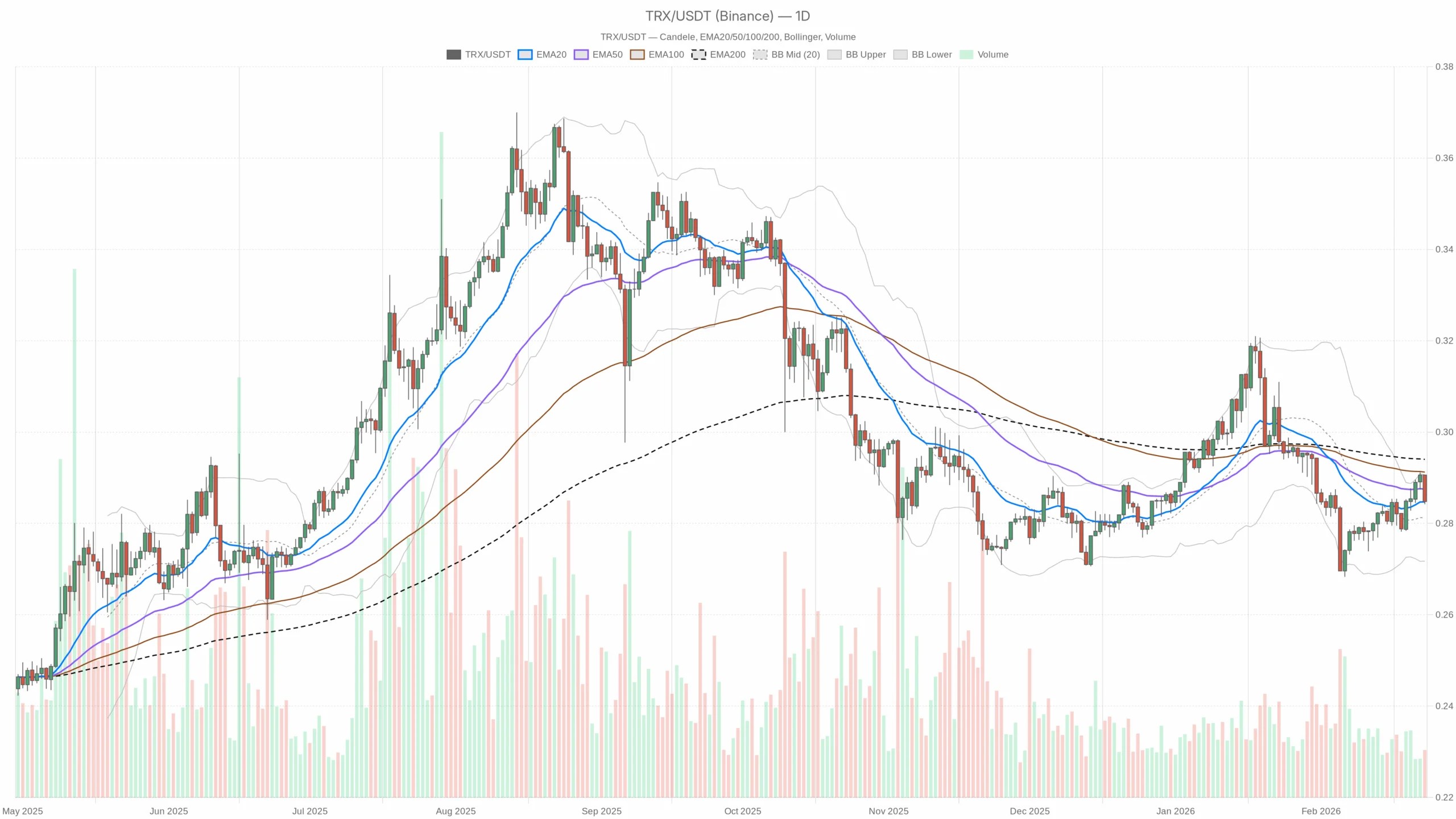
Tron crypto Analysis: 3 Scenarios for TRXUSDT

Tron crypto Analysis: 3 Scenarios for TRXUSDT

The post Tron crypto Analysis: 3 Scenarios for TRXUSDT appeared on BitcoinEthereumNews.com. While the broader crypto market leans risk‑off, Tron crypto (TRXUSDT
Share
BitcoinEthereumNews2026/02/24 02:33