Pavel Durov warns that governments are tightening control over the Internet, threatening privacy and free speech worldwide. Toncoin’s decentralized system is being seen as a possible path to protect online freedom and restore digital independence. Telegram founder Pavel Durov has warned that the free Internet is slowly disappearing. In a message shared on X, he [...]]]>Pavel Durov warns that governments are tightening control over the Internet, threatening privacy and free speech worldwide. Toncoin’s decentralized system is being seen as a possible path to protect online freedom and restore digital independence. Telegram founder Pavel Durov has warned that the free Internet is slowly disappearing. In a message shared on X, he [...]]]>

“The Free Internet Is Dying,” Warns Telegram Founder Durov — Can Toncoin Solve It?

  • Pavel Durov warns that governments are tightening control over the Internet, threatening privacy and free speech worldwide.
  • Toncoin’s decentralized system is being seen as a possible path to protect online freedom and restore digital independence.

Telegram founder Pavel Durov has warned that the free Internet is slowly disappearing. In a message shared on X, he said that what was once a space for open communication is now being turned into a tool for control.

His remarks have sparked new conversations about online privacy, freedom of speech, and whether decentralized systems like Toncoin can help restore what is being lost.

Pavel Durov’s Warning About Freedom Online

Pavel Durov said he did not feel like celebrating his 41st birthday because he believes the Internet is no longer free. He said governments that were once seen as protectors of liberty are now introducing strict digital rules.

Durov listed examples such as digital IDs in the United Kingdom, online age checks in Australia, and the scanning of private messages in the European Union. 

He also said that Germany is targeting people who criticize public officials online, and that the United Kingdom is jailing people for their social media posts. Durov called these developments “dystopian” and warned that the world is slipping into a period of control and censorship. 

According to Durov, people are being made to believe that the real fight of this generation is to tear down what their forefathers built: freedom, privacy, and independence. He said that by doing so, society is walking towards moral and intellectual decline.

Telegram Founder on Internet PrivacyTelegram Founder on Internet Privacy | Source: Pavel Durov

Durov’s post has gained wide attention because it reflects the growing fear that the open Internet is being replaced by systems designed to watch and restrict users. His message was emotional but clear: freedom online is at risk, and time is running out to protect it.

While discussions about the free status of the Internet are growing within the crypto community, a new comment also seems to support the role of digital cryptocurrency in the era of the Internet gauge. As noted in our earlier post, the Bank of America (BoA) has compared Bitcoin to major inventions such as the Internet and the electric car.

Can Toncoin Protect the Free Internet?

Toncoin, the digital token linked to The Open Network (TON), has become part of the discussion since Durov’s statement. As detailed in our recent publication, Toncoin was first connected to Telegram’s plan for a faster and safer online platform before the project became independent. 

It is important to add that Toncoin is now a decentralized blockchain network that aims to give users more control over their data and digital transactions. In addition, supporters of Toncoin believe it could help defend online freedom because it is not controlled by any single government or company. 

Additionally, Information on the network is spread across many systems, making it harder to censor or shut down. This idea fits with Durov’s long-standing belief that technology should empower people, not control them.

Even though Pavel Durov did not mention Toncoin directly, his warning has renewed attention around it. Market participants are now speculating on how the project could be used to protect the interests of the Internet. Many are asking whether decentralised technology can truly keep the Internet free, or if global restrictions have already gone too far.

In a separate update around the project, AlphaTON Capital Corp closed $71 million in financing and acquired its first $30 million tranche of TON tokens. As mentioned in our previous news brief, it plans to expand its Toncoin treasury to $100 million by Q4 2025.

]]>
Market Opportunity
FreeRossDAO Logo
FreeRossDAO Price(FREE)
$0,00005442
$0,00005442$0,00005442
+1,28%
USD
FreeRossDAO (FREE) Live Price Chart
Disclaimer: The articles reposted on this site are sourced from public platforms and are provided for informational purposes only. They do not necessarily reflect the views of MEXC. All rights remain with the original authors. If you believe any content infringes on third-party rights, please contact service@support.mexc.com for removal. MEXC makes no guarantees regarding the accuracy, completeness, or timeliness of the content and is not responsible for any actions taken based on the information provided. The content does not constitute financial, legal, or other professional advice, nor should it be considered a recommendation or endorsement by MEXC.

You May Also Like

Pippin (PIPPIN) Price Prediction 2026–2030: Can PIPPIN Hit $0.70 Soon?

Pippin (PIPPIN) Price Prediction 2026–2030: Can PIPPIN Hit $0.70 Soon?

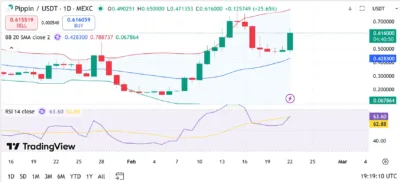
PIPPIN has surged sharply on the daily timeframe, printing a powerful bullish candle with over 25% gains. RSI is holding above 60, signaling strengthening momentum
Share
Coinstats2026/02/23 04:29
Will Cardano Reach $10 by 2030? Analysts Break Down ADA’s Growth Cycles

Will Cardano Reach $10 by 2030? Analysts Break Down ADA’s Growth Cycles

The post Will Cardano Reach $10 by 2030? Analysts Break Down ADA’s Growth Cycles appeared first on Coinpedia Fintech News Cardano (ADA) is trading at $0.9024 with a market cap of $32.91 billion. Experts say ADA has the potential to climb much higher, with some placing long-term targets as high as $10. The token continues to benefit from stronger visibility, rising liquidity, and increasing inflows from both institutional and retail markets. Can Cardano Hit $10 …
Share
CoinPedia2025/09/18 17:19
Crypto whale loses $6M to sneaky phishing scheme targeting staked Ethereum

Crypto whale loses $6M to sneaky phishing scheme targeting staked Ethereum

The post Crypto whale loses $6M to sneaky phishing scheme targeting staked Ethereum appeared on BitcoinEthereumNews.com. A crypto whale lost more than $6 million in staked Ethereum (stETH) and Aave-wrapped Bitcoin (aEthWBTC) after approving malicious signatures in a phishing scheme on Sept. 18, according to blockchain security firm Scam Sniffer. According to the firm, the attackers disguised their move as a routine wallet confirmation through “Permit” signatures, which tricked the victim into authorizing fund transfers without triggering obvious red flags. Yu Xian, founder of blockchain security company SlowMist, noted that the victim did not recognize the danger because the transaction required no gas fees. He wrote: “From the victim’s perspective, he just clicked a few times to confirm the wallet’s pop-up signature requests, didn’t spend a single penny of gas, and $6.28 million was gone.” How Permit exploits work Permit approvals were originally designed to simplify token transfers. Instead of submitting an on-chain approval and paying fees, a user can sign an off-chain message authorizing a spender. That efficiency, however, has created a new attack surface for malicious players. Once a user signs such a permit, attackers can combine two functions—Permit and TransferFrom—to drain assets directly. Because the authorization takes place off-chain, wallet dashboards show no unusual activity until the funds move. As a result, the assets are gone when the approval executes on-chain, and tokens are redirected to the attacker’s wallet. This loophole has made permit exploits increasingly attractive for malicious actors, who can siphon millions without needing complex hacks or high-cost gas wars. Phishing losses The latest theft highlights a wider trend of escalating phishing campaigns. Scam Sniffer reported that in August alone, attackers stole $12.17 million from more than 15,200 victims. That figure represented a 72% jump in losses compared with July. According to the firm, the most significant share of August’s damages came from three large accounts that accounted for nearly half…
Share
BitcoinEthereumNews2025/09/19 02:31