We use tabular datasets originally from OpenML and compiled into a set of benchmark datasets from the Inria-Soda team on HuggingFace. We train on 28,855 training samples and test on the remaining 9,619 samples. All the MLPs are trained with a batch size of 64, 64, and 0,0005, and we study 3 layers of 100 neurons each. We define the top six metrics used in our work here.We use tabular datasets originally from OpenML and compiled into a set of benchmark datasets from the Inria-Soda team on HuggingFace. We train on 28,855 training samples and test on the remaining 9,619 samples. All the MLPs are trained with a batch size of 64, 64, and 0,0005, and we study 3 layers of 100 neurons each. We define the top six metrics used in our work here.

The Geek’s Guide to ML Experimentation

2025/09/21 13:47

Abstract and 1. Introduction

1.1 Post Hoc Explanation

1.2 The Disagreement Problem

1.3 Encouraging Explanation Consensus

  1. Related Work

  2. Pear: Post HOC Explainer Agreement Regularizer

  3. The Efficacy of Consensus Training

    4.1 Agreement Metrics

    4.2 Improving Consensus Metrics

    [4.3 Consistency At What Cost?]()

    4.4 Are the Explanations Still Valuable?

    4.5 Consensus and Linearity

    4.6 Two Loss Terms

  4. Discussion

    5.1 Future Work

    5.2 Conclusion, Acknowledgements, and References

Appendix

A APPENDIX

A.1 Datasets

In our experiments we use tabular datasets originally from OpenML and compiled into a set of benchmark datasets from the Inria-Soda team on HuggingFace [11]. We provide some details about each dataset:

\ Bank Marketing This is a binary classification dataset with six input features and is approximately class balanced. We train on 7,933 training samples and test on the remaining 2,645 samples.

\ California Housing This is a binary classification dataset with seven input features and is approximately class balanced. We train on 15,475 training samples and test on the remaining 5,159 samples.

\ Electricity This is a binary classification dataset with seven input features and is approximately class balanced. We train on 28,855 training samples and test on the remaining 9,619 samples.

A.2 Hyperparameters

Many of our hyperparameters are constant across all of our experiments. For example, all MLPs are trained with a batch size of 64, and initial learning rate of 0.0005. Also, all the MLPs we study are 3 hidden layers of 100 neurons each. We always use the AdamW optimizer [19]. The number of epochs varies from case to case. For all three datasets, we train for 30 epochs when 𝜆 ∈ {0.0, 0.25} and 50 epochs otherwise. When training linear models, we use 10 epochs and an initial learning rate of 0.1.

A.3 Disagreement Metrics

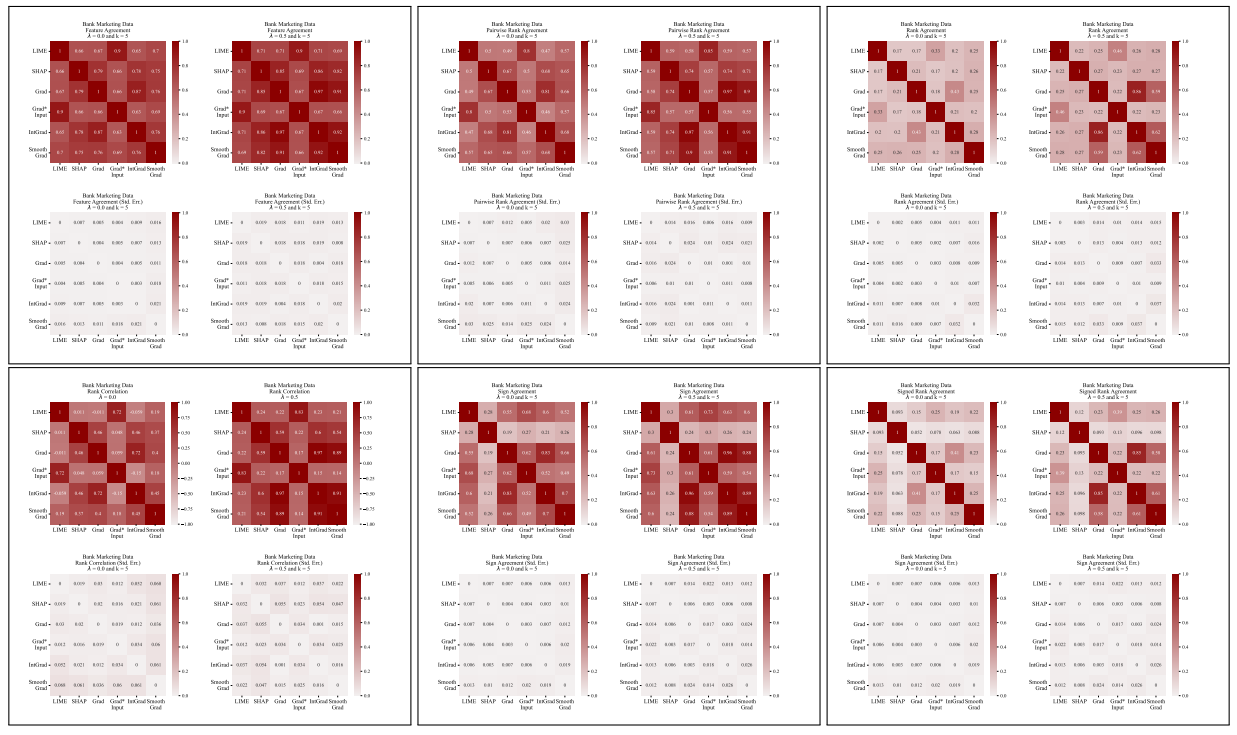
We define each of the six agreement metrics used in our work here.

\ The first four metrics depend on the top-𝑘 most important features in each explanation. Let 𝑡𝑜𝑝_𝑓 𝑒𝑎𝑡𝑢𝑟𝑒𝑠(𝐸, 𝑘) represent the top-𝑘 most important features in an explanation 𝐸, let 𝑟𝑎𝑛𝑘 (𝐸, 𝑠) be the importance rank of the feature 𝑠 within explanation 𝐸, and let 𝑠𝑖𝑔𝑛(𝐸, 𝑠) be the sign (positive, negative, or zero) of the importance score of feature 𝑠 in explanation 𝐸.

\
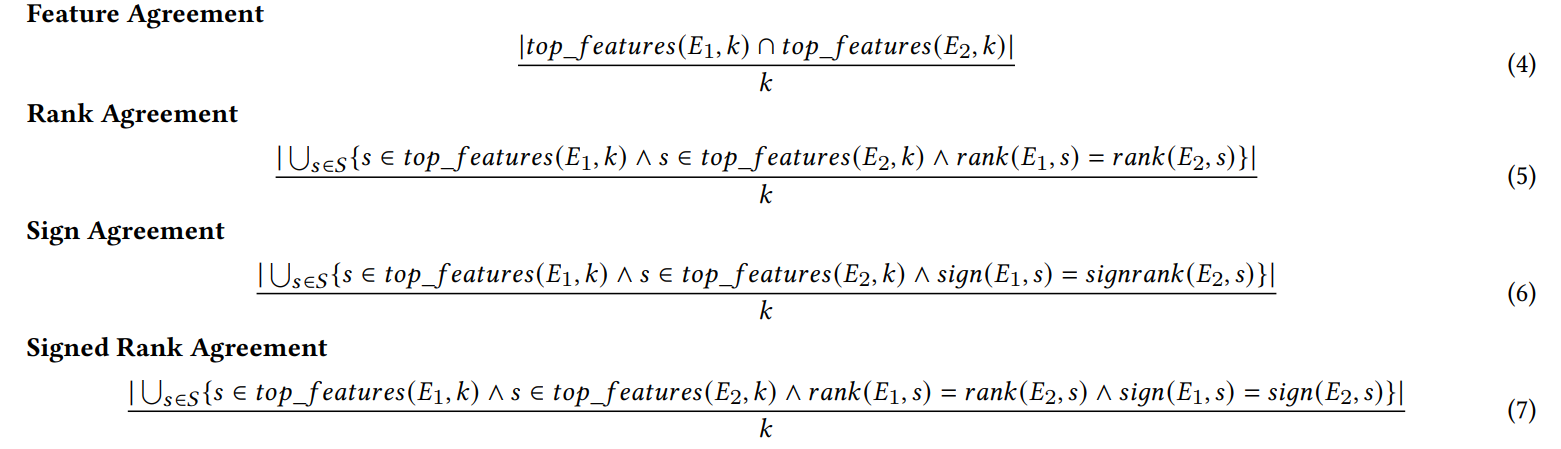
\ The next two agreement metrics depend on all features within each explanation, not just the top-𝑘. Let 𝑅 be a function that computes the ranking of features within an explanation by importance.

\

\ (Note: Krishna et al. [15] specify in their paper that 𝐹 is to be a set of features specified by an end user, but in our experiments we use all features with this metric).

A.4 Junk Feature Experiment Results

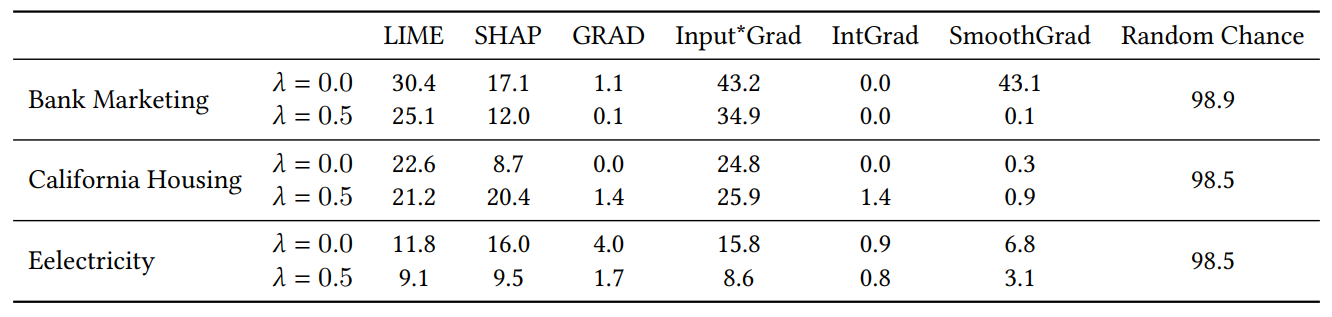
When we add random features for the experiment in Section 4.4, we double the number of features. We do this to check whether our consensus loss damages explanation quality by placing irrelevant features in the top-𝐾 more often than models trained naturally. In Table 1, we report the percentage of the time that each explainer included one of the random features in the top-5 most important features. We observe that across the board, we do not see a systematic increase of these percentages between 𝜆 = 0.0 (a baseline MLP without our consensus loss) and 𝜆 = 0.5 (an MLP trained with our consensus loss)

\ Table 1: Frequency of junk features getting top-5 ranks, measured in percent.
A.5 More Disagreement Matrices

Figure 9: Disagreement matrices for all metrics considered in this paper on Bank Marketing data.

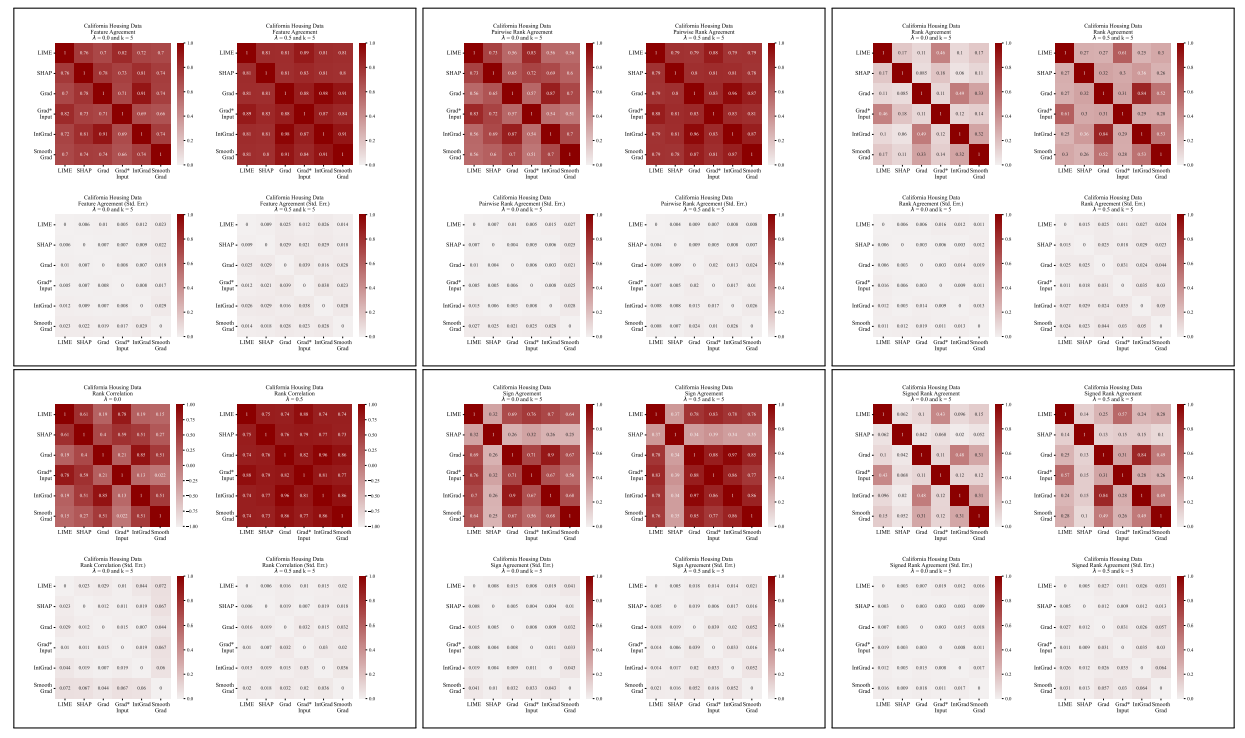
\ Figure 10: Disagreement matrices for all metrics considered in this paper on California Housing data.

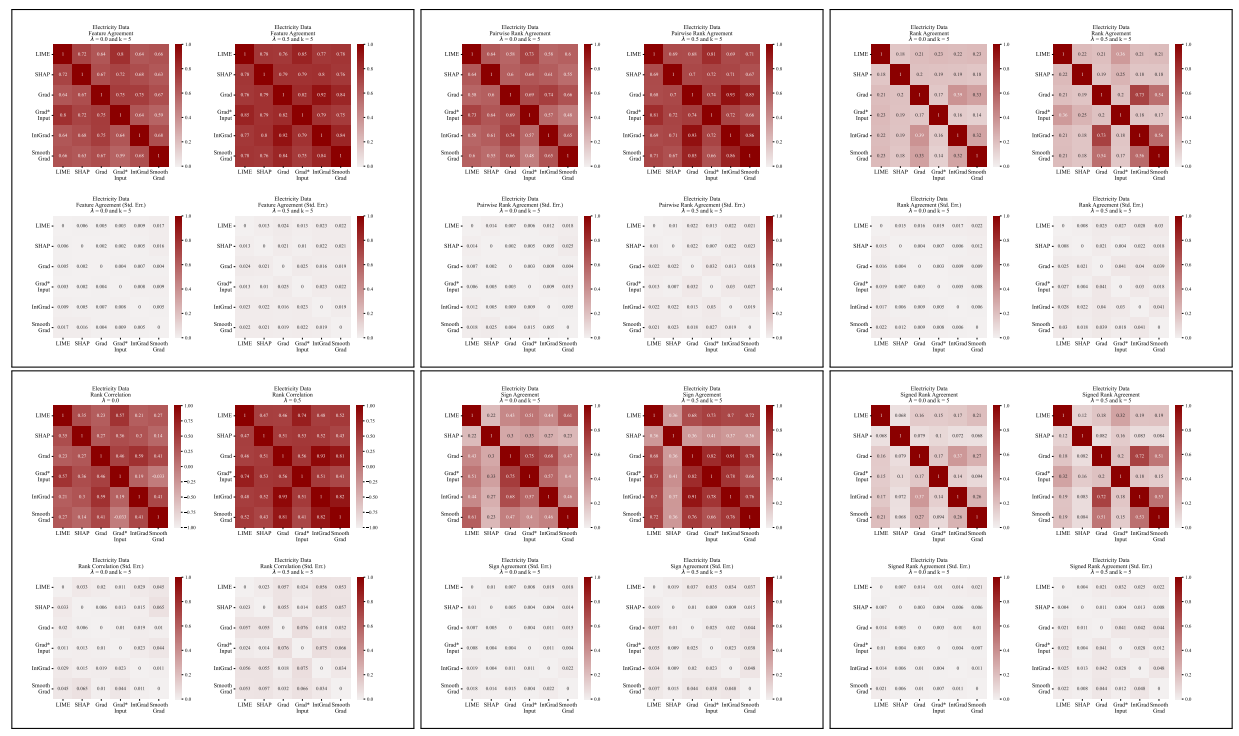
\ Figure 11: Disagreement matrices for all metrics considered in this paper on Electricity data.

A.6 Extended Results

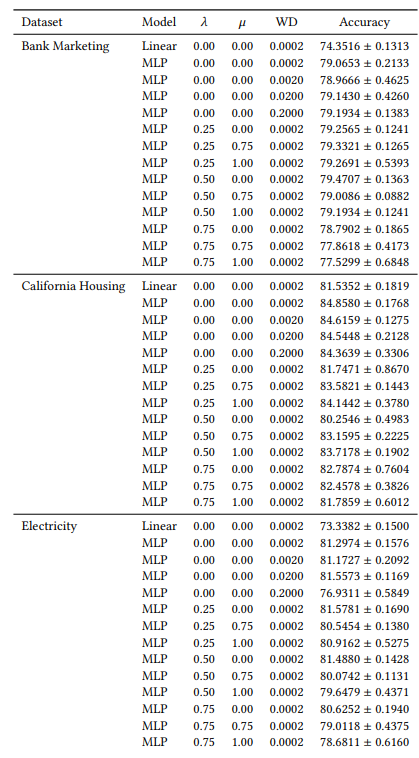
Table 2: Average test accuracy for models we trained. This table is organized by dataset, model, the hyperparameters in the loss, and the weight decay coefficient (WD). Averages are over several trials and we report the means ± one standard error.

A.7 Additional Plots

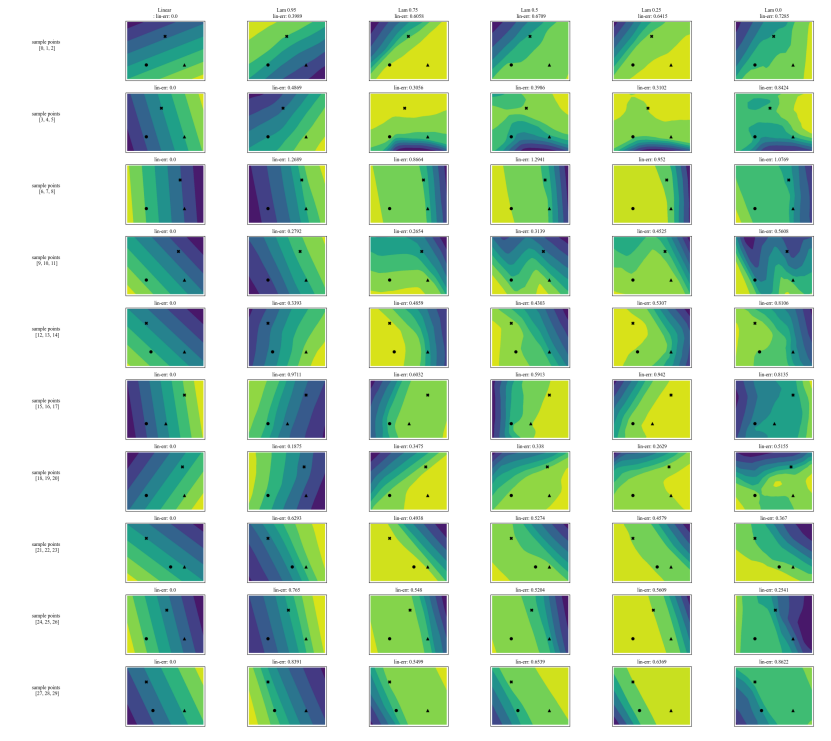
Figure 12: The logit surfaces for MLPs, each trained with a different lambda value, on 10 randomly constructed three-point planes from the Bank Marketing dataset.

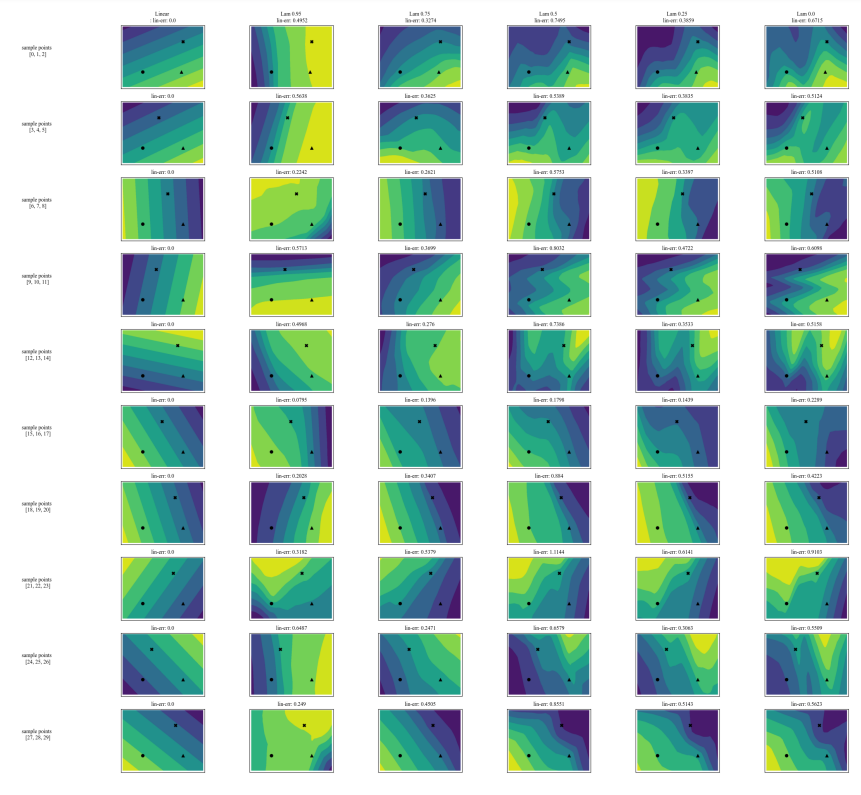
\ Figure 13: The logit surfaces for MLPs, each trained with a different lambda value, on 10 randomly constructed three-point planes from the California Housing dataset.

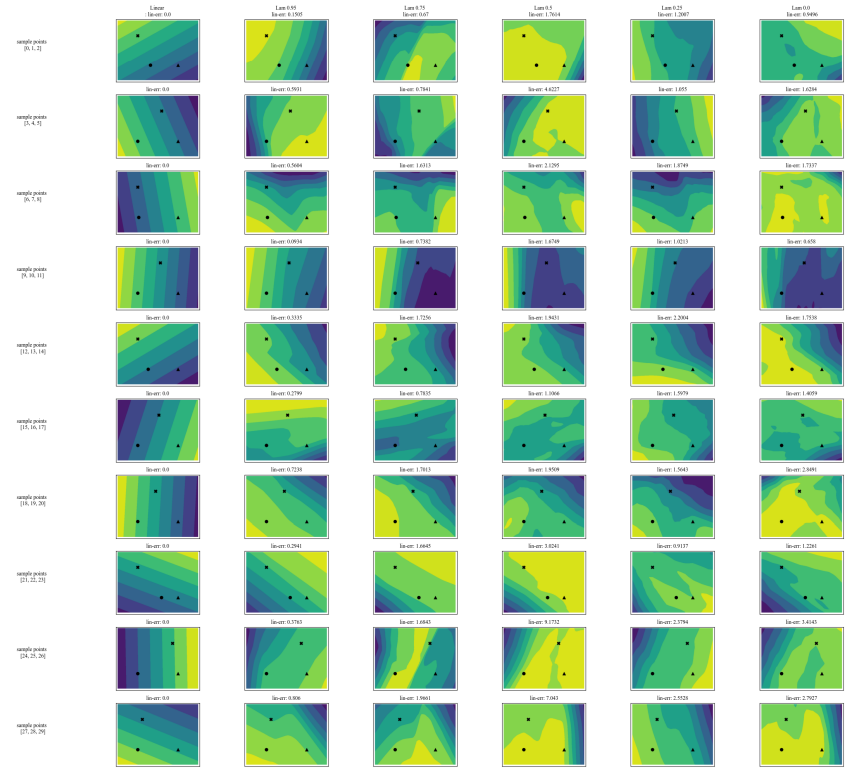
\ Figure 14: The logit surfaces for MLPs, each trained with a different lambda value, on 10 randomly constructed three-point planes from the Electricity dataset.

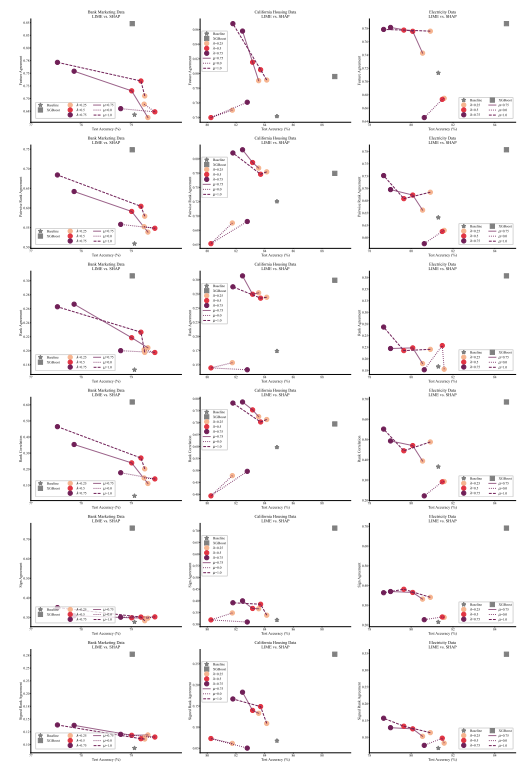
\ Figure 15: Additional trade-off curve plots for all datasets and metrics.

\

:::info Authors:

(1) Avi Schwarzschild, University of Maryland, College Park, Maryland, USA and Work completed while working at Arthur (avi1umd.edu);

(2) Max Cembalest, Arthur, New York City, New York, USA;

(3) Karthik Rao, Arthur, New York City, New York, USA;

(4) Keegan Hines, Arthur, New York City, New York, USA;

(5) John Dickerson†, Arthur, New York City, New York, USA (john@arthur.ai).

:::


:::info This paper is available on arxiv under CC BY 4.0 DEED license.

:::

\

Disclaimer: The articles reposted on this site are sourced from public platforms and are provided for informational purposes only. They do not necessarily reflect the views of MEXC. All rights remain with the original authors. If you believe any content infringes on third-party rights, please contact service@support.mexc.com for removal. MEXC makes no guarantees regarding the accuracy, completeness, or timeliness of the content and is not responsible for any actions taken based on the information provided. The content does not constitute financial, legal, or other professional advice, nor should it be considered a recommendation or endorsement by MEXC.

You May Also Like

Patriots Hall Of Famer Julian Edelman Is A Rising Media Star At FOX Sports

Patriots Hall Of Famer Julian Edelman Is A Rising Media Star At FOX Sports

The post Patriots Hall Of Famer Julian Edelman Is A Rising Media Star At FOX Sports appeared on BitcoinEthereumNews.com. Julian Edelman has a burgeoning media career, including as an analyst on FOX NFL Kickoff. Lily Hernandez The day before the Kansas City Chiefs hosted the Philadelphia Eagles, Julian Edelman was in a reflective mood. The last weekend he had spent in Arrowhead Stadium was when he helped the New England Patriots defeat the Chiefs in overtime to advance to the Patriots’ last Super Bowl. “I was definitely getting some flashbacks,” Edelman exclusively shared. “It’s definitely a special place to come. Not because we won (but) because we knew how hard it was to win here. This place rocks. Arrowhead is one of the most electric opponent stadiums that we played in. It was one of the greatest to be the villain.” Edelman had seven catches and 96 yards in that 37-31 overtime win against the Chiefs, paving the way for Super Bowl LIII, a game in which he won Super Bowl MVP. That may have been the apex of his playing career, which earned him induction into the Patriots’ Hall of Fame this weekend, but his post-NFL media career is ascending. He’s not only an analyst on FOX NFL Kickoff, the show that precedes FOX NFL Sunday, but also has his own production company and hosts two weekly podcasts. “It kind of (just) happened,” Edelman said. “My goal is really to just be around football in some form or fashion.” Julian Edelman of the New England Patriots celebrates after scoring in the fourth quarter against the Seattle Seahawks during Super Bowl XLIX. (Photo by Kevin C. Cox/Getty Images) Getty Images Toward the end of his playing career, Edelman started creating short-from content for his YouTube channel and picked up a cult following among New England fans. Then for his first two years out of the league, he was an…
Share
BitcoinEthereumNews2025/09/18 21:56