Tokenized Crypto Treasuries Amplify Risks for Volatile Asset Holders: Exec Insights
The rise of tokenized stocks and blockchain-based trading is heralding a new era for traditional and digital markets alike. As cryptocurrency and blockchain innovations drive efforts toward 24/7 trading, regulatory uncertainties and on-chain risks pose significant challenges for investors and industry players. Industry leaders warn that tokenized equities on bridges to crypto markets could intensify market volatility and security concerns, prompting a reassessment of how digital assets integrate with traditional securities.
- Tokenized stocks have surpassed $1.3 billion in value but carry compounded risks due to market volatility and regulatory grey zones.
- Experts highlight the dangers of 24/7 trading on blockchains, including rapid price swings outside of traditional market hours.
- Smart contract vulnerabilities and hacking threats further increase risks associated with crypto-backed treasury shares.
- Major exchanges like Nasdaq and the NYSE are exploring expanded trading hours to compete with continuous crypto markets.
- The lack of clear regulation raises concerns over investor protection amid the surge in digital securities.
Risks in Tokenized Equity and Blockchain Trading
Companies offering digital tokenization of their stocks are amplifying investor exposure and operational risks, according to several crypto industry executives. Kadan Stadelmann, CTO of the Komodo decentralized exchange, pointed out that cryptomarkets operate nonstop, unlike traditional venues constrained by specific hours. This opens the door to choppy onchain price swings occurring outside regular market hours, which could trigger sudden sell-offs without swift company response.
Tokenized stocks have crossed $1.3 billion in value. Source: RWA.XYZSmart contract vulnerabilities—such as code exploits—and hacking threats pose further dangers, potentially jeopardizing both the physical assets backing the tokens and the security of underlying funds. Kanny Lee, CEO of SecondSwap, warned:
Despite the momentum, tokenized stocks are navigating a murky regulatory landscape. Numerous companies have embraced this trend, with many now offering tradable shares on blockchain platforms. Meanwhile, the SEC continues to signal an interest in launching around-the-clock capital markets, yet the legal framework remains undefined, adding a layer of uncertainty for investors and issuers alike.
SEC and Mainstream Market Initiatives for 24/7 Trading
The U.S. Securities and Exchange Commission is actively exploring blockchain solutions to modernize legacy stock trading systems that traditionally take nights and weekends off. Officials are contemplating allowing regulated crypto exchanges to facilitate tokenized stock trading, opening a pathway toward seamless, around-the-clock markets.
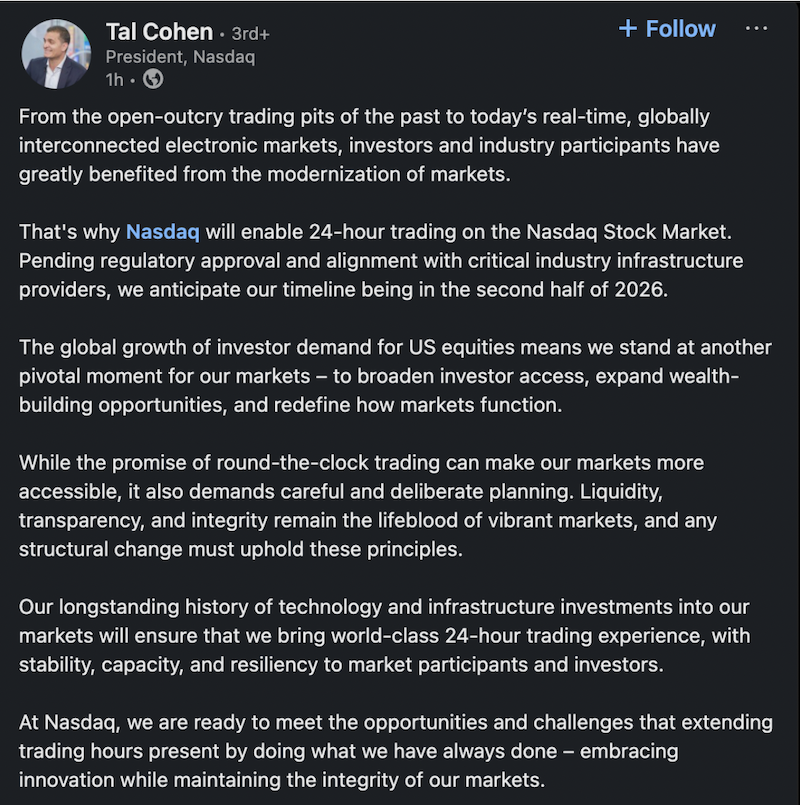 Nasdaq president Tal Cohen announces the push for 24-hour stock trading. Source: Tal Cohen
Traditional exchanges like Nasdaq and the NYSE are also pushing for extended trading hours to better compete with the 24/7 nature of crypto markets. Nasdaq announced plans to offer continuous trading during weekdays, aiming for a rollout in the latter half of 2026, signaling a significant shift in how equities might be traded in the future.
As blockchain innovation continues to influence mainstream financial infrastructure, the integration of tokenized stocks raises essential questions around regulation, cybersecurity, and market stability. Industry stakeholders advocate for clearer rules to safeguard investors amid these rapid technological developments.
This article was originally published as Tokenized Crypto Treasuries Amplify Risks for Volatile Asset Holders: Exec Insights on Crypto Breaking News – your trusted source for crypto news, Bitcoin news, and blockchain updates.
You May Also Like
Wormhole Unleashes W 2.0 Tokenomics for a Connected Blockchain Future

The aftermath of the energy war: As Microsoft, BlackRock monopolize infrastructure, Eden Miner becomes retail’s last backdoor to the “hashrate yield network”