This article documents the process of digitizing Kurdish historical publications and training Tesseract OCR to recognize the language. The team sourced rare archives from the Zheen Center, processed fragile scans into clean line-by-line images, and created a ground-truth dataset of over 1,200 files. Using Ubuntu and tesstrain, they set up a training environment, corrected image skew, applied cropping, and built transcription pairs to teach the model Kurdish text recognition. The results showcase how open-source OCR tools can help preserve cultural heritage through machine learning.This article documents the process of digitizing Kurdish historical publications and training Tesseract OCR to recognize the language. The team sourced rare archives from the Zheen Center, processed fragile scans into clean line-by-line images, and created a ground-truth dataset of over 1,200 files. Using Ubuntu and tesstrain, they set up a training environment, corrected image skew, applied cropping, and built transcription pairs to teach the model Kurdish text recognition. The results showcase how open-source OCR tools can help preserve cultural heritage through machine learning.

Training Tesseract OCR on Kurdish Historical Documents

Abstract and 1. Introduction

1.1 Printing Press in Iraq and Iraqi Kurdistan

1.2 Challenges in Historical Documents

1.3 Kurdish Language

  1. Related work and 2.1 Arabic/Persian

    2.2 Chinese/Japanese and 2.3 Coptic

    2.4 Greek

    2.5 Latin

    2.6 Tamizhi

  2. Method and 3.1 Data Collection

    3.2 Data Preparation and 3.3 Preprocessing

    3.4 Environment Setup, 3.5 Dataset Preparation, and 3.6 Evaluation

  3. Experiments, Results, and Discussion and 4.1 Processed Data

    4.2 Dataset and 4.3 Experiments

    4.4 Results and Evaluation

    4.5 Discussion

  4. Conclusion

    5.1 Challenges and Limitations

    Online Resources, Acknowledgments, and References

4 Experiments, Results, and Discussion

Initially, we collected some historical publications from the Zaytoon Public Library in Erbil. However, due to the fragile condition of the documents, it was not easy to transfer them into digital format. Then, via the internet, we found the Zheen Center for Documentation and Research in Sulaymaniyahn https://zheen.org, a facility specializing in scanning and archiving historical documents using unique technologies explicitly designed for that function. After visiting them and explaining our project, they agreed to provide us with digital copies of the earliest Kurdish publications they had in their collection.

4.1 Processed Data

To handle image processing tasks, we utilized a dedicated batch processing tool that was freely available. With this tool, we loaded the images and applied a de-skewing process to correct any skew present in the images. We also performed automatic cropping and converted the images to binary format, saving them in the specified destination directory.

4.2 Dataset

After receiving the historical documents from Zheen Center for Documentation and Research in a digital format, we converted the pages into single-line images with respected transcription for the line. We used an Image Processing application to crop lines and saved them in TIFF format.

\ After converting the pages into image lines (See Figure 16), we created transcription files for each image line using a text editing program by manually typing what is written in the images.

\ \ Figure 15: Sample page in the book titled ’Awat’ published in 1938 (Zheen Center for Documentation and Research)
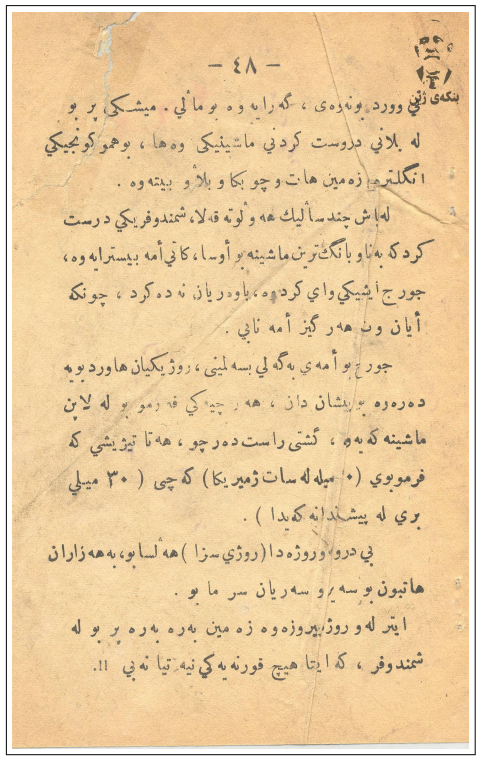
\ \ We named the transcription files the same name as the image line with (.gt.txt) postfix (See Figure 17).

\ This way, the dataset for training Tesseract was created, which resulted in 1233 files. Half are the image lines, and the other is the transcription files (See Table 1).

4.3 Experiments

In this section, we provide details of the steps taken to prepare our environment, the training process of the model, and other relevant aspects.

\ 4.3.1 Environment Setup

\ For this training environment, we used Ubuntu 22.04.2 LTS (Jammy Jellyfish). We cloned the tesstrain from https://github.com/tesseract-ocr/tesstrain and we trained the model using our prepared dataset.

\

:::info Authors:

(1) Blnd Yaseen, University of Kurdistan Howler, Kurdistan Region - Iraq (blnd.yaseen@ukh.edu.krd);

(2) Hossein Hassani University of Kurdistan Howler Kurdistan Region - Iraq (hosseinh@ukh.edu.krd).

:::


:::info This paper is available on arxiv under ATTRIBUTION-NONCOMMERCIAL-NODERIVS 4.0 INTERNATIONAL license.

:::

\

Disclaimer: The articles reposted on this site are sourced from public platforms and are provided for informational purposes only. They do not necessarily reflect the views of MEXC. All rights remain with the original authors. If you believe any content infringes on third-party rights, please contact service@support.mexc.com for removal. MEXC makes no guarantees regarding the accuracy, completeness, or timeliness of the content and is not responsible for any actions taken based on the information provided. The content does not constitute financial, legal, or other professional advice, nor should it be considered a recommendation or endorsement by MEXC.

You May Also Like

Quick Tips for Passing Your MyCPR NOW Final Exam

Quick Tips for Passing Your MyCPR NOW Final Exam

Introduction: Getting certified in CPR is an important step in becoming prepared to handle emergencies. Whether you’re taking the course for personal knowledge,
Share
Techbullion2025/12/23 00:50
Best Crypto to Buy as Saylor & Crypto Execs Meet in US Treasury Council

Best Crypto to Buy as Saylor & Crypto Execs Meet in US Treasury Council

The post Best Crypto to Buy as Saylor & Crypto Execs Meet in US Treasury Council appeared on BitcoinEthereumNews.com. Michael Saylor and a group of crypto executives met in Washington, D.C. yesterday to push for the Strategic Bitcoin Reserve Bill (the BITCOIN Act), which would see the U.S. acquire up to 1M $BTC over five years. With Bitcoin being positioned yet again as a cornerstone of national monetary policy, many investors are turning their eyes to projects that lean into this narrative – altcoins, meme coins, and presales that could ride on the same wave. Read on for three of the best crypto projects that seem especially well‐suited to benefit from this macro shift:  Bitcoin Hyper, Best Wallet Token, and Remittix. These projects stand out for having a strong use case and high adoption potential, especially given the push for a U.S. Bitcoin reserve.   Why the Bitcoin Reserve Bill Matters for Crypto Markets The strategic Bitcoin Reserve Bill could mark a turning point for the U.S. approach to digital assets. The proposal would see America build a long-term Bitcoin reserve by acquiring up to one million $BTC over five years. To make this happen, lawmakers are exploring creative funding methods such as revaluing old gold certificates. The plan also leans on confiscated Bitcoin already held by the government, worth an estimated $15–20B. This isn’t just a headline for policy wonks. It signals that Bitcoin is moving from the margins into the core of financial strategy. Industry figures like Michael Saylor, Senator Cynthia Lummis, and Marathon Digital’s Fred Thiel are all backing the bill. They see Bitcoin not just as an investment, but as a hedge against systemic risks. For the wider crypto market, this opens the door for projects tied to Bitcoin and the infrastructure that supports it. 1. Bitcoin Hyper ($HYPER) – Turning Bitcoin Into More Than Just Digital Gold The U.S. may soon treat Bitcoin as…
Share
BitcoinEthereumNews2025/09/18 00:27
Why Investors Choose Pepeto As 2025’s Best Crypto: The Next Bitcoin Story

Why Investors Choose Pepeto As 2025’s Best Crypto: The Next Bitcoin Story

Desks still pass that story around because it’s proof that one coin can change everything. And the question that always […] The post Why Investors Choose Pepeto As 2025’s Best Crypto: The Next Bitcoin Story appeared first on Coindoo.
Share
Coindoo2025/09/18 04:39