The United Arab Emirates (UAE) has announced that it will roll out an automatic crypto tax reporting system by 2027 and has launched an industry consultation to finalize implementation details before official rollout. In an official government release, the UAE Ministry of Finance revealed that it has signed the Multilateral Competent Authority Agreement on the Automatic Exchange of Information under the Crypto-Asset Reporting Framework (CARF), following its announcement last November of its intention to implement the framework. CARF implementation in the UAE is now scheduled to go live in 2027, with the first tax information reporting expected in 2028.Source: UAE Ministry of Finance “The framework establishes a mechanism for the automatic exchange of tax-related information on crypto-asset activities, ensuring that the UAE provides certainty and clarity to the crypto-asset sector while upholding the principles of global tax transparency,” the Ministry said. The move builds on the UAE’s efforts to attract crypto businesses after exempting crypto transactions from VAT in 2024 and Dubai setting regulatory guidelines for digital asset companies. The Ministry is now seeking industry feedback before implementing the rules. All participants in the crypto sector, including exchanges, custodians, traders, and advisors, are invited to join the public consultation to share their concerns about potential impacts. The consultation has already opened on September 15 and is expected to close on November 8, 2025. For Crypto Investors: What Does the UAE Crypto Tax Reporting Agreement Means The UAE will begin automatically sharing information on crypto transactions and holdings with tax authorities in other countries starting in 2028. This means that crypto will no longer be treated as an opaque asset class for offshore investors. Investors who rely on the UAE as a low-tax or no-tax hub will need to ensure they report their crypto holdings correctly in their home jurisdictions. Authorities can cross-check disclosures with the data exchanged under CARF, making tax evasion much harder. UAE-based exchanges, custodians, and wallet providers will be required to collect and report customer data, similar to how banks and brokers report under FATCA/CRS. Crypto investors should expect stricter KYC and AML processes, as platforms prepare to comply with international reporting standards. Institutional investors may view this as a positive development, as it reduces reputational risk and regulatory uncertainty. However, privacy-focused investors who rely on crypto for tax avoidance or secrecy may feel uneasy as cross-border reporting reduces anonymity. There could be higher compliance costs, especially for traders using multiple wallets, custodians, or offshore entities. Non-compliant investors might face penalties, back taxes, or investigations in their home countries as the tax avoidance window closes by 2027–2028. UAE’s Local Tax Position Remains Unchanged It’s worth noting that the UAE’s signing the CARF does not mean it will start taxing crypto gains locally. What it does mean is that if you are a foreigner living in the UAE but remain tax-resident elsewhere, your home country can now receive details of your UAE crypto activity and tax you according to its laws. For UAE nationals and residents who are only tax-resident in the UAE, crypto will still be exempt from income tax, unless a new domestic law is introduced later. Currently in the UAE, there’s no personal income tax on individuals, whether from salary, business profits, or crypto gains. Similarly, the 5% VAT in the country only applies to goods and services, but not to investment gains (like profits from selling crypto). So until now, crypto trading by individuals has not been taxed in the UAE. However, a corporate tax of 9% was introduced in June 2023, but it mainly applies to companies with profits exceeding AED 375,000. Individuals trading crypto on their own are not subject to corporate tax. Who Should Worry Most About the Crypto Tax Reporting System? The first category includes expats in the UAE who are still tax residents in their home countries. Also, investors who have been under-reporting or not reporting crypto gains back home and high-net-worth individuals who moved assets into UAE exchanges for “privacy.” This means if you’re from the US, EU, UK, Canada, Australia, Japan, South Korea, or India, the new CARF agreement means your home tax authority will soon have a clear view of your UAE crypto accounts. But suppose you’re from countries like Saudi Arabia, Qatar, Singapore, or Switzerland, or you’re a UAE national/resident who is only tied to the UAE. In that case, there’s little change since your jurisdiction doesn’t currently tax crypto gainsThe United Arab Emirates (UAE) has announced that it will roll out an automatic crypto tax reporting system by 2027 and has launched an industry consultation to finalize implementation details before official rollout. In an official government release, the UAE Ministry of Finance revealed that it has signed the Multilateral Competent Authority Agreement on the Automatic Exchange of Information under the Crypto-Asset Reporting Framework (CARF), following its announcement last November of its intention to implement the framework. CARF implementation in the UAE is now scheduled to go live in 2027, with the first tax information reporting expected in 2028.Source: UAE Ministry of Finance “The framework establishes a mechanism for the automatic exchange of tax-related information on crypto-asset activities, ensuring that the UAE provides certainty and clarity to the crypto-asset sector while upholding the principles of global tax transparency,” the Ministry said. The move builds on the UAE’s efforts to attract crypto businesses after exempting crypto transactions from VAT in 2024 and Dubai setting regulatory guidelines for digital asset companies. The Ministry is now seeking industry feedback before implementing the rules. All participants in the crypto sector, including exchanges, custodians, traders, and advisors, are invited to join the public consultation to share their concerns about potential impacts. The consultation has already opened on September 15 and is expected to close on November 8, 2025. For Crypto Investors: What Does the UAE Crypto Tax Reporting Agreement Means The UAE will begin automatically sharing information on crypto transactions and holdings with tax authorities in other countries starting in 2028. This means that crypto will no longer be treated as an opaque asset class for offshore investors. Investors who rely on the UAE as a low-tax or no-tax hub will need to ensure they report their crypto holdings correctly in their home jurisdictions. Authorities can cross-check disclosures with the data exchanged under CARF, making tax evasion much harder. UAE-based exchanges, custodians, and wallet providers will be required to collect and report customer data, similar to how banks and brokers report under FATCA/CRS. Crypto investors should expect stricter KYC and AML processes, as platforms prepare to comply with international reporting standards. Institutional investors may view this as a positive development, as it reduces reputational risk and regulatory uncertainty. However, privacy-focused investors who rely on crypto for tax avoidance or secrecy may feel uneasy as cross-border reporting reduces anonymity. There could be higher compliance costs, especially for traders using multiple wallets, custodians, or offshore entities. Non-compliant investors might face penalties, back taxes, or investigations in their home countries as the tax avoidance window closes by 2027–2028. UAE’s Local Tax Position Remains Unchanged It’s worth noting that the UAE’s signing the CARF does not mean it will start taxing crypto gains locally. What it does mean is that if you are a foreigner living in the UAE but remain tax-resident elsewhere, your home country can now receive details of your UAE crypto activity and tax you according to its laws. For UAE nationals and residents who are only tax-resident in the UAE, crypto will still be exempt from income tax, unless a new domestic law is introduced later. Currently in the UAE, there’s no personal income tax on individuals, whether from salary, business profits, or crypto gains. Similarly, the 5% VAT in the country only applies to goods and services, but not to investment gains (like profits from selling crypto). So until now, crypto trading by individuals has not been taxed in the UAE. However, a corporate tax of 9% was introduced in June 2023, but it mainly applies to companies with profits exceeding AED 375,000. Individuals trading crypto on their own are not subject to corporate tax. Who Should Worry Most About the Crypto Tax Reporting System? The first category includes expats in the UAE who are still tax residents in their home countries. Also, investors who have been under-reporting or not reporting crypto gains back home and high-net-worth individuals who moved assets into UAE exchanges for “privacy.” This means if you’re from the US, EU, UK, Canada, Australia, Japan, South Korea, or India, the new CARF agreement means your home tax authority will soon have a clear view of your UAE crypto accounts. But suppose you’re from countries like Saudi Arabia, Qatar, Singapore, or Switzerland, or you’re a UAE national/resident who is only tied to the UAE. In that case, there’s little change since your jurisdiction doesn’t currently tax crypto gains

UAE Announces 2027 Rollout of Automatic Crypto Tax Reporting System – What Does it Mean for Investors?

The United Arab Emirates (UAE) has announced that it will roll out an automatic crypto tax reporting system by 2027 and has launched an industry consultation to finalize implementation details before official rollout.

In an official government release, the UAE Ministry of Finance revealed that it has signed the Multilateral Competent Authority Agreement on the Automatic Exchange of Information under the Crypto-Asset Reporting Framework (CARF), following its announcement last November of its intention to implement the framework.

CARF implementation in the UAE is now scheduled to go live in 2027, with the first tax information reporting expected in 2028.
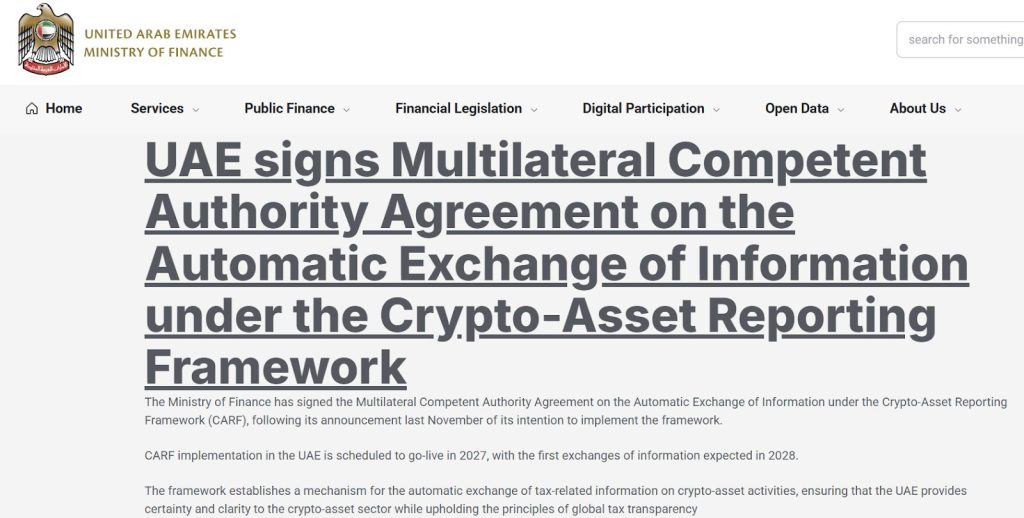
UAE Announces 2027 Rollout of Automatic Crypto Tax Reporting System – What Does it Mean for Investors?Source: UAE Ministry of Finance

The framework establishes a mechanism for the automatic exchange of tax-related information on crypto-asset activities, ensuring that the UAE provides certainty and clarity to the crypto-asset sector while upholding the principles of global tax transparency,” the Ministry said.

The move builds on the UAE’s efforts to attract crypto businesses after exempting crypto transactions from VAT in 2024 and Dubai setting regulatory guidelines for digital asset companies.

The Ministry is now seeking industry feedback before implementing the rules.

All participants in the crypto sector, including exchanges, custodians, traders, and advisors, are invited to join the public consultation to share their concerns about potential impacts.

The consultation has already opened on September 15 and is expected to close on November 8, 2025.

For Crypto Investors: What Does the UAE Crypto Tax Reporting Agreement Means

The UAE will begin automatically sharing information on crypto transactions and holdings with tax authorities in other countries starting in 2028.

This means that crypto will no longer be treated as an opaque asset class for offshore investors.

Investors who rely on the UAE as a low-tax or no-tax hub will need to ensure they report their crypto holdings correctly in their home jurisdictions.

Authorities can cross-check disclosures with the data exchanged under CARF, making tax evasion much harder.

UAE-based exchanges, custodians, and wallet providers will be required to collect and report customer data, similar to how banks and brokers report under FATCA/CRS.

Crypto investors should expect stricter KYC and AML processes, as platforms prepare to comply with international reporting standards.

Institutional investors may view this as a positive development, as it reduces reputational risk and regulatory uncertainty.

However, privacy-focused investors who rely on crypto for tax avoidance or secrecy may feel uneasy as cross-border reporting reduces anonymity.

There could be higher compliance costs, especially for traders using multiple wallets, custodians, or offshore entities.

Non-compliant investors might face penalties, back taxes, or investigations in their home countries as the tax avoidance window closes by 2027–2028.

UAE’s Local Tax Position Remains Unchanged

It’s worth noting that the UAE’s signing the CARF does not mean it will start taxing crypto gains locally.

What it does mean is that if you are a foreigner living in the UAE but remain tax-resident elsewhere, your home country can now receive details of your UAE crypto activity and tax you according to its laws.

For UAE nationals and residents who are only tax-resident in the UAE, crypto will still be exempt from income tax, unless a new domestic law is introduced later.

Currently in the UAE, there’s no personal income tax on individuals, whether from salary, business profits, or crypto gains.

Similarly, the 5% VAT in the country only applies to goods and services, but not to investment gains (like profits from selling crypto).

So until now, crypto trading by individuals has not been taxed in the UAE.

However, a corporate tax of 9% was introduced in June 2023, but it mainly applies to companies with profits exceeding AED 375,000. Individuals trading crypto on their own are not subject to corporate tax.

Who Should Worry Most About the Crypto Tax Reporting System?

The first category includes expats in the UAE who are still tax residents in their home countries.

Also, investors who have been under-reporting or not reporting crypto gains back home and high-net-worth individuals who moved assets into UAE exchanges for “privacy.”

This means if you’re from the US, EU, UK, Canada, Australia, Japan, South Korea, or India, the new CARF agreement means your home tax authority will soon have a clear view of your UAE crypto accounts.

But suppose you’re from countries like Saudi Arabia, Qatar, Singapore, or Switzerland, or you’re a UAE national/resident who is only tied to the UAE. In that case, there’s little change since your jurisdiction doesn’t currently tax crypto gains.

Disclaimer: The articles reposted on this site are sourced from public platforms and are provided for informational purposes only. They do not necessarily reflect the views of MEXC. All rights remain with the original authors. If you believe any content infringes on third-party rights, please contact service@support.mexc.com for removal. MEXC makes no guarantees regarding the accuracy, completeness, or timeliness of the content and is not responsible for any actions taken based on the information provided. The content does not constitute financial, legal, or other professional advice, nor should it be considered a recommendation or endorsement by MEXC.

You May Also Like

Fed Decides On Interest Rates Today—Here’s What To Watch For

Fed Decides On Interest Rates Today—Here’s What To Watch For

The post Fed Decides On Interest Rates Today—Here’s What To Watch For appeared on BitcoinEthereumNews.com. Topline The Federal Reserve on Wednesday will conclude a two-day policymaking meeting and release a decision on whether to lower interest rates—following months of pressure and criticism from President Donald Trump—and potentially signal whether additional cuts are on the way. President Donald Trump has urged the central bank to “CUT INTEREST RATES, NOW, AND BIGGER” than they might plan to. Getty Images Key Facts The central bank is poised to cut interest rates by at least a quarter-point, down from the 4.25% to 4.5% range where they have been held since December to between 4% and 4.25%, as Wall Street has placed 100% odds of a rate cut, according to CME’s FedWatch, with higher odds (94%) on a quarter-point cut than a half-point (6%) reduction. Fed governors Christopher Waller and Michelle Bowman, both Trump appointees, voted in July for a quarter-point reduction to rates, and they may dissent again in favor of a large cut alongside Stephen Miran, Trump’s Council of Economic Advisers’ chair, who was sworn in at the meeting’s start on Tuesday. It’s unclear whether other policymakers, including Kansas City Fed President Jeffrey Schmid and St. Louis Fed President Alberto Musalem, will favor larger cuts or opt for no reduction. Fed Chair Jerome Powell said in his Jackson Hole, Wyoming, address last month the central bank would likely consider a looser monetary policy, noting the “shifting balance of risks” on the U.S. economy “may warrant adjusting our policy stance.” David Mericle, an economist for Goldman Sachs, wrote in a note the “key question” for the Fed’s meeting is whether policymakers signal “this is likely the first in a series of consecutive cuts” as the central bank is anticipated to “acknowledge the softening in the labor market,” though they may not “nod to an October cut.” Mericle said he…
Share
BitcoinEthereumNews2025/09/18 00:23
Sonami Token Presale Launches With 53% Staking Rewards, Powering a Solana Layer-Two Network Vision

Sonami Token Presale Launches With 53% Staking Rewards, Powering a Solana Layer-Two Network Vision

The post Sonami Token Presale Launches With 53% Staking Rewards, Powering a Solana Layer-Two Network Vision appeared on BitcoinEthereumNews.com. Sonami Token Presale
Share
BitcoinEthereumNews2026/01/21 16:05
Will Intel stock keep soaring as Q4 earnings approach?

Will Intel stock keep soaring as Q4 earnings approach?

The post Will Intel stock keep soaring as Q4 earnings approach? appeared on BitcoinEthereumNews.com. Even though Intel (INTC) was once the world’s largest semiconductor
Share
BitcoinEthereumNews2026/01/21 16:24