The WormHole algorithm demonstrates that efficient routing in large graphs can be achieved with minimal error and limited queries. By maintaining a sublinear “inner ring” that still contains the Chung–Lu core, WormHole ensures routing paths deviate by at most O(log log n) from the true shortest path, even in worst-case scenarios. The paper further bounds its query complexity under the node query model, proving that high-accuracy results can be obtained with a fraction of the exploration cost.The WormHole algorithm demonstrates that efficient routing in large graphs can be achieved with minimal error and limited queries. By maintaining a sublinear “inner ring” that still contains the Chung–Lu core, WormHole ensures routing paths deviate by at most O(log log n) from the true shortest path, even in worst-case scenarios. The paper further bounds its query complexity under the node query model, proving that high-accuracy results can be obtained with a fraction of the exploration cost.

Understanding Approximation Error and Query Complexity in WormHole Routing

2025/10/16 20:00

Abstract and 1. Introduction

1.1 Our Contribution

1.2 Setting

1.3 The algorithm

  1. Related Work

  2. Algorithm

    3.1 The Structural Decomposition Phase

    3.2 The Routing Phase

    3.3 Variants of WormHole

  3. Theoretical Analysis

    4.1 Preliminaries

    4.2 Sublinearity of Inner Ring

    4.3 Approximation Error

    4.4 Query Complexity

  4. Experimental Results

    5.1 WormHole𝐸, WormHole𝐻 and BiBFS

    5.2 Comparison with index-based methods

    5.3 WormHole as a primitive: WormHole𝑀

References

4.3 Approximation Error

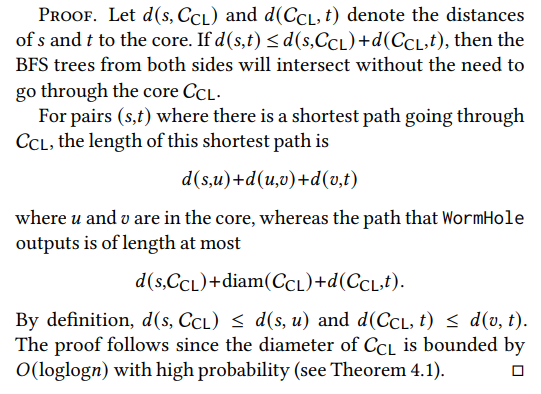
Now that we have a sublinear inner ring that contains the Chung-Lu core, we must show that routing paths through it incurs only a small penalty. Intuitively, the larger the inner ring, the easier this is to satisfy: if the inner ring is the whole graph, the statement holds trivially. Therefore the challenge lies in showing that we can achieve a strong guarantee in terms of accuracy even with a sublinear inner ring. We prove that WormHole incurs an additive error at most 𝑂(loglog𝑛) for all pairs, which is much smaller than the diameter Θ(log𝑛).

\

\ The above result holds with high probability even in the worst case. Namely, for all pairs (𝑠,𝑡) of vertices in the graph, the length of the path returned by WormHole is at most𝑂(loglog𝑛) higher than the actual distance between 𝑠 and 𝑡. This trivially implies that the average additive error of WormHole is, with high probability, bounded by the same amount.

\
\

4.4 Query Complexity

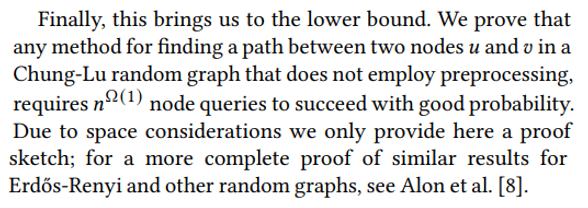
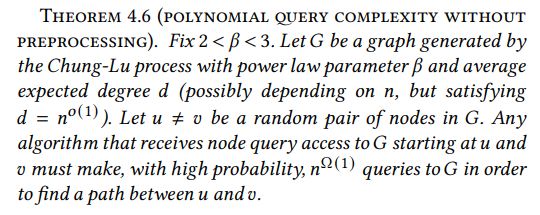
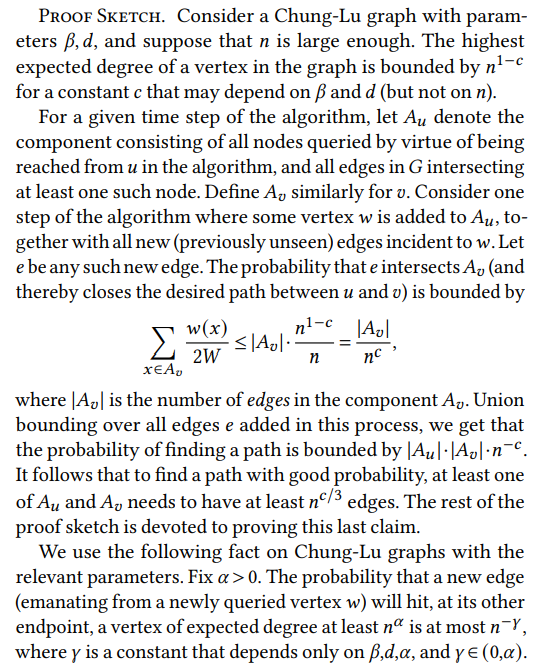
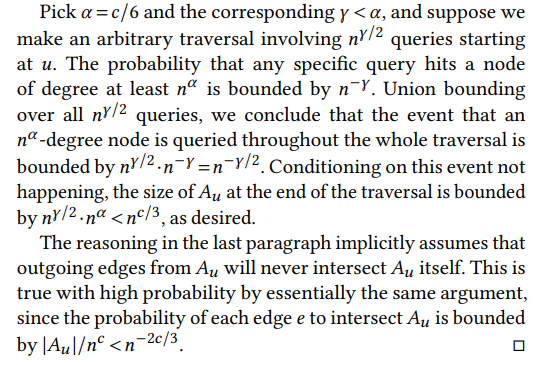
Recall the node query model in this paper (see §1.2): starting from a single node, we are allowed to iteratively make queries, where each query retrieves the neighbor list of a node 𝑣 of our choice. We are interested in the query complexity, i.e., the number of queries required to conduct certain operations.

\ \
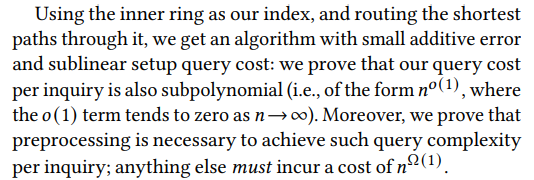
\ \ The first result is the upper bound on our performance.

\ \
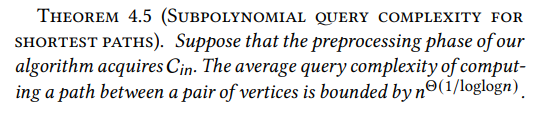
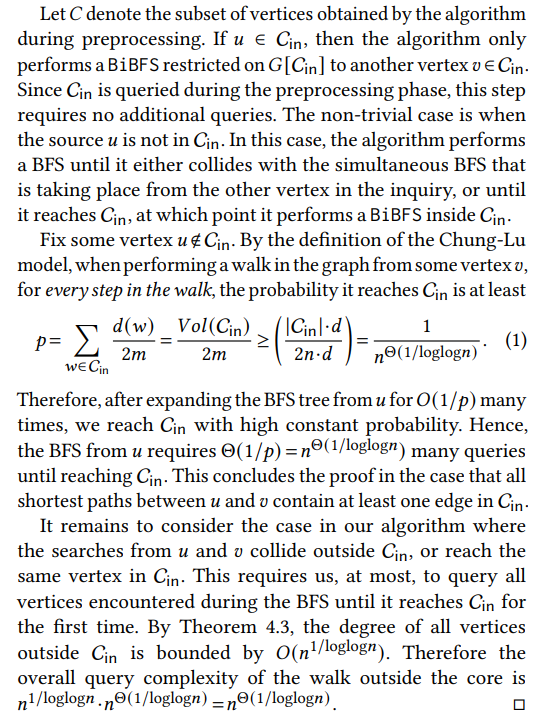
\ \ Proof Sketch. For a given inquiry SP(𝑢, 𝑣), we give an upper bound on the query complexity of the BFS that starts at 𝑢, and similarly for𝑣; the total query complexity is the sum of these two quantities.

\ \
\ \ \
\ \ \
\ \ \
\ \ \
\ \

:::info Authors:

(1) Talya Eden, Bar-Ilan University (talyaa01@gmail.com);

(2) Omri Ben-Eliezer, MIT (omrib@mit.edu);

(3) C. Seshadhri, UC Santa Cruz (sesh@ucsc.edu).

:::


:::info This paper is available on arxiv under CC BY 4.0 license.

:::

\

Disclaimer: The articles reposted on this site are sourced from public platforms and are provided for informational purposes only. They do not necessarily reflect the views of MEXC. All rights remain with the original authors. If you believe any content infringes on third-party rights, please contact service@support.mexc.com for removal. MEXC makes no guarantees regarding the accuracy, completeness, or timeliness of the content and is not responsible for any actions taken based on the information provided. The content does not constitute financial, legal, or other professional advice, nor should it be considered a recommendation or endorsement by MEXC.

You May Also Like

CME Group to launch options on XRP and SOL futures

CME Group to launch options on XRP and SOL futures

The post CME Group to launch options on XRP and SOL futures appeared on BitcoinEthereumNews.com. CME Group will offer options based on the derivative markets on Solana (SOL) and XRP. The new markets will open on October 13, after regulatory approval.  CME Group will expand its crypto products with options on the futures markets of Solana (SOL) and XRP. The futures market will start on October 13, after regulatory review and approval.  The options will allow the trading of MicroSol, XRP, and MicroXRP futures, with expiry dates available every business day, monthly, and quarterly. The new products will be added to the existing BTC and ETH options markets. ‘The launch of these options contracts builds on the significant growth and increasing liquidity we have seen across our suite of Solana and XRP futures,’ said Giovanni Vicioso, CME Group Global Head of Cryptocurrency Products. The options contracts will have two main sizes, tracking the futures contracts. The new market will be suitable for sophisticated institutional traders, as well as active individual traders. The addition of options markets singles out XRP and SOL as liquid enough to offer the potential to bet on a market direction.  The options on futures arrive a few months after the launch of SOL futures. Both SOL and XRP had peak volumes in August, though XRP activity has slowed down in September. XRP and SOL options to tap both institutions and active traders Crypto options are one of the indicators of market attitudes, with XRP and SOL receiving a new way to gauge sentiment. The contracts will be supported by the Cumberland team.  ‘As one of the biggest liquidity providers in the ecosystem, the Cumberland team is excited to support CME Group’s continued expansion of crypto offerings,’ said Roman Makarov, Head of Cumberland Options Trading at DRW. ‘The launch of options on Solana and XRP futures is the latest example of the…
Share
BitcoinEthereumNews2025/09/18 00:56