A new Galaxy Research report finds that the primary beneficiaries of the meme coins are not the traders, but the infrastructure providers.  Platforms such as launchpads, decentralized exchanges (DEXs), and automated trading bots capture substantial revenues. Meanwhile, the majority of individual participants incur losses in what is called a zero-sum game with negative expected value (EV). The Meme Coin Paradox: Mass Participation, Concentrated Profits  Meme coins, often described as tokens created around internet jokes or cultural trends with no utility, have been around for over a decade. Notably, the surge in popularity and ease of creation has sparked a full-scale boom. Millions of new tokens have flooded the market in the past few years. Traders are frequently drawn to this space by the promise of quick profits. Nonetheless, Galaxy Digital noted that,  “Trading them is less about fundamentals and more about what can be described as ‘cultural arbitrage’: predicting or front-running attention cycles, e.g., buying the token for a viral TikTok trend before the market recognizes it is viral. In the long run, the vast majority of market participants end up losing money trading meme coins, and in many respects, it’s just plain gambling.” In the latest report, Galaxy Digital’s research analyst Will Owens explained that the meme coin ecosystem functions as a stack. Here, the flow of money is mostly concentrated in the infrastructure that supports creation and trading. Meme Coin Ecosystem Structure. Source: Galaxy Digital At the base level, blockchains like Solana dominate. It hosts over 32 million tokens, a more than 300% increase since early 2024. The blockchain accounts for 56% of the 57 million meme coins across major chains, including Ethereum, Base, and BNB Chain.  “Base and BSC also host significant activity, while Ethereum hosts bigger tokens and a less cutthroat culture,” the report reads. Solana’s low fees and high throughput have made it the preferred venue, with meme coins accounting for approximately 20- 30% of its DEX trading volume, down from 60% in January. Next, launchpads form a critical layer, enabling rapid token deployment. Solana’s Pump.fun, which debuted in early 2024, exemplifies this trend by industrializing the process through bonding curves that guarantee liquidity at minimal cost.  The platform has created about 12.9 million tokens, which make up 40.31% of the total 32 million Solana tokens. Tokens launched on Pump.fun boast an aggregated fully diluted market cap (FDMC) exceeding $4.8 billion, though this peaked above $10 billion earlier in the year.  “The power-law distribution of value among Pump.fun tokens is astonishing. Out of nearly 12.9 million tokens launched on the platform, just 12 account for more than half of all fully diluted market cap (FDMC). Those dozen tokens collectively represent $2.69 billion, or 56% of the total $4.8 billion FDMC, while the other 44% is split among the remaining millions of tokens,” Owens noted. Furthermore, Pump.fun has generated significant fees from creation and trading. In summer 2024, it briefly lost ground to competitors like LetsBonk. Nonetheless, the launchpad reclaimed dominance through innovations such as Project Ascend, which introduces dynamic fee models for creators, and integrations with streamers for interactive launches. Meanwhile, DEX aggregators and automated market makers (AMMs) like Jupiter, Raydium, Orca, and Pump.fun’s in-house PumpSwap further extract value by handling immediate post-launch trading. These platforms benefit from high volumes, with meme coins fueling user acquisition and ecosystem growth. Trading bots, including Axiom, BONKbot, and Trojan, enhance this by enabling sniping—purchasing tokens at inception—and rapid execution, contributing to a hyper-competitive, player-versus-player (PvP) environment.  “Axiom, for example, has broken $200 million in cumulative revenue with a team of less than 10 individuals,” the report highlighted. Lastly, token deployers, insiders, and key opinion leaders (KOLs) also reap rewards. Developers and insiders often retain large supply portions in hidden wallets, dumping into retail liquidity for gains. KOLs on platforms like X amplify narratives through coordinated campaigns. “X (formerly Twitter) communities and Telegram groups amplify memes and coordinate shilling campaigns. Communities are incentivized to push their token higher, with collective belief substituting for fundamentals. KOLs are a huge part of this layer,” the analyst wrote. Key Crypto KOLs on X. Source: Galaxy Digital Are Retail Traders the Biggest Losers in the Meme Coin Boom?  In contrast, most traders face structural disadvantages. The report revealed that the median hold time for Solana meme coins is around 100 seconds. This is quite a drop from 300 seconds a year prior. “This means that the average participant isn’t ‘holding’ a token for hours, let alone days. Instead, they’re rotating rapidly, scalping a few percent profit against other traders in what is essentially a PvP trading game,” Owens detailed. Risks abound, including honeypots—tokens that allow buys but block sells—rug pulls, where insiders withdraw liquidity, and vamping, where copycats siphon value from originals. High-profile incidents, such as the LIBRA token incident, have resulted in millions in trader losses while insiders profited.  This ecosystem paradox highlights a broader trend: while meme coins serve as onramps to cryptocurrency, drawing new users into wallets and DEXs, the speculative frenzy primarily enriches a concentrated group of infrastructure owners.  For most participants, trading remains negative EV. Thus, meme coins may look like a casino, but it’s the house — not the players — that always wins.A new Galaxy Research report finds that the primary beneficiaries of the meme coins are not the traders, but the infrastructure providers.  Platforms such as launchpads, decentralized exchanges (DEXs), and automated trading bots capture substantial revenues. Meanwhile, the majority of individual participants incur losses in what is called a zero-sum game with negative expected value (EV). The Meme Coin Paradox: Mass Participation, Concentrated Profits  Meme coins, often described as tokens created around internet jokes or cultural trends with no utility, have been around for over a decade. Notably, the surge in popularity and ease of creation has sparked a full-scale boom. Millions of new tokens have flooded the market in the past few years. Traders are frequently drawn to this space by the promise of quick profits. Nonetheless, Galaxy Digital noted that,  “Trading them is less about fundamentals and more about what can be described as ‘cultural arbitrage’: predicting or front-running attention cycles, e.g., buying the token for a viral TikTok trend before the market recognizes it is viral. In the long run, the vast majority of market participants end up losing money trading meme coins, and in many respects, it’s just plain gambling.” In the latest report, Galaxy Digital’s research analyst Will Owens explained that the meme coin ecosystem functions as a stack. Here, the flow of money is mostly concentrated in the infrastructure that supports creation and trading. Meme Coin Ecosystem Structure. Source: Galaxy Digital At the base level, blockchains like Solana dominate. It hosts over 32 million tokens, a more than 300% increase since early 2024. The blockchain accounts for 56% of the 57 million meme coins across major chains, including Ethereum, Base, and BNB Chain.  “Base and BSC also host significant activity, while Ethereum hosts bigger tokens and a less cutthroat culture,” the report reads. Solana’s low fees and high throughput have made it the preferred venue, with meme coins accounting for approximately 20- 30% of its DEX trading volume, down from 60% in January. Next, launchpads form a critical layer, enabling rapid token deployment. Solana’s Pump.fun, which debuted in early 2024, exemplifies this trend by industrializing the process through bonding curves that guarantee liquidity at minimal cost.  The platform has created about 12.9 million tokens, which make up 40.31% of the total 32 million Solana tokens. Tokens launched on Pump.fun boast an aggregated fully diluted market cap (FDMC) exceeding $4.8 billion, though this peaked above $10 billion earlier in the year.  “The power-law distribution of value among Pump.fun tokens is astonishing. Out of nearly 12.9 million tokens launched on the platform, just 12 account for more than half of all fully diluted market cap (FDMC). Those dozen tokens collectively represent $2.69 billion, or 56% of the total $4.8 billion FDMC, while the other 44% is split among the remaining millions of tokens,” Owens noted. Furthermore, Pump.fun has generated significant fees from creation and trading. In summer 2024, it briefly lost ground to competitors like LetsBonk. Nonetheless, the launchpad reclaimed dominance through innovations such as Project Ascend, which introduces dynamic fee models for creators, and integrations with streamers for interactive launches. Meanwhile, DEX aggregators and automated market makers (AMMs) like Jupiter, Raydium, Orca, and Pump.fun’s in-house PumpSwap further extract value by handling immediate post-launch trading. These platforms benefit from high volumes, with meme coins fueling user acquisition and ecosystem growth. Trading bots, including Axiom, BONKbot, and Trojan, enhance this by enabling sniping—purchasing tokens at inception—and rapid execution, contributing to a hyper-competitive, player-versus-player (PvP) environment.  “Axiom, for example, has broken $200 million in cumulative revenue with a team of less than 10 individuals,” the report highlighted. Lastly, token deployers, insiders, and key opinion leaders (KOLs) also reap rewards. Developers and insiders often retain large supply portions in hidden wallets, dumping into retail liquidity for gains. KOLs on platforms like X amplify narratives through coordinated campaigns. “X (formerly Twitter) communities and Telegram groups amplify memes and coordinate shilling campaigns. Communities are incentivized to push their token higher, with collective belief substituting for fundamentals. KOLs are a huge part of this layer,” the analyst wrote. Key Crypto KOLs on X. Source: Galaxy Digital Are Retail Traders the Biggest Losers in the Meme Coin Boom?  In contrast, most traders face structural disadvantages. The report revealed that the median hold time for Solana meme coins is around 100 seconds. This is quite a drop from 300 seconds a year prior. “This means that the average participant isn’t ‘holding’ a token for hours, let alone days. Instead, they’re rotating rapidly, scalping a few percent profit against other traders in what is essentially a PvP trading game,” Owens detailed. Risks abound, including honeypots—tokens that allow buys but block sells—rug pulls, where insiders withdraw liquidity, and vamping, where copycats siphon value from originals. High-profile incidents, such as the LIBRA token incident, have resulted in millions in trader losses while insiders profited.  This ecosystem paradox highlights a broader trend: while meme coins serve as onramps to cryptocurrency, drawing new users into wallets and DEXs, the speculative frenzy primarily enriches a concentrated group of infrastructure owners.  For most participants, trading remains negative EV. Thus, meme coins may look like a casino, but it’s the house — not the players — that always wins.

Who Really Profits From Meme Coins? Galaxy Says It’s Not the Traders

A new Galaxy Research report finds that the primary beneficiaries of the meme coins are not the traders, but the infrastructure providers. 

Platforms such as launchpads, decentralized exchanges (DEXs), and automated trading bots capture substantial revenues. Meanwhile, the majority of individual participants incur losses in what is called a zero-sum game with negative expected value (EV).

The Meme Coin Paradox: Mass Participation, Concentrated Profits 

Meme coins, often described as tokens created around internet jokes or cultural trends with no utility, have been around for over a decade. Notably, the surge in popularity and ease of creation has sparked a full-scale boom. Millions of new tokens have flooded the market in the past few years.

Traders are frequently drawn to this space by the promise of quick profits. Nonetheless, Galaxy Digital noted that, 

In the latest report, Galaxy Digital’s research analyst Will Owens explained that the meme coin ecosystem functions as a stack. Here, the flow of money is mostly concentrated in the infrastructure that supports creation and trading.
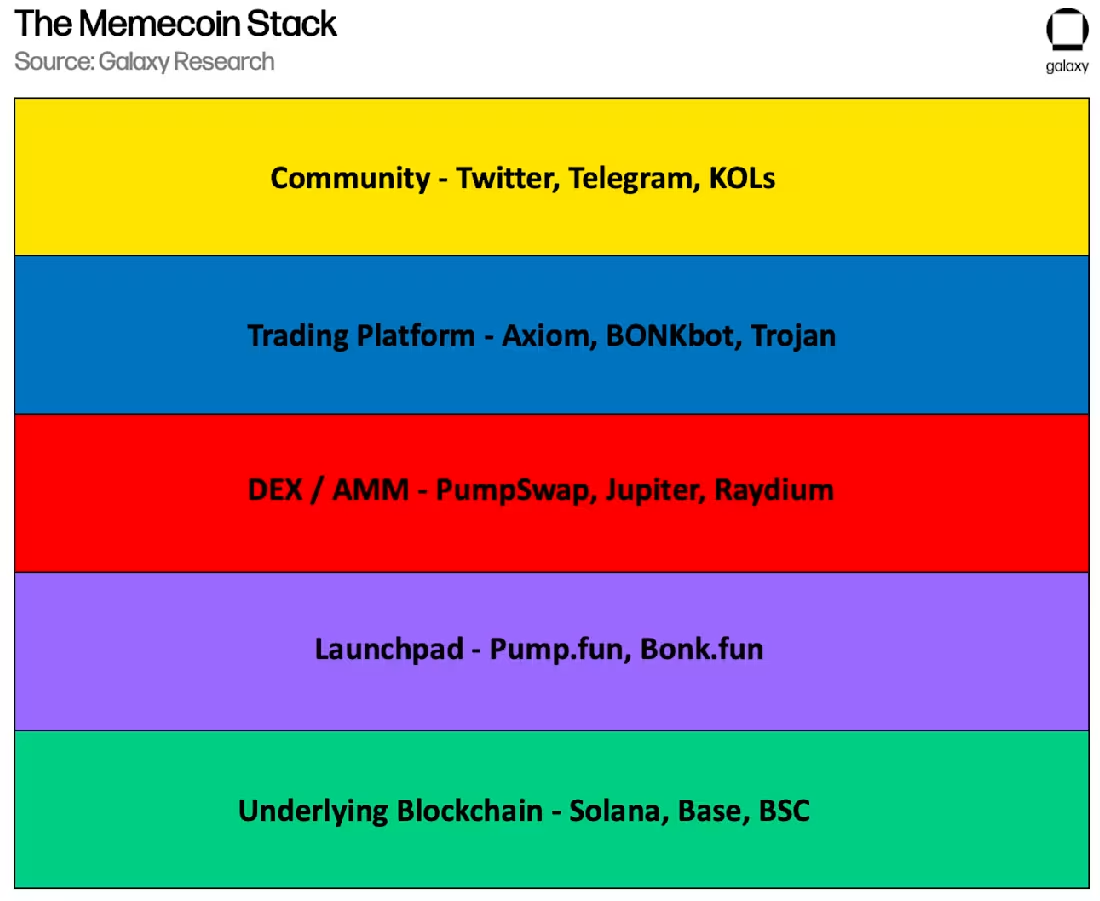
Meme Coin Ecosystem Structure. Meme Coin Ecosystem Structure. Source: Galaxy Digital

At the base level, blockchains like Solana dominate. It hosts over 32 million tokens, a more than 300% increase since early 2024. The blockchain accounts for 56% of the 57 million meme coins across major chains, including Ethereum, Base, and BNB Chain. 

Solana’s low fees and high throughput have made it the preferred venue, with meme coins accounting for approximately 20- 30% of its DEX trading volume, down from 60% in January.

Next, launchpads form a critical layer, enabling rapid token deployment. Solana’s Pump.fun, which debuted in early 2024, exemplifies this trend by industrializing the process through bonding curves that guarantee liquidity at minimal cost. 

The platform has created about 12.9 million tokens, which make up 40.31% of the total 32 million Solana tokens. Tokens launched on Pump.fun boast an aggregated fully diluted market cap (FDMC) exceeding $4.8 billion, though this peaked above $10 billion earlier in the year. 

Furthermore, Pump.fun has generated significant fees from creation and trading. In summer 2024, it briefly lost ground to competitors like LetsBonk. Nonetheless, the launchpad reclaimed dominance through innovations such as Project Ascend, which introduces dynamic fee models for creators, and integrations with streamers for interactive launches.

Meanwhile, DEX aggregators and automated market makers (AMMs) like Jupiter, Raydium, Orca, and Pump.fun’s in-house PumpSwap further extract value by handling immediate post-launch trading. These platforms benefit from high volumes, with meme coins fueling user acquisition and ecosystem growth.

Trading bots, including Axiom, BONKbot, and Trojan, enhance this by enabling sniping—purchasing tokens at inception—and rapid execution, contributing to a hyper-competitive, player-versus-player (PvP) environment. 

Lastly, token deployers, insiders, and key opinion leaders (KOLs) also reap rewards. Developers and insiders often retain large supply portions in hidden wallets, dumping into retail liquidity for gains. KOLs on platforms like X amplify narratives through coordinated campaigns.
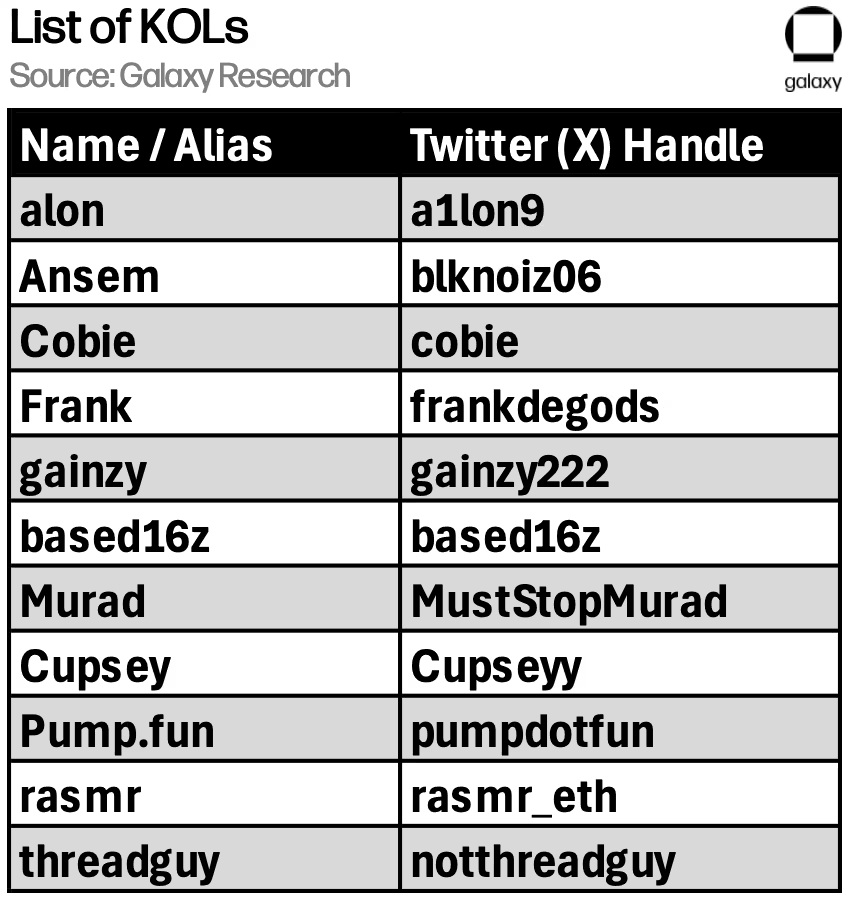
Key Crypto KOLs on XKey Crypto KOLs on X. Source: Galaxy Digital

Are Retail Traders the Biggest Losers in the Meme Coin Boom? 

In contrast, most traders face structural disadvantages. The report revealed that the median hold time for Solana meme coins is around 100 seconds. This is quite a drop from 300 seconds a year prior.

Risks abound, including honeypots—tokens that allow buys but block sells—rug pulls, where insiders withdraw liquidity, and vamping, where copycats siphon value from originals. High-profile incidents, such as the LIBRA token incident, have resulted in millions in trader losses while insiders profited. 

This ecosystem paradox highlights a broader trend: while meme coins serve as onramps to cryptocurrency, drawing new users into wallets and DEXs, the speculative frenzy primarily enriches a concentrated group of infrastructure owners. 

For most participants, trading remains negative EV. Thus, meme coins may look like a casino, but it’s the house — not the players — that always wins.

Market Opportunity
Memecoin Logo
Memecoin Price(MEME)
$0,0011651
$0,0011651$0,0011651
-3,59%
USD
Memecoin (MEME) Live Price Chart
Disclaimer: The articles reposted on this site are sourced from public platforms and are provided for informational purposes only. They do not necessarily reflect the views of MEXC. All rights remain with the original authors. If you believe any content infringes on third-party rights, please contact service@support.mexc.com for removal. MEXC makes no guarantees regarding the accuracy, completeness, or timeliness of the content and is not responsible for any actions taken based on the information provided. The content does not constitute financial, legal, or other professional advice, nor should it be considered a recommendation or endorsement by MEXC.

You May Also Like

Lucid to begin full Saudi manufacturing in 2026

Lucid to begin full Saudi manufacturing in 2026

Lucid Group, the US carmaker backed by the Public Investment Fund (PIF), reportedly plans to start full-scale vehicle manufacturing in Saudi Arabia this year, transitioning
Share
Agbi2026/01/15 15:52
Exploring Market Buzz: Unique Opportunities in Cryptocurrencies

Exploring Market Buzz: Unique Opportunities in Cryptocurrencies

In the ever-evolving world of cryptocurrencies, recent developments have sparked significant interest. A closer look at pricing forecasts for Cardano (ADA) and rumors surrounding a Solana (SOL) ETF, coupled with the emergence of a promising new entrant, Layer Brett, reveals a complex market dynamic. Cardano's Prospects: A Closer Look Cardano, a stalwart in the blockchain space, continues to hold its ground with its research-driven development strategy. The latest price predictions for ADA suggest potential gains, predicting a double or even quadruple increase in its valuation. Despite these optimistic forecasts, the allure of exponential gains drives traders toward more speculative ventures. The Buzz Around Solana ETF The potential introduction of a Solana ETF has the crypto community abuzz, potentially catapulting SOL prices to new heights. As investors await regulatory decisions, the impact of such an ETF on Solana's value could be substantial, potentially reaching up to $300. However, as with Cardano, the substantial market capitalization of Solana may temper its growth potential. Why Layer Brett is Gaining Traction Amidst established names, a new contender, Layer Brett, has started to capture the market's attention with its early presale stages. Offering a low entry price of just $0.0058 and promising over 700% in staking rewards, Layer Brett presents a tempting proposition for those looking to maximize returns. Comparative Analysis: ADA, SOL, and $LBRETT While both ADA and SOL offer stable investment choices with reliable growth, Layer Brett emerges as a high-risk, high-reward option that could potentially offer significantly higher returns due to its nascent market position and aggressive economic model. Initial presale pricing lets investors get in on the ground floor. Staking rewards currently exceed 690%, a persuasive incentive for early adopters. Backed by Ethereum's Layer 2 for enhanced transaction speed and reduced costs. A community-focused $1 million giveaway to further drive engagement and investor interest. Predicted by some analysts to offer up to 50x returns in coming years. Shifting Sands: Investor Movements As the crypto market landscape shifts, many investors, including those traditionally holding ADA and SOL, are beginning to diversify their portfolios by turning to high-potential opportunities like Layer Brett. The combination of strategic presale pricing and significant staking rewards is creating a momentum of its own. Act Fast: Time-Sensitive Opportunities As September progresses, opportunities to capitalize on these low entry points and high yield offerings from Layer Brett are likely to diminish. With increasing attention and funds being directed towards this new asset, the window to act is closing quickly. Invest in Layer Brett now to secure your position before the next price hike and staking rewards reduction. For more information, visit the Layer Brett website, join their Telegram group, or follow them on X by clicking the following links: Website Telegram X Disclaimer: This is a sponsored press release and is for informational purposes only. It does not reflect the views of Bitzo, nor is it intended to be used as legal, tax, investment, or financial advice.
Share
Coinstats2025/09/18 18:39
United Kingdom Trade Balance; non-EU declined to £-11.457B in November from previous £-10.255B

United Kingdom Trade Balance; non-EU declined to £-11.457B in November from previous £-10.255B

The post United Kingdom Trade Balance; non-EU declined to £-11.457B in November from previous £-10.255B appeared on BitcoinEthereumNews.com. Gold loses ground after
Share
BitcoinEthereumNews2026/01/15 16:23