BIP-110 Bitcoin fork stalls after two blocks
Overview
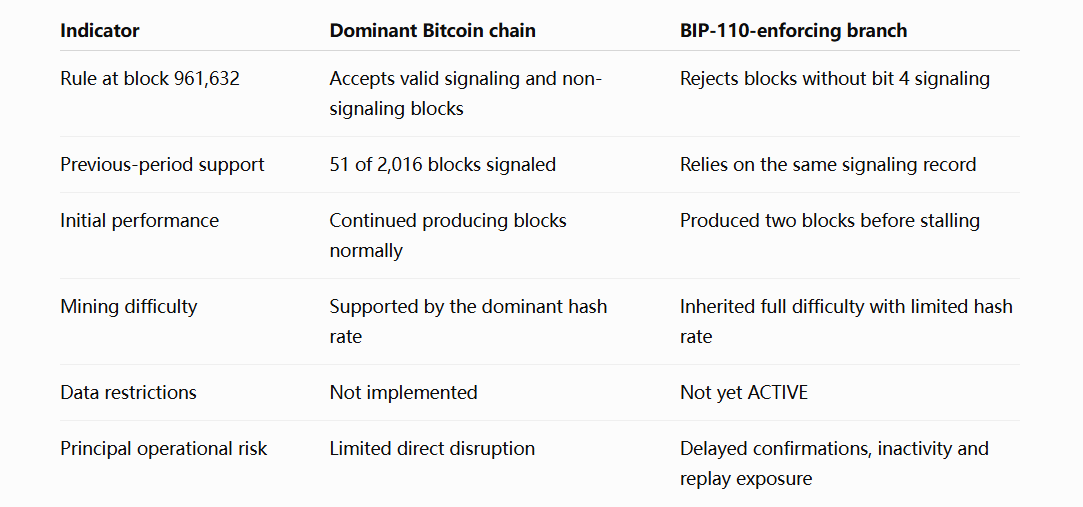
The BIP-110 Bitcoin fork began at block 961,632 after nodes enforcing the proposal started rejecting blocks that did not signal support through version bit 4. This rule divergence produced a minority branch separate from the dominant Bitcoin chain, but the enforcing branch generated only blocks 961,632 and 961,633 before effectively stalling.
The outcome reflected limited mining support rather than a technical activation of BIP-110 across Bitcoin. Only 51 of the previous 2,016 blocks signaled support, equivalent to 2.53% and far below the proposal’s 55% threshold. Because the minority branch inherited Bitcoin’s existing mining difficulty while receiving only a small fraction of its hash rate, it could not maintain Bitcoin’s approximate 10-minute block interval.
BIP-110 seeks to impose temporary consensus restrictions on certain methods of storing non-financial data in Bitcoin transactions. However, those restrictions have not entered the ACTIVE stage. The event is therefore better understood as a rule split and a real-time test of user-activated soft-fork coordination, not a completed Bitcoin protocol upgrade. The stalled branch also creates practical risks because transactions may be valid on both chains without reliable replay protection.
Key Takeaways
- BIP-110-enforcing nodes separated from the dominant chain at block 961,632.
- The enforcing branch produced only two blocks before stalling.
- Miner signaling reached 51 of 2,016 blocks, or 2.53%.
- The proposed data restrictions have not entered the ACTIVE stage.
- A lack of replay protection could expose users attempting to move forked coins to losses on the dominant Bitcoin chain.
How the BIP-110 Bitcoin fork began
What happened at Bitcoin block 961,632?
At block 961,632, nodes running BIP-110 enforcement began rejecting any block that did not signal support through version bit 4. Standard Bitcoin nodes continued accepting valid proof-of-work blocks regardless of that signal, causing the two groups of nodes to disagree about which block should extend the chain.
AntPool mined a non-signaling block at height 961,632 that was accepted by the wider Bitcoin network. BIP-110 nodes rejected it and instead followed an alternative signaling block produced by a miner using OCEAN’s infrastructure. That alternative branch was then extended to block 961,633.
The dominant chain continued producing blocks close to Bitcoin’s normal schedule, while the BIP-110 branch stopped advancing after its second block. The split did not interrupt the operation of the chain followed by the overwhelming majority of miners, exchanges, wallets and other market infrastructure.
This distinction is important because a blockchain fork does not automatically divide the economic network equally. Two incompatible chain histories can exist technically, but their practical relevance depends on hash rate, liquidity, infrastructure support and whether users recognize the assets on each branch.
Mandatory signaling is not final activation
The start of mandatory signaling did not activate BIP-110’s proposed transaction restrictions. It only introduced a rule under which enforcing nodes would reject blocks that failed to signal support.
The mandatory window covers blocks 961,632 through 963,647. Under the proposal’s state sequence, the enforcing branch would need to reach block 963,648 and satisfy the required conditions before entering LOCKED_IN. The restrictions would not become ACTIVE until block 965,664.
Because the minority branch remained at block 961,633 after its initial two blocks, it was still thousands of blocks away from activation. Describing the event as the successful implementation of BIP-110 would therefore confuse the beginning of enforcement with completion of the proposed soft fork.
Publication in the Bitcoin Improvement Proposals repository also does not indicate community approval or imminent adoption. The repository documents proposals that meet its editorial requirements, but Bitcoin’s participants determine whether to run or economically recognize the associated rules.
Why the minority BIP-110 chain stalled
The BIP-110 Bitcoin fork lacked miner support
The immediate constraint was extremely limited hash-rate support. During the 2,016-block period preceding enforcement, only 51 blocks signaled for BIP-110. That represented 2.53% of the period, compared with the 55% threshold contemplated by the proposal.
Signaling is not a perfect measure of every miner’s political opinion, but it provides observable evidence of the blocks miners were willing to produce under the specified conditions. The large gap between 2.53% and 55% indicated that the enforcing branch would have difficulty maintaining regular block production unless substantial hash power changed sides.
Public node counts cannot replace this measurement. A node validates blocks and independently chooses its rules, but it does not necessarily contribute proof-of-work. One organization can also operate many visible nodes without representing an equivalent number of users or an equivalent share of economic activity.
Similarly, hash rate alone does not settle every governance question. Exchanges, custodians, payment processors, wallet providers and holders influence which chain is treated as Bitcoin. In this case, however, the lack of mining support prevented the minority branch from producing enough blocks to become operationally competitive.
Why does inherited mining difficulty matter?
Inherited difficulty matters because the minority branch must solve blocks calibrated for Bitcoin’s much larger total hash rate. The branch lost most of the computing power supporting the chain but did not receive an immediate reduction in mining difficulty.
Bitcoin normally recalculates difficulty every 2,016 blocks to keep average block production near one block every 10 minutes. A chain that loses most of its hash rate at the beginning of a difficulty period must still complete that period before a conventional retarget can make mining easier.
This creates a severe coordination problem for the BIP-110 branch. Slow block production makes confirmations impractical, discouraging users, exchanges and miners from supporting it. That reduced participation can make the branch even less attractive, reinforcing its operational weakness.
The branch has not necessarily ceased to exist permanently. A miner could still direct hash power toward it and extend the chain. Nevertheless, restoring a usable block interval would require a material increase in mining support, and the first two blocks provide no evidence that such support had arrived.
What the split means for Bitcoin users
Can holders safely sell coins from the fork?
No. Holders should not assume that coins on the minority branch can be moved or sold safely. If both chains recognize the same transaction format and signatures, a transaction broadcast on one branch could potentially be replayed on the other.
For example, a holder attempting to transfer minority-chain coins could create a transaction that is also valid on the dominant Bitcoin chain. If that transaction reaches miners or nodes on the dominant chain, the holder’s actual BTC could move as well. The precise exposure depends on wallet construction, coin history and whether effective chain-splitting protections are introduced.
This does not mean every transaction will necessarily be replayed. It means users cannot rely on the chain split itself to isolate their balances. Exchanges and custodians would need to evaluate deposit confirmation, chain identification and replay protection before supporting any separate asset.
The risk is especially significant on a branch with irregular block production and limited infrastructure. Even if a transaction is included, users may face extremely long confirmation times and little or no secondary-market liquidity.
What does BIP-110 reveal about Bitcoin governance?
The event shows that users can adopt stricter validation rules, but software rules alone do not guarantee economic adoption. A user-activated soft fork depends on coordination among node operators, miners, exchanges, wallets, businesses and holders.
BIP-110 supporters seek to restrict certain forms of non-financial data storage, arguing that these uses increase the burden on node operators and move Bitcoin away from its monetary purpose. Opponents argue that users who pay transaction fees should be able to compete for block space and that protocol-level filtering creates undesirable restrictions.
The stalled branch does not resolve that underlying policy debate. It demonstrates that the proposal had insufficient mining support at the enforcement point, but it does not establish universal agreement about how Bitcoin block space should be used.
The case also illustrates the difference between social support and measurable operational capacity. Online discussion, node adoption or endorsements can influence governance, but a viable chain still requires sufficient mining, infrastructure and economic recognition.
BIP-110 shows that node rules still need economic support
The BIP-110 Bitcoin fork successfully triggered the rule behavior encoded by its supporters: enforcing nodes rejected non-signaling blocks from height 961,632 and followed a separate chain. What it did not achieve was enough mining participation to keep that chain advancing at a usable rate.
Only 2.53% of blocks in the preceding 2,016-block period signaled support. The minority branch then inherited a mining difficulty calibrated for the dominant Bitcoin network while retaining only limited hash power. Producing two blocks before stalling was therefore a mechanical consequence of the imbalance between difficulty and available computing power.
The result should not be described as BIP-110 becoming active across Bitcoin. Its proposed data restrictions remain outside the ACTIVE stage, and the chain followed by the wider market continued operating normally. Nor should the branch be declared technically impossible to revive, since miners could direct additional hash power toward it.
The next indicators are whether the minority branch resumes producing blocks, whether recognized mining pools join it, whether exchanges support a separate asset and whether developers implement reliable replay protection. Reaching blocks 963,648 and 965,664 would also be necessary for the proposal to advance through its intended state sequence.
Until those conditions change, the event is best viewed as a live experiment in Bitcoin governance. It confirms that node operators can enforce alternative rules, while also showing that a rule set requires mining and economic coordination to become a functioning network.
Sources
https://github.com/bitcoin/bips/blob/master/bip-0110.mediawiki
https://crypto.news/bitcoin-bip-110-split-widens-as-fork-freezes-at-2-blocks/
Risk Disclaimer: This article is for reference only and does not constitute investment advice. The cryptocurrency market is highly volatile. Please make decisions cautiously based on your individual circumstances.
Ayrıca Şunları da Beğenebilirsiniz

2026 UEFA Champions League Final Prediction: Paris Saint-Germain FC vs Arsenal – Who Will Lift the Trophy?

Pump.fun vs Fomo: Can onchain trading go mainstream?

Remixpoint Turns Bitcoin Treasury Into Yield Engine