With only two weeks left of 2025, market participants wonder whether the Bitcoin (BTC) and the rest of the crypto market will continue to struggle or begin recoveringWith only two weeks left of 2025, market participants wonder whether the Bitcoin (BTC) and the rest of the crypto market will continue to struggle or begin recovering

Did Crypto Investors Stop Believing In The Four-Year Cycle? Analyst Weighs In

2025/12/18 15:00

With only two weeks left of 2025, market participants wonder whether the Bitcoin (BTC) and the rest of the crypto market will continue to struggle or begin recovering. An analyst discussed the current market sentiment and the impact it may have on market performance.

The Four-Year Crypto Cycle Is ‘Like Faith In God’

As we approach the end of the year, concerns about the crypto market’s performance continue to mount. Bitcoin, the largest cryptocurrency by market capitalization, has seen a 30% decline from its early October peak.

As the volatility persist and the flagship crypto trades below its yearly opening price of $93,500, some investors questioned the four-year cycle theory, suggesting that the theory may no longer hold after the recent market’s performance.

Responding to one of these comments, pseudonym market observer Plur affirmed that the four-year crypto cycle has evolved over the years and that “there is no magical rule of nature stating price must go up and down on this fixed cadence.”

The analyst explained that the theory is a “memetic consensus, which is a form of implicit agreement and coordination that people will buy and sell together at set times, and by doing so, force outsiders to participate and bring their money.”

“It’s an egregore-as-cartel. It’s a large group of loosely connected people all saying, every 4 years, we are going to hike up and down this mountain at the same time,” he detailed on the Wednesday post.

Another community member added that the crypto cycle “is like faith in God: everyone believes in it, but no one has ever seen it.” Plur added that the initial catalyst and “original metronome” of this theory was the halving but that it has become “something more than that.”

Market Struggles As Investors’ Faith Splits

The evolution of the four-year crypto cycle has led some market participants to try to shift their behavior to “front run the moves of others” to benefit more.” As a result, many investors started to sell aggressively in 2025 anticipating of the end of the cycle.

To the market watcher, this “represents a fraying in the memetic consensus, and eventually it collapses, as belief decays.” Similarly, Ark Invest’s CEO, Cathie Wood, recently affirmed that Bitcoin is currently “climbing another wall of worry” that has made investors cautious of the upcoming market performance.

She explained that there is fear of the four-year cycle, which suggests that 2026 will be a corrective year. Plur noted that the crypto market is in an uncertain state, where some investors continue to believe in the theory and some don’t.

“The biggest impact that might have is not giving people enough confidence to buy on the upswing. Remember how assured you felt buying in 2023? Now the troops are scattered because the coordination mechanism is gone,” he stated.

Plur added that “in equities the memetic consensus is that the index will always grind up over time, buy the dip, trust the process. (…) I had been hopeful that something similar could come in for BTC to replace the 4 year cycle, but sell pressure was way too high,” leading to the indeterminate state of the market. He concluded that it’s time to wait and see if a new form of memetic consensus can form.
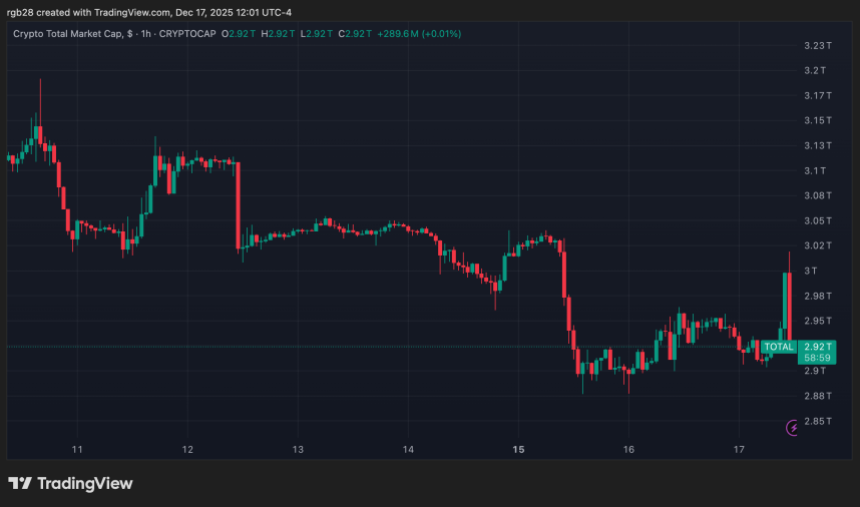
crypto, TOTAL
Sorumluluk Reddi: Bu sitede yeniden yayınlanan makaleler, halka açık platformlardan alınmıştır ve yalnızca bilgilendirme amaçlıdır. MEXC'nin görüşlerini yansıtmayabilir. Tüm hakları telif sahiplerine aittir. Herhangi bir içeriğin üçüncü taraf haklarını ihlal ettiğini düşünüyorsanız, kaldırılması için lütfen service@support.mexc.com ile iletişime geçin. MEXC, içeriğin doğruluğu, eksiksizliği veya güncelliği konusunda hiçbir garanti vermez ve sağlanan bilgilere dayalı olarak alınan herhangi bir eylemden sorumlu değildir. İçerik, finansal, yasal veya diğer profesyonel tavsiye niteliğinde değildir ve MEXC tarafından bir tavsiye veya onay olarak değerlendirilmemelidir.

Ayrıca Şunları da Beğenebilirsiniz

Whales keep selling XRP despite ETF success — Data signals deeper weakness

Whales keep selling XRP despite ETF success — Data signals deeper weakness

The post Whales keep selling XRP despite ETF success — Data signals deeper weakness appeared on BitcoinEthereumNews.com. XRP ETFs have crossed $1 billion in assets
Paylaş
BitcoinEthereumNews2025/12/20 02:55
Foreigner’s Lou Gramm Revisits The Band’s Classic ‘4’ Album, Now Reissued

Foreigner’s Lou Gramm Revisits The Band’s Classic ‘4’ Album, Now Reissued

The post Foreigner’s Lou Gramm Revisits The Band’s Classic ‘4’ Album, Now Reissued appeared on BitcoinEthereumNews.com. American-based rock band Foreigner performs onstage at the Rosemont Horizon, Rosemont, Illinois, November 8, 1981. Pictured are, from left, Mick Jones, on guitar, and vocalist Lou Gramm. (Photo by Paul Natkin/Getty Images) Getty Images Singer Lou Gramm has a vivid memory of recording the ballad “Waiting for a Girl Like You” at New York City’s Electric Lady Studio for his band Foreigner more than 40 years ago. Gramm was adding his vocals for the track in the control room on the other side of the glass when he noticed a beautiful woman walking through the door. “She sits on the sofa in front of the board,” he says. “She looked at me while I was singing. And every now and then, she had a little smile on her face. I’m not sure what that was, but it was driving me crazy. “And at the end of the song, when I’m singing the ad-libs and stuff like that, she gets up,” he continues. “She gives me a little smile and walks out of the room. And when the song ended, I would look up every now and then to see where Mick [Jones] and Mutt [Lange] were, and they were pushing buttons and turning knobs. They were not aware that she was even in the room. So when the song ended, I said, ‘Guys, who was that woman who walked in? She was beautiful.’ And they looked at each other, and they went, ‘What are you talking about? We didn’t see anything.’ But you know what? I think they put her up to it. Doesn’t that sound more like them?” “Waiting for a Girl Like You” became a massive hit in 1981 for Foreigner off their album 4, which peaked at number one on the Billboard chart for 10 weeks and…
Paylaş
BitcoinEthereumNews2025/09/18 01:26
New York Regulators Push Banks to Adopt Blockchain Analytics

New York Regulators Push Banks to Adopt Blockchain Analytics

New York’s top financial regulator urged banks to adopt blockchain analytics, signaling tighter oversight of crypto-linked risks. The move reflects regulators’ concern that traditional institutions face rising exposure to digital assets. While crypto-native firms already rely on monitoring tools, the Department of Financial Services now expects banks to use them to detect illicit activity. NYDFS Outlines Compliance Expectations The notice, issued on Wednesday by Superintendent Adrienne Harris, applies to all state-chartered banks and foreign branches. In its industry letter, the New York State Department of Financial Services (NYDFS) emphasized that blockchain analytics should be integrated into compliance programs according to each bank’s size, operations, and risk appetite. The regulator cautioned that crypto markets evolve quickly, requiring institutions to update frameworks regularly. “Emerging technologies introduce evolving threats that require enhanced monitoring tools,” the notice stated. It stressed the need for banks to prevent money laundering, sanctions violations, and other illicit finance linked to virtual currency transactions. To that end, the Department listed specific areas where blockchain analytics can be applied: Screening customer wallets with crypto exposure to assess risks. Verifying the origin of funds from virtual asset service providers (VASPs). Monitoring the ecosystem holistically to detect money laundering or sanctions exposure. Identifying and assessing counterparties, such as third-party VASPs. Evaluating expected versus actual transaction activity, including dollar thresholds. Weighing risks tied to new digital asset products before rollout. These examples highlight how institutions can tailor monitoring tools to strengthen their risk management frameworks. The guidance expands on NYDFS’s Virtual Currency-Related Activities (VCRA) framework, which has governed crypto oversight in the state since 2022. Regulators Signal Broader Impact Market observers say the notice is less about new rules and more about clarifying expectations. By formalizing the role of blockchain analytics in traditional finance, New York is reinforcing the idea that banks cannot treat crypto exposure as a niche concern. Analysts also believe the approach could ripple beyond New York. Federal agencies and regulators in other states may view the guidance as a blueprint for aligning banking oversight with the realities of digital asset adoption. For institutions, failure to adopt blockchain intelligence tools may invite regulatory scrutiny and undermine their ability to safeguard customer trust. With crypto now firmly embedded in global finance, New York’s stance suggests that blockchain analytics are no longer optional for banks — they are essential to protecting the financial system’s integrity.
Paylaş
Coinstats2025/09/18 08:49