Overview
Representing a transformative convergence between retail brokerages and decentralized finance, the launch of Robinhood Chain by online trading powerhouse
Robinhood has captured global financial attention. Constructed on dedicated
Arbitrum technology, the Ethereum Layer 2 network operates with 100-millisecond block intervals, native Ethereum data availability via blobs, and comprehensive compliance rails designed for tokenized real-world assets (RWAs). According to quantitative decentralized finance telemetry from
DefiLlama, Robinhood Chain rapidly secured over $780 million in total value locked within on-chain protocols, while aggregate bridged collateral surged to roughly $2.7 billion. With daily decentralized exchange volumes regularly crossing $600 million to $800 million, market allocators, quantitative desks, and institutional market makers are actively dissecting the network to determine which on-chain project commands the highest popularity, liquidity depth, and structural user engagement.
Key Takeaways
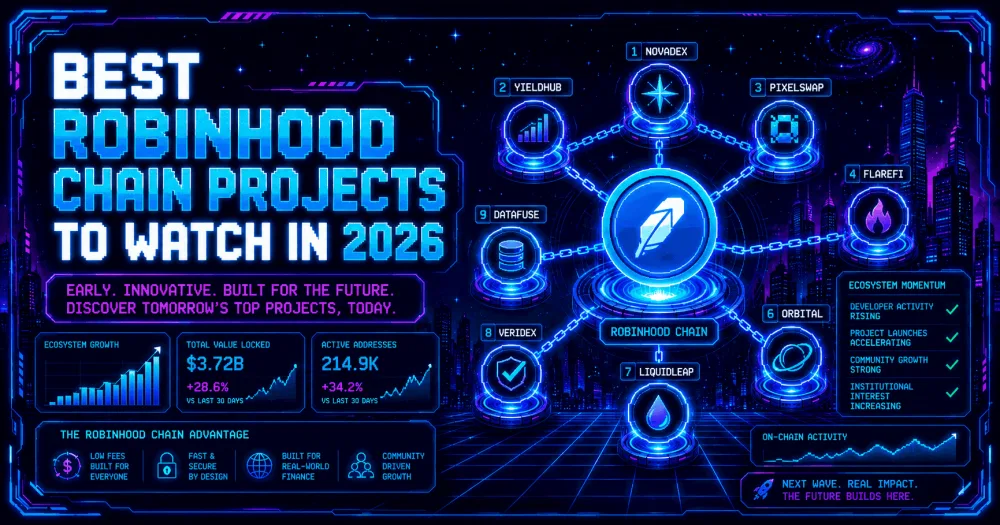
Institutional Capital Anchor: Decentralized lending protocol Morpho commands undisputed capital dominance, capturing over $486 million in deposits to account for more than sixty percent of total decentralized finance value locked on the network as the foundational engine behind the Robinhood Earn yield program.
Spot Liquidity Engine: Automated market maker Uniswap serves as the primary public exchange layer from genesis, orchestrating frictionless swaps across more than 190 tokenized equity products and major crypto assets with multi-hundred-million daily trading volumes.
Derivative Growth Outlier: Perpetual futures venue Lighter achieved breakout popularity among active derivative traders through direct native integration into the mobile Robinhood Wallet, utilizing an eleven-million-token incentive structure to generate over two billion dollars in weekly trading turnover.
The Core Asset Foundation: Tokenized debt securities branded as Stock Tokens represent the structural raison d'etre of the entire blockchain, delivering 24/7 exposure to US equities with automated dividend reinvestment mechanisms across more than 120 eligible non-US jurisdictions.
Retail Cultural Momentum: Community-driven meme tokens led by CASHCAT generated viral retail engagement, establishing nine-figure market capitalizations and elevated trading velocity that reflect the vibrant WallStreetBets retail trading heritage translated onto blockchain infrastructure.
Technical Architecture and Financial Scale: Bridging Wall Street Liquidity On-Chain
Understanding the popularity and capital distribution of projects deployed across Robinhood Chain requires an examination of the underlying Layer 2 infrastructure.
Arbitrum Orbit Foundations and Sub-Second Execution Latency
Technical assessments published by
L2BEAT confirm that Robinhood Chain operates as an Arbitrum Orbit rollup settling transaction state proofs to the Ethereum mainnet. The platform utilizes Ethereum blobs for cost-effective data availability and ETH as its native gas accounting asset. Engineering the network with 100-millisecond block production schedules enables transaction finality and matching speeds comparable to centralized equity order books, eliminating latency arbitrage risks for high-frequency algorithmic liquidity providers.
Rapid Expansion Across Bridged Asset Capital
Reporting from
Bloomberg highlights that Robinhood leveraged its existing base of tens of millions of retail and institutional accounts to seed instant on-chain liquidity. Total bridged capital across the network expanded rapidly toward $2.7 billion. This liquidity foundation includes traditional native crypto collateral alongside segregated custody assets supporting tokenized securities, providing immense transactional reserves for applications deployed across the ecosystem.
The Undisputed Capital Leader: How Morpho Dominates Total Value Locked
When evaluating project popularity through the lens of institutional balance sheet allocation and capital depth,
Morpho stands as the definitive leader across the network.
Isolated Credit Markets and USDG Yield Mechanics
The central pillar of Robinhood Chain's consumer yield offering is Robinhood Earn, a program designed to deliver floating yields on the USDG stablecoin, which is managed and backed by short-term US Treasury reserves through licensed trust institution
Paxos. Operating behind the simplified consumer application interface is Morpho's isolated lending market infrastructure. Financial analysis from
Reuters confirms that isolating credit risks within independent asset pairs prevents market-wide insolvency risks, offering institutional lenders a resilient environment for capital preservation.
Commanding Sixty Percent of On-Chain Capital
Metrics published on
DefiLlama reveal that Morpho has secured approximately $486 million in total value locked on Robinhood Chain, representing over sixty percent of the network's entire decentralized finance collateral base. Institutional asset managers and crypto-native yield allocators supply stablecoins into Morpho vaults to finance automated market-maker borrowing and delta-neutral trading operations. In terms of sheer financial weight and capital retention, Morpho represents the most vital protocol on the blockchain.
The Public Spot Exchange Hub: Uniswap Anchors Equity Token Liquidity
While Morpho dominates balance sheet retention, decentralized trading activity is anchored by automated market-making pioneer
Uniswap, which serves as the public exchange engine for the entire network.
Primary Liquidity Venue for Tokenized Securities
Deploying its complete suite including v2, v3, v4, and UniswapX routing contracts alongside the network's public mainnet, Uniswap functions as the decentralized marketplace where market participants trade over 190 tokenized equities against stable assets. Whether exchanging synthetic exposures to Nvidia, Apple, Alphabet, or broader equity index funds, concentrated liquidity pools on Uniswap ensure tight pricing spreads outside traditional stock exchange operating hours.
Sustained Multi-Hundred-Million Daily Spot Volume
Aggregated market telemetry from
CoinGecko indicates that Robinhood Chain regularly registers daily spot decentralized exchange volumes ranging between $600 million and $800 million, with Uniswap routing the overwhelming majority of transactions. Global quantitative firms utilize the network's sub-second execution speeds to continuously arbitrage on-chain pricing against secondary equity and off-hours derivatives markets, cementing Uniswap as the primary venue for spot trading velocity.
Market participants actively analyzing the integration of traditional equities into decentralized finance can track specialized assets on premier global platforms.
Furthermore, institutional liquidity indicators on
MEXC show robust market depth and order book stability across tokens representing real-world asset infrastructure.
The Leveraged Derivatives Outlier: Lighter Captures High-Frequency Traders
In the perpetual futures sector, specialized decentralized derivatives exchange Lighter has emerged as the most explosive and heavily discussed trading platform within the ecosystem.
Direct Frictionless Integration Within the Robinhood Wallet
Whereas traditional decentralized perpetual protocols require manual wallet approvals and external network bridging, Lighter's primary competitive advantage stems from its native embedded presence inside the non-custodial Robinhood Wallet application. Technology reporting from the
Financial Times illustrates that eligible international users can execute leveraged long and short contracts directly from their mobile interface without navigating complex external web decentralized applications.
Liquidity Incentives Catalyze Billions in Weekly Volume
To build immediate market depth, Lighter allocated an incentive pool of 11 million native tokens exclusively for Robinhood ecosystem participants, offering point multipliers on market-making, open interest, and order execution. This structure catalyzed immediate institutional engagement, driving single-day derivative turnover past $300 million and expanding weekly volume beyond $2.1 billion. In terms of community discourse, retail trading frequency, and momentum, Lighter has achieved remarkable popularity.
The Foundational RWA Pillar: Institutional Mechanics of Stock Tokens
Any comprehensive analysis of Robinhood Chain must highlight the foundational asset class that justifies the network's architectural existence, namely the Stock Tokens issued by Robinhood's offshore operating structure.
Fully Collateralized Custody and Dynamic Dividend Multipliers
Regulatory disclosures confirm that the 190+ tokenized stocks available on-chain represent tokenized debt securities issued by Robinhood Assets (Jersey) Limited, backed on a strict one-to-one basis by physical underlying shares held in custody by US-licensed banking partners. To resolve the operational complexity of physical cash distributions on-chain, the platform implemented an automated multiplier mechanism. When an underlying equity distributes cash dividends, proceeds are programmatically reinvested to acquire additional underlying shares, dynamically increasing the token's backing ratio and generating compounded economic returns without manual user intervention.
Global Market Inclusion Across 120 Jurisdictions
Regulatory frameworks enforced by the
U.S. Securities and Exchange Commission preclude offering unregistered tokenized securities to domestic US, Canadian, or UK residents. However, the protocol successfully unlocks fractional equity investment for eligible individuals across more than 120 countries in Europe, Asia, and Latin America. With active on-chain real-world asset market capitalizations approaching $200 million according to
CoinMarketCap, Stock Tokens serve as collateral across Morpho and liquidity pairs on Uniswap, acting as the primary anchor of network utility.
Retail Meme Culture: Viral Engagement Surrounding CASHCAT
In parallel to institutional capital and regulated tokenized equity reserves, Robinhood Chain has developed an active retail culture driven by community meme tokens.
Translating WallStreetBets Heritage into On-Chain Communities
Robinhood's historical role during the retail market movements of 2021 established a cultural identity that transitioned onto its proprietary blockchain. Spearheaded by community-launched tokens such as CASHCAT, retail market participants introduced playful WallStreetBets slang into active decentralized trading pools. CASHCAT achieved valuation peaks exceeding $200 million with tens of millions in daily turnover, drawing public acknowledgment from Robinhood executive leadership regarding the chain's cultural versatility.
On-Chain Activity and Gas Consumption Drivers
Unlike institutional capital that executes disciplined, low-frequency portfolio rebalancing, meme token traders engage in continuous on-chain transactions. Block explorer data reveals that during retail trading peaks, speculative community tokens accounted for over thirty percent of total network transaction counts, driving steady gas consumption. For retail traders focused on short-term market momentum, community tokens represent the most visible and socially viral segment of the ecosystem.
Multidimensional Popularity Assessment: Identifying the True Ecosystem King
Determining which project commands the highest popularity on Robinhood Chain requires establishing clear quantitative evaluation criteria.
Evaluating popularity through the metric of total capital retention and institutional confidence reveals Morpho as the definitive leader. Securing $486 million in deposits to command over sixty percent of the network's decentralized finance value, Morpho is the operational cornerstone for ecosystem solvency.
Assessing popularity through daily user transaction frequency, market liquidity depth, and core exchange functionality highlights Uniswap as the essential operational hub for both crypto assets and tokenized corporate equities.
Measuring popularity by derivative velocity, trader engagement, and rapid capital scaling establishes Lighter as the undisputed standout among active leveraged market participants, supported by seamless native mobile wallet integration.
Evaluating popularity through viral social reach and speculative retail sentiment positions CASHCAT and related community tokens at the center of cultural attention.
All of these diverse protocols ultimately derive their foundational differentiation from the official Stock Tokens. Without tokenized equities as the primary exclusive asset class, Robinhood Chain would function as an ordinary Layer 2 network. Consequently, in terms of systemic importance and long-term durability, the tokenized equity infrastructure represents the definitive crown jewel of the blockchain.
Exclusive View from James Mitchell
From a quantitative market structure and capital cycle perspective, the emergence of Robinhood Chain represents a structural transition where traditional equity brokers actively construct their own decentralized clearing houses.
Market participants frequently evaluate young Layer 2 networks purely through the narrow metric of raw developer contract counts, overlooking the unique industrial characteristics of institutional real-world assets. The long-term viability of a financial blockchain is determined by its ability to capture compliant, sticky capital capable of generating real-world economic returns. By integrating Morpho for isolated institutional lending and Uniswap for 24/7 equity token trading, Robinhood Chain has successfully harmonized off-chain securities pricing with on-chain liquidity velocity. For professional allocators and quantitative traders, the critical metric to monitor is not short-term speculative meme turnover, but the retention rate of non-US net inflows into Stock Tokens and the steady expansion of corporate borrowing demand across Morpho vaults. If this capital loop continues scaling, Robinhood Chain will establish itself as the premier bridge connecting traditional securities with global decentralized finance.
FAQ
What is Robinhood Chain and how does it differ from standard Layer 2 networks?
Robinhood Chain is an Ethereum Layer 2 blockchain developed on Arbitrum Orbit technology by online brokerage Robinhood. Designed specifically for financial institutions and tokenized real-world assets, the network delivers 100-millisecond block times and natively incorporates fully collateralized tokenized equities and regulated yield-bearing stablecoins.
Which decentralized application holds the highest total value locked on Robinhood Chain?
Lending protocol Morpho commands the highest total value locked, securing over $486 million in assets to account for more than sixty percent of the network's entire decentralized finance collateral base, serving as the core engine powering the consumer Robinhood Earn program.
Why has Lighter grown so rapidly among derivative traders?
Lighter expanded rapidly due to its native mobile integration within the Robinhood Wallet, allowing eligible international users to trade high-leverage perpetual contracts directly from their personal device, supported by an 11-million-token incentive program that drove billions in weekly derivative volume.
How do Stock Tokens function and do they pay cash dividends?
Stock Tokens are tokenized debt securities issued by an offshore Robinhood entity, backed on a one-to-one basis by physical shares held in custody by regulated US financial partners. Instead of distributing fragmented cash payments, the protocol utilizes an automated multiplier mechanism that reinvests dividends to purchase more shares, dynamically increasing each token's equity backing ratio.
Can residents of the United States purchase Stock Tokens on Robinhood Chain?
Due to federal securities registration requirements, Stock Tokens are not offered or available to residents of the United States, Canada, the United Kingdom, or Switzerland. The asset class is designed specifically for eligible non-US investors across more than 120 international jurisdictions.
What primary risks should investors monitor across Robinhood Chain projects?
Investors should evaluate severe liquidity volatility across speculative community meme tokens, liquidation risks associated with high-leverage perpetual futures, technical risks surrounding newly deployed Layer 2 sequencers and cross-chain bridges, and shifting international regulatory policies regarding tokenized securities and synthetic assets.
Disclaimer
The information, analysis, and views contained in this article are provided for general educational and informational purposes only and do not constitute financial advice, investment advice, legal advice, tax advice, or a recommendation to buy or sell any security, digital asset, or financial derivative. Equity securities, cryptocurrencies, and related financial instruments are subject to high market volatility and capital risk. Past operational performance, financial results, and quantitative indicators do not guarantee future market returns. Investors must conduct independent due diligence and evaluate their personal financial situation, risk tolerance, and investment goals before executing any trade. The MEXC Crypto Pulse team assumes no liability for any direct or indirect financial losses resulting from the use of or reliance upon the information published herein.
About the Author
James Mitchell specializes in technical analysis, market trends, and trading strategies for both Bitcoin and altcoins. Based in London, he has over 10 years of experience in financial markets. Before joining MEXC Learn, James worked as a senior analyst at a leading European investment firm, where he developed expertise in risk management and quantitative trading. His transition to cryptocurrency markets began in 2017, and he has since become recognized for his data-driven approach. He holds a Master's degree in Financial Economics from the London School of Economics. His analytical approach combines traditional technical analysis with on-chain metrics to provide readers with actionable insights.
Areas of Expertise: Technical Analysis, Market Trends & Cycles, Trading Strategies, Bitcoin & Altcoin Analysis, Risk Management.
Research References