Exploring how biases in the peer-review system impact researchers' choices, showing how principles of fairness relate to the production of scientific knowledge based on topic importance and hardness.Exploring how biases in the peer-review system impact researchers' choices, showing how principles of fairness relate to the production of scientific knowledge based on topic importance and hardness.

Academic Publishing and Fairness: A Game-Theoretic Model of Peer-Review Bias

2025/09/17 23:15

Abstract and 1. Introduction

  1. A free and fair economy: definition, existence and uniqueness

    2.1 A free economy

    2.2 A free and fair economy

  2. Equilibrium existence in a free and fair economy

    3.1 A free and fair economy as a strategic form game

    3.2 Existence of an equilibrium

  3. Equilibrium efficiency in a free and fair economy

  4. A free economy with social justice and inclusion

    5.1 Equilibrium existence and efficiency in a free economy with social justice

    5.2 Choosing a reference point to achieve equilibrium efficiency

  5. Some applications

    6.1 Teamwork: surplus distribution in a firm

    6.2 Contagion and self-enforcing lockdown in a networked economy

    6.3 Bias in academic publishing

    6.4 Exchange economies

  6. Contributions to the closely related literature

  7. Conclusion and References

Appendix

6.3 Bias in academic publishing

\
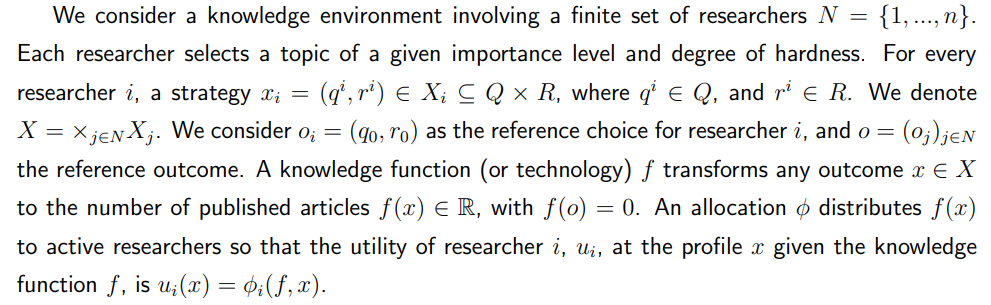
\
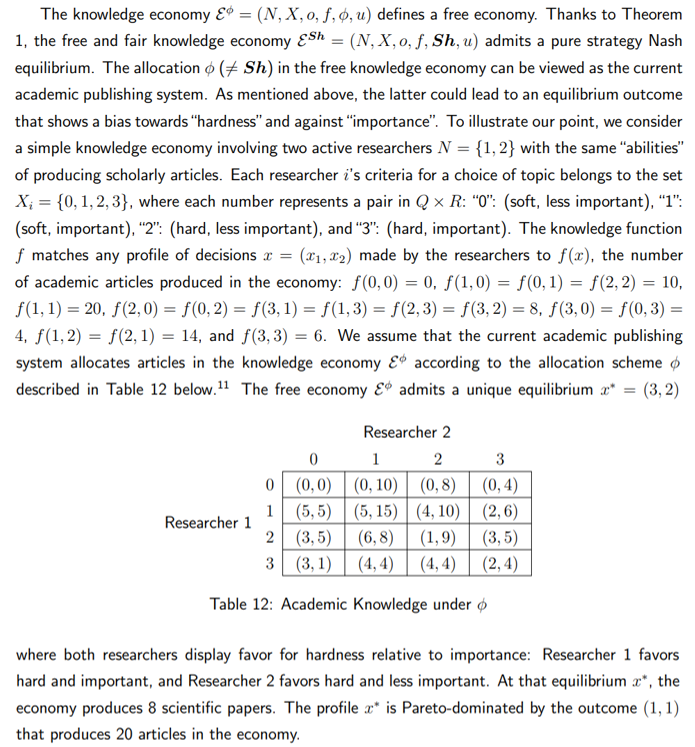
\
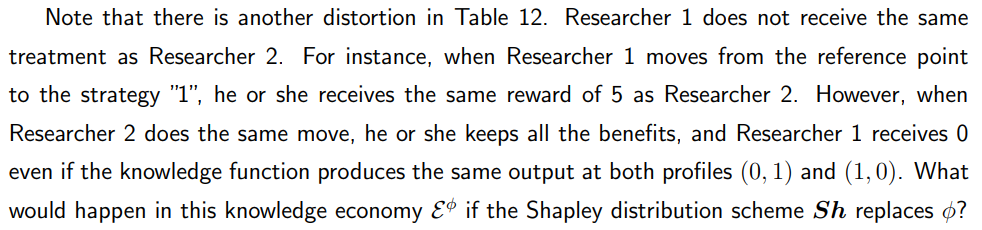
\ Well, it is straightforward to show that the researchers are symmetric under the knowledge function f. Using Anonymity and the other principles of merit-based justice, Table 13 below describes the allocation of academic articles under the allocation Sh.

\
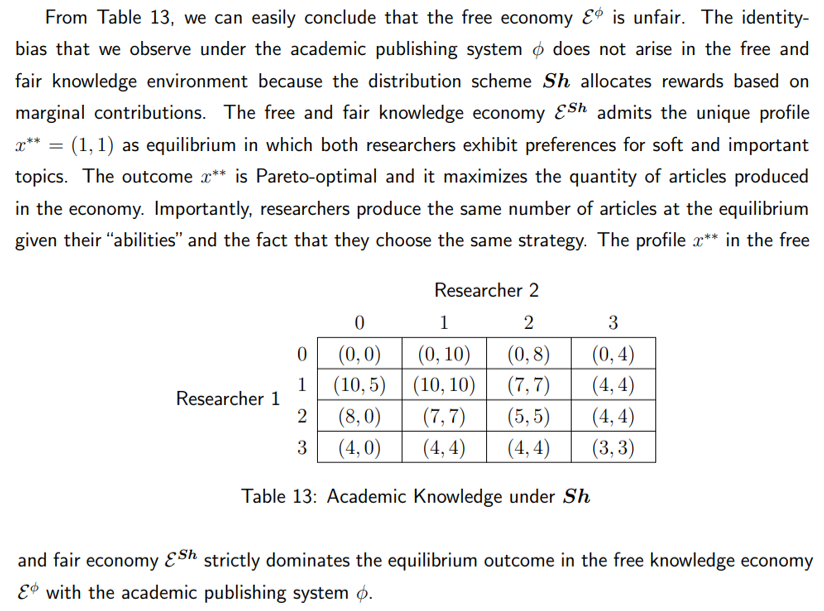
\

:::info Authors:

(1) Ghislain H. Demeze-Jouatsa, Center for Mathematical Economics, University of Bielefeld (demeze jouatsa@uni-bielefeld.de);

(2) Roland Pongou, Department of Economics, University of Ottawa (rpongou@uottawa.ca);

(3) Jean-Baptiste Tondji, Department of Economics and Finance, The University of Texas Rio Grande Valley (jeanbaptiste.tondji@utrgv.edu).

:::


:::info This paper is available on arxiv under CC BY 4.0 DEED license.

:::

[10] Tough the trade-off between the two quality dimensions can be viewed as a rational decision, the consequences can be detrimental to economics, as a discipline and profession. For instance, some general interest journals suffer from the “incest factor” [Heckman et al., 2017], and Akerlof [2020] shows that the tendency of rewarding “hard” topics versus“ soft ”topics in economics results in “sins of omissions” where issues that are relevant to the literature and can not be approached in a “hard” way are ignored.

\

Disclaimer: The articles reposted on this site are sourced from public platforms and are provided for informational purposes only. They do not necessarily reflect the views of MEXC. All rights remain with the original authors. If you believe any content infringes on third-party rights, please contact service@support.mexc.com for removal. MEXC makes no guarantees regarding the accuracy, completeness, or timeliness of the content and is not responsible for any actions taken based on the information provided. The content does not constitute financial, legal, or other professional advice, nor should it be considered a recommendation or endorsement by MEXC.

You May Also Like

GBP/USD rebounds following Fed’s third straight rate trim

GBP/USD rebounds following Fed’s third straight rate trim

The post GBP/USD rebounds following Fed’s third straight rate trim appeared on BitcoinEthereumNews.com. GBP/USD punched a fresh hole into seven-week highs on Wednesday, rising back into the 1.3400 neighborhood after the Federal Reserve (Fed) delivered a widely expected third straight interest rate cut. Fed Chair Jerome Powell gave a particularly cautious showing, hinting that the Fed could be poised for another extended “wait and see” period. Global markets largely brushed off the Fed head’s warnings, and rate markets are already pricing in a faster pace of rate cuts over the next two years than the Fed itself expects. Although the Fed projected only one cut for next year, Chair Jerome Powell signaled that rate hikes are essentially off the table, a stance traders welcomed. Futures markets reacted immediately, pricing in a strong chance of two or more cuts in 2026. Stocks had drifted sideways heading into this final meeting of the year, but the Fed’s decision aligned with expectations and helped stabilize sentiment. The remainder of the week is largely lacking in meaningful economic events, but that all ends next week. Cable traders will be staring down the barrel of four straight days of high-impact data releases from next Tuesday, starting with the latest rolling three-month UK labor statistics and global Purchasing Managers Index (PMI) survey results. Wednesday brings the latest UK Consumer Price Index (CPI) inflation figures, and the real calendar-rattler will be the Bank of England’s (BoE) latest interest rate call, slated for Thursday. UK Retail Sales figures are trailing behind the BoE, and will close out the week’s UK data docket on Friday. GBP/USD daily chart widely expected Pound Sterling FAQs The Pound Sterling (GBP) is the oldest currency in the world (886 AD) and the official currency of the United Kingdom. It is the fourth most traded unit for foreign exchange (FX) in the world, accounting for 12% of…
Share
BitcoinEthereumNews2025/12/11 07:34