The first prediction markets exchange to be regulated by the CFTC, Kalshi, has launched the KalshiEco Hub in partnership with Solana and Coinbase-backed Base. The new program aims to bring builders, traders, and content creators onto an expanding ecosystem of blockchain-based prediction markets. The launch of the KalshiEco Hub signals a step toward linking traditional […]The first prediction markets exchange to be regulated by the CFTC, Kalshi, has launched the KalshiEco Hub in partnership with Solana and Coinbase-backed Base. The new program aims to bring builders, traders, and content creators onto an expanding ecosystem of blockchain-based prediction markets. The launch of the KalshiEco Hub signals a step toward linking traditional […]

Kalshi Partners with Solana & Base to Launch KalshiEco Hub for Onchain Prediction Markets

Kalshi
  • Kalshi launches KalshiEco Hub with Solana and Base to expand regulated prediction markets.
  • Kalshi strengthens blockchain prediction markets with grants, partnerships, and Solana support.
  • SOL price trades near $240, signaling a potential breakout as the prediction market’s partnership expands.

The first prediction markets exchange to be regulated by the CFTC, Kalshi, has launched the KalshiEco Hub in partnership with Solana and Coinbase-backed Base. The new program aims to bring builders, traders, and content creators onto an expanding ecosystem of blockchain-based prediction markets.

The launch of the KalshiEco Hub signals a step toward linking traditional finance with crypto-native innovation. Kalshi stated on X, “We’re backing offchain and onchain innovation, with dedicated grants partnering with Solana and Base.”

The collaboration merges the prediction platform’s regulated status with the scalability of Solana infrastructure and Base’s Ethereum layer-2 technology. The prediction platform also affirmed that it will enable direct deposits of Solana’s SOL token and USDC stablecoin.

KalshiEco hub to expand blockchain prediction markets

KalshiEco is designed to make digital assets accessible to users already engaged in digital assets. The program also offers grants, technical support, and marketing assistance to selected projects. By providing developers with resources and grants, the Prediction platform also aims to accelerate the creation of new products in the prediction market. 

The initiative creates a community flywheel where builders launch their products, creators highlight their products, and traders drive more visibility and growth.

The CFTC-regulated exchange also has collaborators like Kalshinomics, an analytics dashboard for market analytics, and Verso, which is building professional-grade tools for market discovery. Other partners, like Caddy, are targeting retail-based trading solutions.

Kalshi faces competition amid a shifting regulatory landscape

The development of prediction markets has gained renewed momentum. Through prediction markets, users can trade contracts based on real-life events, including political elections and economic policy outcomes. 

Notably, on the day of the KalshiEco launch, Kalshi’s prediction market on the Federal Reserve interest rate decision surpassed $85 million in trading volume.
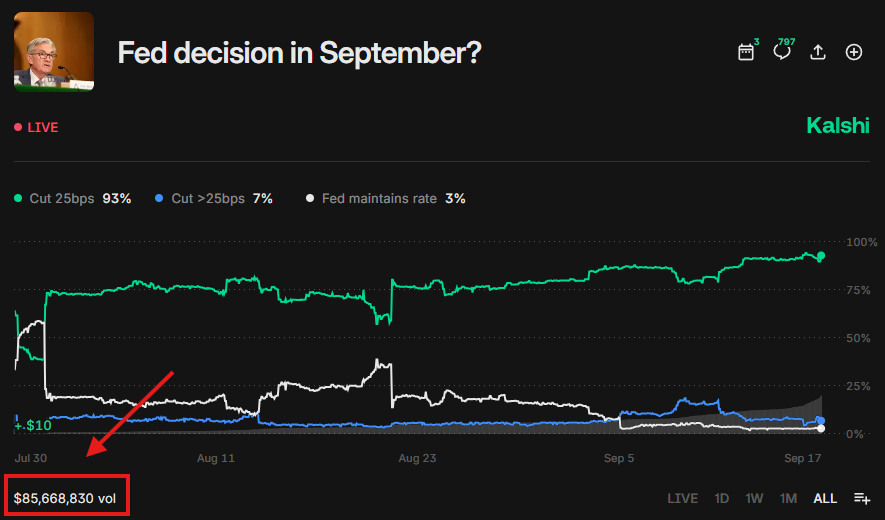
Source: X

Nevertheless, prediction markets are still subject to legal scrutiny in the United States. Although the exchange operates its business with the CFTC’s approval, some states doubt that these kinds of contracts can be considered gambling. 

Furthermore, Polymarket, a prediction markets platform, recently acquired QCEX, a licensed derivatives exchange, in anticipation of U.S. operations subject to regulatory supervision. Meanwhile, PredictIt is still seeking clarity on its legal status.

The introduction of KalshiEco indicates how licensed exchanges are applying blockchain integration to stay competitive. The regulated exchange is providing developers and traders with an ecosystem that is flexible for on-chain innovation with Solana and Base.

Also Read: Polymarket Acquires CFTC-Licensed QCEX for $112 Million to Relaunch U.S. Prediction Market

SOL price consolidates at $240 ahead of key breakout

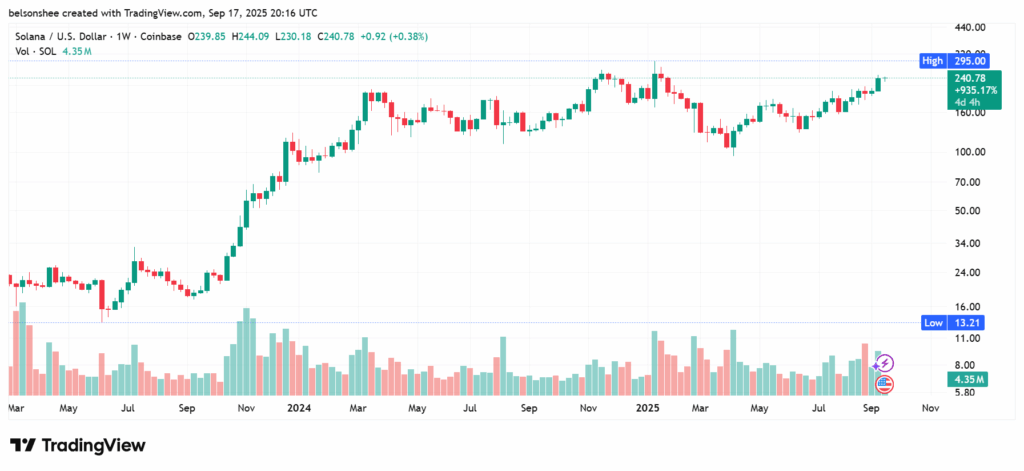
Recent price action in Solana (SOL) supports the timing of Kalshi’s collaboration with the network. As of September 17, SOL is trading around $240, which is up 8.5% in the last week. The token has been in the range of $175.99 to $249.12 over the past 30 days. 

On the weekly chart, the price action is steadily at higher lows, with resistance being created in the $245-$250 range. If the trading volume continues to increase, this could suggest a potential breakout.
Source: TradingView

Moreover, the chart pattern shows that a key breakout above $250 may open the door to the $260-$265 area and possibly retest the all-time high around $295. 

On the downside, a break of the $230 support is likely to lead to a pullback towards $221, potentially leading to a deeper correction towards the $176-180 level if selling pressure is strong enough. These market dynamics may affect liquidity, adoption, and overall integration of blockchain-based prediction markets for builders and traders.

Also Read:  Solana Poised to Retest $249.60 as Institutional Support Strengthens

Disclaimer: The articles reposted on this site are sourced from public platforms and are provided for informational purposes only. They do not necessarily reflect the views of MEXC. All rights remain with the original authors. If you believe any content infringes on third-party rights, please contact service@support.mexc.com for removal. MEXC makes no guarantees regarding the accuracy, completeness, or timeliness of the content and is not responsible for any actions taken based on the information provided. The content does not constitute financial, legal, or other professional advice, nor should it be considered a recommendation or endorsement by MEXC.

You May Also Like

Ethereum Fusaka Upgrade Set for December 3 Mainnet Launch, Blob Capacity to Double

Ethereum Fusaka Upgrade Set for December 3 Mainnet Launch, Blob Capacity to Double

Ethereum developers confirmed the Fusaka upgrade will activate on mainnet on December 3, 2025, following a systematic testnet rollout beginning on October 1 on Holesky. The major hard fork will implement around 11-12 Ethereum Improvement Proposals targeting scalability, node efficiency, and data availability improvements without adding new user-facing features. According to Christine Kim, the upgrade introduces a phased blob capacity expansion through Blob Parameter Only forks occurring two weeks after Fusaka activation. Initially maintaining current blob limits of 6/9 target/max, the first BPO fork will increase capacity to 10/15 blobs one week later. A second BPO fork will further expand limits to 14/21 blobs, more than doubling total capacity within two weeks. Strategic Infrastructure Overhaul Fusaka prioritizes backend protocol improvements over user-facing features, focusing on making Ethereum faster and less resource-intensive. The upgrade includes PeerDAS implementation through EIP-7594, allowing validator nodes to verify data by sampling small pieces rather than downloading entire blobs. This reduces bandwidth and storage requirements while enhancing Layer 2 rollup scalability. The upgrade builds on recent gas limit increases from 30 million to 45 million gas, with ongoing discussions for further expansion. EIP-7935 proposes increasing limits to 150 million gas, potentially enabling significantly higher transaction throughput. These improvements complement broader scalability efforts, including EIP-9698, which suggests a 100x gas limit increase over two years to reach 2,000 transactions per second. Fusaka removes the previously planned EVM Object Format redesign to reduce complexity while maintaining focus on essential infrastructure improvements. The upgrade introduces bounded base fees for blob transactions via EIP-7918, creating more predictable transaction costs for data-heavy applications. Enhanced spam resistance and security improvements strengthen network resilience against scalability bottlenecks and attacks. Technical Implementation and Testing Timeline The Fusaka rollout follows a conservative four-phase approach across Ethereum testnets before mainnet deployment. Holesky upgrade occurs October 1, followed by Sepolia on October 14 and Hoodi on October 28. Each testnet will undergo the complete BPO fork sequence to validate the blob capacity expansion mechanism. BPO forks activate automatically based on predetermined epochs rather than requiring separate hard fork processes. On mainnet, the first BPO fork launches December 17, increasing blob capacity to 10/15 target/max. The second BPO fork activates January 7, 2026, reaching the final capacity of 14/21 blobs. This automated approach enables flexible blob scaling without requiring full network upgrades. Notably, node operators face release deadlines ranging from September 25 for Holesky to November 3 for mainnet preparation. The staggered timeline, according to the developers, allows comprehensive testing while giving infrastructure providers sufficient preparation time. Speculatively, the developers use this backward-compatible approach to ensure smooth transitions with minimal disruption to existing applications. PeerDAS implementation reduces node resource demands, potentially increasing network decentralization by lowering barriers for smaller operators. The technology enables more efficient data availability sampling, crucial for supporting growing Layer 2 rollup adoption. Overall, these improvements, combined with increased gas limits, will enable Ethereum to handle higher transaction volumes while maintaining security guarantees. Addressing Network Scalability Pressures The Fusaka upgrade addresses mounting pressure for Ethereum base layer improvements amid criticism of Layer 2 fragmentation strategies. Critics argue that reliance on rollups has created isolated chains with limited interoperability, complicating user experiences. The upgrade’s focus on infrastructure improvements aims to enhance base layer capacity while supporting continued Layer 2 growth. The recent validator queue controversy particularly highlights ongoing network scalability challenges. According to a Cryptonews report covered yesterday, currently, over 2M ETH sits in exit queues facing 43-day delays, while entry queues process in just 7 days.Ethereum Validator Queue (Source: ValidatorQueue) However, Vitalik Buterin defended these delays as essential for network security, comparing validator commitments to military service requiring “friction in quitting.” The upgrade coincides with growing institutional interest in Ethereum infrastructure, with VanEck predicting that Layer 2 networks could reach $1 trillion market capitalization within six years. Fusaka’s emphasis on data availability and node efficiency supports Ethereum’s evolution toward seamless cross-chain interoperability. The upgrade complements initiatives like the Open Intents Framework, where Coinbase Payments recently joined as a core contributor. The initiative, if successful, will address the $21B surge in cross-chain crime. These coordinated efforts aim to unify the fragmented multichain experience while maintaining Ethereum’s security and decentralization principles
Share
CryptoNews2025/09/19 16:37
Eyes nine-day EMA barrier near 1.3450

Eyes nine-day EMA barrier near 1.3450

The post Eyes nine-day EMA barrier near 1.3450 appeared on BitcoinEthereumNews.com. GBP/USD remains steady for the second successive session, trading around 1.3430
Share
BitcoinEthereumNews2026/01/15 11:59
Why Bitcoin Is Rising Despite Hot US Inflation Data

Why Bitcoin Is Rising Despite Hot US Inflation Data

Bitcoin is showing renewed strength, climbing close to $97,000 and reaching its highest level in nearly two months. What makes the move notable is not just the
Share
Coinstats2026/01/15 11:53