

Malta to Offer Free ChatGPT Plus Across the Country via OpenAI
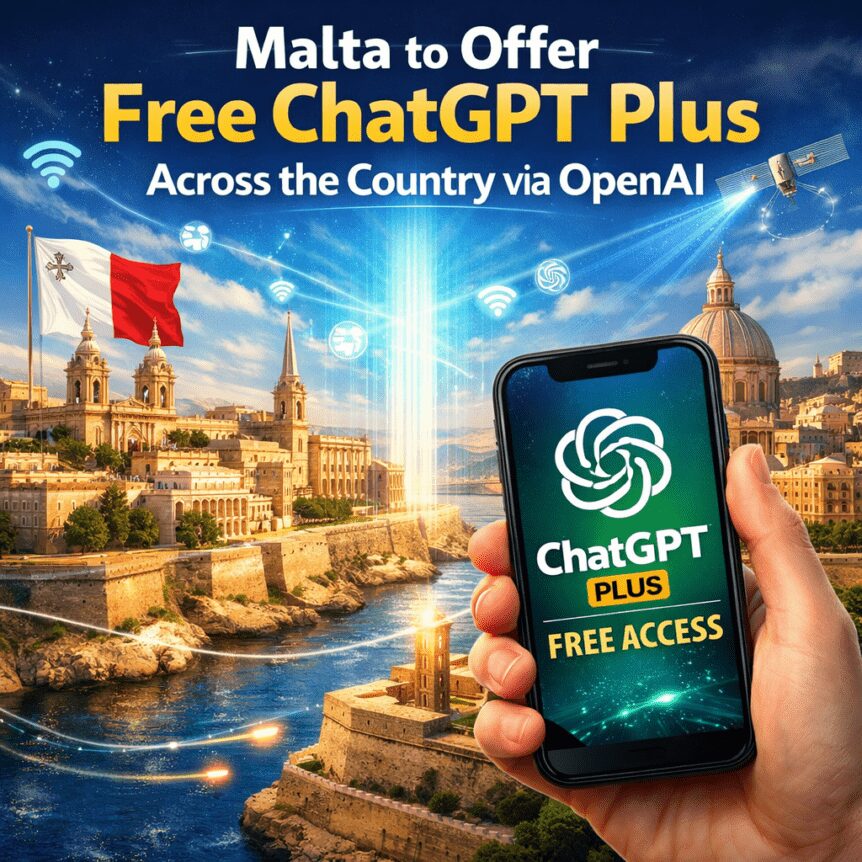
OpenAI and the Maltese government have unveiled a world-first partnership to roll out ChatGPT Plus to all Maltese citizens, marking a notable milestone in government-backed AI access. The plan ties free access to a year-long ChatGPT Plus subscription to the completion of a government-supported AI literacy course for residents.
Under the programme, citizens who finish the AI literacy course—developed by the University of Malta—will receive complimentary access to ChatGPT Plus for one year. The course itself covers the basics of what AI is, what it can and cannot do, and how to use it responsibly at home and in the workplace.
“Malta is the first country to launch a partnership of this scale because we refuse to let our citizens stay behind in the digital age,” said Silvio Schembri, Maltese minister for economy, enterprise and strategic projects. “The goal is to turn AI from an unfamiliar concept into practical assistance for our families, students, and workers.”
The Malta Digital Innovation Authority will oversee distribution to eligible participants when the first phase launches this month, with plans to broaden the program as more residents and citizens abroad complete the course.
Key takeaways
- The Maltese government and OpenAI are partnering to provide free ChatGPT Plus access for one year to citizens who complete a government-backed AI literacy course developed by the University of Malta.
- The initiative represents a “world-first” scale in government-AI collaboration and aims to translate AI from a theoretical concept into practical everyday use for families, students, and workers.
- Distribution will be managed by the Malta Digital Innovation Authority, with the first phase starting this month and expansion tied to course completion by more residents and Maltese abroad.
- The partnership sits within OpenAI’s broader “OpenAI for Countries” program, which tailors AI adoption to each nation’s priorities such as education, workforce training and public services.
- OpenAI has signaled a growing global footprint in government partnerships, including work with Estonia on ChatGPT Edu and with Greece under separate country-focused initiatives, as well as defense-related deployments in the U.S. on classified networks.
A first-of-its-kind deal in Malta
At a time when policymakers are weighing how to accelerate AI literacy while managing risks, Malta’s approach pairs education with practical tooling. The University of Malta-led course is designed to demystify AI and provide a framework for responsible usage, a step that could help bridge the gap between theoretical understanding and everyday application. By tying certification and household access to a government-endorsed curriculum, the program signals a deliberate strategy to bake AI familiarity into public life rather than leaving it to private platforms alone.
The one-year ChatGPT Plus subsidy acts as an incentive for citizens to engage with the course and begin integrating AI into daily tasks—from research and writing to workflow automation and problem-solving. The government’s aim is not only to boost digital literacy but to demonstrate how AI can serve as a practical assistant across education, work, and family life. The initial phase is set to roll out this month, with the Malta Digital Innovation Authority charged with ensuring eligible participants receive access and that the rollout scales as more people complete the course, including Maltese residents living abroad.
From a governance perspective, the arrangement underscores a growing willingness among governments to experiment with official AI programs that go beyond mere procurement or pilot projects. It also places a spotlight on how AI access programs can be paired with formal education to produce measurable literacy and usage outcomes rather than ad hoc, platform-centric uptake.
OpenAI for Countries: a tailored, country-by-country approach
The Malta agreement is a notable example within OpenAI’s broader OpenAI for Countries initiative, a programme through which the company collaborates with governments to push AI from early interest to nationwide adoption. Unlike standardized models, this program emphasizes customization aligned with each country’s priorities—spanning education, workforce training and public services. The Malta partnership demonstrates how such a framework can translate into tangible benefits for citizens and institutions alike.
In a broader context, OpenAI has pursued a multi-country strategy designed to fit diverse governance architectures and policy objectives. For example, last year Estonia’s government partnered with OpenAI to provide all secondary school students and teachers with access to ChatGPT Edu, a version tailored to educational needs. Separately, OpenAI has launched an initiative with Greece to expand AI-enabled capabilities within public services. These moves illustrate how governments are experimenting with AI in a structured, policy-aligned manner rather than adopting a one-size-fits-all solution.
The flexibility of the OpenAI for Countries program aligns with a growing trend toward customized public-sector AI tooling, where the focus is not only on how to deploy models but also on how to integrate them into educational curricula, job training, and service delivery. In some arenas, OpenAI’s technology has also found roles beyond civil government—for instance, a reported deal to deploy its models on classified military networks in collaboration with the U.S. defense complex. Such arrangements highlight both the breadth of potential applications and the sensitivities that accompany AI in high-stakes environments.
According to the program’s framing, the goal is to move beyond curiosity about AI to practical, system-wide adoption that can improve efficiency, accessibility and decision-making across public life. The Malta programme signals this broader ambition, illustrating how a national-scale effort can begin with education and access—and scale into ongoing public-sector utility.
What this means for investors, users and builders
From an investor and developer perspective, Malta’s model offers a live-case study in how government partnerships can underpin user onboarding and capability-building around AI tools. For users, the immediate benefit is clear: a structured pathway to use an advanced AI service at no personal cost for a defined period, contingent on completing an educational module that frames safe and responsible use. For builders and policymakers, the initiative tests governance, data governance, privacy protections, and the interoperability of AI services with public-sector workflows. The Malta rollout could inform subsequent programs in other jurisdictions that seek to harmonize AI access with formal education and service delivery standards.
As OpenAI continues to expand country-specific programs, observers will watch how these partnerships navigate issues such as data governance, digital inclusion, and the alignment of AI capabilities with public-interest goals. The Estonia and Greece examples show that governments can tailor AI deployments to educational and administrative ecosystems, potentially creating a blueprint for similar initiatives elsewhere. However, observers will also scrutinize how these programs adapt to different regulatory environments, privacy norms, and financial models as they scale beyond initial pilots.
For developers and platforms building AI-powered tools, Malta’s approach reinforces the importance of establishing clear educational content, public-facing risk disclosures, and governance channels that can handle large-scale adoption. It also underscores the potential for AI literacy to become a prerequisite for broad access to advanced tools, a development that could shape product design, user onboarding, and policy dialogue in the months ahead.
In the broader market context, Malta’s move sits at the intersection of digital literacy, public-sector modernization and AI-enabled public services. While the immediate commercial impact to OpenAI or the University of Malta may be limited by the program’s scope, the symbolic and practical implications could influence how other nations approach AI education and access, potentially accelerating a wave of country-led AI initiatives in the coming years.
Readers should stay tuned to how the first phase unfolds in Malta, including participation rates, user feedback, and any adjustments in eligibility or course content. The evolution of this program will offer important signals about the practical viability of government-backed AI access and its place in a broader strategy to democratize advanced technologies.
OpenAI’s broader strategy to engage with governments remains a developing landscape. As nations explore tailored AI adoption—balancing innovation with safeguards—the Malta initiative adds a concrete data point to the evolving policy and market narrative around AI in the public sector.
For now, the Maltese program marks a notable milestone: a government-backed pathway that connects AI literacy, civic participation and consumer access to a leading AI service, with potential implications that reach far beyond a single country’s borders.
As this initiative unfolds, watchers should monitor not only uptake and satisfaction but also the durability of the model once the year-long free access ends, and how Malta plans to sustain AI-enabled public services in the long term.
This article was originally published as Malta to Offer Free ChatGPT Plus Across the Country via OpenAI on Crypto Breaking News – your trusted source for crypto news, Bitcoin news, and blockchain updates.


You May Also Like

Iran’s foreign minister targeted in assassination attempt, wife killed

Why Binance Believes RWAs Are Crypto’s Next Trillion-Dollar Opportunity




